
Executive Overview
On November 6, the Virginia Opera (VAO) officially launched its highly anticipated 2026–27 season with a striking, psychologically complex staging of Ruggero Leoncavallo’s verismo masterpiece, Pagliacci ("Clowns"). Set against the backdrop of a sun-bleached, neutral-toned Italian village square, the production strips away the traditional operatic gloss to expose the raw, frayed nerves of a traveling commedia dell’arte troupe. Rather than leaning solely into the sensationalism of the opera’s violent climax, this vision embraces the work’s dense psychological landscape. It examines the agonizing friction between performative surface and devastating interior reality.
Led by Artistic Director Adam Turner in the pit and anchored by a powerhouse principal cast making major role debuts—aside from a commanding turn by baritone Kidon Choi—the production showcases an impressive synthesis of vocal discipline and theatrical verisimilitude. Supported by the Virginia Symphony Orchestra (VSO) and the robust, finely tuned harmonies of the VAO chorus coached by Brandon Eldredge, the opening night performance proved that Pagliacci remains a vital, bruising theatrical experience. By grounding the tragedy in the mundane, grinding exhaustion of itinerant performers, this staging transforms a staple of the standard repertoire into a mirror reflecting the crushing inevitability of everyday desperation.
Detailed Chronology: From Afternoon Arrival to Tragic Denouement
The Prologue and the Breaking of the Fourth Wall
The evening commenced with a brief, scene-setting overture that foreshadowed the underlying thematic motifs of betrayal and heartbreak. This gave way to the opera’s iconic Prologue, delivered by baritone Kidon Choi with effortless clarity and a rich, enveloping warmth.
Most members of the cast navigated a dual existence, portraying both their everyday theatrical personas and the characters they inhabited within the evening’s play-within-a-play. Choi, however, expanded this framework into a triple performance. He first stepped directly in front of the curtain to deliver Leoncavallo’s manifesto for the verismo style. Choi’s vocal phrasing immediately reeled the audience in, establishing an intimate, conversational rapport. He convinced the house to open their hearts before seamlessly stepping back behind the curtain—and, in the process, solidifying the fourth wall just as opacity returned to the dramatic space.
The Village Square and the Illusion of Joy
As the curtain rose on the neutral-toned village square, the chorus bounded forward as a bustling collective of townsfolk celebrating the return of the clown Pagliaccio and his ragtag company. These opening scenes pulsed with the buoyant energy of daily life, marked by petty disputes, eager prodding, and infectious excitement.
The VAO choristers delivered a robust, beautifully balanced sound under Brandon Eldredge’s direction, with ringing high notes and crisp harmonies filling the hall. Herndon Foundation Emerging Artists Douglas Culclasure and Joel Clemens stepped forward to handle demanding solo lines with assurance. Yet, beneath the communal joy, the orchestra’s string-led, lyrical undertones hinted at emotions the characters desperately needed to feel, but ultimately could not sustain.
Nedda’s Isolation and the Intrusion of Romance
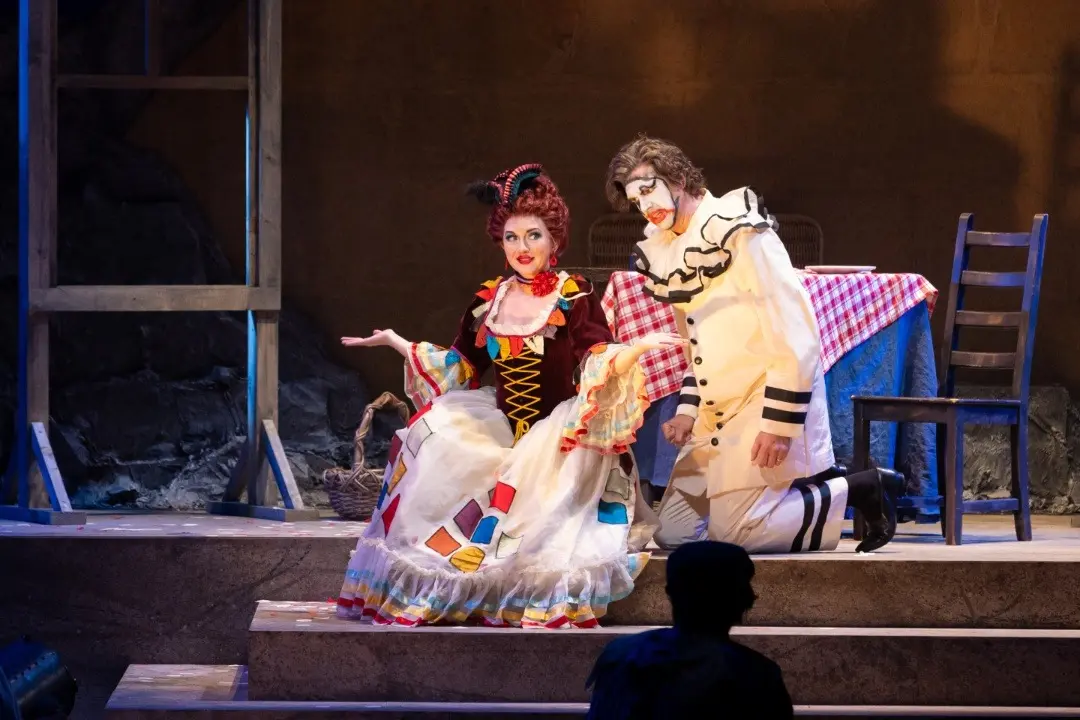
As the troupe settled into the village, the veneer of camaraderie quickly splintered. Soprano Sarah Tucker delivered a searing portrayal of Nedda (Colombina), capturing the profound, unique isolation of a woman trapped in a transactional existence. Tucker’s bright soprano was carefully textured, revealing a complex figure who recognized a fleeting ray of hope in a bleak life. Married to an increasingly volatile alcoholic, she navigated Canio’s abusive instincts while fending off the predatory, brutal advances of Tonio.
Left momentarily to her own thoughts, Tucker’s Nedda struggled with internal quiet. Amid the orchestra’s simulation of joyful bird calls, her confusion was palpable—not necessarily driven by an envy of avian freedom, but by the poignant realization that birds at least instinctively know what to do with their agency.
This fragile vacuum was briefly filled by bass-baritone Hunter Enoch as Silvio. Enoch’s lyric tone quickly established his romantic credentials, softening effectively to bare Silvio’s desperate anxieties before Nedda returned his affections.
The Descent into Madness and the Climax
The fragile peace shattered upon the return of Canio, brilliantly portrayed by tenor Zach Borichevsky. Charting Canio’s erratic, terrifying descent from irritable suspicion to jealous rage and, ultimately, murder, Borichevsky anchored his performance in a resonant baseline before expanding his vocal volume with terrifying control. Even as the character lost his grip on reality, Borichevsky maintained pristine vocal discipline.
His delivery of "Ridi, Pagliaccio!"—opera’s ultimate breaking point, where the clown must laugh while his heart shatters—was both singular and deeply satisfying. Rather than treating Canio’s anguish as an isolated incident of operatic madness, the production framed it within the crushing verismo tradition. The tragedy was not merely that a man was consumed by jealousy, but that he was forced to continue performing his routine while his life burned to the ground.
In the final moments, the townsfolk returned, eager to witness a commedia dell’arte plot that horrifyingly mirrored the real-life drama unfolding before them. Carlos Ahrens, utilizing his bright, agile tenor, brought a sense of weary pragmatism to Beppe (Harlequin). Desperate simply to keep the show on the tracks and finish the season, Beppe remained blind to the dark currents swirling among his colleagues. As the lines between performance and reality completely dissolved, the audience joined the townsfolk in paralyzed horror, unable to stop the swift, violent conclusion.
Supporting Context & Metrics
To fully appreciate the artistic triumphs of this production, one must examine the structural and technical elements that elevated the performance beyond standard repertory fare:
- Orchestral Nuance: Under the baton of Artistic Director Adam Turner, the Virginia Symphony Orchestra functioned not merely as accompaniment, but as an active participant in the psychological drama. The brass section—particularly the horns—invoked a circus-like atmosphere with strict modulation, while the strings carried the lyrical weight of unfulfilled romantic aspirations.
- Minimalist Set and Lighting Design: Eschewing traditional set changes, the production utilized a static, multi-level set featuring various entry and exit routes. This design allowed Jonah Schnell’s mood-driven lighting to take center stage. The lighting transformed subtly throughout the day, eventually shifting into dramatic horizontal angles and monochromatic shades during Canio’s aria.
- The Intermezzo Masterclass: During the under-appreciated orchestral interlude, the set nearly vanished entirely. A single footlight cast an immense, expressionless shadow of Pagliaccio’s mask on the back wall as Canio sat desperately trying to apply his makeup. This striking visual anchored the VSO’s luminous reading of the intermezzo, turning a routine scene change into an artistic revelation.
- Role Debuts: Opening night marked notable milestones for the principal cast, with nearly every lead artist making their role debut with the company—a testament to the high-stakes preparation and collaborative vision driving the Virginia Opera this season.
Official Statements & Artistic Vision
The creative team behind the production emphasized that the enduring power of Pagliacci lies in its refusal to offer easy moral binaries. In director and artistic statements surrounding the opening, the emphasis was placed squarely on the "day-to-day sameness of life" that defines the verismo genre.
Artistic Director Adam Turner noted that the integration of the orchestra with the psychological states of the characters was central to the vision:
"The score constantly converses with what the characters wish they were feeling versus the grim reality of their circumstances. The VSO played with a degree of color and restraint that allowed the vocalists to bare their psychological wounds without fighting the pit."
Furthermore, critics and observers alike pointed to the production’s commentary on labor and performance. As one attendee aptly observed, the ultimate tragedy of verismo is not merely the violence of the crime passionnel, but the inescapable reality that "you gotta go to work even when your life is going to hell." This ethos guided the performers away from cartoonish villainy, grounding Tonio, Canio, Nedda, and Beppe in the desperate, grinding economic and emotional realities of itinerant theater life in late-19th-century Italy.
Future Outlook
With the triumphant opening of Pagliacci, the Virginia Opera has set a remarkably high bar for the remainder of the 20th anniversary and 2026–27 concert calendars. The production demonstrated that regional opera companies can successfully marry rigorous psychological depth with grand-scale vocal performance, breathing fresh life into foundational works without resorting to distracting, surface-level modernization.
As the company looks toward its upcoming slate of winter and spring productions, the standard established by Turner, Choi, Tucker, Borichevsky, and the VSO signals an era of elevated artistic risk-taking. Audiences can expect the remainder of the season to lean further into this intersection of vocal excellence and uncompromising dramatic truth, ensuring that the Virginia Opera remains a vital cultural anchor in the mid-Atlantic region.