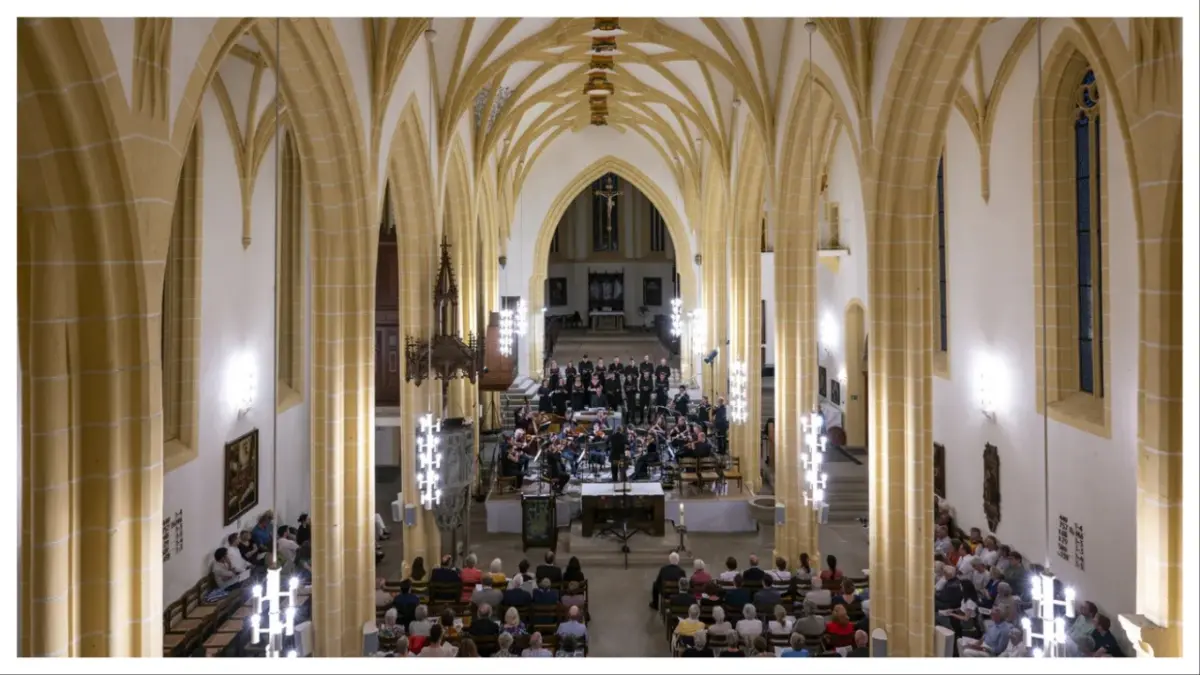

(Photo credit: Holger Schneider)
Executive Overview
The Internationale Bachakademie Stuttgart has officially unveiled the highly anticipated programming for its 2027 season, presenting an extraordinary panorama of choral and vocal masterworks that spans centuries of sacred and secular composition. True to its historic mission, the upcoming festival places the human voice at the absolute center of its artistic inquiry, curating a month-long sonic exploration that bridges the timeless polyphony of the Baroque era with the profound emotional resonance of Romanticism and the striking sonic textures of contemporary sacred music.
Scheduled for March 2027, the festival’s itinerary is nothing short of breathtaking. It brings together world-renowned conductors, elite chamber choirs, period-instrument orchestras, and some of the most sought-after vocal soloists on the international stage. From the foundational counterpoint of Heinrich Schütz and Johann Sebastian Bach to the lush Romanticism of Felix Mendelssohn Bartholdy and Anton Bruckner, and further forward to the contemplative soundscapes of Arvo Pärt, Pēteris Vasks, and James MacMillan, the 2027 season is structured as an immersive journey through the evolution of Western vocal art.
At the heart of this year’s festival lies a deep commitment to intergenerational dialogue. Alongside legendary ensembles like the Gaechinger Cantorey and the Dresden Chamber Choir, the festival heavily invests in the next generation of musical interpreters, notably through the Young Stuttgart Bach Ensemble. This dual focus on venerated masterpieces and dynamic, forward-looking performance practices ensures that the Internationale Bachakademie Stuttgart remains a vital, beating heart in the global classical music landscape. This comprehensive preview details the chronological trajectory, artistic significance, and structural brilliance of the 2027 vocal season.
Detailed Chronology of the 2027 Season
The 2027 festival unfolds across March like a meticulously crafted altarpiece, with each performance illuminating a distinct facet of the vocal and choral canon.
Opening Night: Schütz and the Foundations of German Baroque
- Performance Date: March 5, 2027
- Artists: Dresden Chamber Choir, led by Hans-Christoph Rademann
The festival opens with an authoritative nod to the roots of German Baroque music. The illustrious Dresden Chamber Choir, under the visionary leadership of Hans-Christoph Rademann—a leading authority on early German repertoire—takes the stage to present a program dedicated entirely to Heinrich Schütz. Known for their immaculate blend, historical sensitivity, and dramatic rhetorical delivery, the Dresden ensemble will explore the spatial and expressive dimensions of Schütz’s motets and sacred concertos, setting a profoundly spiritual and art historical tone for the weeks ahead.
Intimate Masterworks: Bach’s Jesu, meine Freude
- Performance Date: March 7, 2027
- Artists: Tabea Krause, Lea Elisabeth Müller, Philipp Nicklaus, and Jan-Henrik Witkowski (soloists); Lydia Schimmer (conductor)
Shifting from expansive choral textures to more intimate, chamber-scale polyphony, the festival highlights J.S. Bach’s monumental motet Jesu, meine Freude (BWV 227). Under the baton of conductor Lydia Schimmer, a rising talent in the realm of historically informed performance, a quartet of brilliant young vocal soloists—Tabea Krause, Lea Elisabeth Müller, Philipp Nicklaus, and Jan-Henrik Witkowski—will dissect the architectural and emotional complexities of Bach’s longest and most symmetrically structured motet. This performance promises an intense, transparent reading of Bach’s intricate theological text-painting.
The Next Generation: The Young Stuttgart Bach Ensemble
- Performance Dates: March 8 and March 14, 2027
- Artists: Choir of the Young Stuttgart Bach Ensemble 2027, JSB Ensemble; Matthias Böhringer and Kristina Pfeffer (conductors)
One of the cornerstone educational and artistic pillars of the Bachakademie is the Young Stuttgart Bach Ensemble. For the 2027 season, forty exceptional young singers hailing from numerous countries across the globe have been selected to form this elite international choir. Collaborating with the instrumentalists of the JSB Ensemble, these rising stars will tackle one of the ultimate mountains of the choral repertoire: J.S. Bach’s St. Matthew Passion.
Beyond the towering pillars of Bach, the Young Stuttgart Bach Ensemble will also showcase their staggering versatility in a dedicated program of choral masterworks spanning the 19th, 20th, and 21st centuries. Under the dual baton of conductors Matthias Böhringer and Kristina Pfeffer, the choir will perform sacred gems by Felix Mendelssohn Bartholdy, Anton Bruckner, Arvo Pärt, Cyrillus Kreek, Max Reger, Herbert Howells, and Jacobus Gallus. This cross-era programming highlights how deeply the stylistic traditions of Bach echo through subsequent generations of choral composition.
The Monumental Core: The St. Matthew Passion with Rademann and the Gaechinger Cantorey
- Performance Dates: March 10, 11, 13, and 14, 2027
- Artists: Benedikt Kristjánsson, Isabel Schicketanz, Alex Potter, Christoph Pfaller, Matthias Lika, Jonas Müller (soloists); JSB Ensemble & Gaechinger Cantorey; Hans-Christoph Rademann (conductor)
The undisputed centerpiece of the 2027 Internationale Bachakademie Stuttgart season is a four-night residency of J.S. Bach’s dramatic masterwork, the St. Matthew Passion (BWV 244). Directed by Hans-Christoph Rademann, these performances unite the period-instrument forces of the Gaechinger Cantorey and the JSB Ensemble.
Rademann has assembled a dream team of vocal soloists renowned for their mastery of Baroque performance practice. The cast features tenor Benedikt Kristjánsson, celebrated internationally for his deeply moving and agile portrayals of the Evangelist; soprano Isabel Schicketanz; countertenor Alex Potter; tenor Christoph Pfaller; bass-baritone Matthias Lika; and bass Jonas Müller. Given the acoustic splendor of the performance venues and Rademann’s theatrical yet reverent approach to Bach’s sacred drama, these four dates are poised to be the most sought-after tickets of the European classical spring.
Romantic Devotion: Mendelssohn at the Collegiate Church
- Performance Date: March 14, 2027
- Artists: Vocal soloists, Stuttgart Collegiate Church Philharmonic Orchestra; Kay Johannsen (conductor)
Felix Mendelssohn Bartholdy’s tireless advocacy for the music of Johann Sebastian Bach is legendary, but his own sacred vocal output remains a treasure trove of early-to-mid 19th-century devotion. On March 14, conductor Kay Johannsen leads the Stuttgart Collegiate Church Philharmonic Orchestra alongside a slate of exceptional vocal soloists in a program dedicated entirely to Mendelssohn’s sacred choral and orchestral writing. This concert provides a vital bridge in the festival’s narrative, demonstrating how the structural integrity of the Baroque era was transfigured by the lyrical warmth and harmonic color of Romanticism.
Contemporary Sacred Soundscapes: MacMillan, Vaughan Williams, and Vasks
- Performance Date: March 19, 2027
- Artists: SWR Vocal Ensemble, Württemberg Chamber Orchestra Heilbronn; Risto Joost (conductor)
Expanding the festival’s stylistic boundaries into the 20th and 21st centuries, conductor Risto Joost takes the podium to lead two powerhouse ensembles: the world-class SWR Vocal Ensemble and the Württemberg Chamber Orchestra Heilbronn. This concert is a masterclass in modern sacred introspection, featuring music by three distinct contemporary and 20th-century masters: Scotland’s James MacMillan, England’s Ralph Vaughan Williams, and Latvia’s Pēteris Vasks.
The juxtaposition of Vaughan Williams’ mystic English pastoralism with MacMillan’s fiery, emotionally charged Catholic modernism and Vasks’ luminous, transcendent Baltic minimalism offers festivalgoers a profound meditation on the spiritual capacity of the modern human voice.
Polyphonic Heritage: Cantus Stuttgart Explores Bach, Zelenka, and J.M. Bach
- Performance Date: March 21, 2027
- Artists: Cantus Stuttgart; Jörg-Hannes Hahn (conductor)
On the final Sunday of the festival, Cantus Stuttgart, under the direction of Jörg-Hannes Hahn, presents an intricate program that places J.S. Bach in direct conversation with his contemporaries and forebears. Featuring works by J.S. Bach, the visionary Bohemian composer Jan Dismas Zelenka, and Johann Michael Bach, this concert delves deep into the stylistic cross-currents of the high Baroque. Zelenka’s famously idiosyncratic, daringly chromatic counterpoint will provide a thrilling contrast to the polished elegance of the Bach family lineage.
A Historic Finale: Schumann’s Arrangement of the St. John Passion
- Performance Date: March 21, 2027
- Artists: Rowan Pierce, Henriette Gödde, Patrick Grahl, Tobias Berndt, Markus Eiche (soloists); Choir of the Gaechinger Cantorey, Basel Chamber Orchestra; Hans-Christoph Rademann (conductor)
The 2027 Internationale Bachakademie Stuttgart draws its magnificent curtain with a performance of immense musicological and artistic significance. Hans-Christoph Rademann leads the Basel Chamber Orchestra and the Choir of the Gaechinger Cantorey in a performance of J.S. Bach’s St. John Passion—specifically utilizing the rare and fascinating historical arrangement by Robert Schumann.
Schumann, a passionate pioneer of the 19th-century Bach revival, famously edited and re-scored parts of Bach’s masterworks to suit the romantic sensibilities and orchestral palate of his own time. Hearing the St. John Passion through Schumann’s ears offers a unique lens into music history, demonstrating how 19th-century masters interpreted, adapted, and revered their Baroque predecessors.
The vocal cast for this grand finale features an all-star roster of soloists: soprano Rowan Pierce, alto Henriette Gödde, tenor Patrick Grahl, baritone Tobias Berndt, and bass Markus Eiche. Together with the combined forces of the choir and the Basel Chamber Orchestra, they will deliver a closing statement that bridges two golden ages of German musical expression.
Supporting Context & Metrics
To fully appreciate the scope of the Internationale Bachakademie Stuttgart’s 2027 season, one must examine the institutional weight and logistical complexity required to mount such a comprehensive festival.
Scale and International Reach
- Duration: Spanning over two weeks in March 2027 (March 5 to March 21).
- Global Talent Pool: The Young Stuttgart Bach Ensemble alone draws 40 elite young singers chosen through rigorous international auditions, representing diverse cultural and musical backgrounds from across multiple continents.
- Ensemble Diversity: The festival deploys an array of specialized performance bodies, ranging from world-class period-instrument orchestras (Gaechinger Cantorey, Basel Chamber Orchestra) and modern chamber orchestras (Württemberg Chamber Orchestra Heilbronn, Stuttgart Collegiate Church Philharmonic Orchestra) to professional broadcast choirs (SWR Vocal Ensemble) and historic chamber choirs (Dresden Chamber Choir).
- Repertoire Span: The chronological timeline of the festival covers nearly 400 years of music history, stretching from Heinrich Schütz (born 1585) to contemporary luminaries like Arvo Pärt and James MacMillan.
The Educational and Cultural Imperative
Beyond its concert listings, the Bachakademie functions as a premier research and pedagogical institution. By pairing legendary veterans of historically informed performance (such as conductor Hans-Christoph Rademann and tenor Benedikt Kristjánsson) with the emerging artists of the Young Stuttgart Bach Ensemble, the festival ensures the active transmission of stylistic knowledge. Young singers are not merely performing; they are participating in masterclasses, historical seminars, and intensive rehearsals that decode the rhetorical, theological, and technical demands of the sacred vocal canon.
Official Statements and Artistic Vision
While specific individual press quotes for the 2027 rollout continue to be disseminated through cultural ministries and the Bachakademie’s central offices, the curatorial philosophy guiding the season has been articulated clearly by the institution’s artistic leadership.
The decision to focus exclusively on vocal and choral works for the 2027 season underscores a fundamental belief in the primacy of the text. In the vision of the festival organizers, vocal music is never purely abstract; it is an intersection of poetry, theology, human breath, and divine aspiration.
"The human voice is our most ancient, direct, and vulnerable instrument," artistic representatives noted during preliminary program briefings. "By focusing our 2027 season entirely on vocal works—from the stark, rhetorical recitatives of Heinrich Schütz to the sweeping romanticism of Mendelssohn and the daring modernism of MacMillan and Vasks—we invite our audiences to experience music not just as sound, but as a profound dialogue between humanity and the transcendent."
Furthermore, the inclusion of Robert Schumann’s historic arrangement of the St. John Passion for the closing night highlights the academy’s ongoing dedication to musicological discovery. It challenges listeners to look beyond rigid purism and understand how masterworks evolve through the generations, refracted through the artistic imaginations of subsequent masters.
Future Outlook
As the classical music world looks toward the spring of 2027, the Internationale Bachakademie Stuttgart has once again cemented its status as an indispensable beacon of artistic excellence and historical inquiry. By refusing to rest upon its laurels as a mere custodian of Bach’s legacy, the institution continues to expand its intellectual and geographical boundaries.
The 2027 season is much more than a collection of high-profile concerts; it is a meticulously curated acoustic ecosystem. It honors the past while aggressively nurturing the future, providing a platform where established masters and emerging international talents can converse across the centuries. For performers, scholars, and passionate concertgoers alike, March 2027 in Stuttgart will offer a once-in-a-lifetime convergence of sacred art, historic performance practice, and emotional transformation.
Ticket packages and individual performance reservations for the Internationale Bachakademie Stuttgart 2027 season are expected to experience unprecedented global demand. Music lovers are advised to consult the official Bachakademie portal for comprehensive booking details, venue information, and supplementary lecture schedules as the festival dates draw closer.