
Executive Overview
The landscape of voice science, pedagogy, and vocal health has undergone a radical transformation over the past several decades, evolving from isolated pockets of empirical teaching into a sophisticated, multidisciplinary science. At the very epicentre of this evolution stands The Voice Foundation—an international nexus for laryngologists, speech-language pathologists, vocal scientists, educators, and performing artists.
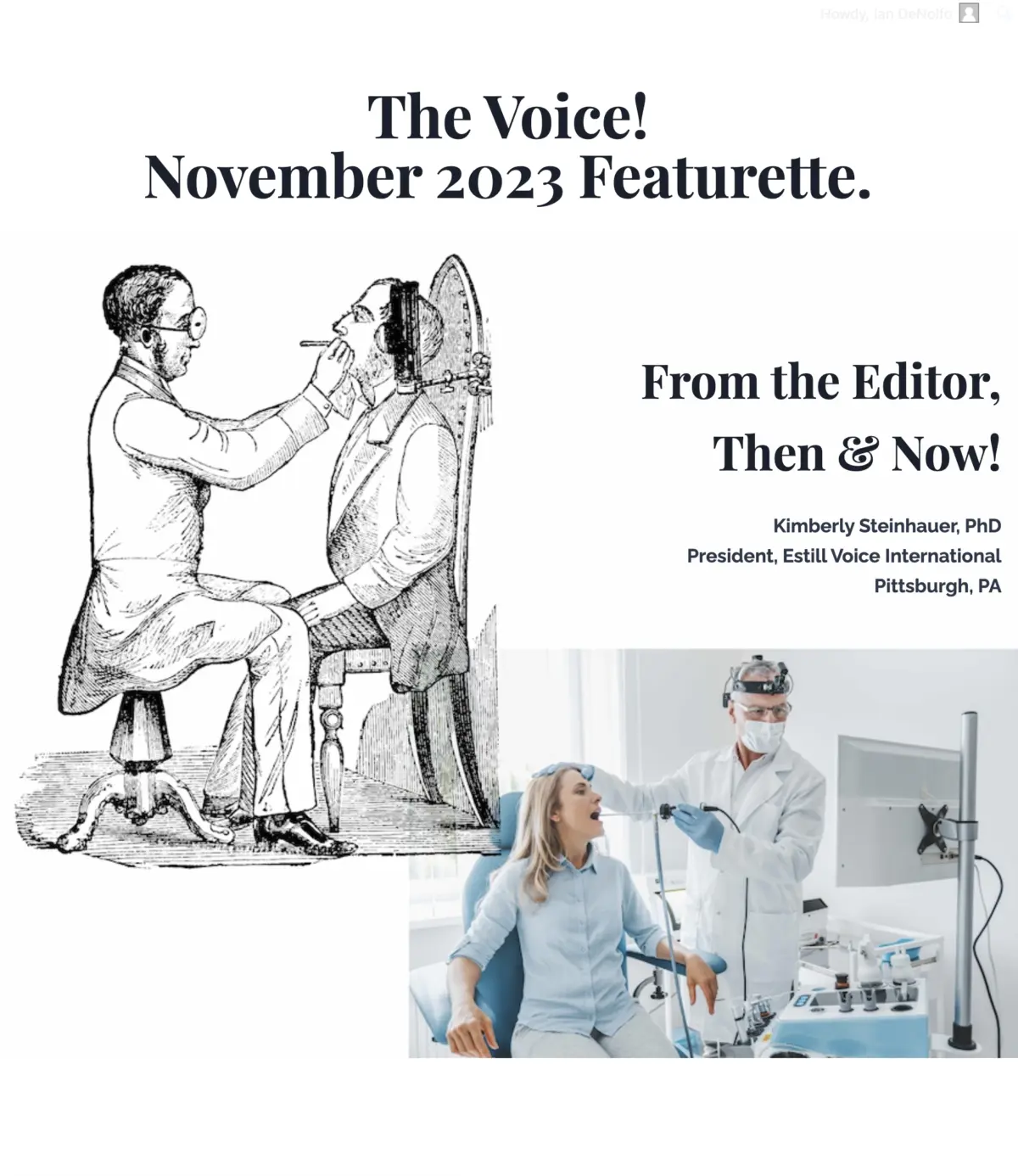
In a special investigative issue of The Voice, guest editor and Estill Voice International President Dr. Kimberly Steinhauer, Ph.D., has curated a retrospective exploration examining the driving forces, personal motivations, and professional trajectories of the organization’s key architects. Framed playfully around the ubiquitous contemporary cultural phenomenon of social media "Then & Now" memes, this commemorative edition moves past mere nostalgia. Instead, it offers a rigorous examination of institutional memory, leadership dedication, and the foundational pillars that continue to sustain the global voice community.
Inspired by the profound historical insights delivered during the 2023 Symposium’s G. Paul Moore Lecture by Margaret Baroody, M.M., Dr. Steinhauer launched a probing investigative survey titled "Ten Questions for our Leaders." The resulting issue captures candid reflections from Executive Director Ian DeNolfo, Advisory Board Chairman Dr. Michael Johns III, and Chairman of the Board Dr. Robert T. Sataloff. Together, these profiles illuminate the intersection of passion and perseverance, demonstrating how early personal aspirations coalesced into lifelong vocations dedicated to understanding and preserving the human voice.
Detailed Chronology: The Genesis and Evolution of Voice Science Leadership
To understand the current leadership of The Voice Foundation, one must examine the chronological trajectory that bridged the art of singing with the empirical methodologies of voice science. For centuries, vocal pedagogy relied heavily on imagery, subjective sensation, and anecdotal tradition. The transition toward a scientifically grounded discipline began to accelerate in the latter half of the 20th century, catalyzed by pioneers who recognized the necessity of bridging artistic expression with anatomical and physiological realities.
The Formative Years: Merging Art, Science, and Pedagogy
For Dr. Kimberly Steinhauer, the journey began with a tripartite ambition: a profound love for music, a growing fascination with science, and an intrinsic joy in teaching. As she reflects in her editorial, her early academic pursuits were intentionally designed to synthesize these three distinct realms. This multidisciplinary approach was not common in traditional conservatories of the era, where science and art frequently operated in mutual isolation.
During the foundational decades of modern voice science—when organizations like The Voice Foundation were carving out a legitimate academic and clinical space—scholars and performers alike had to forge new pathways. Steinhauer’s trajectory from an inquisitive undergraduate to an advanced researcher and the president of Estill Voice International mirrors the maturation of the field itself. The realization of her early aspirations—transitioning from hoping to join the inner circle of voice science to actively editing its primary communications—underscores a broader institutional trend: the democratization and expansion of specialized vocal knowledge.
The 2023 Symposium and the Spark of Institutional Memory
The intellectual catalyst for the "Then & Now" initiative emerged during the 2023 Annual Symposium on Care of the Professional Voice. There, Margaret Baroody delivered the prestigious G. Paul Moore Lecture, an address dedicated to exploring the historical lineage, clinical breakthroughs, and institutional memory of The Voice Foundation.
Baroody’s lecture served as a stark reminder that contemporary breakthroughs in phonosurgery, voice therapy, and pedagogical science do not happen in a vacuum. They are built upon decades of tireless advocacy, cross-disciplinary collaboration, and organizational resilience. Struck by the depth of Baroody’s historical overview, Dr. Steinhauer recognized an urgent need to document the personal histories of the individuals currently steering the organization. How did today’s leaders find their way into voice science? What sustained their commitment through decades of administrative, clinical, and artistic challenges? These questions gave rise to the "Ten Questions for our Leaders" survey, a project designed to extract both biographical data and philosophical insights from the Foundation’s executive core.
Supporting Context & Metrics: The Anatomy of Modern Voice Research and Leadership
The significance of The Voice Foundation’s leadership cannot be fully appreciated without contextualizing the scale and impact of modern voice science. Over the past four decades, the field has transitioned from a niche medical subspecialty into a robust global enterprise involving millions of patients, educators, and performing artists.
The Interdisciplinary Ecosystem
Modern vocal health relies on a complex, collaborative triad:
- Laryngologists and Otolaryngologists: Medical doctors specializing in the surgical and medical management of vocal fold pathologies.
- Speech-Language Pathologists (SLPs) / Voice Therapists: Rehabilitation specialists focused on restoring and optimizing voice function post-injury or pathology.
- Vocal Pedagogues and Scientists: Educators and researchers who study acoustic, aerodynamic, and myoelastic-aerodynamic principles to train healthy, resilient voices.
The leadership team surveyed in The Voice represents the crystallization of this triad. Executive Director Ian DeNolfo, Advisory Board Chairman Dr. Michael Johns III, and Chairman of the Board Dr. Robert T. Sataloff operate at the intersection of clinical excellence, academic rigor, and organizational governance.
Quantitative Indicators of Growth
While the human element remains central—as emphasized by leaders who routinely deflect personal praise to highlight the "unseen armies" of volunteers, researchers, and clinicians working behind the scenes—the institutional metrics of voice science reflect unprecedented expansion:

- Global Participation: Annual symposia regularly attract hundreds of multidisciplinary professionals from dozens of countries, fostering cross-cultural methodologies in voice care.
- Publication Reach: Peer-reviewed journals, such as the Journal of Voice, continue to publish hundreds of high-impact studies annually, driving evidence-based standards for vocal pedagogy and laryngeal surgery.
- Educational Outreach: Foundation-affiliated newsletters, webinars, and regional workshops reach tens of thousands of educators, singers, actors, and corporate voice users annually.
Official Statements and Leadership Perspectives
The core of Dr. Steinhauer’s investigative feature lies in the candid responses provided by the Foundation’s primary executives. While each leader occupies a distinct institutional role, their narratives share common threads of intellectual curiosity, mentorship, and an unwavering dedication to the human voice.
The Philosophy of Governance: Dr. Robert T. Sataloff
As Chairman of the Board, Dr. Robert T. Sataloff—a globally recognized authority in otolaryngology and performing arts medicine—has witnessed the evolution of voice care from its infancy. In his contributions to the survey, Dr. Sataloff emphasizes that the Foundation’s enduring success rests on its capacity to integrate disparate fields. His "Then & Now" perspective bridges the era when vocal injury meant the premature end of a career with the modern reality of micro-phonosurgery and advanced behavioral voice therapy. Dr. Sataloff’s insights consistently underscore the ethical imperative of protecting the professional voice, viewing it not merely as an occupational tool, but as an essential component of human identity.
Clinical Direction and Community: Dr. Michael Johns III
Serving as Advisory Board Chairman, Dr. Michael Johns III brings vital clinical and academic leadership to the table. His perspective within the survey highlights the vital bridge between academic medical centers and the practicing artistic community. Dr. Johns notes that the challenges facing professional voice users—ranging from environmental stressors and post-viral laryngeal neuropathies to the rigorous demands of modern touring schedules—require continuous adaptation from the medical and pedagogical communities. His reflections emphasize that the strength of The Voice Foundation lies in its refusal to remain siloed; true innovation occurs only when the singer, the scientist, and the surgeon sit at the same table.
Administrative Resilience: Ian DeNolfo
As Executive Director, Ian DeNolfo manages the intricate operational framework that keeps The Voice Foundation running on a global scale. In responding to Steinhauer’s survey, DeNolfo sheds light on the unseen labor required to maintain a world-class non-profit research and educational institution. He notes that while leaders and researchers often receive public recognition, the day-to-day vitality of the organization is sustained by a passionate community of administrative staff, donors, symposium coordinators, and passionate volunteers. DeNolfo’s "Then & Now" outlook focuses on modernization—harnessing digital communication platforms, expanding global access to educational archives, and ensuring financial sustainability for future generations of voice researchers.
Future Outlook: The Next Frontier in Voice Science and Pedagogy
As The Voice Foundation looks beyond its historical milestones, the leadership team profiled in this special issue is actively charting the course for the future of vocal health and education. Several critical frontiers are poised to define the next era of voice research:
1. Artificial Intelligence and Machine Learning in Vocal Diagnostics
The integration of AI into laryngeal imaging and acoustic analysis represents one of the most promising frontiers in voice care. Future research supported by Foundation leaders aims to utilize machine learning algorithms to detect subtle, early-stage pathologies—such as micro-lesions or early neurological impairments—long before they manifest as severe dysphonia. Furthermore, AI-driven biofeedback tools are expected to revolutionize remote voice therapy, allowing patients and students to monitor vocal fold closure and aerodynamic efficiency in real time.
2. Regenerative Medicine and Vocal Fold Tissue Engineering
Scoring a major triumph over historically permanent vocal fold scarring, regenerative medicine is shifting from theoretical research to clinical application. Future initiatives supported by institutional leaders will likely focus on stem cell therapies, injectable biomaterials, and tissue-engineered extracellular matrices designed to restore pristine mucosal wave mechanics to damaged vocal folds. For professional singers, this research holds the promise of reversing what was once considered career-ending vocal trauma.
3. Expanding Global Access and Diversity in Voice Pedagogy
Historically, advanced voice science and specialized voice care were concentrated within major academic medical centers in North America and Western Europe. A primary objective for the current and future leadership of The Voice Foundation is the democratization of this knowledge. By leveraging digital symposia, international fellowship programs, and cross-cultural pedagogical partnerships, the Foundation is working to ensure that singers, speech pathologists, and otolaryngologists in underserved global regions gain equitable access to state-of-the-art voice science.
4. Sustainable Multidisciplinary Education
As Dr. Steinhauer’s editorial aptly demonstrates, the future of the field depends upon training the next generation to think across traditional academic boundaries. Future pedagogical models will increasingly require vocal performance majors to study basic acoustic science and vocal anatomy, while medical students specializing in otolaryngology will spend more clinical hours working directly with vocal pedagogues. This cross-pollination ensures that the art and science of the human voice remain permanently intertwined.
Conclusion
The "Then & Now" issue of The Voice transcends a simple retrospective exercise. By synthesizing the personal histories of leaders like Dr. Kimberly Steinhauer, Ian DeNolfo, Dr. Michael Johns III, and Dr. Robert T. Sataloff, the publication honors the visionary pioneers who built modern voice science while issuing a challenge to the practitioners of tomorrow.
From its origins as an audacious attempt to merge artistic passion with empirical science, The Voice Foundation has matured into an indispensable global institution. As new technologies, medical breakthroughs, and pedagogical methodologies reshape the sonic landscape, the core ethos remains unchanged: a profound, unwavering devotion to understanding, healing, and celebrating the human voice.