
Executive Overview
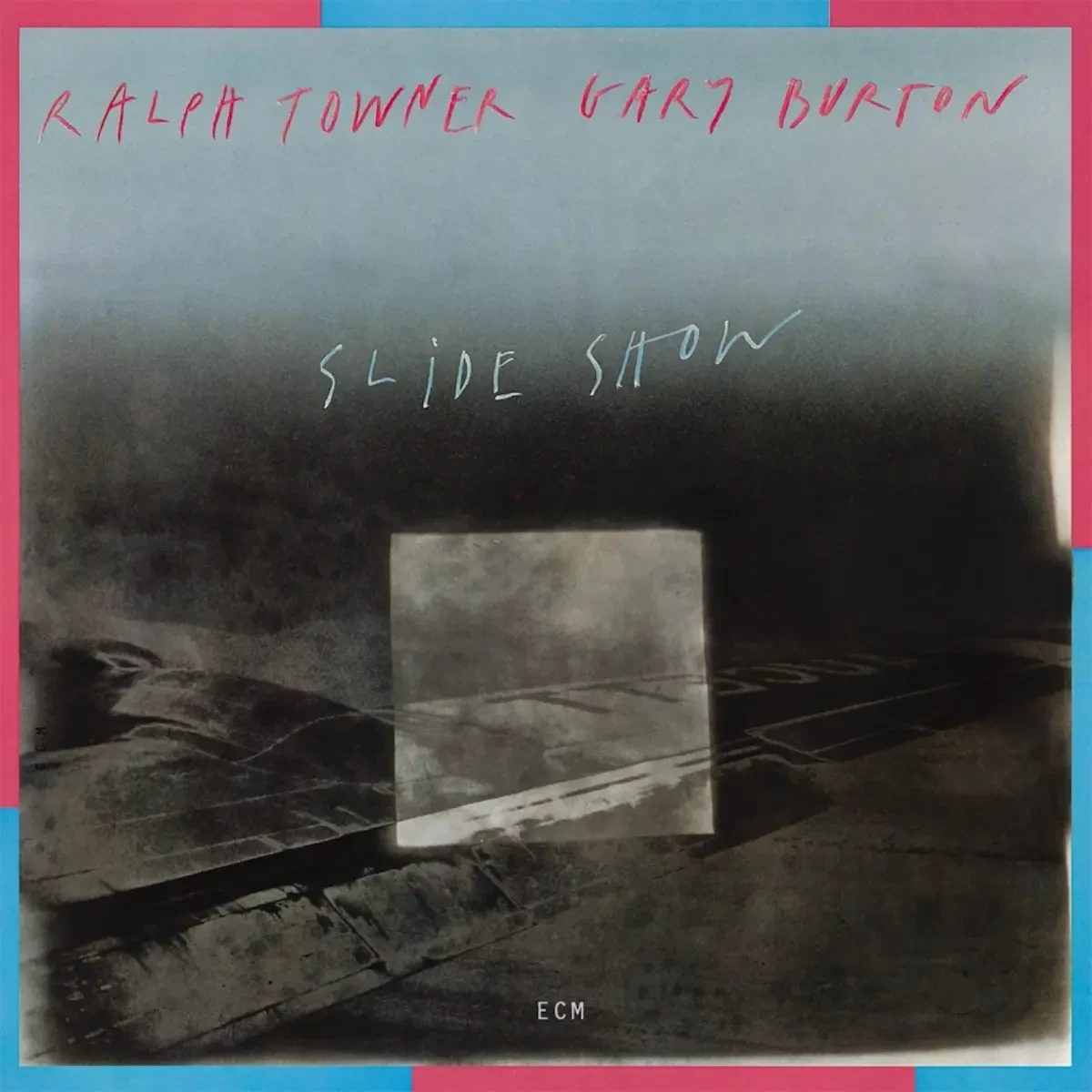
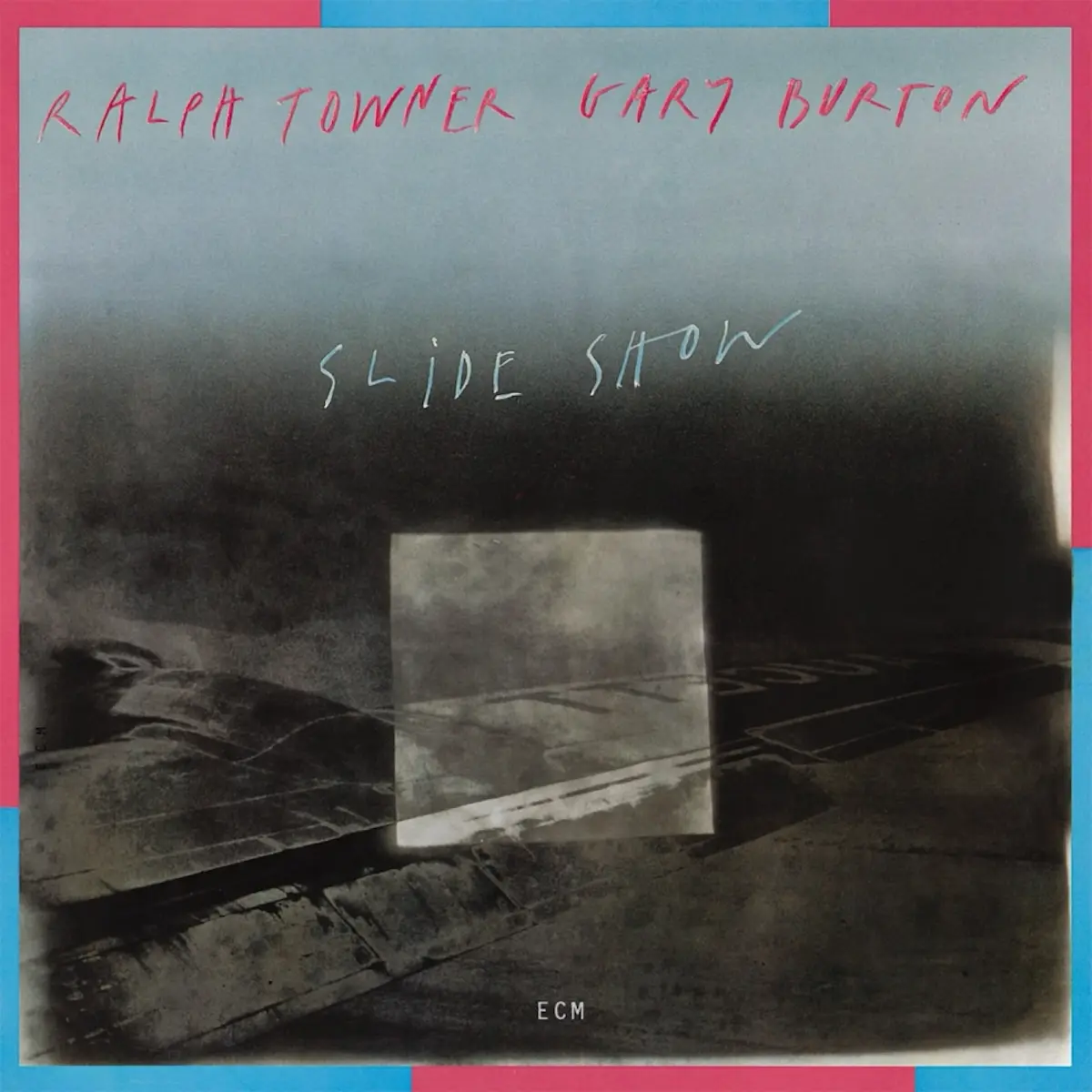
Forty years after its initial publication in the pages of Jazz Journal (September 1986), critic Simon Adams’ retrospective confession remains a testament to the unpredictable nature of jazz collaborations. Approaching the pairing of classical/12-string guitar virtuoso Ralph Towner and vibraphone/marimba innovator Gary Burton with initial skepticism—fearing an "insipid blend of sugary vibraphone and frantic guitar strumming"—Adams was forced to eat his words. What emerged from Tonstudio Bauer in Ludwigsburg, Germany, in May 1985 was not a polite, amorphous chamber-jazz experiment, but an exhilarating, rhythmically kinetic roller coaster of a record: Slide Show (ECM 1306).
Looking back across four decades, this review acts as a critical time capsule, capturing a pivotal moment when two distinct stylistic titans of the ECM Records stable collided. Towner, best known for his work as the acoustic linchpin of Oregon, and Burton, the undisputed master of four-mallet vibraphone technique who revolutionized modern jazz harmony and fusion, discovered an unexpected and profound symmetry. The interplay between Towner’s sharp, articulate pizzicato attack and Burton’s smooth, legato resonance forged an entirely new textural vocabulary.
This comprehensive feature revisits that landmark 1986 critique, contextualizes the historical weight of Slide Show, breaks down the mechanics of its extraordinary tracklist, and examines how this unlikely pairing of guitar and vibes altered the trajectory of modern improvised music.
Detailed Chronology: The Genesis of Slide Show
To understand the magnitude of Slide Show, one must trace the parallel trajectories of Ralph Towner and Gary Burton leading up to their historic May 1985 sessions in Ludwigsburg. By the mid-1980s, both artists were already foundational pillars of the European and American avant-garde, largely due to their symbiotic relationships with Manfred Eicher’s ECM Records.
The Paths Converge (Pre-1985)
Gary Burton had spent the late 1960s and 1970s pushing the boundaries of jazz fusion, mentorship, and ensemble instrumentation. Having popularized the independent four-mallet grip, Burton transformed the vibraphone from a purely textural or percussive novelty into a deeply expressive, polyphonic lead instrument. His collaborations with guitarists like Pat Metheny, Mick Goodrick, and John Scofield cemented his reputation for spotting and challenging string-instrument virtuosos.
Concurrently, Ralph Towner was redefining acoustic guitar in jazz. Emerging from classical training and a profound study of world music traditions, Towner brought a rare compositional sophistication to the instrument. Whether through his solo outings or his work with the genre-defying group Oregon, Towner’s command of both classical and 12-string guitars married intricate European counterpoint with spontaneous American swing.
When Eicher brought Towner and Burton together in the pristine acoustic environment of Tonstudio Bauer in May 1985, it was a high-stakes gamble. Pairing two chordal, harmonically sophisticated instrumentalists without a traditional rhythm section (bass and drums) exposes every harmonic misstep and rhythmic hesitation. Yet, as the subsequent recording proved, the absence of a rhythm section liberated them, allowing them to trade roles as rhythm keeper and melodic lead with breathtaking fluidity.
The Critical Reception (September 1986)
When Jazz Journal published Simon Adams’ review in September 1986, it arrived amidst a crowded landscape of mid-80s jazz releases characterized by heavy synthesizers and slick production. Slide Show stood in stark, organic contrast. Adams’ candid admission of his initial prejudice—and his subsequent self-flagellation for doubting two masters—set a tone of unadulterated enthusiasm that resonated throughout the critical community.
Adams noted how Towner’s plucking sharpened Burton’s sustained metallic tones, while Burton’s warm harmonic blankets softened the percussive edges of Towner’s acoustic attack. Tracks like "Maelstrom" and "Around The Bend" quickly became critical touchstones, proving that chamber jazz could possess the visceral, white-knuckle excitement of a heavy-hitting bebop combo.
Supporting Context & Metrics: Anatomy of an ECM Masterpiece
The structural integrity of Slide Show lies in its immaculate balance of composition and improvisation. Recorded over a few intensive days in Ludwigsburg under the watchful ear of producer Manfred Eicher, the album’s tracklist is divided into two distinct LP sides, totaling roughly 46 minutes of music.
Tracklist Breakdown & Musical Architecture
- Side One (23:11):
- Maelstrom
- Vessel
- Around The Bend
- Blue In Green
- Side Two (22:51):
- Beneath An Evening Sky
- The Donkey Jamboree (originally listed on the sleeve/notes as Donkee Jamboree)
- Continental Breakfast
- Charlotte’s Tangle
- Innocent
Sonic Microscopy: Key Selections
- "Maelstrom": Serving as an early statement of intent, this track showcases the duo’s masterclass in light and shade. Cross-rhythms ripple beneath the surface, keeping the piece in a state of perpetual, graceful motion. Towner and Burton weave in and out of each other’s frequency ranges with zero acoustic crowding.
- "Vessel": Driven by a remarkably strong, memorable melody, this track highlights the deep telepathic empathy between the two players. They shift back and forth from melodic lead to percussive rhythm with an effortless grace that belies the technical difficulty of the charts.
- "Around The Bend": A masterclass in velocity and precision. Hearing the sheer fluency of Burton’s mallets matching the frantic, articulate cascades of Towner’s 12-string guitar at full tilt leaves listeners gasping for air.
- "Beneath An Evening Sky": Offering a striking contrast to the high-velocity workouts, this quieter, more contemplative piece demonstrates how intimately the two musicians could lock their instruments together, creating a unified sonic organism.
- "The Donkey Jamboree": Injecting a dose of playful syncopation, this calypso-inflected number proved that neither artist took themselves too seriously, eliciting genuine joy—and wide grins—from critics and listeners alike.
Production and Acoustic Signatures
Recorded at Tonstudio Bauer, Slide Show benefits directly from the legendary "ECM sound": crystalline clarity, deep spatial reverb, and an almost tactile intimacy. Every scrape of Towner’s fingers against the guitar strings and every dampening nuance of Burton’s vibraphone pedals are captured with absolute fidelity. Without a rhythm section cluttering the low-end, the space between the notes becomes a functional compositional element.
Official Statements & Archival Perspectives
Reflecting on the legacy of Slide Show, contemporary jazz historians and archival notes from the era emphasize how unusual this pairing was for both artists’ discographies.
"I didn’t expect to like this album at all, expecting a rather insipid blend of sugary vibraphone and frantic guitar strumming. After repeated listenings (and repeated self-inflicted thwacks around the head for being so prejudiced) I pronounce this album my rave of the month."
— Simon Adams, Jazz Journal, September 1986
While official retrospective interviews with Towner and Burton regarding this specific album are sparse, the overarching philosophy of their respective labels and collaborators sheds light on the session’s success. Manfred Eicher’s production ethos has always prioritized "the most beautiful sound next to silence." By stripping away drums and bass, Eicher forced Towner and Burton into an exposed acoustic dialogue where harmonic vocabulary and dynamic control were the sole arbiters of success.
Gary Burton’s long-standing philosophy regarding instrumental partnerships has always centered on finding musicians who possess a strong compositional voice. In Towner, Burton found an equal who treated the acoustic guitar not merely as a rhythm machine, but as a polyphonic orchestra capable of holding its own against the sweeping harmonic vistas of the vibraphone and marimba.
Future Outlook: The Enduring Legacy of Slide Show
As we look back at Slide Show four decades after its inception, its influence on contemporary acoustic improvisation and chamber jazz remains profound. In an era dominated by digital production, quantization, and hyper-processed studio creations, the raw, breathing human interaction captured on this 1985 recording serves as a vital antidote.
Lessons for the Modern Improviser
- Overcoming Instrumental Prejudice: As Simon Adams candidly admitted, preconceptions about instrumentation ("guitar and vibes can’t swing") often blind listeners and critics to innovative possibilities. Slide Show remains a textbook case study in defying genre expectations.
- The Power of Space: The absence of a traditional rhythm section teaches modern musicians that rhythmic drive does not require a drum kit; it can be generated through interlocking metric accents, syncopation, and dynamic interplay between two melodic voices.
- Timbral Complementarity: The pairing of a plundered, percussive string instrument with a sustained, mallet-driven metal percussion instrument created a sonic hybrid that continues to inspire contemporary jazz and contemporary classical composers alike.
Conclusion
Forty years after Simon Adams declared it his "rave of the month," Slide Show refuses to gather dust. It stands proudly as a high-water mark in the catalogs of both Ralph Towner and Gary Burton, a shining jewel in ECM’s historic vault, and an enduring reminder of what happens when two master musicians step outside their comfort zones to chase pure, unadulterated musical magic. For those who have yet to experience its roller-coaster thrills, a rewarding sonic journey awaits—just be prepared to eat your words, too.