
Executive Overview
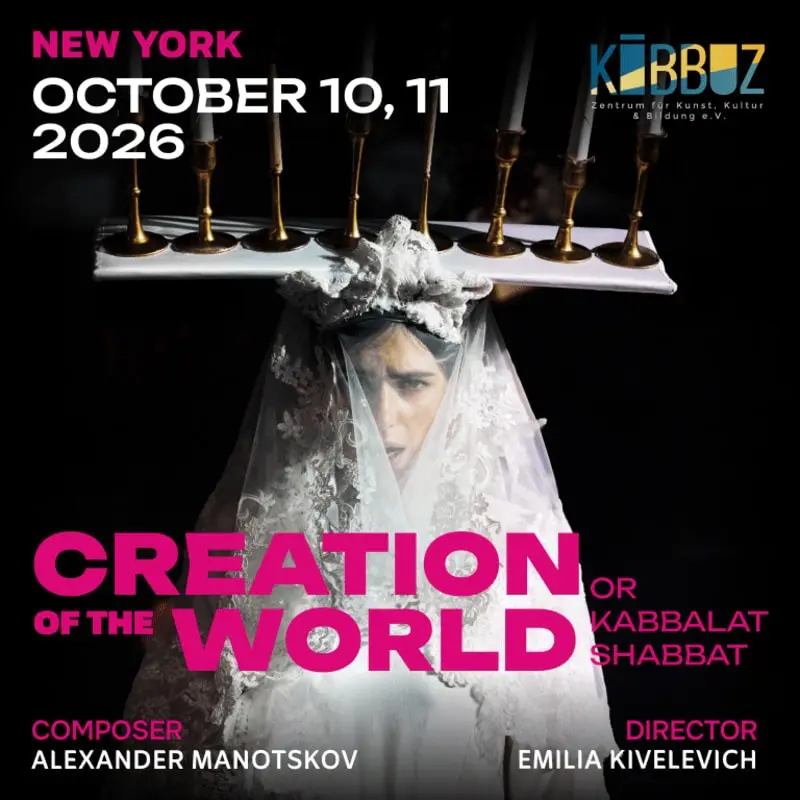
The contemporary classical music landscape is bracing for a profound cultural convergence this coming autumn, as composer Alexander Manotskov’s critically acclaimed avant-garde opera, Creation of the World, or Kabbalat Shabbat, prepares for its highly anticipated United States premiere. Set for October 10 and 11, 2026, at The 1986 Studio in Brooklyn, New York, the production marks a major milestone in the North American staging of contemporary European-born experimental opera.
Rooted deeply in ancient theological text yet vibrantly modern in its execution, the Hebrew-language opera draws its thematic and structural inspiration from the biblical narrative of the six days of creation, culminating in the serene holiness of the seventh-day Sabbath (Shabbat). Directed with avant-garde precision by Emiliia Kivelevich, the upcoming Brooklyn presentations follow a string of successful, thought-provoking European runs across Germany and the Netherlands.
For the American classical music community, this premiere represents far more than just a localized performance; it serves as a bridge connecting diasporic artistic expression with the rich lineage of American academic modernism. As composer Alexander Manotskov noted in official press communications, the opera seeks to transcend geopolitical and cultural boundaries, utilizing a universal artistic vocabulary to draw diverse audiences into a shared meditative space. This comprehensive report explores the origins of the opera, its thematic foundations, the creative philosophy of its creators, and the broader cultural implications of its historic arrival in New York City.
Detailed Chronology: From Concept to U.S. Stage
The trajectory of Creation of the World, or Kabbalat Shabbat is a testament to the resilience of contemporary opera in the face of shifting sociopolitical landscapes. To understand the significance of its upcoming American debut, one must trace the developmental path that brought Manotskov’s creation from its conceptual inception to the stages of Western Europe and, ultimately, to the artistic hub of Brooklyn.
The Genesis of the Work
Alexander Manotskov, a prominent figure in contemporary Russian and European compositional circles known for his radical stylistic versatility and deep engagement with text, conceived the piece as a universal meditation on existence, order, and time. Rather than relying on traditional operatic tropes of melodramatic plotlines, Manotskov structured the opera around the cosmic architecture of Genesis. The first six movements reflect the arduous, dynamic unfolding of the universe—light, firmament, land, celestial bodies, living creatures, and humanity—while the seventh movement shifts into the tranquil, introspective stasis of Kabbalat Shabbat (the welcoming of the Sabbath), a ritual cessation of labor that invites spiritual renewal.
European Development and Staging
Before turning its sights toward North America, the production underwent a rigorous gestation period in Western Europe. Over the course of its development, Creation of the World, or Kabbalat Shabbat was staged five times across various cultural centers in Germany and the Netherlands. These early performances were instrumental in refining the staging mechanics under the watchful eye of director Emiliia Kivelevich.
European critics praised the production for its minimalist yet striking visual aesthetics, which avoided heavy-handed theatricality in favor of contemplative pacing. The choice to preserve the original Hebrew libretto—even as the opera traveled through non-Hebrew-speaking regions—proved to be an artistic masterstroke. It forced audiences to engage with the phonetics, rhythm, and emotional cadence of the ancient language, turning the sonic landscape itself into a universal signifier.
The Bridge to Brooklyn (October 2026)
The decision to bring the production to The 1986 Studio in Brooklyn on October 10 and 11, 2026, marks a strategic expansion into the American cultural consciousness. New York City, with its historically vibrant ecosystem for experimental theater, contemporary classical music, and diasporic art, offers an ideal crucible for the U.S. premiere. The 1986 Studio, known for its intimate, adaptable performance spaces, provides an environment where the boundary between spectator and performer can dissolve, allowing Manotskov’s spatialized vocal writing and instrumental textures to envelop the listener intimately.
Supporting Context & Metrics: The Mechanics of Modern Diasporic Opera
To fully grasp the weight of Manotskov’s U.S. premiere, it is essential to examine the socio-cultural dynamics of modern émigré art, the structural demands of the score, and the specific ecosystem of Brooklyn’s contemporary performance venues.
The Power of Émigré Art Across Generations
Art created in exile or by artists navigating transnational displacement has historically occupied a unique and transformative space within Western civilization. As Manotskov himself pointed out, the phenomenon of émigré art reaching its absolute zenith when it transcends national borders has historic precedent.
[Traditional Homeland / Cultural Roots]
                  │
                  ▼
   (Transnational Displacement / Exile)
                  │
                  ▼
  [Cross-Pollination with Host Culture]
                  │
                  ▼
[Universal Artistic Transcendence (e.g., Stravinsky, Kandinsky, Manotskov)]
Figures like composer Igor Stravinsky and painter Wassily Kandinsky fundamentally reshaped twentieth-century modernism precisely because their displacement forced them to look beyond parochial nationalism toward a universal humanism.
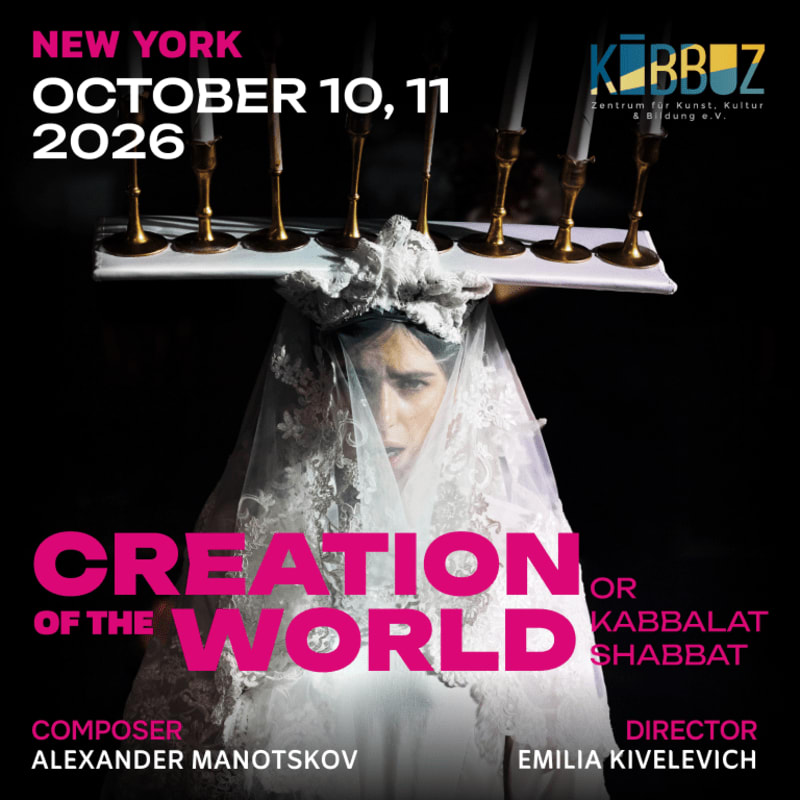
Creation of the World, or Kabbalat Shabbat operates within this exact philosophical lineage. By taking a deeply specific religious and linguistic text—classical Hebrew scripture—and filtering it through a contemporary European avant-garde sensibility that heavily incorporates elements of the American academic compositional tradition, the opera actively resists being boxed into a singular national or ethnic category. Instead, it becomes a cosmopolitan artifact designed for the twenty-first-century global citizen.
Musical Architecture and the American Academic Tradition
Musically, Manotskov’s score defies simple categorization. While it draws upon liturgical and historical vocal traditions, it is fundamentally informed by rigorous structuralism. The composer’s explicit connection to the "American academic tradition"—often associated with the lineage of experimentalism, minimalism, and complex tonal exploration pioneered by figures such as Morton Feldman, John Cage, and Steve Reich—provides a fascinating framework for the upcoming Brooklyn performances.
The American academic tradition has long celebrated music that treats time not merely as a vehicle for narrative progression, but as a tangible, architectural space. The biblical narrative of Creation is inherently concerned with the organization of time and space (the separation of light from darkness, the division of waters). By aligning the structural pacing of the Hebrew text with the patient, unhurried developmental techniques found in American experimentalism, Manotskov creates a sonic tapestry that feels simultaneously ancient and hyper-modern.
Venue Profile: The 1986 Studio, Brooklyn
The choice of venue is critical to understanding the production’s artistic goals. Large-scale opera houses with gilded proscenium arches are inherently designed to project grand theatrical illusions across vast distances. In contrast, independent performance spaces like The 1986 Studio favor immediacy, acoustic transparency, and spatial intimacy.
For an opera like Creation of the World, which relies heavily on microtonal vocal nuances, subtle textual inflections, and atmospheric instrumental textures, an intimate studio setting ensures that every sonic detail reaches the audience with uncompromised clarity. This venue selection underscores the production’s ethos: it is not intended as an elite, inaccessible spectacle, but as an immersive communal ritual.
Official Statements and Artistic Philosophy
The overarching vision of the production is best understood through the articulated philosophy of its creator. In an official press release surrounding the announcement of the U.S. premiere, composer Alexander Manotskov offered profound insights into the universal ambitions of the work and its relationship with the American cultural landscape:
"This work is designed to be open to everyone," Manotskov stated. "Its universality reflects the text’s essence and our aspiration to unite audiences. Emigrant art often finds its greatest strength when transcending national boundaries, as seen with Stravinsky and Kandinsky. The opera’s musical language is deeply connected to the American academic tradition, making this project a significant cultural dialogue."
This statement encapsulates the dual identity of the opera. On one hand, it acknowledges the reality of artistic migration and the conditions of displacement that frequently characterize contemporary avant-garde creation. On the other hand, it firmly rejects isolationism, positioning the opera as an active participant in an ongoing, cross-cultural conversation.
Director Emiliia Kivelevich’s staging philosophy complements this vision. Rather than imposing an overt political or social narrative onto the biblical text, Kivelevich’s direction leans into the inherent abstraction of creation. The staging utilizes light, shadow, and minimal spatial markers to mirror the theological progression from void to form, allowing the audience to project their own internal landscapes onto the performance. The deliberate avoidance of literalistic costume design or theatrical gimmicks ensures that the focus remains squarely where it belongs: on the interplay between the human voice, the Hebrew language, and the acoustic environment.
Future Outlook: Implications for Contemporary Opera
As the classical music world looks ahead to the October 2026 performances in Brooklyn, Creation of the World, or Kabbalat Shabbat stands poised to leave a lasting imprint on the North American contemporary music scene. Several broader implications emerge from this high-profile premiere:
- The Resurgence of Independent Operatic Production: The success of avant-garde works staged in non-traditional venues like The 1986 Studio demonstrates that the future of opera does not rest solely on the shoulders of legacy institutions. Independent studios and flexible black-box spaces are increasingly becoming the incubators for daring, boundary-pushing artistic work.
- Globalized Collaboration and Diasporic Visibility: At a time of heightened geopolitical friction and fractured international relations, Manotskov’s production offers a powerful reminder of art’s capacity to build bridges. By uniting European theatrical sensibilities, ancient Semitic text, and American academic musical traditions, the project exemplifies a truly globalized artistic practice.
- Redefining Accessibility in Contemporary Classical Music: Far from alienating audiences with dense academic formalism, Creation of the World leverages the universal human themes of rest, creation, and renewal. By framing the performance as an open, inclusive experience rather than an exclusive high-art ritual, the creative team charts a sustainable path forward for new opera in the twenty-first century.
When the house lights dim at The 1986 Studio on the evening of October 10, 2026, the audience will not merely be witnessing a theatrical performance; they will be stepping into an ancient, yet radically contemporary, dialogue about the very nature of existence. Through the visionary synergy of Alexander Manotskov’s score and Emiliia Kivelevich’s direction, the timeless mystery of creation will find a vibrant, echoing new home in the heart of Brooklyn.