
Executive Overview
In the vast landscape of broadcast journalism, few cultural touchstones endure with the intellectual rigor and cultural resonance of NPR’s Fresh Air, hosted by the inimitable Terry Gross. For decades, the Peabody Award-winning program has served as an auditory archive of human curiosity, plumbing the depths of politics, literature, the arts, and the sciences. Among the thousands of interviews conducted by Gross since the show’s inception, rare and specialized segments often stand out not merely for their entertainment value, but for their foundational contributions to public health education.
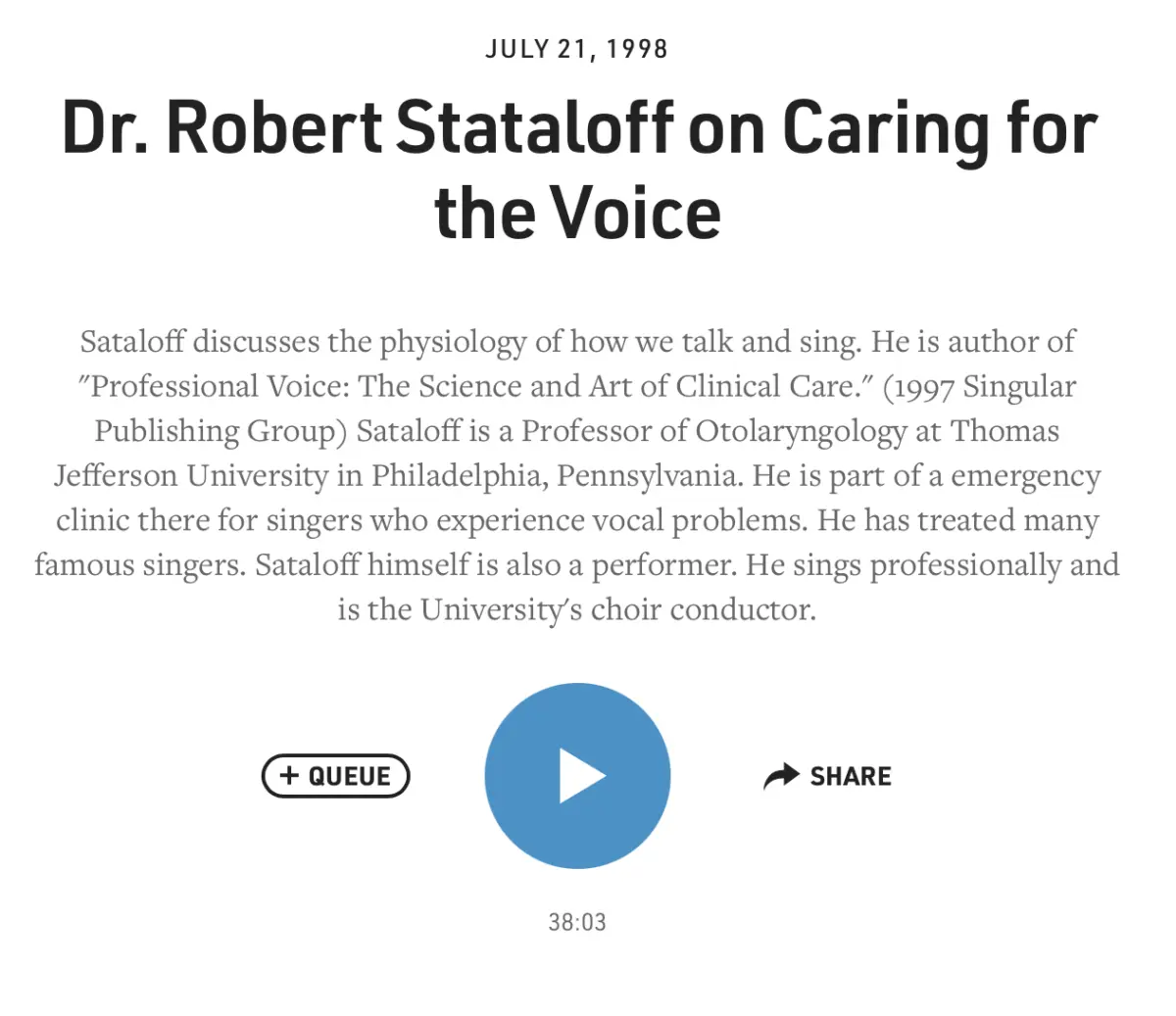
One such milestone occurred in 1998, when Dr. Robert Thayer Sataloff—a globally renowned otolaryngologist, surgeon, and vocal health authority—sat down with Gross for a comprehensive, deeply illuminating discussion on the human voice. Released to the public consciousness and preserved by archival historians like Ian DeNolfo, who highlighted the interaction in a retrospective piece for The Voice Foundation, this interview remains a masterclass in science communication.
At the intersection of art and medicine, the human voice is both a biological instrument and an emotional vector. Dr. Sataloff’s 1998 dialogue with Gross demystified the intricate mechanisms of vocal production, exploring everything from the fragility of the vocal cords to the physiological impacts of aging, pathology, and psychological stress. This retrospective analysis explores the anatomy of that historic conversation, tracing its profound legacy within voice science, contextualizing its metrics and clinical implications, and evaluating how Dr. Sataloff’s pioneering insights continue to shape modern otolaryngology and vocal pedagogy in the 21st century.
Detailed Chronology: The Genesis of a Broadcast Classic
To fully appreciate the impact of the 1998 Fresh Air interview, one must understand both the institutional trajectory of the program at the close of the 20th century and Dr. Sataloff’s rapidly ascending stature in the medical community.
The Cultural Landscape of 1998
By 1998, NPR’s Fresh Air had successfully transitioned from its regional roots in Philadelphia to become a nationally syndicated powerhouse. Terry Gross had honed her signature interviewing style: an exquisite blend of exhaustive research, soft-spoken yet incisive questioning, and an uncanny ability to translate complex, esoteric subjects into compelling radio.
Simultaneously, the late 1990s marked a period of rapid technological and medical innovation. The fields of laryngology and voice science were experiencing a renaissance, shifting from rudimentary treatments for acute hoarseness to sophisticated, microscopic surgical interventions and multidisciplinary care teams that united speech-language pathologists, vocal coaches, and specialized surgeons.
Enter Dr. Robert Thayer Sataloff
Dr. Robert Thayer Sataloff was—and remains—a titan in this specialized field. Serving as a professor, chairman, and prolific author, Sataloff dedicated his professional life to the diagnosis and treatment of professional voice users: opera singers, Broadway performers, politicians, trial lawyers, and broadcasters whose livelihoods depend on vocal endurance and precision.
When Dr. Sataloff entered the Fresh Air studio in 1998, the public perception of vocal health was largely reactive. Singers went to the doctor only when they lost their voices; public speakers accepted hoarseness as an occupational hazard. The interview served as an unprecedented public forum to reframe the voice not as an immutable gift, but as an athletic organ requiring rigorous care, scientific understanding, and preventive maintenance.

The Arc of the Conversation
During the broadcast, Gross guided Dr. Sataloff through a carefully structured exploration of vocal mechanics:
- The Physical Reality: Sataloff explained the rapid, microscopic oscillations of the vocal folds, painting a vivid mental picture for listeners of two muscular ribbons vibrating hundreds of times per second within the larynx.
- Pathology and Abuse: The discussion detailed how nodules, polyps, and hemorrhages form due to vocal misuse, establishing a clear link between mechanical stress and tissue damage.
- The Mind-Voice Connection: Sataloff illuminated how psychological anxiety, adrenaline, and emotional states instantaneously alter vocal tract tension and resonance.
- The Aging Voice: The conversation addressed presbylaryngis—the natural structural aging of the larynx—and debunked fatalistic myths about inevitable vocal decline in older adults.
Supporting Context & Metrics: The Science of Sound and Surgery
To contextualize Dr. Sataloff’s 1998 broadcasted insights, it is vital to examine the quantitative and qualitative metrics that govern human voice production and clinical otolaryngology.
The Physics of Vocal Fold Oscillation
The human voice is generated through the myoelastic-aerodynamic theory of phonation. Air expelled from the lungs creates subglottal pressure beneath the adducted vocal folds. When this pressure overcomes the elastic resistance of the folds, they are blown apart, releasing a puff of air. The Bernoulli effect, combined with the tissue’s natural elasticity, snaps the folds back together.
- Frequency Metrics: During normal conversational speech, a biological male typically speaks at a fundamental frequency ($F_0$) ranging from 85 Hz to 180 Hz, while a biological female speaks between 165 Hz and 255 Hz. Trained opera singers, however, can span massive ranges; sopranos routinely ascend beyond 1,000 Hz (C6 and above), while professional bass singers can descend below 80 Hz.
- Vibration Rates: To produce a high C (approximately 1,046.5 Hz), the vocal folds must open and close approximately 1,046 times every single second. The microscopic precision required to execute this without shearing delicate mucosal tissue is one of the most astonishing feats of human physiology.
Clinical Metrics in Laryngology
Dr. Sataloff’s work heavily emphasized objective, diagnostic measurement over subjective guesswork. Modern voice clinics utilize tools that were emerging or being refined during the late 1990s:
| Diagnostic Tool | Measurement Metric | Clinical Purpose |
|---|---|---|
| Stroboscopy | Mucosal wave propagation, symmetry, and glottal closure | Visualizing the vibratory pattern of the vocal folds in apparent slow motion. |
| Acoustic Analysis | Jitter (frequency perturbation) and Shimmer (amplitude perturbation) | Quantifying the stability and micro-instability of voice production. |
| Aerodynamic Testing | Airflow rate, subglottal pressure, and laryngeal resistance | Assessing the efficiency of valving air through the glottis. |
| Electroglottography (EGG) | Contact quotient of the vocal folds | Measuring the relative surface area of contact between vocal folds over time. |
The Economic and Occupational Impact
The insights shared by Dr. Sataloff underscored a stark economic reality: for professional voice users, a vocal injury is not merely a medical inconvenience; it is a catastrophic career interruption. Voice disorders affect approximately 3% to 9% of the general population at any given time, but prevalence spikes dramatically among occupational voice users—teachers, telemarketers, fitness instructors, and performing artists.
By educating the public on vocal hygiene, hydration, and pacing via mainstream media platforms like Fresh Air, pioneers like Sataloff helped mitigate preventable occupational injuries, saving millions of dollars in lost wages and medical interventions.
Official Statements and Archival Significance
The preservation of the 1998 interview through platforms like the Fresh Air Archive and its promotion by institutions such as The Voice Foundation highlights a growing recognition of broadcast journalism as a primary historical source for medical history.
In discussions surrounding the archiving of historical science media, cultural historians note that interviews with medical luminaries serve a dual purpose. First, they democratize specialized knowledge, translating complex otorhinolaryngological concepts into accessible vernacular. Second, they capture the philosophical evolution of medicine—documenting the exact moment when clinical practice began shifting toward holistic, multidisciplinary patient care.

Ian DeNolfo, writing for The Voice Foundation in January 2023 when revisiting the archival link, emphasized the timeless nature of Dr. Sataloff’s advice. While imaging technology—such as high-speed digital cinematography and advanced narrow-band imaging—has advanced exponentially since 1998, the fundamental truths articulated by Sataloff regarding vocal stewardship remain immutable.
"The human voice is our most intimate instrument," experts in the field frequently echo, reflecting the ethos championed by Sataloff. "To understand it is to understand the intersection of biology, psychology, and art."
Future Outlook: The Legacy of Voice Science in the 21st Century
As we look toward the future of laryngology and vocal health, the foundational principles articulated by Dr. Robert Thayer Sataloff in his 1998 interview with Terry Gross continue to ripple through modern science and medicine.
Technological Horizons
The 21st-century voice clinic bears little resemblance to the practice environments of the late 20th century, yet the philosophical framework remains anchored in Sataloff’s teachings. Today, researchers are exploring regenerative medicine to heal scarred vocal folds. Stem cell therapy, tissue-engineered biocompatible scaffolds, and office-based injection augmentation using novel biomaterials are transforming the management of vocal fold scarring and atrophy—conditions that were once considered permanent career-enders.
Furthermore, artificial intelligence (AI) and machine learning are revolutionizing voice diagnostics. Algorithms can now analyze acoustic recordings for subtle markers of laryngeal pathology, neurological disorders (such as early-stage Parkinson’s disease or ALS), and emotional distress long before overt clinical symptoms manifest.
The Expansion of Multidisciplinary Care
Perhaps Dr. Sataloff’s most enduring legacy is the championing of the voice team. The model of care that integrates otolaryngologists, speech-language pathologists, singing voice specialists, and voice scientists—once a revolutionary concept—is now the gold standard worldwide. Educational institutions and performing arts academies increasingly incorporate vocal health education directly into their curricula, ensuring that the next generation of speakers and singers approach their craft with scientific awareness and preventive discipline.
Conclusion
The rediscovery and celebration of Dr. Robert Thayer Sataloff’s 1998 Fresh Air interview with Terry Gross—as spotlighted by archival projects—is more than a nostalgic nod to late-90s public radio. It is a vital reminder of the power of accessible science communication. By bridging the gap between the operating room and the living room, Sataloff and Gross created an enduring educational artifact. As voice science marches boldly into an era of regenerative medicine and AI diagnostics, the core tenets of that historic conversation endure: respect the fragility of the human instrument, understand its marvelous mechanics, and treat the voice with the scientific rigor and artistic reverence it so richly deserves.