
Executive Overview
Franz Joseph Haydn’s 1779 azione teatrale, L’isola disabitata, occupies a fascinating yet frequently overlooked corner of operatic history. Running for a remarkably compact eighty minutes, the piece stands as a uniquely concise chamber opera that defies the bloated proportions often associated with late-eighteenth-century theatrical works. Recently, the esteemed Orchestra of the Eighteenth Century brought this rare gem to the stage of the Oldenburg State Theater, delivering a production that fully embraced the opera’s inherent brevity through a stripped-back, minimalist aesthetic.
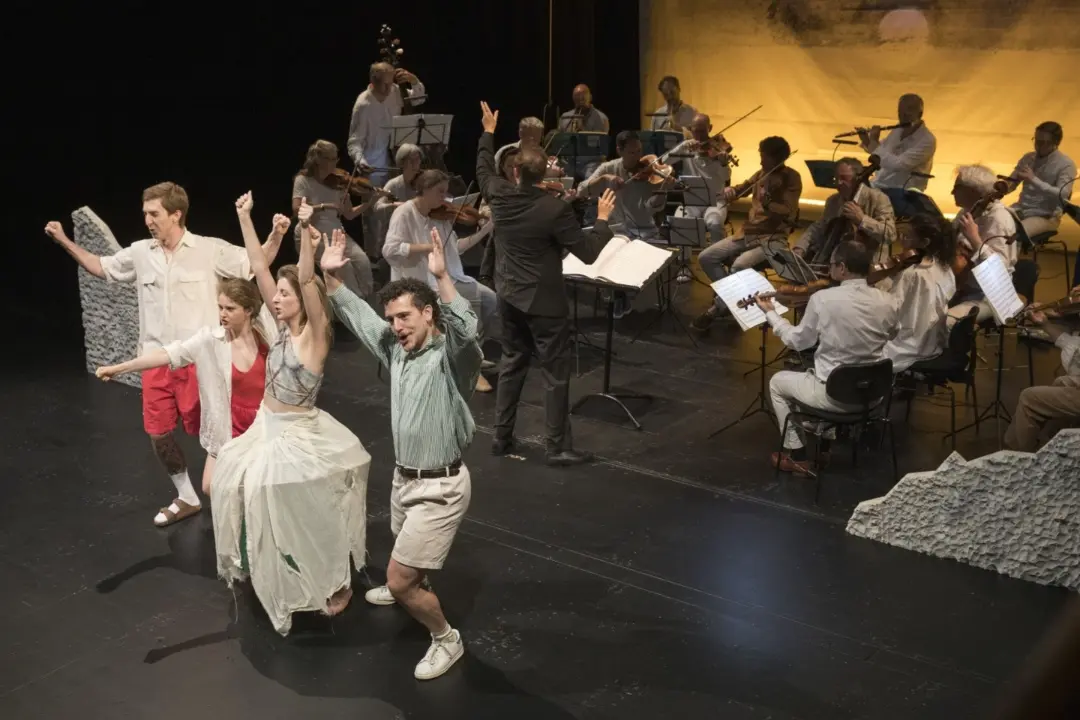
Under the baton and musical direction of Benjamin Perry Wenzelberg, the production sought to marry Haydn’s refined instrumental writing with a clean, modern visual vocabulary. The resulting staging relied heavily on atmospheric lighting, stark textures, and an intimate spatial arrangement that positioned the orchestra at the absolute center of the action. By pushing the singers downstage and limiting the physical set pieces to a pair of abstract artificial rocks and a dynamic, Turner-esque backdrop, the creative team focused the audience’s attention squarely on the psychological nuances of the libretto.
Yet, as with any revival of a lesser-known classical score, the production offered a complex tapestry of triumphs and vulnerabilities. While the cast—featuring Hannah Gries, Sharon Tadmor, Peter O’Reilly, and Michał Karski—brought distinct characterizations and palpable energy to their respective roles, the musical execution and dramaturgical pacing occasionally encountered friction. This comprehensive review examines the architectural design, vocal performances, orchestral execution, and theatrical implications of Oldenburg’s L’isola disabitata, offering a granular look at how a master of the classical style translates to the contemporary European stage.
Detailed Chronology and Production Mechanics
The Overture and Visual Architecture
The performance commenced with Haydn’s roughly seven-minute Sinfonia, a substantial orchestral introduction that establishes a mood of brooding, tempestuous isolation. At the Oldenburg State Theater, this overture served as a living canvas. A simple, textured grey backdrop was manually raised during the musical progression, coming alive as a sophisticated array of lighting cues cast shifting hues across the fabric. Visually, the canvas evoked the turbulent, sublime sea landscapes of J. M. W. Turner, instantly framing the psychological weather of the characters.
However, this extended instrumental opening also exposed an early dramaturgical hurdle. For an opera spanning a mere eighty minutes, a seven-minute opening orchestral movement without stage action creates an imbalance. Apart from the manual manipulation of the background curtain, the staging offered little else during the Sinfonia, rendering the exposition somewhat uninspired. Furthermore, while the lighting design successfully established a moody atmosphere, the static nature of the seascape curtain occasionally felt too fixed for its own good, lacking the dynamic evolution required to sustain visual engagement over the duration of the work.
Spatial Dynamics and Mise-en-Scène
The spatial configuration of the production was one of its boldest choices. The Orchestra of the Eighteenth Century was positioned directly in the center of the stage, effectively splitting the theatrical space and forcing the vocalists to perform almost exclusively downstage. This hyper-intimate arrangement brought the singers into exceptionally close proximity to the audience, heightening the chamber music qualities of the piece.
To signify the desolate shoreline mandated by the libretto, two artificial rocks were placed on the far left and right extremes of the stage. These minimalist props served a dual purpose: they anchored the geographical setting and provided a physical surface for the character of Costanza to enact her harrowing, painstakingly carved inscriptions of despair. By eschewing heavy, realistic scenery, the production prioritized emotional truth over literal illustration, setting a tone of austere elegance that mirrored the economy of Haydn’s score.
Vocal Performances and Character Interpretations
Hannah Gries as Costanza: A Portrait of Worn Despair
In the lead role, soprano Hannah Gries stepped onto the stage as a deeply troubled, weathered Costanza. Opening the performance in a tattered crinoline skirt and draped in a worn canvas cloak stamped with the stark word “abbandonata,” she presented an immediate, striking image of profound sorrow. Her physical vocabulary—characterized by hesitant, weary steps—directly mirrored a woman who had spent years crushed under the weight of isolation and emotional devastation.
Gries’s dramatic commitment was total, effectively conveying the internal anguish of a character teetering on the edge of madness. Yet, this intense psychological exposure also laid bare certain vocal vulnerabilities. Under the intense acoustic scrutiny of the downstage placement, her tone occasionally required greater breath support to fill the theater space, and her upper register leaned toward a slight strain during moments of heightened emotional intensity.
Despite these technical hurdles, the production offered a wonderfully refreshing subversion of operatic convention during one of Costanza’s most pivotal moments. In the original libretto by Metastasio, Costanza is expected to faint dramatically upon catching sight of her long-lost husband, Gernando. Instead, director and staging choices directed Gries to freeze entirely in place, acting like a living statue. This sudden, absolute physical paralysis left the incoming men staring at her in utter confusion, injecting a brilliant stroke of Haydn-esque humor directly into what could have been a standard, predictable dramatic cliché.
Sharon Tadmor as Silvia: Untamed Freedom and Awakening Youth
In vibrant, striking contrast to her sister Costanza’s heavy gloom, coloratura soprano Sharon Tadmor infused the production with a bright wave of youthful, untamed energy as Silvia. Stepping onto the stage clad in a vivid red swimsuit, Tadmor immediately shattered the gloomy ambiance of the island, projecting a sense of boundless freedom and unvarnished curiosity.
Tadmor approached her solitary island life with a delightfully fresh perspective, remaining genuinely and comically bewildered by her sister’s persistent melancholy. Later, when she unexpectedly encountered the two newly arrived men on the shore, her performance captured a brilliant psychological blend of raw curiosity and nervous tension, executed with fearless exuberance.
The absolute musical highlight of the evening arrived with Silvia’s awakening to first love upon meeting Enrico. Supported by the crisp, lively playing of the ensemble, Tadmor captured the awkward, jittery charm of a young heart discovering unfamiliar passions for the very first time. Her vocal timbre was joyfully pure, natural, and refreshingly unpretentious, yet it retained an impressive, acrobatic agility during her demanding coloratura passages.
While her portrayal of a girl entirely unversed in the ways of the world was exceptionally convincing, her performance could have scaled even greater heights with more judicious breath control during the aria "Come il vapor s’accende." Additionally, her choice to deliberately slow the tempo significantly during a series of unusually low vocal lines for a soprano occasionally disrupted the forward momentum of the musical phrase.
Peter O’Reilly and Michał Karski: Modern Voyagers and Devoted Allies
The arrival of the male contingent injected a distinctly different dynamic into the dramatic ecosystem of the island. Tenor Peter O’Reilly (Gernando) and bass-baritone Michał Karski (Enrico) made an immediate, memorable impression upon striding onto the isolated shore dressed in contemporary holiday clothing and sunglasses. This subtle anachronism underscored the timelessness of the human themes at play while establishing an instant, believable chemistry that marked them clearly as devoted, lifelong friends.
Karski’s vocal production as Enrico was remarkably solid, confident, and inherently masculine. He maintained a calm, steady presence throughout the evening, offering a grounded stage persona that served as Gernando’s vital emotional anchor during his worst moments of crisis. Karski’s tonal security and phrasing provided a sturdy architectural pillar for the ensemble numbers.
Meanwhile, O’Reilly shouldered the more complex dramatic arc of Gernando with admirable sincerity. He successfully charted the character’s volatile emotional progression: beginning with unwavering loyalty, plunging into sheer, guttural horror upon reading Costanza’s carved message on the rock, and finally rising to an explosion of overwhelming jubilation as the two long-separated lovers were at last reconciled.
Supporting Context & Metrics
To fully appreciate the scope of this production, it is helpful to examine the historical and logistical metrics surrounding Haydn’s L’isola disabitata.
| Production Metric / Detail | Description |
|---|---|
| Composer | Franz Joseph Haydn |
| Librettist | Pietro Metastasio |
| Year of Composition | 1779 |
| Genre | Azione teatrale / Chamber Opera |
| Runtime | Approximately 80 minutes (No intermission) |
| Ensemble | Orchestra of the Eighteenth Century |
| Conductor | Benjamin Perry Wenzelberg |
| Primary Venue | Oldenburg State Theater |
| Cast Principals | Hannah Gries (Costanza), Sharon Tadmor (Silvia), Peter O’Reilly (Gernando), Michał Karski (Enrico) |
Historically, L’isola disabitata was composed for the private theater of Eszterháza, tailored specifically for the intimate acoustics of a courtly audience rather than a cavernous public opera house. This historical context makes the Oldenburg State Theater’s decision to utilize a minimalist, downstage-focused configuration not merely a modern directorial whim, but an authentic nod to the work’s chamber origins. The eighty-minute continuous runtime demands an economic storytelling style that leaves little room for ornamental indulgence—a challenge that the Oldenburg creative team met with mixed, yet deeply engaging, results.
Official Statements and Artistic Vision
While formal press releases from the Oldenburg State Theater emphasized the democratization of space and the rediscovery of Haydn’s theatricality, the artistic choices on stage spoke volumes about the contemporary approach to classical masterworks.
Directorial notes and rehearsal insights shared by the production team highlighted an intentional desire to strip away the historical dust often clinging to eighteenth-century partition scores. By placing the Orchestra of the Eighteenth Century dead-center, the production effectively democratized the acoustic space, making the instrumentalists active participants in the physical mise-en-scène rather than hidden accompanists tucked away in an orchestra pit.
Conductor Benjamin Perry Wenzelberg’s approach was rooted in stylistic clarity, striving to maintain the refined elegance and relaxed intimacy essential for a chamber opera of this scale. In statements regarding the musical preparation, the ensemble stressed the importance of transparency—allowing every strand of Haydn’s counterpoint to breathe without the oppressive weight of nineteenth-century romanticism. However, as critics noted, this pursuit of relaxed intimacy occasionally bled into a lack of rhythmic urgency, suggesting that future iterations of this interpretive approach might benefit from a sharper, more driving momentum between musical numbers.
Future Outlook and Critical Legacy
The revival of L’isola disabitata at the Oldenburg State Theater serves as a vital case study in the modern programming of eighteenth-century rarities. As major and regional opera houses alike grapple with declining audience attention spans and the economic realities of large-scale productions, compact masterworks like Haydn’s 1779 gem offer a viable, artistically rich path forward.
The production proved that audiences are more than willing to engage with unfamiliar repertoire, provided the theatrical framing is intellectually honest and visually cohesive. The daring choice to place the orchestra center-stage, combined with the striking juxtaposition of Gries’s tragic, canvas-wrapped Costanza and Tadmor’s sun-drenched, red-swimsuited Silvia, created a vibrant dialectic between despair and renewal.
Looking ahead, this staging leaves important takeaways for future mountings of Haydn’s theatrical works. Directors must remain hyper-vigilant regarding pacing, particularly during extended instrumental introductions like the opening Sinfonia, where visual stagnation can threaten to derail audience engagement before a single sung note is uttered. Similarly, vocalists tackling these demanding roles must balance deep psychological commitment with the pristine breath control and vocal support required by downstage, un-amplified acoustic environments.
Ultimately, despite minor dramaturgical and musical friction—such as conservative tempi transitions and occasional vocal strain—the Oldenburg production remains a lighthearted, visually clean, and emotionally sincere triumph. By treating Haydn’s compact score with profound affection and fearless theatrical imagination, the Orchestra of the Eighteenth Century and the Oldenburg State Theater succeeded in transforming a forgotten theatrical experiment into a genuinely joyful, memorable evening of music theater.