
(Photo Credit: G. Antonoglou)
Executive Overview
Over the past decade, New York City’s classical music landscape has experienced a vibrant transformation, catalyzed by the regular arrival of major international opera companies making their formal debuts. These cultural delegations do more than simply showcase foreign repertoires; they serve as communal touchstones, forging deep bonds within local diaspora communities and fostering a rich, multi-dimensional cultural exchange. While institutions like Madrid’s Teatro Real and the Hungarian State Opera have celebrated landmark New York engagements in recent seasons, October 15, 2026, marked a particularly historic chapter in this ongoing cross-cultural dialogue.
On a single, electric autumn night—coinciding with the Teatro Real’s return to the city at David Geffen Hall—the Greek National Opera (GNO) made its long-awaited, formal New York debut at the iconic Carnegie Hall.
Years in the making, the debut was originally slated for 2019 before the global COVID-19 pandemic upended institutional planning worldwide. The intervening years forced a profound reassessment of artistic identity, resulting in a meticulously curated program that placed Greek composers and the literary titan Nikos Kazantzakis at the absolute center of the cultural narrative. Under the assured, minimalist baton of maestro Vassilis Christopoulos, the GNO Orchestra, alongside an extraordinary roster of soloists including soprano Maria Kostraki and celebrated mezzo-soprano Anita Rachvelishvili, delivered a performance that was at once intensely personal and monumentally celebratory.
Despite minor logistical friction, programmatic oversights, and structural stage delays, the evening emerged as a triumph of storytelling, cultural pride, and artistic resilience. It was an immersive journey into the Mediterranean soul, reminding a packed Carnegie Hall audience of the enduring potency of Greek art.
Detailed Chronology: A Night of Mythos and Music
The Literary Catalyst: Honoring Nikos Kazantzakis
To understand the emotional and structural arc of the GNO’s Carnegie Hall program, one must look to its literary muse. Nikos Kazantzakis (1883–1957) stands as one of the most towering figures in modern Greek literature. Masterpieces such as Zorba the Greek, Captain Michalis, and The Last Temptation of Christ transcended their regional origins to become universal touchstones of the human condition. Kazantzakis’s fierce existentialism, deep spiritual questioning, and celebration of the untamed Mediterranean spirit have inspired generations of Greek composers. On October 15, 2026, it was precisely this lineage of creative inspiration that dictated the evening’s sonic trajectory.
Part I: Orchestral Power and the Mediterranean Tide
The evening commenced with the Orchestra of the Greek National Opera, led by Vassilis Christopoulos, occupying the forefront of the stage for a compelling first half. They plunged the audience immediately into the Cretan Feast by legendary conductor Dimitri Mitropoulos, presented in an orchestral arrangement by Nikos Skalkottas. Conceived in a robust sonata form, the piece functioned as an immediate statement of intent. It showcased the orchestra’s physical muscularity, razor-sharp cohesion, and unified sense of purpose.
This opening statement established a cohesive, unbreakable thread that carried through the first half of the concert:
- Series I, No. 2 (Cretikos) by Nikos Skalkottas: A dance bearing character and execution as potent as its predecessor.
- Series I, No. 5 (Cretikos – “I Enjoy No Other Dance”): A rambunctious, wildly contrasting movement defined by an improvisatory nature. The music swung between ecstatic euphoria and pastoral calm, seamlessly layering intricate instrumental solos throughout.
- Series II, No. 3 (Cretikos – “Early at Dawn I Will Rise”): A relaxed, deeply evocative transition that prepared the audience for the narrative’s emotional peak.
The orchestral first half culminated in Giorgos Koumendakis’s Amor Fati. Despite busy, dissonant wind writing that occasionally overwhelmed the violin solo—a rare moment of sonic imbalance likely baked into the orchestration itself—the piece was profoundly meditative and soothing. Listening to Amor Fati was akin to experiencing the Mediterranean Sea: an endless succession of ebbs and flows, punctuated by episodic eruptions resembling crashing waves. The work’s deliberate repetition and seemingly loose formal structure reinforced this elemental association. Though expansive in duration, its cumulative hypnotic effect was undeniable, drawing a rapturous response from the hall as the house lights dimmed for intermission.
Part II: Vocal Intimacy and the Hadjidakis Enclave
Following the intermission, the stage configuration shifted to accommodate the vocalists, beginning with selections from Manos Hadjidakis’s Captain Michalis—a suite for small ensemble and vocalist exploring narrative episodes from Kazantzakis’s acclaimed novel.
(Note: Initial program materials provided to attendees regrettably omitted crucial context and lyric translations for both the Hadjidakis and concluding Theodorakis sets. While the GNO press team subsequently supplied these materials, the initial oversight slightly hindered the audience’s ability to deeply contextualize the performance in real-time.)
Taking the stage alongside soprano Maria Kostraki, the Manos Hadjidakis Ensemble utilized amplification to showcase a soundscape best described as otherworldly. The instrumentation featured a rare fusion of harpsichord, violin, cello, double bass, and an array of guitars drawn from diverse historical and cultural traditions. The conversational interplay among these instruments was endlessly inventive. In one striking sequence, guitars and harpsichord traded motifs in a four-part reprise. Later, the hall lights dimmed to a solitary spotlight focusing on two guitarists engaged in a delicate, whispered dialogue. Elsewhere, the violin and cello combined for lush lyricism, while the double bass was granted subtle, elegant prominence.
At the emotional center of this segment was soprano Maria Kostraki, who delivered an impassioned, masterclass reading. Making her entrance in the second movement, "Where is God," she spun a soaring, luminous melody. Given the intimate nature of the scoring, the vocal line frequently resided in a surprisingly low tessitura for a soprano. Yet, Kostraki sculpted every phrase with supreme elegance and unshakeable authority. In more rhythmic numbers like "The Evening The Night is Heavy," her diction and articulation were pristine; in subsequent dramatic passages, she communicated desperate yearning through pointed, accented phrasing. The Carnegie Hall audience responded with wild, prolonged applause.
The Logistical Bottleneck and Pacing Challenges
Following the sheer enchantment of the Hadjidakis set, the evening hit its sole major operational hurdle. The stage crew was tasked with dismantling the intimate ensemble, removing the harpsichord, and rebuilding the full orchestra for the final segment. This labor-intensive transition severely disrupted the concert’s momentum, prompting questions regarding optimal stage management.
Artistically, placing the Hadjidakis set at the conclusion of the first half—thereby utilizing the formal intermission for the stage reset—might have preserved momentum. However, doing so would have sacrificed the unbroken emotional and programmatic cohesion established by Koumendakis’s Amor Fati. While the production team worked diligently, the delay highlighted the unique logistical pressures placed on touring international ensembles working within historic American venues.
The Grand Finale: Theodorakis and the Spirit of Zorbas
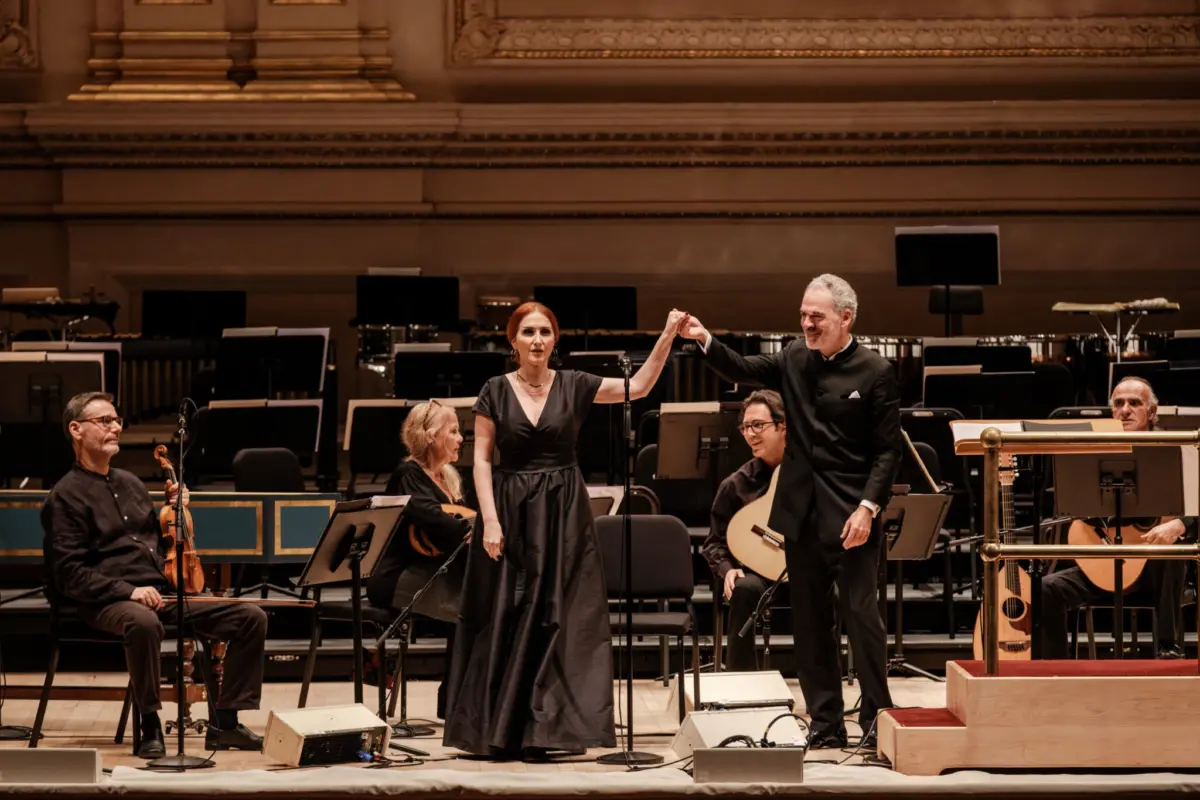
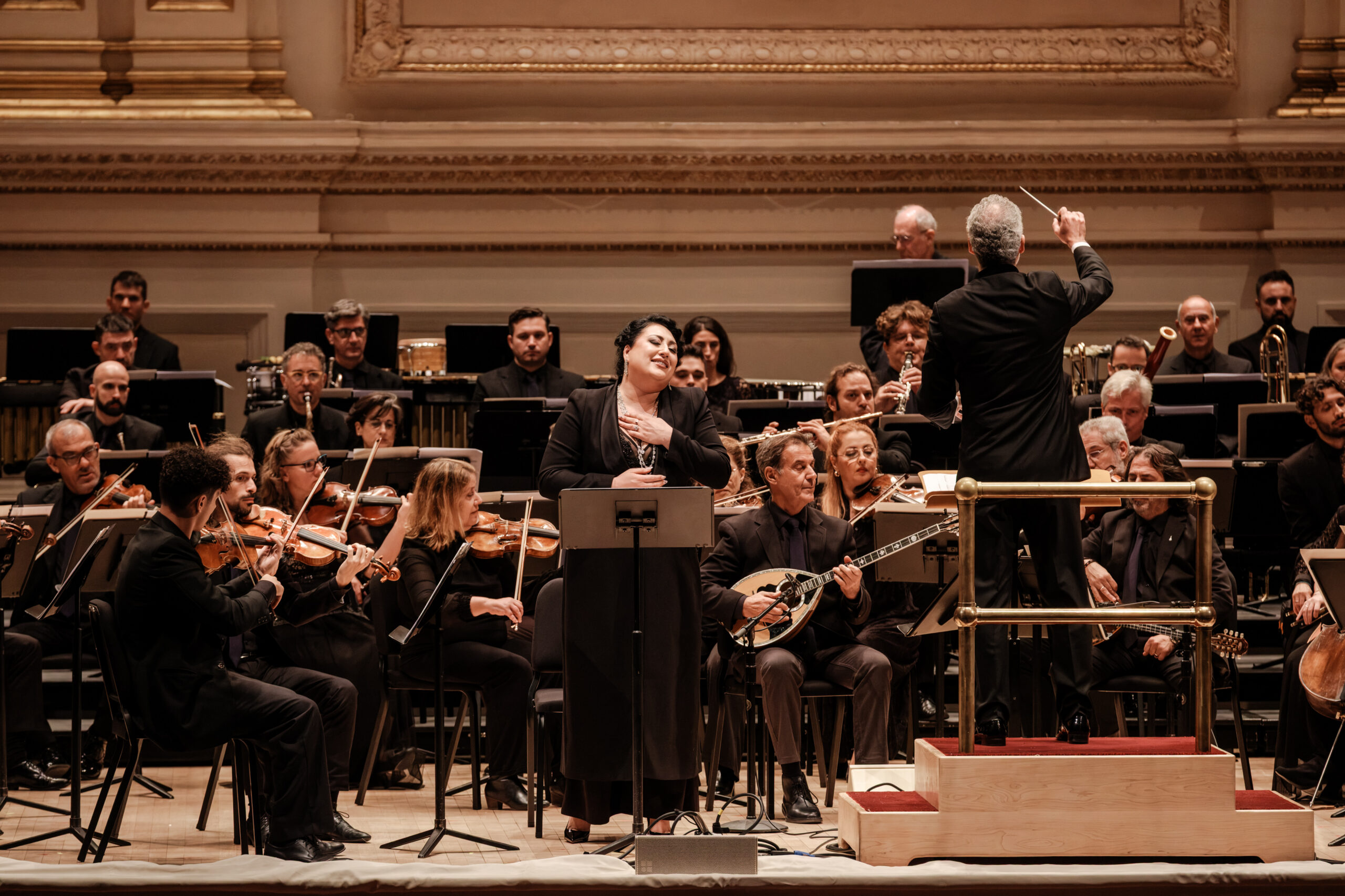
The evening swept toward its explosive conclusion with selections from Mikis Theodorakis’s Zorbas. The opening number erupted as a militaristic march, the orchestra striking the hall with fierce, rhythmic vigor. This momentum carried into the second movement before yielding to the third, which marked the return of acclaimed mezzo-soprano Anita Rachvelishvili to a New York stage following widely publicized vocal health challenges.
Much like Kostraki’s earlier work, Theodorakis’s score demanded a gentle, hushed vocal approach. However, Rachvelishvili faced a different acoustic challenge: navigating a massive, unamplified orchestra. In her opening number, "Odysseas Elytis," Rachvelishvili relied on secure, centered legato phrasing deeply rooted in her lower register, while maestro Christopoulos dynamically tailored the orchestra’s volume to protect her vocal line.
The duo achieved an even higher synergy in the subsequent "With the Morning Star," a piece requiring extreme dynamic restraint, where Rachvelishvili reduced her voice to a captivating, magnetic whisper.
The climax arrived with "Make Your Bed for Two," a raucous, life-affirming dance. Here, Rachvelishvili allowed her voice to blossom into the hall, a radiant smile gracing her face. Upon completing her vocal duties, she transitioned into a master of ceremonies role, encouraging the audience to clap along with the accelerating rhythm. The crowd enthusiastically complied, transforming the final movements into an interactive celebration.
The infectious energy proved so potent that ushers were forced to patrol the aisles, gently reminding exuberant audience members to stow their cell phones—a charmingly human postscript to an evening that routinely blurred the boundary between performer and spectator.
Supporting Context & Metrics
To appreciate the scale and significance of the Greek National Opera’s Carnegie Hall debut, one must examine the logistical and institutional parameters of the event:
- Date of Performance: October 15, 2026
- Venue: Carnegie Hall (Stern Auditorium / Perelman Stage), New York City
- Coinciding Event: Teatro Real (Madrid) performance at David Geffen Hall, marking a historic night of dual major European opera company debuts in Manhattan.
- Original Planning Year: 2019 (delayed seven years due to global pandemic disruptions).
- Primary Musical Forces:
- The Orchestra of the Greek National Opera
- The Manos Hadjidakis Ensemble
- Principal Artistic Leadership: Vassilis Christopoulos (Conductor / Music Director)
- Featured Soloists:
- Maria Kostraki (Soprano)
- Anita Rachvelishvili (Mezzo-Soprano)
- Featured Composers: Dimitri Mitropoulos, Nikos Skalkottas, Giorgos Koumendakis, Manos Hadjidakis, and Mikis Theodorakis.
- Literary Inspiration: Nikos Kazantzakis (1883–1957)
Official Statements & Artistic Vision
While formal press conferences were limited during the fast-paced debut tour, programmatic notes and statements from the GNO artistic administration underscored the profound mission behind the Carnegie Hall engagement.
General Artistic Director Giorgos Koumendakis previously emphasized the imperative of exporting contemporary Greek artistic dialogue to global capitals:
"Our mission is not merely to mirror the classical European canon, but to articulate our own distinct cultural heritage through the universal language of symphonic and operatic performance. Bringing the GNO to Carnegie Hall is a testament to the resilience of our artists and the enduring relevance of our literary giants like Kazantzakis."
Conductor Vassilis Christopoulos reflected on his minimalist podium philosophy during post-concert reflections, noting the deep mutual trust established between the conductor and the orchestral musicians:
"When you lead an ensemble with the cultural weight of the Greek National Opera, your primary job is to create the structural space for truth to emerge. The musicians carry the Mediterranean pulse within them; my role is simply to listen, guide, and let the music breathe on its own terms."
Future Outlook: A New Chapter for Hellenic Opera Abroad
The Greek National Opera’s triumphant Carnegie Hall debut signals a watershed moment for the institution’s international footprint. By successfully navigating post-pandemic rescheduling hurdles, artistic pivots, and complex logistical demands, the GNO has firmly established itself as a vital ambassador of contemporary Hellenic culture on the global stage.
Looking ahead, industry analysts and opera executives are watching closely to see how international institutions leverage these high-profile North American debuts. The resounding success of the Hadjidakis and Theodorakis showcases proves that American audiences are eager for authentic, culturally specific programming that moves beyond traditional Italian and German repertoire.
For the GNO, this debut is not a culmination, but a springboard. Plans are already underway to expand international touring models, deepen collaborative exchanges with North American performing arts centers, and bring newly commissioned Hellenic works to global audiences. As maestro Christopoulos lowered his baton to the final, echoing applause in Carnegie Hall, one thing became abundantly clear: the voice of the Greek National Opera has arrived in New York, and its resonance will be felt for years to come.