
Executive Overview
In an era where houses of worship strive to foster deeply connected, inclusive, and welcoming communities, one invisible barrier frequently isolates members of the congregation: hearing loss. While modern sanctuary audio engineering has advanced dramatically, utilizing line arrays, sophisticated digital signal processing (DSP), and acoustically treated spaces, millions of individuals still struggle to fully comprehend spoken sermons, scripture readings, and musical lyrics. Ambient noise, reverberation, and distance from the sound source create acoustic hurdles that standard amplification alone simply cannot clear.
To solve this challenge, modern religious organizations are increasingly turning to Assistive Listening Systems (ALS). However, the successful integration of an ALS requires far more than merely purchasing and plugging in equipment. It demands a strategic, highly empathetic, and structured approach that encompasses congregation assessment, financial planning, comprehensive staff training, and proactive community outreach.
This report provides an authoritative, step-by-step framework for church leaders, AV directors, and facility managers looking to implement or upgrade an assistive listening infrastructure. By examining the essential phases—understanding demographic needs, evaluating technological options, preparing operational teams, and driving congregation-wide awareness—facilities can transform their worship experiences for those with hearing impairments, ensuring that the message of inclusion is not just preached, but genuinely practiced.
Detailed Chronology: The Four-Step Implementation Roadmap
Implementing an Assistive Listening System is a transformative project that touches every facet of a church’s ministry, from technical operations to guest services. To ensure maximum adoption and return on investment, organizations should follow a disciplined, chronologically sound implementation roadmap.
Phase 1: Assess and Understand Congregational Needs
Before a single dollar is allocated or a piece of hardware is unboxed, church leadership must accurately diagnose the specific acoustic challenges and hearing profiles of their community. Assumptions regarding who can and cannot hear during services can lead to misguided technology purchases.
The most effective diagnostic methodology is deploying a comprehensive congregational survey. This survey should be distributed broadly—via digital bulletins, email newsletters, and physical paper forms—to capture input from all demographics, particularly seniors and older adults. Key data points to collect include:
- Current Experience: How would congregants rate their ability to understand the spoken word and music during standard services?
- Device Utilization: Do members currently use hearing aids or cochlear implants?
- T-Coil Compatibility: Crucially, do these hearing devices feature telecoils (t-coils), which allow them to receive audio directly from induction loop systems or neck loops?
By aggregating this data, the AV team and leadership can quantify the exact scale of the need. For instance, if a high percentage of respondents utilize t-coil-equipped hearing aids, investing in an audio induction loop system may yield the highest satisfaction. Conversely, if a diverse demographic requires multi-language translation or discrete audio support without hearing aids, traditional RF (Radio Frequency) or Wi-Fi streaming receivers may be more appropriate.
Phase 2: Budgeting, Sourcing, and Technology Evaluation
Once the congregation’s specific needs are mapped out, the next phase involves evaluating the technological and financial landscape. Estimating the total cost of ownership—including transmitters, receivers, charging stations, signage, and installation labor—is critical for responsible stewardship of church funds.
Specialized AV integration partners, such as CCI Solutions, offer invaluable assistance during this phase, frequently providing free consultations to help ministries navigate budgeting complexities. Church boards must weigh the upfront capital expenditure against the long-term ministry impact. To offset these costs, many congregations incorporate ALS procurement into broader capital campaigns, leverage dedicated accessibility grants, or organize targeted fundraising initiatives supported by members who champion disability inclusion.
During this evaluation window, decision-makers must also review facility architecture. Large, historic sanctuaries with marble pillars and vaulted ceilings present unique acoustic challenges that dictate the type of assistive technology required, ensuring seamless integration without aesthetic disruption.
Phase 3: Operational Readiness and Staff Training
Even the most advanced Assistive Listening System will fail if the personnel operating it are unprepared. The success of an ALS relies heavily on the frontline staff and volunteers stationed at welcome desks, audio booths, and information kiosks.
These individuals serve as the organization’s "Assisted Listening Ambassadors." Comprehensive training sessions must be conducted prior to the system’s launch, ensuring that every volunteer understands:
- Device Operation: How to power on, adjust volume, and troubleshoot receivers.
- Hygienic Maintenance: Proper sanitization protocols for earpieces and neck loops between services.
- Distribution and Collection: A streamlined check-in and check-out procedure for physical receivers.
Furthermore, operational readiness requires proactive customer service. Volunteers should be trained to gently ask arriving guests if they would benefit from an assistive listening device, rather than waiting for guests to ask—a step that eliminates the social friction or embarrassment some individuals feel when requesting accommodations. To maintain operational consistency, facilities should keep a laminated, easily readable FAQ sheet at the distribution counter, addressing common questions about battery life, channel selection, and compatibility.
Phase 4: Cultivating Awareness and Community Outreach
An installed system that sits unused in a drawer represents a missed opportunity for ministry. The final, ongoing phase of the implementation timeline is driving robust awareness both inside the walls of the church and throughout the surrounding community.
Visibility is paramount. Conspicuous, universally recognized signage indicating the availability of Assisted Listening Devices (ALDs) must be placed at all primary entrances, guest services desks, and sanctuary doors. Additionally, ministries should utilize multi-channel communication strategies:

- Print and Digital Bulletins: Weekly reminders should be printed in service programs and displayed on pre-service digital slides.
- Live Training Moments: Consider hosting a brief, dedicated demonstration during a Sunday service or adult education hour, allowing congregants to test the technology firsthand and experience the acoustic clarity it provides.
- Community Advertising: Extend outreach beyond the active membership. Local retirement communities, senior centers, and local advocacy groups for the hard of hearing should be informed that the church offers accessible services. Many individuals abandon regular church attendance due to hearing fatigue; learning about a dedicated ALS can inspire them to return.
Supporting Context & Metrics: The Hidden Epidemic of Hearing Loss
To fully appreciate the urgency of implementing Assistive Listening Systems, one must examine the broader public health context of hearing loss and its direct impact on social and spiritual engagement.
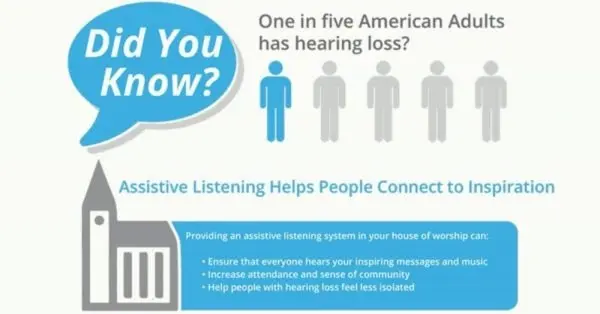
According to data from the World Health Organization (WHO) and the Centers for Disease Control and Prevention (CDC), hearing loss is one of the most prevalent chronic conditions affecting adults globally. In the United States alone, approximately 15% of American adults—representing roughly 37.5 million people—report some degree of trouble hearing. As the demographic curve bends toward an aging population, this number continues to scale upward.
| Demographic / Metric | Estimated Prevalence / Impact |
|---|---|
| U.S. Adults with Hearing Loss | ~37.5 million (approx. 15%) |
| Seniors (Ages 65–74) | Nearly 1 in 3 experience disabling hearing loss |
| Seniors (Ages 75+) | Nearly 1 in 2 experience significant hearing impairment |
| Social Isolation Risk | Unaddressed hearing loss increases the risk of depression, anxiety, and cognitive decline by up to 50% |
| Acoustic Environment Deficit | Average reverberation time in traditional churches exceeds speech intelligibility recommendations by 200–300% |
The spiritual implications of these statistics are profound. Humans are biologically and spiritually wired for community, fellowship, and shared storytelling. When an individual sits in a house of worship but can only perceive a muddy wash of reverberant sound, they experience a profound sense of isolation. Over time, this frustration leads many to quietly stop attending services altogether, severing vital ties to their faith community during times when they often need support the most.
Furthermore, architectural acoustics in modern sanctuaries frequently work against speech clarity. While large, expansive rooms create majestic visual aesthetics and reverberant spaces for choral music, they act as acoustic nightmares for the spoken word. Sound waves bounce off hard surfaces, creating overlapping echoes that merge into an unintelligible din for anyone with compromised hearing. Assistive Listening Systems bypass these environmental obstacles, delivering pristine, direct-from-the-soundboard audio straight to the listener’s ear.
Official Statements and Industry Insights
Industry leaders, accessibility advocates, and technical experts emphasize that providing assistive listening is no longer an optional luxury or an afterthought—it is a fundamental component of universal design and radical hospitality.
"Reaching out to those who feel disconnected from your community due to hearing loss is central to sharing the message of inclusion," notes the editorial team at Listen Technologies in their comprehensive House of Worship Assistive Listening Toolkit. "Genuinely compassionate service involves being aware of and caring for the needs of everyone, especially those dealing with impairments. Make sure they are able to hear the beauty and emotion of the spoken word in your church by providing them with the equipment they need to stay connected."
Accessibility consultants also point out that compliance with federal regulations, such as the Americans with Disabilities Act (ADA) in the United States, establishes minimum legal requirements for public assembly areas. However, houses of worship frequently transcend mere legal compliance. For religious organizations, the motivation is deeply theological: ensuring that no soul is unintentionally barred from hearing the Gospel message due to a physical impairment.
AV systems integrators echo this sentiment, stressing that the technology has evolved to become remarkably user-friendly and unobtrusive. Modern Wi-Fi-based systems allow congregants to stream pristine sanctuary audio directly to their personal smartphones using standard earbuds or Bluetooth-connected hearing aids, removing any lingering social stigma associated with wearing specialized receivers.
Future Outlook: The Next Generation of Acoustic Inclusion
Looking ahead, the landscape of assistive listening in houses of worship is poised for continuous technological evolution, driven by advancements in wireless transmission, artificial intelligence, and personal medical devices.
1. Integration of Personal Smart Devices (Bring Your Own Device – BYOD)
The proliferation of smartphones has fundamentally altered consumer expectations regarding accessibility. Future-forward churches are increasingly deploying IP-based audio streaming solutions that allow users to download a mobile application and listen to the service directly through their personal headphones or hearing aids. This minimizes the hardware management burden on church staff while offering a seamless, familiar user experience for tech-savvy seniors and younger generations alike.
2. AI-Driven Environmental Adaptation and Noise Cancellation
As artificial intelligence permeates audio engineering, future ALS architectures will likely incorporate smart algorithms capable of dynamically filtering out ambient HVAC noise, audience shuffling, and side chatter in real-time. This ensures that the listener receives an optimized, crystal-clear vocal stream tailored to their specific auditory profile.
3. Universal Adoption of Auracast™ Broadcast Audio
One of the most anticipated horizons in assistive listening is Bluetooth Auracast™. This emerging standard enables an audio transmitter—such as a church’s sound system—to broadcast high-quality audio simultaneously to an unlimited number of compatible audio receivers, including next-generation hearing aids, earbuds, and consumer headphones. Auracast™ promises to eliminate the need for separate, dedicated venue receivers entirely, making hearing accessibility as ubiquitous and frictionless as connecting to public Wi-Fi.
Conclusion
The integration of an Assistive Listening System is far more than a technical upgrade; it is a profound declaration of pastoral care. By systematically assessing congregational needs, investing in the appropriate technology, training dedicated volunteer ambassadors, and actively promoting accessibility, houses of worship can dismantle invisible walls and embrace every member of their flock.
For ministries seeking to deepen their impact, comprehensive resources—including sample surveys, signage templates, and implementation announcements—are readily available through specialized guides such as the Listen Technologies Church Assistive Listening Toolkit. By taking these decisive steps today, religious communities ensure that the transformative beauty, emotion, and power of the spoken word resonate in the hearts and ears of all who enter.