
Executive Overview
In an era defined by rapid technological advancements in sanctuary audio, visual media, and architectural acoustics, a significant segment of churchgoers remains systematically underserved: individuals experiencing hearing loss. For many congregants, Sunday worship services are marred by acoustic challenges, reverberation, and competing soundscapes that render the spoken word—and the emotional resonance of the service—difficult or impossible to comprehend.
Implementing an Assistive Listening System (ALS) is no longer merely an afterthought or a compliance-driven checkbox; it is a foundational element of radical hospitality and inclusive ministry. When houses of worship invest in robust listening technologies, they fundamentally transform the worship experience for seniors, the hard of hearing, and those transitioning into hearing care.
However, the acquisition and deployment of an ALS require far more than simply purchasing hardware off the shelf and plugging it into a soundboard. A successful rollout demands a calculated, multi-stage approach encompassing comprehensive congregation assessments, rigorous financial and technological planning, staff and volunteer mobilization, and ongoing community-wide communication.
This special report provides an authoritative, exhaustive framework for faith-based leadership teams, technical directors, and facility managers looking to bridge the acoustic divide. Drawing from industry best practices, acoustic integration standards, and insights from leading audio-visual solution providers like CCI Solutions and Listen Technologies, this article details the four critical pillars of ALS implementation: needs assessment, options evaluation, staff preparation, and awareness creation.
Detailed Chronology: The Four-Step Implementation Framework
To transition a house of worship from an acoustically challenging environment to a fully inclusive sanctuary, facility teams must follow a deliberate sequence of operational milestones. Rushing this process frequently results in wasted capital, underutilized equipment, and frustrated congregants.
Phase 1: Understand Your Needs (Data-Driven Discovery)
The foundational error many ministry teams make is assuming they already know the scope of hearing loss within their congregation. Demographics can be deceptive; hearing impairment does not exclusively affect the elderly. Noise-induced hearing loss, congenital conditions, and sudden sensorineural hearing loss impact individuals across all age brackets.
The most effective, methodologically sound approach to understanding your church’s unique acoustic landscape is to execute a congregation-wide survey. This instrument should be deployed digitally via church apps and email newsletters, as well as physically through printed inserts in Sunday bulletins.
Key data points to capture in this phase include:
- Subjective Service Experience: Ask respondents to rate their current ability to understand the sermon, scripture readings, and musical lyrics from various seating zones within the sanctuary.
- Assistive Device Utilization: Inquire whether congregants currently wear hearing aids, cochlear implants, or personal sound amplification products (PSAPs).
- Telecoil (T-Coil) Integration: Specifically ask if their hearing aids are equipped with telecoils—a vital hardware feature that allows devices to receive audio signals directly from induction loops or neck loops without the need for additional receivers.
By aggregating this data, the audio-visual (AV) team and church leadership can map "dead zones" within the room, quantify the exact volume of receivers needed, and determine whether an RF (Radio Frequency), IR (Infrared), Wi-Fi, or Audio Induction Loop system is the most appropriate technological fit.
Phase 2: Fully Understand Your Options (Financial and Technical Evaluation)
Once the congregation’s needs are clearly mapped, leadership must evaluate the technical and financial landscape. Assistive listening technology is not one-size-fits-all. Systems range from infrared radiators ideal for confidential spaces to wide-area radio frequency systems and hearing loop installations that integrate seamlessly with modern hearing aids.
Estimating the total cost of ownership involves looking beyond the initial hardware purchase line items. It includes installation labor, cabling, signage, charging stations, and ongoing maintenance. Because budgeting for capital improvements can stretch mid-sized and smaller ministries, houses of worship should leverage professional consulting services.
Industry partners, such as CCI Solutions, offer specialized assistance and complimentary consultations to help administrative boards navigate equipment selection, engineering specifications, and expense forecasting. Furthermore, churches should explore targeted fundraising campaigns, capital stewardship initiatives, or dedicated accessibility endowments specifically earmarked for inclusion ministries. Framing the purchase of an ALS as a spiritual and pastoral investment—rather than a mere line-item expense—fosters higher donor engagement and faster capital acquisition.
Phase 3: Prepare for Success (The Human Element and Operational Protocols)
The most advanced audio engineering in the world will fail if the human systems supporting it break down. The third phase of implementation focuses on operational readiness: training staff, AV technicians, and hospitality volunteers.
Think of your welcome team, ushers, and audio engineers as your "Assisted Listening Ambassadors." These individuals are the frontline touchpoints for users of the new technology. When a visitor or regular congregant requests an assistive listening device, the transaction must be smooth, respectful, and educational.

- Hands-On Training Protocols: Volunteers must undergo practical training sessions where they learn how to clean, store, charge, and operate the receivers. They should understand how to pair neck loops with hearing aid t-coils and how to troubleshoot minor connectivity issues on the fly.
- Clear Operational Check-Out Procedures: Establish a formalized check-out and check-in system at the welcome desk or audio booth to prevent loss or damage of expensive hardware.
- Embedded Support Resources: To reduce friction and anxiety for volunteers, keep a laminated, highly legible copy of Frequently Asked Questions (FAQs) posted directly at the distribution counter. This ensures that even rotating or substitute volunteers can answer basic user inquiries with confidence.
Phase 4: Create Awareness (Marketing Inclusion)
Building an inclusive environment requires proactive communication. An Assistive Listening System yields zero return on investment if the congregation does not know it exists. Launching an awareness campaign is vital to ensuring maximum utilization from day one.
- Universal Signage: Install clear, internationally recognized signage at all primary entrances, parking lot doors, and welcome centers indicating that Assisted Listening Devices are available, along with directional arrows pointing to the pick-up location.
- Print and Digital Prompts: Embed a permanent, recurring reminder in every Sunday bulletin, digital app notification, and pre-service multi-media slide loop.
- Dedicated Training Events: Consider hosting a special demonstration or live training session during a fellowship hour or mid-week gathering. Allowing seniors and hard-of-hearing individuals to test the technology in a low-pressure environment builds familiarity and trust.
- Outreach to the Surrounding Community: Broaden your perspective beyond the current membership rolls. Advertise your accessibility efforts to local senior centers, retirement communities, and audiologist clinics. Many individuals with hearing loss drop out of church attendance entirely because they assume traditional sanctuaries cannot accommodate their needs. Publicizing your ALS creates an immediate, welcoming pathway for them to return.
Supporting Context & Metrics: The Undeniable Need for Sanctuary Accessibility
To contextualize the urgency of implementing assistive listening technology, one must examine broader demographic and sociological metrics regarding hearing loss.
According to data compiled by the Hearing Loss Association of America (HLAA) and the World Health Organization (WHO):
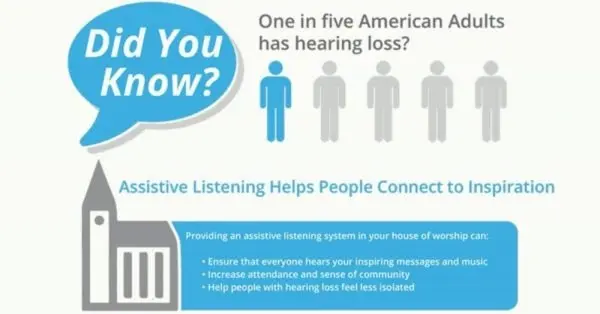
- Approximately 48 million Americans (one in five) experience some degree of hearing loss.
- By age 65, that statistic jumps to one in three individuals.
- Despite these staggering numbers, it is estimated that less than 20% of those who could benefit from a hearing aid actually use one, and an even smaller percentage utilize assistive listening accessories in public venues.
In a house of worship setting, the architectural dynamics—high ceilings, hard reflective surfaces, complex PA routing, and variable background noise—exacerbate these challenges. Traditional sound reinforcement simply amplifies overall volume; it does not improve the signal-to-noise ratio for a hearing-impaired listener.
An Assistive Listening System bypasses acoustic interference by transmitting the audio feed directly to the user’s ear or hearing device. By investing in this technology, churches directly combat isolation, depression, and spiritual disengagement—common side effects of age- or illness-related hearing impairment.
Official Statements: Industry Perspectives on Inclusive Worship
Technical integration experts and ministry advocates emphasize that acoustic accessibility is a core component of modern church stewardship.
"Reaching out to those who feel disconnected from your community due to hearing loss is central to sharing the message of inclusion," notes the advisory team at Listen Technologies. "Genuinely compassionate service involves being aware of and caring for the needs of everyone, especially those dealing with impairments. Make sure they are able to hear the beauty and emotion of the spoken word in your church by providing them with the equipment they need to stay connected."
AV engineering specialists consistently reiterate that the psychological barrier to entering a sanctuary is often higher than the physical barrier. When a church proactively signals its commitment to accessibility through visible signage and advanced listening infrastructure, it sends an unmistakable pastoral message: You belong here, and we have prepared a place for you.
Future Outlook: The Evolution of Sanctuary Accessibility
Looking ahead, the landscape of assistive listening is evolving rapidly in tandem with consumer electronics and hearing aid technology.
Future-proofing a church’s audio infrastructure means looking beyond traditional radio frequency packs. The rise of Bluetooth Low Energy (BLE) Audio and Auracast™ broadcast audio technology represents the next frontier in sanctuary accessibility. Auracast allows audio transmitters to broadcast crystal-clear, multi-channel sound directly to an unlimited number of compatible hearing aids, cochlear implants, and personal smartphones simultaneously, drastically reducing the need to manage and sanitize physical receivers.
As houses of worship transition toward these advanced protocols, the foundational steps outlined in this report remain unchanged. Technology is only as effective as the human systems surrounding it. Churches that begin today by assessing their congregation’s needs, budgeting thoughtfully, training their volunteer ambassadors, and aggressively marketing their accessibility features will be exceptionally well-positioned to adopt next-generation audio standards.
Resources for Further Action
For leadership teams ready to take the next step, comprehensive deployment toolkits are readily available. Facility directors can download the official Listen Technologies Church Assistive Listening Toolkit, which includes sample congregation surveys, printable signage templates, and bulletin announcements.
Does your worship facility currently meet the acoustic needs of every congregant? Contact your systems integrator today to evaluate how an upgraded Assistive Listening System can transform your ministry of inclusion.