
Executive Overview
In an era defined by rapid technological advancement in broadcast, projection, and acoustic design, the ultimate measure of a sanctuary’s hospitality remains profoundly foundational: Can every member of the congregation clearly hear the spoken word, the spoken prayer, and the resonant chords of worship? For millions of individuals navigating age-related hearing loss, tinnitus, or auditory processing disorders, attending a weekly service can often feel like an exercise in profound isolation. The architectural beauty of vaulted ceilings and historic sanctuaries, while visually breathtaking, frequently creates a subterranean acoustic nightmare characterized by reverberation, echo, and muddy sound reinforcement.
Addressing this silent barrier is no longer merely an optional amenity for progressive congregations; it is an urgent pastoral imperative and, increasingly, a legal and ethical necessity. Implementing an Assistive Listening System (ALS) transforms the worship experience from an exercise in frustration into an environment of seamless, immersive connection. However, the deployment of such technology cannot be treated as a simple "plug-and-play" retail transaction. To achieve true accessibility, church leadership, audio-visual (AV) technicians, and ministry volunteers must execute a deliberate, highly strategic rollout.
This special report provides an exhaustive, authoritative roadmap for houses of worship aiming to bridge the hearing divide. Drawing from industry standards, acoustic engineering insights, and practical frameworks provided by accessibility advocates and audio innovators like Listen Technologies and CCI Solutions, this article outlines a four-phased methodology for success: assessing congregational needs, navigating complex technological options, preparing operational teams for flawless execution, and cultivating widespread community awareness. By approaching inclusion with strategic rigor, faith communities can ensure that no soul is left straining to hear the message of grace.
Detailed Chronology: The Four-Step Implementation Roadmap
Successfully integrating an assistive listening system into an existing or newly constructed ministry environment requires a disciplined, chronological approach. Skipping steps—such as failing to survey the congregation or neglecting staff training—frequently leads to low device utilization, wasted capital expenditure, and continued alienation of the hard-of-hearing demographic. The following chronological framework details the lifecycle of a successful ALS implementation project.
Phase 1: Assess and Understand Congregational Needs
Before a single dollar is allocated toward hardware, church leadership must cultivate a granular understanding of the specific auditory challenges facing their community. Assumptions are the enemy of effective accessibility; leadership often radically underestimates the percentage of their congregation that struggles with hearing loss.
The most reliable, statistically valid method to uncover these needs is the deployment of a comprehensive congregational survey. This instrument should be distributed both digitally (via email newsletters and church apps) and physically (inserted into Sunday bulletins and made available at welcome desks).
Key data points to gather during this phase include:
- Subjective Service Experience: Ask respondents to rate the clarity of the audio during various portions of the service (e.g., spoken sermons, whispered prayers, choir performances, congregational singing).
- Hearing Aid Utilization: Determine how many congregants currently wear hearing aids or cochlear implants.
- T-Coil Compatibility: This is a critical technical inquiry. Ask specifically whether their hearing devices are equipped with telecoils (t-coils). A t-coil is a tiny wireless receiver found in many hearing aids and cochlear implants that allows the user to receive sound directly from a magnetic loop system or personal neckloop, bypassing the acoustic environment entirely.
By compiling this data, the worship planning and AV teams can move beyond guesswork and tailor their technology investments to the exact acoustic profile and demographic makeup of their flock.
Phase 2: Evaluate and Understand Technological Options
Once the congregation’s needs are clearly mapped, the next critical juncture involves navigating the landscape of available audio distribution technologies. Choosing the wrong system can result in high maintenance overhead, poor sound fidelity, and user frustration.
Generally, houses of worship evaluate three primary modalities of assistive listening technology:
- Infrared (IR) Systems: Utilizing invisible light waves to transmit audio, IR systems offer exceptional security (the signal cannot pass through walls) and high audio fidelity. However, they require a direct line of sight between the transmitter and the receiver, making them prone to dropouts if a congregant shifts their position or if sunlight interferes.
- Radio Frequency (RF) Systems: Operating via FM radio waves, RF systems broadcast audio throughout the entire sanctuary. Users wear small pocket-sized receivers equipped with lightweight headphones or ear buds. RF systems do not require a line of sight and can cover vast architectural spaces easily, making them a popular choice for larger traditional and contemporary sanctuaries alike.
- Audio Induction Loop (Hearing Loop) Systems: Widely considered the gold standard by accessibility advocates, a hearing loop uses a copper wire installed around the perimeter of the seating area. This wire transmits an electromagnetic field picked up directly by the t-coil inside a user’s hearing aid. No extra headset or receiver is required; the hearing aid itself acts as the personalized speaker.
Estimating the cost of these systems requires careful budgeting. Organizations such as CCI Solutions provide invaluable assistance in this arena, offering complimentary consultations to help church boards navigate expense projections, hardware packages, and integration hurdles. Furthermore, ministries should explore dedicated fundraising campaigns, capital stewardship initiatives, or memorial gifts to offset the financial investment required for premium assistive technologies.
Phase 3: Prepare Operational Staff and Volunteers for Success
The finest audio engineering in the world is utterly useless if the human apparatus charged with its distribution fails. The third phase of implementation focuses heavily on operational readiness, staff training, and volunteer empowerment.
To ensure long-term adoption, church leadership must designate staff members and key hospitality volunteers as "Assisted Listening Ambassadors." These individuals are the frontline interface between the technology and the congregant in need. Training sessions must cover more than just the basic operation of charging docks and beltpack receivers; they must instill a posture of empathetic, dignified service.
Best practices for operational preparedness include:
- Hands-On Device Training: Every usher and welcome desk volunteer must be thoroughly trained in how to turn on, test, sanitize, and distribute the listening devices. They should understand how to pair neckloops with t-coil hearing aids and how to troubleshoot common user errors.
- Personalized Instruction at Checkout: When a device is checked out to a congregant, the Ambassador should never simply hand it across the counter. They must take a moment to gently explain the device’s functions, volume controls, and wearing options, ensuring the user feels confident before entering the sanctuary.
- Visual Reference Materials: Operational desks should be equipped with laminated quick-reference sheets containing answers to Frequently Asked Questions (FAQs). This minimizes friction during high-traffic moments immediately preceding a worship service.
Phase 4: Cultivate Widespread Awareness and Community Outreach
An invisible system is frequently an unused system. Even after purchasing state-of-the-art equipment and training an enthusiastic volunteer corps, churches must actively promote the availability of their new Assistive Listening System to both the internal congregation and the broader surrounding community.
Awareness campaigns should be multi-channel and persistent:
- Strategic Signage: Display clean, universally recognized ADA-compliant signage at every entrance, welcome center, and seating section indicating that Assisted Listening Devices are available and precisely where they can be obtained.
- Print and Digital Reminders: Embed brief, welcoming reminders inside the weekly worship bulletin and on pre-service slide loops or digital announcements.
- Dedicated Live Training Events: Consider hosting a specialized afternoon or mid-week orientation session where congregants can test the technology in an empty sanctuary, familiarize themselves with the equipment, and ask questions without the time pressures of a Sunday morning rush.
- Community-Facing Public Relations: Broaden the marketing horizon. Reach out to local senior centers, retirement communities, and audiologist clinics in the surrounding neighborhoods. Let them know your facility is fully equipped to welcome individuals with hearing loss. Many visitors will seek out and remain loyal to a worship community that actively demonstrates such a profound commitment to physical and spiritual inclusion.
Supporting Context & Metrics: The Human and Architectural Scope
To fully grasp the urgency of implementing an Assistive Listening System, one must examine the staggering demographic and architectural realities facing modern religious institutions.
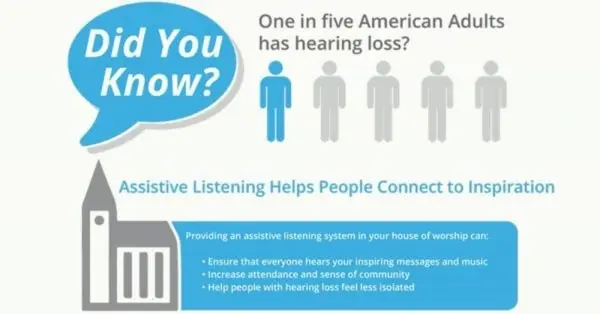
According to public health data from organizations such as the World Health Organization (WHO) and the Hearing Loss Association of America (HLAA), roughly 15% of American adults—representing nearly 48 million individuals—report some degree of hearing loss. Within the demographic most heavily represented in traditional and liturgical house-of-worship settings (adults aged 65 and older), that prevalence spikes dramatically, with nearly one in three experiencing clinically significant hearing reduction.

Despite these figures, sociological studies indicate that individuals experiencing the onset of hearing loss often endure a self-imposed isolation period of seven to ten years before seeking medical intervention. During this prolonged window, attending public gatherings becomes increasingly exhausting. Sanctuary acoustics—often plagued by high reverberation times (RT60) exceeding 1.5 to 2.5 seconds—exacerbate the problem. In a highly reverberant room, direct sound from the voice of a pastor or singer blends with delayed acoustic reflections bouncing off stone, glass, and hardwood surfaces. For a person with normal hearing, the brain can struggle to parse this acoustic soup; for an individual with sensorineural hearing loss, speech intelligibility drops precipitously to near zero.
From a regulatory standpoint, houses of worship are granted certain exemptions under the Americans with Disabilities Act (ADA) regarding religious entities. However, ethical leadership far transcends the bare minimum of legal compliance. True pastoral leadership recognizes that architectural barriers and acoustic neglect function as silent exclusions, locking vulnerable members out of the communal dialogue of faith.
Financial metrics gathered by AVL integration specialists indicate that outfitting a mid-sized sanctuary with a robust, multi-channel assistive listening system represents a remarkably modest capital investment—typically ranging from $1,500 to $5,000 depending on square footage, room geometry, and whether an RF or induction loop architecture is chosen. When amortized over a ten-year equipment lifespan, the cost per soul reached is negligible, yielding an infinitely high return on investment in terms of human connection, retention, and spiritual vitality.
Official Statements & Expert Perspectives
Industry leaders and accessibility advocates emphasize that technology in worship is ultimately an extension of pastoral care. The integration of assistive listening systems is framed not merely as an AV upgrade, but as a theological statement regarding the inherent dignity of every human being.
In the introductory whitepaper of the Listen Technologies Church Assistive Listening Toolkit, accessibility specialists write:
"Reaching out to those who feel disconnected from your community due to hearing loss is central to sharing the message of inclusion. Genuinely compassionate service involves being aware of and caring for the needs of everyone, especially those dealing with impairments. Make sure they are able to hear the beauty and emotion of the spoken word in your church by providing them with the equipment they need to stay connected."
Acoustical engineers echo this sentiment, noting that sound reinforcement systems are frequently designed with the average ear in mind—a flawed metric in congregations where age demographics skew older.
An audio systems consultant with decades of experience outfitting houses of worship explains:
"When a church installs a high-end line array speaker system, they often celebrate the clarity on the mixing desk. But they fail to realize that sound degrades across distance, battling room acoustics and hearing fatigue. An assistive listening system bypasses the air gap entirely. It delivers the pristine, direct mix straight to the ear. It transforms an exhausted listener who is lip-reading in the tenth row back into an active participant who can catch every whisper of a pastoral prayer."
Furthermore, AV integration firms emphasize the importance of leveraging free educational resources. Manufacturers and distributors have invested heavily in creating turn-key collateral to assist non-profit organizations. For instance, comprehensive toolkits—including downloadable sample surveys, printable ADA-compliant signage, bulletin announcement templates, and staff training modules—are readily available through industry leaders such as Listen Technologies. These resources eliminate the administrative guesswork for church staffs that are frequently operating with lean volunteer teams.
Future Outlook: The Horizon of Inclusive Worship
As we look toward the future of congregational life, the intersection of accessibility, digital connectivity, and acoustic engineering will only deepen. Several emerging trends are poised to redefine how houses of worship approach auditory inclusion in the coming decade:
1. The Mainstreaming of Auracast™ and Bluetooth LE Audio
The next great technological leap in assistive listening is already arriving in the form of Bluetooth Low Energy (LE) Audio and Auracast™ broadcast audio technology. Unlike legacy RF or infrared systems that require specialized, proprietary pocket receivers, Auracast™ allows a house of worship to broadcast high-quality audio directly to multiple personal consumer devices—including modern hearing aids, cochlear implants, and wireless earbuds—simultaneously. Congregants will soon be able to access the sanctuary’s audio stream simply by tapping their smartphone or adjusting a setting on their personal Bluetooth-enabled hearing device. This eliminates the stigma and operational friction associated with checking out physical, church-owned receivers at a welcome desk.
2. Artificial Intelligence and Real-Time Speech Enhancement
Artificial intelligence (AI) is rapidly migrating from computing laboratories into live audio processing hardware. Future assistive listening systems will increasingly incorporate neural network-based noise reduction and dynamic speech enhancement algorithms. These systems will be capable of isolating a pastor’s voice in real-time, stripping away ambient HVAC hum, rustling papers, and late-arriving echoes before the audio is ever transmitted to the listener’s ear.
3. Holistic Universal Design
The conversation surrounding church architecture and audio-visual design is shifting away from retroactive accommodation toward proactive universal design. Rather than treating accessibility as an afterthought or an ADA-mandated add-on, future church building projects will bake acoustic management, hearing loops, and multi-modal sensory inclusion into the foundational architectural blueprints from day one.
Conclusion: A Call to Action
The mission of any thriving house of worship is to proclaim a message of profound welcome, healing, and redemption. Yet, that message remains tragically incomplete if physical barriers prevent a segment of the congregation from receiving it.
By executing a disciplined, step-by-step strategy—assessing needs through surveys, evaluating tailored technologies with expert guidance like that of CCI Solutions, training dedicated hospitality ambassadors, and cultivating widespread community awareness—churches can decisively dismantle the silent wall of hearing loss.
For ministry leaders ready to take the next step, comprehensive resources are readily available. To access sample congregation surveys, printable signage, step-by-step training guides, and detailed implementation tools, ministry leaders can download the comprehensive Listen Technologies Church Assistive Listening Toolkit.
Evaluate your sanctuary’s acoustic landscape today. Ensure that every song is heard, every prayer is felt, and every member of your community remains vibrantly connected to the heartbeat of your fellowship.