
Executive Overview
The modern jazz landscape continues to be defined by a vibrant tension between historical reverence and cross-genre experimentation. Across the contemporary international scene, artists are increasingly willing to dismantle traditional stylistic boundaries, infusing classic repertoires with elements of Latin rhythms, rock backbeats, classical vocal techniques, and progressive arrangements.
This investigative review examines three notable recent releases that exemplify this stylistic evolution. Dallas-based saxophonist Justin Pierce offers a polished, groove-oriented debut with his quintet on Sway, blending the Great American Songbook with Latin and New Orleans sensibilities. Moving to the festival stage, New Orleans-born bandleader David Bode captures the explosive, high-energy environment of the 2026 New Orleans Jazz & Heritage Festival with a 22-piece ensemble that pushes big-band conventions into unconventional, genre-blurring territory. Finally, veteran vocalist Sarah Pillow bridges the chasms between jazz, opera, and early music on her genre-defying release Wanderer, backed by a stellar septet of jazz luminaries.
Together, these projects illustrate how contemporary creators are redefining boundaries, offering audiences both thrilling innovations and occasional friction as they forge new paths within the tradition.
Detailed Chronology: Album Breakdowns and Track Analyses
Justin Pierce: Sway (Justin Pierce Music, JPM-001)
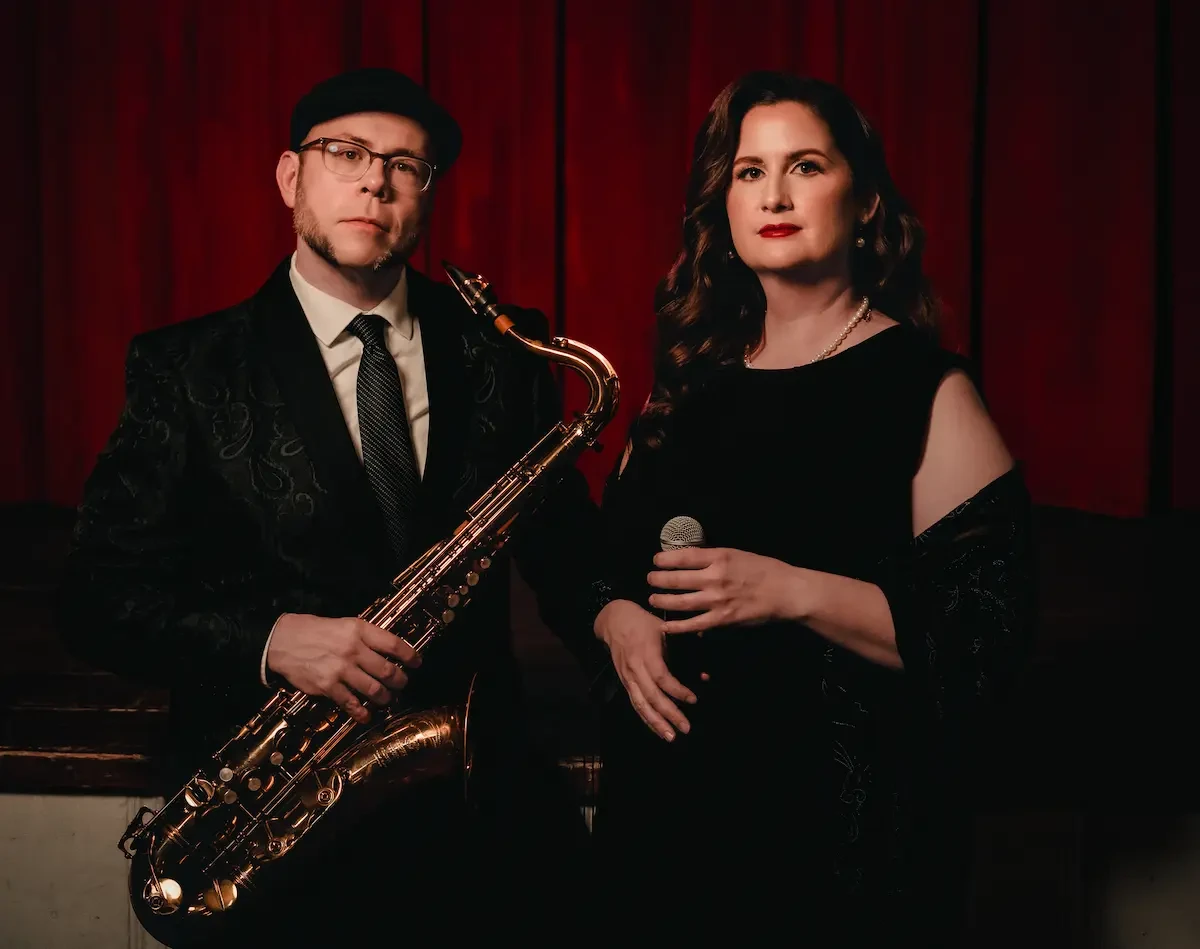
Recorded on May 5, 2025, in Dallas, Texas, Sway marks the debut studio outing for saxophonist Justin Pierce, a seasoned performer who has shared stages with jazz royalty such as Arturo Sandoval, Bob Mintzer, and Randy Brecker. Pierce anchors his quintet with a rhythm section comprised of former peers from the prestigious University of North Texas One O’Clock Lab Band: pianist Sean Giddings, bassist Young Heo, and drummer Matt Young. Crucially, the group features Pierce’s wife and musical partner, Ashley Pierce, on vocals. Across ten standards from the Great American Songbook, Pierce primarily steps away from his customary lead alto chair to handle tenor duties.
The 48-minute album opens with its title track, Sway, which establishes the project’s aesthetic by pairing Pierce’s robust saxophone tones with Ashley Pierce’s warm, clear vocals. However, the momentum of the opener is momentarily disrupted by an uncharacteristically off-kilter piano interlude. The program immediately recovers with a creative reading of Fats Waller’s Honeysuckle Rose, building outward from an intimate bass-and-voice duet into a full-band arrangement.
The sequencing balances vocal numbers with three distinct instrumental showcases. The first of these, a rendition of Horace Silver’s Jody Grind, highlights the band’s dynamic range with shifting tempos and vibrant saxophone phrasing. Mancini’s Meglio Stasera follows, cleverly refashioned as a sprightly samba featuring Italian-language vocals. The second instrumental arrives shortly after: a high-octane overhaul of Miles Davis’s All Blues transformed into a rapid-fire New Orleans-style rollick.
As the album progresses, Schwarz and Dietz’s Alone Together receives a Latin-infused makeover marked by amorous vocals and smooth tenor work, before seamlessly transitioning into a waltzing arrangement of Moon River. Duke Ellington’s melodic In A Sentimental Mood serves as the third instrumental showcase, highlighted by breathy, atmospheric sax lines. A soulful revision of Bill Withers’ Just The Two Of Us precedes the album’s spirited, New Orleans-flavored closer, Kaempfert and Gabler’s L-O-V-E.
Overall, the ensemble exhibits a remarkable internal cohesion. Pierce’s instrumental execution is pitch-perfect, and Ashley Pierce delivers a vocal performance notable for its exceptional clarity and warmth.
- Full Tracklisting: Sway; Honeysuckle Rose; The Jody Grind; Meglio Stasera; All Blues; Alone Together; Moon River; In A Sentimental Mood; Just The Two Of Us; L-O-V-E (48:03)
- Personnel: Justin Pierce (alto saxophone, tenor saxophone); Ashley Pierce (vocals); Sean Giddings (piano); Young Heo (bass); Matt Young (drums).
David Bode: Live At The 2026 New Orleans Jazz & Heritage Festival (MunkMix)
Following his 2025 debut studio recording, Good Hang, which featured a 19-piece ensemble, New Orleans native and big-band leader David Bode returned to the spotlight on April 25, 2026. This time, Bode captured an expansive 22-piece outfit live at the iconic New Orleans Jazz & Heritage Festival.
Comprising eight musical tracks interspersed with live stage banter, the 55-minute recording is entirely arranged by Bode. The set kicks off with an adrenaline-fueled take on Kenny Garrett’s Happy People, which transitions seamlessly into a poignant big-band arrangement of Jeff Buckley’s Lover, You Should Have Come Over. James Black’s Monkey Puzzle follows, featuring an arrangement modeled explicitly after Sammy Nestico’s classic Basie Straight Ahead. Billy Strayhorn’s timeless Lush Life receives a contemporary overhaul, incorporating synthesizer solos, lead vocals by Jenna Winston, and a sophisticated aesthetic reminiscent of 1990s neo-soul.
The middle stretch of the performance leans into stylistic friction. Bode’s arrangement of John Coltrane’s Syeeda’s Song Flute employs a heavy rock backbeat, prolonged trumpet dueling, and a flamboyant trombone solo. This segues into Bode’s own composition, Cold Train Funk. While Bode has noted that the piece draws inspiration from Coltrane’s melodic language, the structural innovations of Johann Sebastian Bach, and the funk rhythms of The Meters, these diverse influences are at times difficult to parse within the dense, high-volume delivery.
The setlist pivots toward indie-rock territory with a New Orleans-bounced interpretation of Radiohead’s Airbag. The concert culminates in a medley of Lennon and McCartney compositions—Dear Prudence paired with Don’t Let Me Down, the latter reimagined through a reggae-infused rhythm.
While undeniably a masterclass in contemporary big-band arranging, the recording presents challenges for home listening. The relentless, high-energy backbeat and frequent stage announcements urging the festival crowd to "make some noise" risk inducing listener fatigue over the course of the set.
- Full Tracklisting: Introduction; Happy People; Lover You Should’ve Come Over; Stage Banter 1; Monkey Puzzle; Stage Banter 2; Lush Life; Syeeda’s Song Flute; Stage Banter 3; Cold Train Funk; Stage Banter 4; Airbag; Dear Prudence/Don’t Let Me Down (55:27)
- Personnel: 22-Piece Big Band arranged and led by David Bode, featuring Jenna Winston (vocals). Recorded live in New Orleans, April 25, 2026.
Sarah Pillow: Wanderer (Buckyball Records, BR046)
Vocalist Sarah Pillow has carved out a uniquely diverse career traversing jazz, classical, opera, early music, and progressive rock. Having performed at the prestigious Montreux Jazz Festival at the tender age of 18—followed by formal jazz studies at the University of California and classical training at the Oberlin Conservatory—Pillow’s pedigree spans elite early music ensembles like Galileo’s Daughters and operatic performances at Carnegie Hall.
Her latest project, Wanderer, recorded on January 13 and 14, 2026, at the Raw Recording Studio in Patterson, New York, features 13 eclectic tracks. The repertoire spans reinterpretations of Irving Berlin and Sérgio Mendes, revisions of compositions by Dizzy Gillespie and Charles Mingus, the exotica of Eden Ahbez, and the traditional spiritual Wayfarin’ Stranger. The album’s intricate arrangements were penned by Pillow’s husband, Marc Wagnon, who also performs on vibraphone within the accompanying septet.
Pillow’s vocal delivery across the album—incorporating frequent scatting and wordless vocalizations—is executed primarily in a semi-operatic register. While her technical mastery as a classical and operatic soprano is unquestionable, the stylistic application leans heavily into a Broadway showbiz sensibility within this jazz-inflected context.
This stylistic choice creates an intriguing dynamic with her backing band. The ensemble features an undisputed roster of modern jazz luminaries: tenor saxophonist Donny McCaslin, alto saxophonist Nicola Caminiti, trumpeter Joey Curreri, pianist Dave Kikoski, bassist Joe Martin, and drummer Mike Clark. However, within the structured parameters of Wagnon’s arrangements, their contributions occasionally risk feeling perfunctory, leading to arrangements that some purists may find garish. Ultimately, Wanderer resists easy categorization; it functions less as a traditional jazz album and more as a compelling, jazz-adjacent cross-genre experiment.
- Full Tracklisting: Blue Skies; So Many Stars; A Night in Tunisia; Duke’s Sound of Love; How High The Moon; Tonight At Noon; The First Circle; Café; Stella By Starlight; Eclipse; 500 Miles High; Nature Boy; Wayfarin’ Stranger (64:04)
- Personnel: Sarah Pillow (vocals); Donny McCaslin (tenor saxophone); Nicola Caminiti (alto saxophone); Joey Curreri (trumpet); Marc Wagnon (vibraphone); Dave Kikoski (piano); Joe Martin (bass); Mike Clark (drums).
Supporting Context & Metrics
To fully appreciate the scope of these releases, it is instructive to examine the structural and demographic parameters of each project:
| Album Title | Artist(s) | Primary Genre / Fusion | Ensemble Size | Release Format & Year |
|---|---|---|---|---|
| Sway | Justin Pierce Quintet | Swing / Latin / New Orleans Jazz | 5 Members | Debut Studio Album (2025) |
| Live At The 2026 Jazz Fest | David Bode | Contemporary Big Band / Funk / Rock | 22 Members | Live Concert Recording (2026) |
| Wanderer | Sarah Pillow | Opera / Jazz-Adjacent / Early Music | 8 Members (Septet + Vocalist) | Studio Album (2026) |
These metrics underscore the vast spectrum of contemporary jazz production: from the tight, collaborative interplay of a classic mid-sized quintet (Sway), to the logistical and sonic heft of an expansive festival big band (Live At The 2026 New Orleans Jazz & Heritage Festival), to the conceptual ambition of an inter-genre septet (Wanderer).
Official Statements and Critical Perspectives
The release of these diverse projects has elicited significant commentary from critics, musicians, and industry observers regarding the state of genre boundaries in modern jazz:
- On Stylistic Synthesis: Industry analysts have noted that the willingness of artists like Justin Pierce and David Bode to incorporate regional American traditions—such as New Orleans second-line grooves and classic big-band arrangements—reflects a broader industry trend toward localized authenticity mixed with global crossover appeal.
- On Vocal Approaches: The divergent vocal styles showcased on these recordings—Ashley Pierce’s warm, intimate clarity; Jenna Winston’s neo-soul belting; and Sarah Pillow’s semi-operatic excursions—highlight an ongoing debate within jazz journalism regarding the ideal intersection of vocal technique and instrumental jazz framing. Critics remain divided on whether operatic and Broadway sensibilities enhance or dilute the foundational swing feel of standard jazz repertoire.
- On Live Capture vs. Studio Polish: The contrast between Justin Pierce’s carefully curated studio debut and David Bode’s high-octane festival document underscores the challenges of translating live performance energy into recorded media. While live albums capture the visceral excitement of an audience, they often introduce acoustic clutter that requires careful editorial navigation.
Future Outlook
As the jazz genre looks beyond 2026, the trajectories of artists like Justin Pierce, David Bode, and Sarah Pillow offer vital clues about the music’s evolutionary path. The erosion of rigid stylistic walls—evident in Bode’s fusion of Coltrane with rock backbeats, Pillow’s marriage of early music and Broadway phrasing with post-bop luminaries, and Pierce’s seamless melding of swing and Latin grooves—demonstrates that contemporary jazz remains a living, breathing art form capable of absorbing infinite external influences.
Future developments in the genre will likely depend on how successfully artists can balance commercial accessibility and cross-genre experimentation with the rigorous internal discipline required of traditional jazz improvisation. For listeners and critics alike, this ongoing dialogue between past traditions and future innovations ensures that the contemporary jazz scene will remain a site of endless surprise and critical debate.