
Executive Overview
The contemporary jazz landscape is defined by a dynamic tension between timeless, swinging classicism and avant-garde, large-ensemble experimentation. In this review-analysis, we examine three recent additions to the international jazz canon that embody these disparate yet complementary artistic poles.
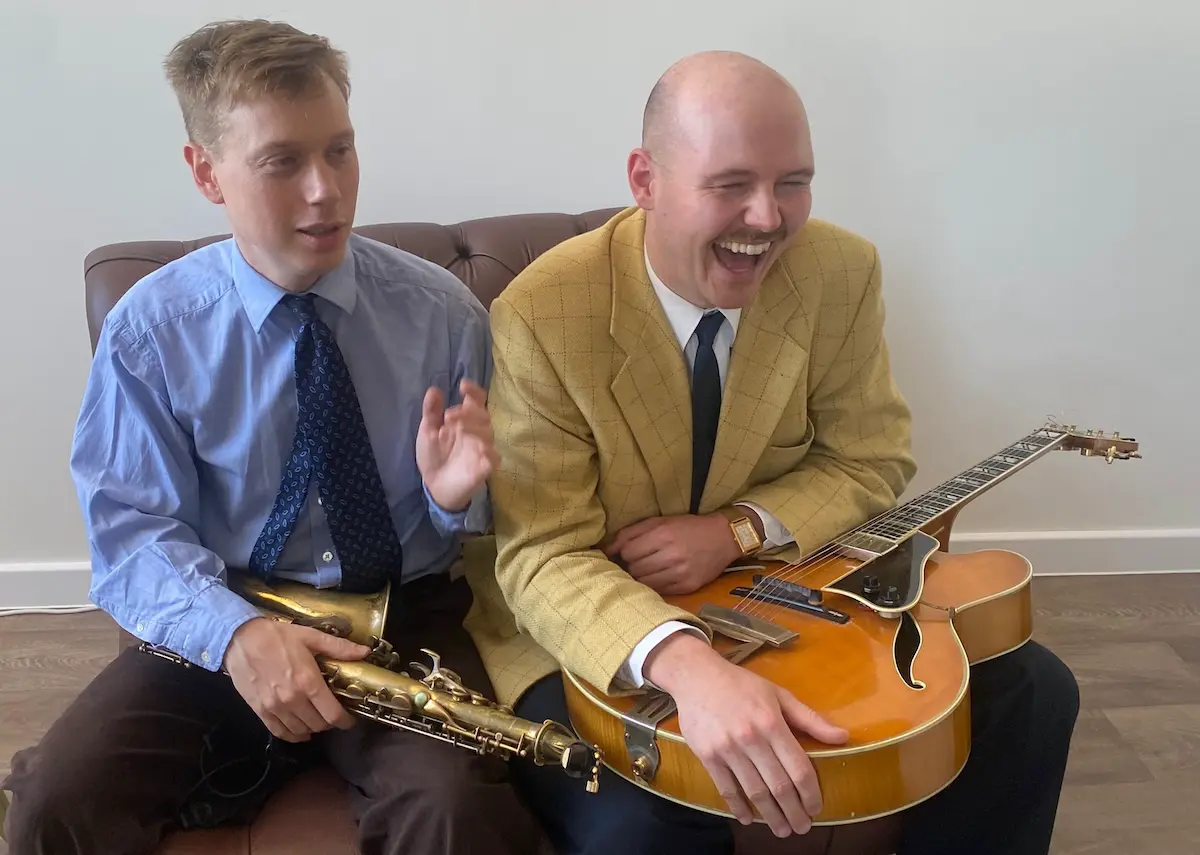
First, we explore the transatlantic quartet collaboration between London-based alto saxophonist Sam Braysher and German-born, Amsterdam-based guitarist Linus Eppinger on their album A Sinner Kissed An Angel (Fresh Sound Records). Recorded over a compressed timeline in Utrecht with veteran rhythm section players Darryl Hall and Eric Ineke, the project offers a masterclass in spontaneous cohesion, drawing on the timeless elegance of the mid-20th-century jazz idiom.
Second, we turn our attention to the prolific Japanese pianist, composer, and bandleader Satoko Fujii, whose relentless creative energy defies conventional industry timelines. We delve into two distinct orchestral statements: Live at Bunker Ulmenwall (Libra Records), a newly unearthed 2014 live recording featuring local music students and regional professionals in Bielefeld, Germany; and After The Storm (Libra Records), a studio-crafted performance by the Satoko Fujii Orchestra Kobe that reflects on the socio-political fractures of a post-pandemic world.
Together, these releases present a panoramic view of modern improvised music—one rooted in the sophisticated, unforced swing of the bebop and cool eras, and the other driven by the expansive, structurally monumental visions of contemporary large-ensemble jazz.
Detailed Chronology & Production History
Sam Braysher & Linus Eppinger: A Sinner Kissed An Angel
The genesis of A Sinner Kissed An Angel rests on pre-existing musical relationships and a calculated leap of faith regarding rhythm section personnel. Sam Braysher, a prominent figure on the London jazz scene known for his oblique phrasing and deep knowledge of the Great American Songbook, found himself stepping out for his fourth album release. To anchor the session, he recruited guitarist Linus Eppinger, a longtime collaborator with whom he shared an intuitive rapport.
To round out the ensemble, the co-leaders brought in American-born, French-resident bassist Darryl Hall and veteran Dutch drummer Eric Ineke. While both Braysher and Eppinger were well-acquainted with Ineke’s tasteful, brush-driven accompaniment and dynamic cymbal work, Hall was an unfamiliar variable to Braysher, known primarily to Eppinger through prior European engagements.
Logistics dictated a rapid production cycle. Following introductory live performances in Den Haag and Amsterdam, the newly formed quartet convened in a Utrecht recording studio on merely their third day of playing together. Due to the scarcity of rehearsal time, the arrangements were kept intentionally accessible, prioritizing spontaneous interaction over intricate structural scaffolding. This limitation proved to be a blessing in disguise, capturing the relaxed, unhurried atmosphere of a working stage band. The resulting 10-track album (Fresh Sound Records FSR-CD 514) runs just over 52 minutes and stands as a remarkably cohesive statement of straight-ahead modern jazz.
Satoko Fujii’s Bunker Ulmenwall Orchestra: Rediscovering a 2014 Milestone
In stark contrast to the swift, spontaneous studio captures of Braysher and Eppinger, Satoko Fujii’s large-ensemble output is characterized by massive architectural scale and historical reclamation. The two-CD release Live at Bunker Ulmenwall (Libra Records 218-083) represents the 24th orchestral album of Fujii’s career. More importantly, it serves as the vanguard of a staggering five-album orchestral release schedule slated for 2026, designed to clear a backlog of creative output compounded by pandemic disruptions.
The recording itself originates from November 22, 2014, captured live at Bunker Ulmenwall—a celebrated, alternative jazz venue housed within a converted World War II air-raid shelter in Bielefeld, northwest Germany. The tape had languished unreleased in the private archives of concert promoter Wolfgang Gross for over a decade. Gross, who had produced numerous Fujii performances over the years, originally conceived the concert not merely as a showcase for established regional professionals, but as an educational and collaborative incubator. He encouraged local music students to participate alongside seasoned avant-garde improvisers, tasking the younger musicians with composing original material and co-leading segments of the orchestra.
When Gross recently rediscovered the tapes and forwarded them to Fujii in Japan, the pianist was struck by the ferocious energy and high-level execution of the forgotten performance. The album splits its running time across two distinct discs: the first dedicated entirely to Fujii’s monumental, multi-phased composition Shiki (46 minutes), and the second featuring works composed and conducted by various members of the orchestra.
Satoko Fujii Orchestra Kobe: After The Storm
Hot on the heels of the Bunker Ulmenwall archival release comes After The Storm (Libra Records 215-084), recorded live in Kobe, Japan, on February 5, 2026. This release is the second installment in Fujii’s aggressive 2026 campaign, with subsequent orchestral sets from Berlin, Nagoya, and Tokyo scheduled to follow by early November.
Crucially, After The Storm is not a document of a public concert; rather, it is a studio recording of a live performance specifically engineered to capture the spatial and sonic dynamics of a full orchestra in real-time. The centerpiece of the album is a four-part suite penned by Fujii in the wake of the global pandemic. The compositional framework was born out of a specific socio-political aspiration:
"I was dreaming that the world would finally find complete peace after the pandemic… I was dreaming we would have no war, no weapons, no violence."
Although global events failed to align with this idealistic vision, Fujii felt compelled to preserve the message of hope and resilience encoded within the music. The recording captures a 17-piece ensemble navigating complex, emotionally turbulent territory across its nearly 58-minute runtime.
Supporting Context & Musical Analysis
Transatlantic Swing: Deconstructing A Sinner Kissed An Angel
Stylistically, A Sinner Kissed An Angel resists easy temporal categorization. Listening to the album, one could easily place its aesthetic lineage anywhere in the past half-century. It bridges the cool-school sensibilities of figures like Lee Konitz with the modern acoustic mainstream, driven by an unforced, conversational interplay between the soloists.
The album opens with A Smooth One—attributed alternately to Benny Goodman and Charlie Christian—establishing an immediate, breezy momentum. Braysher’s oblique, harmonically probing alto saxophone lines are elegantly balanced by Eppinger’s lilting, articulate guitar voicings. Darryl Hall provides a robust, anchor-like low end, while Eric Ineke’s drumming functions as a quietly metronomic heartbeat, rich with understated invention.
A standout track is the group’s interpretation of Spooky, a groovy, mid-tempo homage to Dusty Springfield. While Springfield’s repertoire is rarely mined in traditional jazz circles, Eppinger uses the vehicle to stretch out dynamically, while Braysher subtly mimics the sultry, emotive phrasing characteristic of Springfield’s vocal delivery.
Other highlights include Vernon Duke’s Roundabout, taken at a tear-jerkingly slow, ballad tempo that showcases the ensemble’s collective breathing room, and Horace Silver’s Route 608, which injects a classic hard-bop urgency into the proceedings. The title track—a sentimental favorite famously recorded by a young Frank Sinatra with Tommy Dorsey’s Orchestra in 1941—receives a tender, deeply felt reading, punctuated by Ineke’s delicate brushwork. The album closes with a guitar-led exploration of Charlie Parker’s Relaxing At Camarillo, leaving the listener on a sophisticated, mid-tempo high.
Avant-Garde Architecture: Fujii’s Live at Bunker Ulmenwall
In stark contrast to Braysher’s micro-swing aesthetic, Satoko Fujii’s Live at Bunker Ulmenwall operates on a massive, symphonic scale. Disc One is consumed entirely by Shiki, an expansive, multi-movement composition that stands as one of the most intricate architectural blueprints Fujii has ever constructed.
The piece begins with a quiet, hypnotic drone that gradually accumulates density and urgency. Fujii acts not merely as a traditional conductor, but as a dynamic ringleader who cues soloists, shifts thematic textures, and facilitates spontaneous dialogue between the large ensemble and featured improvisers. As Shiki unfolds, it accommodates explosive drum duets, searing trumpet and saxophone exchanges, and a dazzling, sparkling piano solo by Matthias Klause. The tension between structured orchestral punctuation and free-form improvisation builds continuously until it resolves in a triumphant, celebratory ensemble theme.
Disc Two showcases the compositional depth of the wider ensemble. Bass saxophonist Andreas Kaling contributes Yamantaka, a riff-heavy, angular piece characterized by interlocking thematic cells, cavernous low-end drones, and a thunderous rock-guitar solo by Lucy Liebe. Trumpeter Natsuki Tamura brings a reflective, timbrally adventurous shift in mood with Jasper, before alto saxophonist Luise Volkmann’s Antischwarm introduces restless, shifting rhythmic contours. The set concludes with Fujii’s own Gen Himmel, a serene, celestial composition that provides a profound sense of spiritual and sonic closure.
Post-Pandemic Reflections: Satoko Fujii Orchestra Kobe
After The Storm continues Fujii’s exploration of large-ensemble dynamics, filtered through the prism of collective trauma and recovery. Scored for a 17-piece big band featuring multiple reeds, brass, and a rhythm section anchored by guitarist Takumi Seino, the four-part suite serves as an emotional journey from despair to defiant optimism.
- Part 1 establishes a solemn gravity, opening with a stately solo-bass theme before trombonist Yuichiro Tamagaki delivers a glowing melodic statement. This gives way to a full-throated, abrasive tenor saxophone solo by Tsutomu Takei, underscored by Seino’s jagged guitar accompaniment.
- Part 2 leans heavily into open improvisation. Individual soloists splinter off from the orchestral mass before reintegrating, creating a turbulent, free-form narrative that mirrors societal fracture and realignment.
- Part 3 constructs a monumental wall of sound, highlighted by trumpeter Natsuki Tamura’s molten, microtonal runs that cut through the brass section’s dense harmonic clustering.
- Part 4 provides a sharp tonal pivot, offering a jaunty, upbeat resolution that culminates in a high-voltage electric guitar solo and a brilliant, star-burst tutti from the full ensemble.
Official Statements & Artist Perspectives
The creative motivations behind these releases underscore the resilience and adaptability of contemporary jazz practitioners navigating both historical idioms and modern socio-political realities.
Reflecting on the rapid assembly of his international quartet, Sam Braysher noted the value of trusting experienced collaborators over protracted rehearsal processes:
"When you bring together musicians of this caliber with a shared reverence for the tradition, the music finds its own feet very quickly. We didn’t need weeks of woodshedding; the chemistry was already waiting for us on the bandstand."
Speaking on the rediscovery of the 2014 Bunker Ulmenwall tapes, Satoko Fujii expressed profound astonishment at the archival find:
"When Wolfgang [Gross] sent me the recording after all these years, I was simply amazed at how beautifully we played, and with so much energy. It captured a very special moment of collaboration between seasoned improvisers and young students who were hungry to push the boundaries of large-ensemble music."
Addressing the conceptual underpinning of her recent Kobe recording, Fujii elaborated on the psychological weight of the pandemic and the ongoing global conflicts that informed After The Storm:
"I was dreaming that the world would finally find complete peace after the pandemic… I was dreaming we would have no war, no weapons, no violence. Even though reality turned out differently, I felt strongly that this music—this expression of hope—needed to be shared with listeners who are willing to commit their ears and hearts to the journey."
Future Outlook
As the jazz recording industry continues to adapt to shifting economic models and distribution channels, these three releases signal robust health at both ends of the stylistic spectrum.
For Sam Braysher and Linus Eppinger, A Sinner Kissed An Angel demonstrates the enduring vitality of the straight-ahead acoustic jazz quartet. By focusing on deep song-interpretation, subtle harmonic interplay, and an unhurried sense of swing, the quartet proves that classic idioms remain fertile ground for fresh, contemporary expression without requiring radical stylistic reinvention. Fans of mainstream and cool jazz can anticipate further collaborative touring from this transatlantic lineup as word of the Fresh Sound release spreads.
Meanwhile, Satoko Fujii’s staggering release schedule sets a new benchmark for prolific avant-garde output. With Live at Bunker Ulmenwall and After The Storm establishing the baseline for her 2026 campaign, listeners have much to anticipate as subsequent orchestral albums from Berlin, Nagoya, and Tokyo roll out over the coming months. Fujii’s ability to mobilize diverse regional scenes—fusing local academic talent with hardened free-improvisation veterans—ensures that her large-ensemble music remains one of the most vital, unpredictable forces in modern creative improvised music.
Whether one seeks the polished, swinging intimacy of a Utrecht studio session or the monumental, socio-politically charged sonic architecture of a Japanese big band, current jazz programming offers a rich tapestry of listening experiences that honor past traditions while boldly interrogating the present.