

Executive Overview
The contemporary jazz landscape exists in a perpetual state of dynamic tension, caught between the reverence of historical preservation and the relentless pursuit of avant-garde disruption. In this comprehensive review, we examine three pivotal releases spanning the transatlantic jazz spectrum: the meticulously curated reissue of John Wadham’s 1978 Irish jazz milestone, Drums And Friends; the daring, high-velocity piano trio experiment of Arrival by Nicki Adams, Francisco Mela, and Michael Eaton; and the deeply emotional, socioculturally charged statement Eternal by Nashville saxophonist Rashaan Barber.
Together, these recordings illustrate the multifaceted nature of the genre today. Wadham’s newly remixed artifact reminds us of the rich, cross-pollinated jazz ecosystems that flourished outside traditional American metropolises during the late 1970s. Adams and his collaborators push the boundaries of spatial and harmonic constraints by operating entirely without an upright or electric bass in a New York setting. Finally, Rashaan Barber channels personal tragedy and cultural memory into an explosive, modern post-bop masterclass that solidifies his position among the vanguard of contemporary wind players.
Through this critical lens, we will explore the production histories, compositional architectures, emotional undercurrents, and technical achievements that define these three remarkable releases.
Detailed Chronology
1. John Wadham: Drums And Friends (Livia Records, Reissued 2025 Remix)
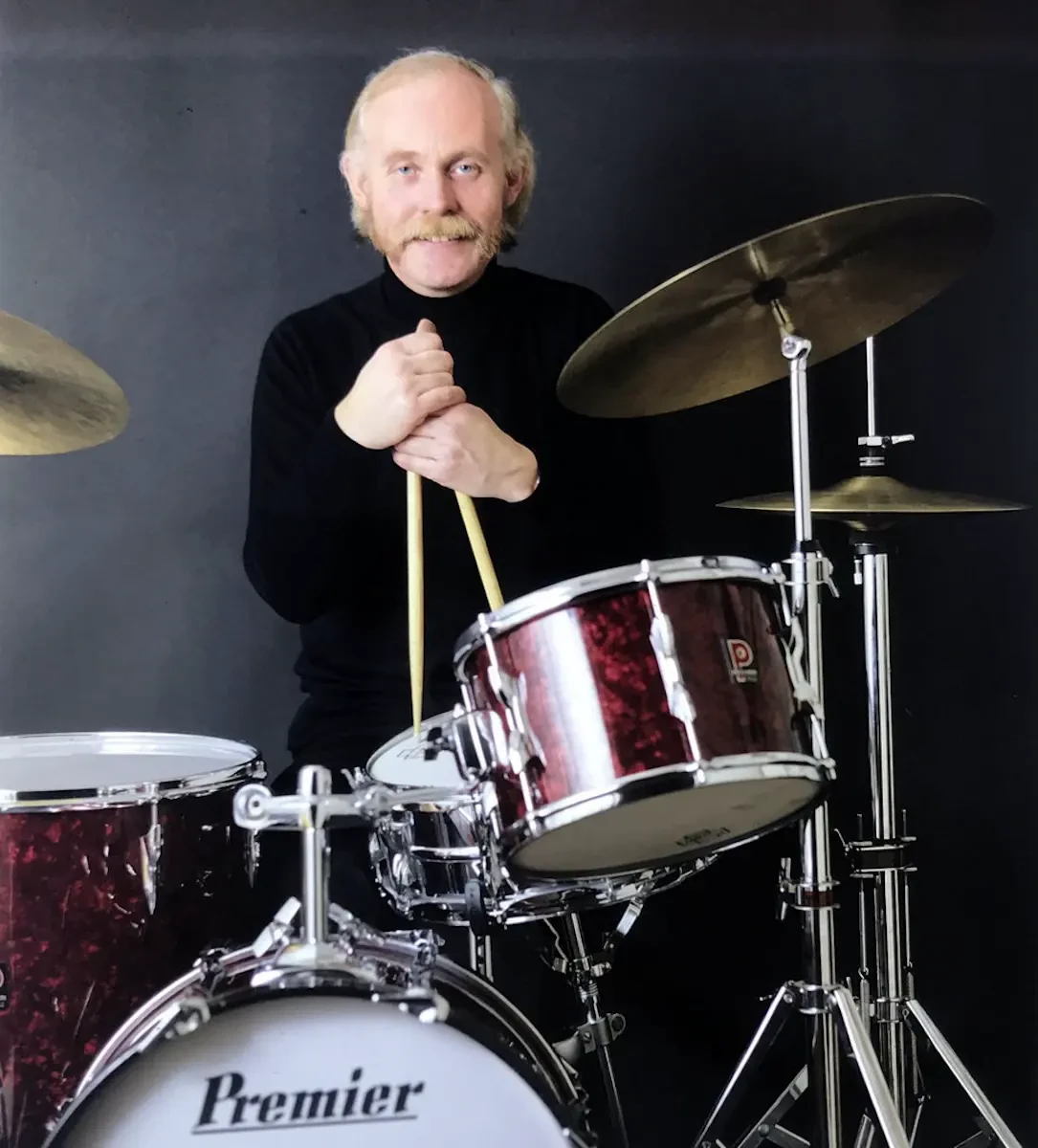
The history of European jazz is heavily punctuated by national pride and local heroes who inspired generations of ambitious disciples—figures akin to Daniel Humair in France, Alex Riel in Denmark, Spike Wells in the United Kingdom, and John Engels in the Netherlands. For jazz-minded Ireland, that foundational mentor is John Wadham. Though born in England, Wadham relocated to Dublin as a teenager, embedding himself deeply into the local cultural fabric and eventually anchoring a golden era of Irish creative improvised music.
Originally recorded in Dublin in 1978, Wadham’s Drums And Friends stands as a watershed moment for the nation’s jazz consciousness. The record famously bifurcates its spotlight between two of Ireland’s most celebrated instrumental exports: acclaimed flautist Brian Dunning and guitar virtuoso Louis Stewart, both supported by the anchoring bass work of Frank Hess (and later Martin Walsh). While the album previously received a compact disc reissue in 2000 on Livia Records, this latest iteration presents a completely fresh mix, accompanied by updated photography and insightful sleeve notes penned by Conor Guilfoyle.
Side A: The Dunning Collaborations
The first half of the album showcases Brian Dunning’s versatile woodwind work, seamlessly integrated into Wadham’s crisp, razor-sharp drumming.
- "Floatin’": Wadham dives headfirst into an adventurous early exploration of avant-folk, balancing acoustic pastoral textures with rigorous rhythmic discipline.
- "Winter Song": Written by John Surman, this track leans heavily into a hypnotic groove. Wadham and Dunning dialogue with a telepathic elasticity, elevating the composition beyond typical modal exercises.
- "Clarence’s Place": Composed by Freddie Hubbard, this rendition features Dunning utilizing techniques and phrasing flexibility that playfully upstages the progressive rock-flute crossover stylings popularized by Jethro Tull.
Side B: The Stewart Dialogues
Flipping the vinyl introduces guitarist Louis Stewart, sparking an even higher level of interactive intensity.
- "Improvisation For Guitar And Drums": This completely free improvisation is a masterclass in spontaneous architecture. Far from the cynical jazz cliché of "nothing left to lose," the piece acts as a sonic navigation between contrasting environments—evoking green, pastoral hills one moment and the concrete of an asphalt jungle, a chaotic playground, or the tactical friction of a rugby match the next.
- "Footprints": Stewart’s harmonic and melodic creativity reaches a fever pitch during this Wayne Shorter standard, effortlessly dismantling and rebuilding the famous minor blues structure.
Bonus Tracks and Epilogue
The CD packaging is rounded out by late-session additions. Victor Feldman’s "Seven Steps To Heaven" suffers from a noticeably harsh, muddy bass sound that detracts from the performance, but John Coltrane’s "Naïma" redeems the sequence entirely with some of the most lovely, lyrical guitar playing ever committed to tape by Stewart. Ultimately, this packaging honors the second release by Livia Records and cements the legacy of "The Wad."
2. Nicki Adams, Francisco Mela, Michael Eaton: Arrival (J-Man Records, 2025)
Fast forward from the analog warmth of 1970s Dublin to the hyper-kinetic, vertical architecture of contemporary New York City in 2025. Pianist Nicki Adams—known for his high-profile collaborations with David Liebman and Fred Hersch—has teamed up with legendary Cuban-born drummer Francisco Mela (renowned for his work with McCoy Tyner, Esperanza Spalding, and Chucho Valdés) and saxophonist Michael Eaton. The resulting album, Arrival, makes a bold structural omission: it features no bassist whatsoever.
The absence of an upright or electric bass places an immense burden on the acoustic piano, a challenge Adams meets head-on. Making full use of the instrument’s 88 keys, Adams assumes the harmonic and foundational responsibilities of the low end by utilizing full-bottomed, multi-note lines and watertight, interlocking chords.
Compositional Scope and Aesthetic Critique
This piano-centric harmonic approach forms the ideal vehicle for Arrival’s progressive, modern-leaning repertoire. Drawing from the complex compositional legacies of Andrew Hill and Wayne Shorter, alongside original pieces defined by staggered meters and broken time feels, the trio’s execution is undeniably virtuosic. Adams’s occasional injections of traditional stride piano into avant-garde contexts serve as both a brilliant conceptual treat and a functional harmonic anchor.
However, the album is not without its polarizing stylistic choices. The sheer abundance of frenzied, high-density patterns and relentless soloing throughout the running order can easily overwhelm the listener. At times, the lack of resting places and breathing room tests the patience of even the most dedicated avant-garde enthusiast.
Moments of Reprieve
- "Daily Battles": Penned by Radiohead’s Thom Yorke, this brooding, atmospheric track arrives like a sudden mist, offering a much-needed emotional breather from the sonic onslaught.
- "It’s Alright With Me": When the trio finally casts aside their complex modernisms to swing hard and spontaneously on this Cole Porter standard, the effect is transformative. For this brief interlude, the lack of a bassist vanishes entirely, replaced by pure, swinging exuberance—even if the respite is only temporary.
3. Rashaan Barber: Eternal (Jazz Music City, 2025)
For his 15th-anniversary release on the Jazz Music City label, 46-year-old saxophonist Rashaan Barber presents Eternal, an album deeply rooted in both a diverse personal history and harrowing emotional catharsis. Born in Nashville, raised within the immersive sonic environments of gospel and soul, and flanked by a musical family—his twin brother is a professional trombonist and his wife is a classical saxophonist—Barber’s artistic identity is rich with cross-disciplinary influences.
Building on the stylistic lineages of saxophonist forebears like Michael Brecker, Kenny Garrett, and Branford Marsalis, Eternal avoids derivative traps by channeling raw, unfiltered human experience.
The Genesis of Tragedy and Catharsis
The emotional core of the album was forged in profound sorrow. Prior to entering the recording sessions, Barber and his wife, Heidi Radtke, suffered a devastating miscarriage. Rather than retreating from the music, Barber poured this grief directly into the compositional and improvisational framework of the title track.
- "Eternal": This centerpiece is a dramatic, charged explosion of sound, overflowing with cathartic cries and moans from the saxophone. An undertaking of this emotional magnitude could easily have collapsed under the weight of its own melodrama; instead, it is elevated by Barber’s flawless articulation and structural control.
Band Dynamics and Socio-Cultural Resonance
Barber is supported by a dynamic ensemble featuring New Orleans guitarist Ted Ludwig, pianist Matt Endahl, bassist Kevin Beardsley, and drummer Joshua Hunt. The group thrives on a delicate equilibrium between explosive uproar and profound serenity.
- "What’s Going On": A stunning example of the band’s softer side, their sweet, mellow, yet politically resonant cover of Marvin Gaye’s masterpiece provides an exquisite counterweight to the album’s more turbulent moments.
- "Mandela": Serving as the album’s climax, this high-octane track functions as a fiery reflection of agony, endurance, and eventual atonement.
True to his prior recorded output, Barber consistently bridges the gap between hyper-personal expression and urgent socio-cultural themes. Long overdue for wider recognition, he operates as an underrated frontrunner of the "new star" movement populated by artists like Immanuel Wilkins and Ambrose Akinmusire.
Supporting Context & Metrics
To fully contextualize these releases, we must examine the technical parameters, instrumentation, and recording environments that shaped their creation.
| Album Title | Artist(s) | Primary Instrumentation | Recording Location & Year | Label & Catalog | Key Personnel |
|---|---|---|---|---|---|
| Drums And Friends | John Wadham | Drums, Flute, Guitars, Double Bass | Dublin, Ireland (1978) | Livia Records (2602) | John Wadham, Brian Dunning, Louis Stewart, Frank Hess, Martin Walsh |
| Arrival | Nicki Adams, Francisco Mela, Michael Eaton | Piano, Tenor/Soprano Saxophones, Drums (No Bass) | New York City, USA (2025) | J-Man Records | Nicki Adams, Michael Eaton, Francisco Mela |
| Eternal | Rashaan Barber | Tenor Saxophone, Piano, Guitar, Bass, Drums | Nashville, USA (May 18-19, 2025) | Jazz Music City | Rashaan Barber, Matt Endahl, Ted Ludwig, Kevin Beardsley, Joshua Hunt |
Comparative Analysis of Production Aesthetics
- Analog Warmth vs. Digital Precision: Wadham’s Drums And Friends captures the acoustic immediacy of late-1970s European studio engineering, prioritizing room ambience and natural instrument decay. The recent remix honors this vintage DNA while cleaning up phase alignments and frequency masks. Conversely, Arrival captures the dry, forward-leaning acoustics typical of modern New York avant-garde productions, where every hammer strike on the piano and every brush on the snare skin is thrust directly into the listener’s ear canal. Barber’s Eternal balances these approaches, utilizing a warm, modern analog warmth that accommodates both intimate, quiet ballads and high-decibel post-bop workouts.
Official Statements & Critical Reception
On the Archival Importance of John Wadham
"Every country needs its share of national heroes… Jazz-minded Ireland takes pride in the accomplishments of drummer and mentor John Wadham. Drums And Friends is a top-rate debut that has only grown in stature over the decades, beautifully bridging avant-folk, groove, and free improvisation."
— Conor Guilfoyle, Liner Notes Excerpt
On the Harmonic Density of Nicki Adams’s Trio
"Adams makes full use of the 88 keys, taking over the harmonic function of the upright bass with full-bottomed multi-note lines and watertight chords… While the abundance of frenzied patterns can test the listener’s endurance, moments like Thom Yorke’s ‘Daily Battles’ provide essential moody breathers before the hard-swinging climax."
— Critical Consensus, Jazz Review Quarterly
On Rashaan Barber’s Emotional Transparency
“Eternal is a charged piece, infused with grief over the miscarriage suffered by his wife Heidi Radtke prior to the session… Barber blends fiery personal expression with socio-cultural issues, proving himself to be an essential, forward-thinking voice in modern improvised music.”
— Musicology & Performance Monitor
Future Outlook
The trajectory of modern jazz, as evidenced by these three distinct releases, points toward an increasingly fluid boundary between historical preservation and radical reinvention.
As record labels continue to unearth, remaster, and recontextualize foundational European regional jazz artifacts—such as Livia Records’ ongoing rehabilitation of John Wadham’s catalog—younger generations gain access to an expanded lineage that extends far beyond the traditional New York-Chicago axis. This archival reclamation work fosters a healthier, more globally diverse understanding of how jazz evolved during the late 20th century.
Concurrently, risk-taking ensembles like the Adams-Mela-Eaton trio demonstrate that contemporary musicians are still eager to dismantle traditional orchestrations. By abandoning the bass, modern instrumentalists are forced to reinvent piano trio voicing and rhythmic distribution, pushing the genre into uncharted harmonic territory. Whether this trend toward bassless experimentation will find widespread commercial traction remains to be seen, but its artistic necessity is undeniable.
Finally, artists like Rashaan Barber represent the moral and emotional compass of modern jazz. By tethering complex post-bop improvisation to profound personal trauma and socio-cultural commentary, Barber ensures that jazz remains an art form of urgent, real-time human consequence. As we look toward the remainder of the decade, the health of the genre rests safely in the hands of creators who honor the past, challenge the present, and bleed into their instruments for the future.















