
Executive Overview
The contemporary jazz landscape is experiencing a remarkable period of cross-generational synthesis, historical reflection, and borderless collaboration. As foundational ensembles of the late 20th century cast long shadows over modern composition, today’s artists are continually finding innovative ways to honor their roots while charting entirely new sonic territories. This expansive review examines three distinct, highly anticipated releases from late 2024 and early 2025 that underscore the vitality of the global jazz ecosystem: veteran British multi-instrumentalist Eddie Parker’s long-awaited return with guitar virtuoso Rob Luft on Airborn; Austrian-based guitarist Martin Iaies’ ambitious large-ensemble statement People, Places. Music For Large Ensemble; and Norwegian guitarist Frode Kjekstad’s hard-swinging transatlantic quartet date, Stars Aligned.
Together, these projects illustrate the breadth of the genre today. Parker’s album bridges the gap between the pioneering spirit of the legendary British big band Loose Tubes and the state-of-the-art modern chamber-jazz idiom. Iaies’ project showcases the expressive potential of a sprawling 11-piece European orchestra infused with chamber textures and sophisticated arrangements. Meanwhile, Kjekstad’s album reaffirms the enduring power of the classic guitar-organ-sax-drums quartet, executed with world-class precision by an internationally celebrated cast. This article provides an exhaustive, critical analysis of these three masterworks, exploring their historical lineages, musical architectures, instrumentation choices, and the broader trajectory of modern improvised music.
Detailed Chronology & Album Breakdowns
Eddie Parker’s Airborn With Rob Luft: A Masterclass in Texture and Lineage
It has been more than four decades since the groundbreaking British big band Loose Tubes captivated audiences with their eponymous debut LP, released independently on their own label. The ensemble served as an incubator for a generation of luminaries, launching the careers of foundational players such as Django Bates, Julian Argüelles, and John Parricelli. While many alumni continued to occupy the vanguard of European jazz, multi-instrumentalist Eddie Parker maintained a relatively low profile following the band’s initial 1990 dissolution. Although Parker’s last recording as a leader was 1996’s Everything You Do To Me (FMR), his presence never truly vanished; he performed on three subsequent albums recorded during the revived Loose Tubes iterations between 2010 and 2015, collaborated extensively with South African multi-instrumentalist Bheki Mseleku throughout the 1990s, and currently maintains a prominent role in the Will Gregory Moog Ensemble.
Parker’s return as a leader on Eddie Parker’s Airborn With Rob Luft (Pig Records) is a watershed moment, elevated significantly by the inclusion of 21-year-old guitar phenom Rob Luft. Luft’s association with Parker’s orbit has deep historical resonance: the young guitarist memorably substituted for John Parricelli during the 2014 Loose Tubes reunion residency at Ronnie Scott’s. Since then, Luft’s trajectory has been meteoric—encompassing stints with the National Youth Jazz Orchestra, a degree from the Royal Academy of Music, eight critically acclaimed albums as a leader or co-leader, and guest appearances alongside jazz royalty such as John Surman, Laura Jurd, and Liane Carroll. Crowned Instrumentalist of the Year at the 2025 UK Parliamentary Jazz Awards, Luft’s prominence is such that his name rightfully shares top billing on the record.
The Sonic Architecture of Airborn
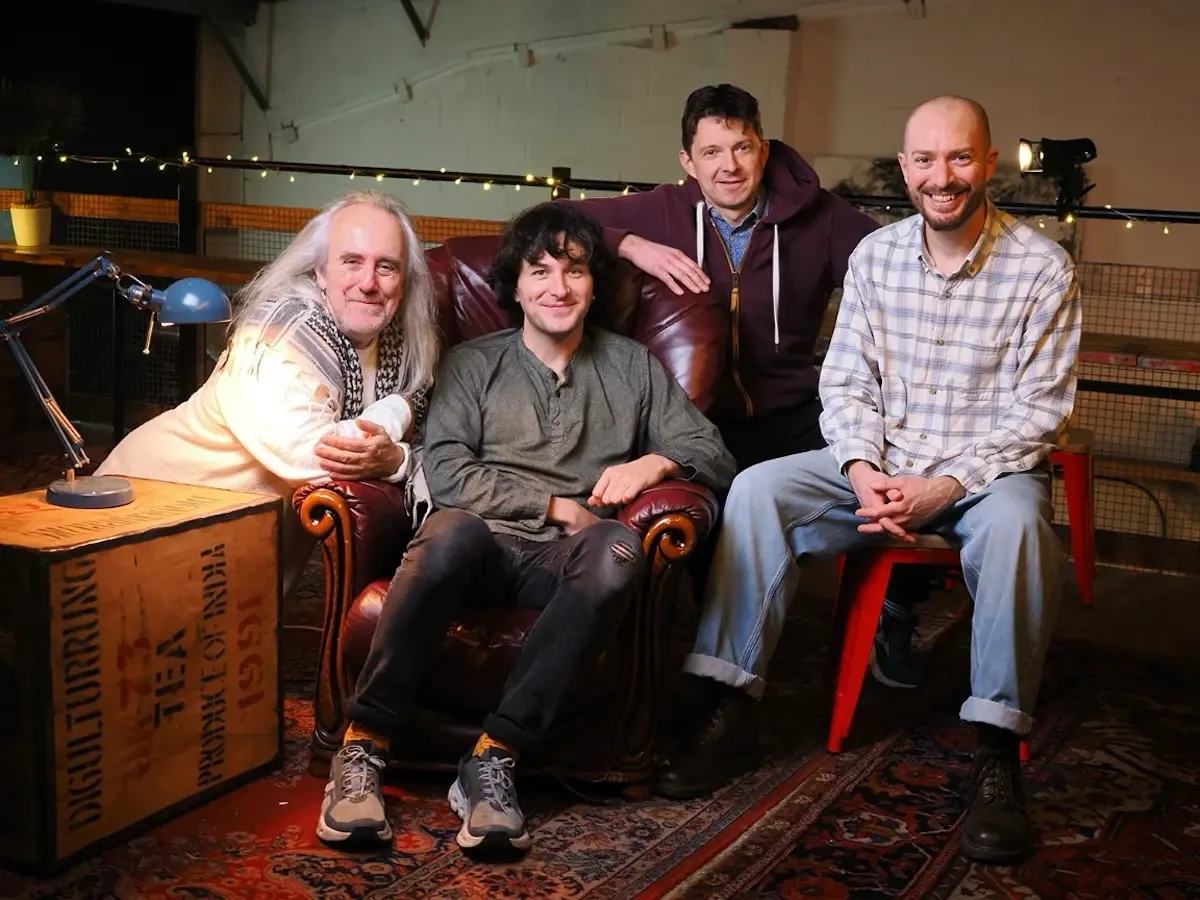
Recorded in London in December 2025, the album features a tight-knit quartet comprising Parker (flute, keyboards, piano), Luft (electric and acoustic guitars), Dave Mannington (bass), and Jay Davis (drums). The tracklist unfolds as a meticulously structured suite of atmospheric vignettes and driving, rhythmically complex excursions:
- Prelude & Airborn 1: The record opens with the soundscape-oriented Prelude, where Parker’s baroque flute establishes an ethereal, reflective mood. This seamlessly bleeds into Airborn 1, launched by Luft’s soaring, cascading guitar lines. A brief, textural keyboard foray by Parker introduces more stunning, inventive fretwork from Luft.
- Intermezzo Chain & Airborn 2-3: A masterclass in pacing, the album utilizes seamless multi-tracking for short, connective interludes. Interlude – Sextet gives way to Airborn 2, a track that captures the symbiotic interplay of the core quartet, highlighted by a warm, resonant pizzicato bass solo from Dave Mannington. Airborn 3 introduces a subtle, infectious funky groove that pays nostalgic homage to the rhythmic vitality of Loose Tubes.
- Latin Grooves and Lyrical Spaces: The mood pivots dramatically with the swinging, polyrhythmic Rock Latin, evoking the luminous, high-energy fusion of Chick Corea and Return to Forever. Following a brisk Interlude – Duo spotlighting Parker on flute and Luft on 12-string guitar, the ensemble settles into the deeply lyrical To Plant A Tree. Here, Luft’s deft, tasteful guitar styling meshes with Parker’s fluid piano, imbuing the composition with a memorable, lissom grace.
- Rhythm, Heritage, and Homage: The rhythmically quirky, eccentrically metered Wonky Clockwork provides drummer Jay Davis with an ideal vehicle to showcase his percussive agility. The funereal, stately momentum of Cortège gradually dissolves into the buoyant Airborn 5, which transitions directly into a 40-second ruminative piano solo (Interlude – Solo). The album closes on a high note with Oke Quixote, Parker’s deeply felt tribute to his hero, the late, great trumpeter Kenny Wheeler. The title brilliantly nods to Wheeler’s compositional style, leaving listeners with a timeless, mesmeric parting gift.
Martin Iaies: People, Places. Music For Large Ensemble
Moving from the intimate, highly textured explorations of Parker’s quartet to the sprawling, orchestral dimensions of a large ensemble, guitarist Martin Iaies delivers his third and most ambitious album to date with People, Places. Music For Large Ensemble (Challenge Records). Born in Austria and based in Vienna, Iaies has steadily built a reputation for sophisticated composition and nuanced guitar work. His prior releases—Rewind & FF (2018) and New Beginnings (2023)—were brilliant quartet outings, the latter notable for featuring British saxophonist Julian Argüelles.
Iaies’ artistic identity is deeply rooted in bridging the gap between jazz improvisation and European chamber music. This exploration previously yielded a dedicated chamber quartet comprising guitar, clarinet, cello, and trombone, born from his composition Cyclical Loss Of Hope. That piece earned first prize in the Alwin-Fill-Förderpreis: Musik für den Frieden, a prestigious competition dedicated to exploring the intersection of music and sociopolitical peace through linguistics.
Chamber Jazz Meets the Orchestral Canvas
On People, Places, recorded live in Graz, Austria, across three days in February 2025, Iaies expands his canvas. The core 11-piece ensemble features an impressive roster: Alana Macpherson (alto/soprano saxophones, flute), Tobias Hoffmann (alto/soprano saxophones, clarinet), Miloš Kostář (tenor saxophone, clarinet), Anna Gollien (baritone saxophone, bass clarinet), Zan Cesar and Jordi Roviró (trumpets, flugelhorns), Matthias Bernsteiner (trombone), Thomas Quendler (piano), Ariel Vei Atanasovski (cello), Maximilian Kreuzer (bass), and Andreas Reisenhofer (drums).
The album’s sequencing reveals a brilliant structural arc. The final two tracks serve as stylistic outliers that highlight Iaies’ affinity for chamber jazz—a medium whose lush tonal color palette and intellectual rigor frequently evoke comparisons to Miles Davis’s historic Birth Of The Cool sessions. The penultimate piece, Canción De Cuna Para Simon, establishes this intimate, refined chamber aesthetic. The album closes with the aforementioned prize-winning Cyclical Loss Of Hope, featuring guest artist Klaus Gesing on wistful soprano saxophone.
German-born Gesing, celebrated globally for his long-standing collaborations with British vocalist Norma Winstone, makes invaluable contributions across the recording. Beyond his soprano work on the closing track, Gesing lends his artistry to an elegant arrangement of Hilda Herrera’s Zamba Del Chaguanco—the sole non-original composition on the album—and shifts to bass clarinet to anchor the sultry, nocturnal soundscapes of In An Unknown Mood.
Throughout the album, Iaies exercises admirable compositional and directorial restraint. Rather than dominating the proceedings with endless guitar solos, he steps forward judiciously. On cuts like the swinging El Donny, his contributions are lithe, economical, and deeply swinging. Meanwhile, Delfina’s Way allows Iaies to stretch out, offering a masterclass in modern jazz guitar that pairs harmonic sophistication with a bluesy, muscular drive. For audiences eager to witness his methodology in real time, archival footage of his 11-piece ensemble performing Graz live at Stockwerk in Graz provides a fascinating visual and sonic companion piece to the physical release.
Frode Kjekstad: Stars Aligned
Shifting gears entirely from chamber-orchestral sophistication and British avant-garde lineage, Norwegian guitarist Frode Kjekstad’s Stars Aligned (Losen Records) offers an exhilarating masterclass in classic, high-octane quartet jazz. Recorded in Sandvika, Norway, in January 2025, the album is a masterclass in pacing, oscillating effortlessly between breakneck, helter-skelter burners, straight-ahead blues workouts, and laid-back, candle-lit ballads.
Kjekstad, whose discography includes the celebrated sophomore release New York Time (Curling Legs, 2004)—which featured the legendary Dr. Lonnie Smith on Hammond B3 organ—has assembled an elite, truly international cast of virtuosos for this outing:
- Eric Alexander (Tenor Saxophone): The powerhouse American saxophonist brings a formidable pedigree forged through decades of collaboration with jazz royalty, including Harold Mabern, Ron Carter, and Kenny Barron.
- Roy Powell (Organ): Hailing from England’s Midlands, Powell is a master of the Hammond organ and synthesizer, known for his creative partnerships with Arild Andersen, Art Farmer, and Dave Liebman.
- Frederik Villmow (Drums): Representing Germany, drummer Villmow provides a rock-solid, endlessly inventive rhythmic foundation, having shared the stage with luminaries such as Chris Potter and Vince Mendoza.
Repertoire and Execution
The compositions on Stars Aligned are refreshingly transparent, matching their titles with direct, visceral musical intent:
- The Phineas Trane sets an immediate tone of urgency, utilizing a harmonic hook modeled on the relentless, rapid-fire pacing of John Coltrane’s Giant Steps.
- Ballad artistry shines brightly on tracks like the elegant Moon Song, where Kjekstad channels the smooth, articulate phrasing and warm chordal styling of Pat Martino. Another plaintive gem, Foggy Morning In The Woods, showcases Kjekstad drawing out lustrous, singing notes while tenorist Eric Alexander demonstrates that his fiery, hard-bop sensibilities can be matched with exquisite, weeping sensitivity.
- The breezy Jingles relies on a playful call-and-response arrangement that evokes George Benson at his most dexterous and swinging.
- Rhythmic diversity is further highlighted by the brisk, elegant jazz waltz Open Ocean, the punningly titled Hammond Cheese—which exudes a joyous, Horace Silver-esque soul-jazz vibe—and the out-and-out foot-tapper Bonebreaker.
With four master improvisers operating at the absolute peak of their powers, Stars Aligned contains zero filler. It is a timeless, intensely satisfying listening experience that rewards multiple replays.
Supporting Context & Production Metrics
To fully appreciate the weight of these three releases, it is instructive to examine their technical specs, recording environments, and release metrics side by side.
| Album Title | Artist(s) | Primary Label | Release Date / Location | Core Instrumentation | Total Runtime |
|---|---|---|---|---|---|
| Airborn | Eddie Parker & Rob Luft | Pig Records (PIG22) | December 2025 / London, UK | Flute, Keyboards, Piano, Electric/Acoustic Guitars, Bass, Drums | 66:07 |
| People, Places | Martin Iaies | Challenge Records (CR73631) | February 2025 / Graz, Austria | 11-piece Large Ensemble + Guest Saxophone/Clarinet | 55:35 |
| Stars Aligned | Frode Kjekstad | Losen Records (LOS 327-2) | January 2025 / Sandvika, Norway | Electric Guitar, Tenor Saxophone, Hammond Organ, Drums | 53:36 |
The production values across all three projects reflect an industry increasingly dedicated to high-fidelity acoustic transparency. Parker’s Airborn benefits from the intimate, highly focused acoustic engineering of London’s studio scene, capturing the microscopic details of Parker’s baroque flute and Luft’s dynamic multi-tracked pedal work. Iaies’ large-ensemble project presented a significantly more complex engineering hurdle: capturing the sprawling dynamics of an 11-piece orchestra live in Austria without sacrificing the clarity of individual horn lines, cello resonance, and rhythmic drive. The resulting mix on Challenge Records successfully balances orchestral mass with improvisational agility. Meanwhile, Kjekstad’s session in Sandvika captures the earthy, room-filling roar of a Hammond B3 organ locking horns with a soaring tenor sax and biting electric guitar—a classic configuration that demands careful EQ balance to avoid muddiness in the lower registers.
Official Statements & Critical Reception
The critical reception of these releases has reinforced the ongoing renaissance of European jazz production. Industry commentators have been quick to note how these albums bridge the gap between historical reverence and modern compositional ambition.
Reflecting on the legacy of Loose Tubes and his unexpected return to the forefront of British jazz, Eddie Parker shared in promotional materials surrounding Airborn:
"The music we forged in Loose Tubes was never about looking backward; it was about an insatiable curiosity for where rhythm and harmony could collide. Working with Rob [Luft] and this extraordinary quartet brought that exact same spirit of discovery back into the room. It’s a continuation of a conversation we started decades ago, spoken in a brand new dialect."
Similarly, Martin Iaies addressed the conceptual framework underpinning People, Places, emphasizing the organic evolution of his writing from intimate chamber settings to full orchestral suites:
"When you write for a large ensemble, you aren’t just writing notes on a page; you are curating a micro-society. Every voice—from the baritone sax to the cello—carries a specific emotional weight. Winning recognition for ‘Cyclical Loss Of Hope’ showed me that chamber jazz could communicate complex human ideas beyond pure abstraction. Expanding that methodology to a full 11-piece orchestra in Graz allowed those textures to breathe on an entirely different scale."
Critical reviews across European and international jazz publications have universally praised the uncompromising artistic integrity of these releases. Reviewers have highlighted Luft’s seamless integration into Parker’s veteran lineup as proof of cross-generational jazz mentoring at its finest. Concurrently, Kjekstad’s Stars Aligned has been lauded for proving that traditional hard-bop and organ-quartet formats remain vital, high-energy vehicles when executed by masters who refuse to rely on tired clichés.
Future Outlook
As the global jazz community looks toward the remainder of the decade and beyond, projects like Airborn, People, Places, and Stars Aligned offer a clear roadmap for the genre’s sustainable evolution. They demonstrate that innovation does not require the abandonment of tradition, nor does historical awareness preclude forward-thinking experimentation.
- Cross-Generational Mentorship: The fruitful collaboration between veteran architect Eddie Parker and twenty-something guitar virtuoso Rob Luft highlights the necessity of bridging generational divides. Expect to see more hybrid lineups in upcoming years as foundational artists seek out younger conservatory-trained talent to inject fresh technical firepower into established compositional frameworks.
- The Expansion of Chamber Jazz: Martin Iaies’ successful scaling of chamber-jazz sensibilities into an 11-piece orchestral format signals a growing appetite for lush, texturally complex large-ensemble writing. As economic pressures on big bands mount, nimble, multi-instrumental chamber-orchestral hybrids offer a viable, emotionally resonant path forward for modern composers.
- Borderless Collaboration: The international pedigree of Kjekstad’s quartet—spanning Norway, America, England, and Germany—reinforces the borderless nature of modern jazz. Physical geography is increasingly irrelevant in the creation of cohesive, high-level improvised music, setting the stage for even more eclectic transatlantic and global partnerships in the future.
Ultimately, these three masterworks remind us why jazz remains one of humanity’s most vital artistic expressions. Whether through the labyrinthine soundscapes of Parker’s flute, the sweeping orchestral grandeur of Iaies’ large ensemble, or the blistering blues-soaked energy of Kjekstad’s quartet, the music continues to challenge, comfort, and elevate its listeners.