
Executive Overview
In an era defined by rapid technological advancements, houses of worship continually seek innovative ways to engage their congregations, project multimedia presentations, and deliver crystal-clear sermons. However, one of the most critical aspects of congregational engagement is frequently overlooked: acoustic accessibility for individuals with hearing impairments. Modern ministry is inherently communal, yet millions of churchgoers worldwide find themselves structurally disconnected from the spiritual heart of the service simply because they cannot hear the spoken word, the scripture readings, or the music clearly.
The implementation of an Assistive Listening System (ALS) bridges this critical communication gap, transforming a standard sanctuary into an inclusive, accessible environment. Installing specialized audio hardware is not merely a logistical upgrade or an ADA compliance measure—it is a profound theological and pastoral commitment to ensuring that every individual, regardless of sensory ability, can fully participate in the worship experience.
Yet, purchasing and installing equipment is only half the battle. True accessibility requires a strategic, multi-phase approach encompassing congregation assessment, financial planning, staff training, and proactive community outreach. Drawing from industry insights and resources provided by audio-visual integration experts such as CCI Solutions and Listen Technologies, this report outlines a comprehensive framework for houses of worship looking to implement, optimize, and champion an Assistive Listening System. By following a structured roadmap—understanding needs, evaluating options, preparing staff, and raising awareness—ministry leaders can foster a truly welcoming culture that leaves no congregant behind.
Detailed Chronology: A Four-Step Implementation Roadmap
Successfully integrating an Assistive Listening System into an existing church infrastructure requires careful planning and sequential execution. Rushing into a purchase without a clear strategy often results in underutilized equipment, wasted budgets, and frustrated congregants. The following chronological framework details the four essential phases every house of worship must navigate to achieve sustainable success.
[Phase 1: Needs Assessment] ➔ [Phase 2: Product Evaluation & Budgeting] ➔ [Phase 3: Staff & Volunteer Training] ➔ [Phase 4: Awareness & Community Outreach]Phase 1: Understand Your Needs
The foundation of any successful audio accessibility initiative begins with data collection and active listening. Before reviewing hardware catalogs or requesting vendor quotes, leadership must establish a clear, quantitative and qualitative understanding of the congregation’s actual hearing-related challenges.
The most effective way to accomplish this is to survey the congregation directly. This survey should be comprehensive, multi-channel (distributed both physically via Sunday bulletins and digitally through email newsletters and church apps), and designed to capture specific data points:
- Service Experience: Ask respondents to evaluate their current ability to hear and comprehend the spoken word, prayers, and musical performances during regular services.
- Hearing Aid Utilization: Determine how many congregants currently wear hearing aids or cochlear implants.
- T-Coil Compatibility: Crucially, inquire whether their devices are equipped with telecoils (t-coils). Understanding the prevalence of t-coil-equipped hearing aids helps determine whether a radio frequency (RF) system, infrared (IR) system, or an audio induction loop system is the most appropriate technological fit.
By gathering this information, ministry teams can avoid guessing games and instead invest in a solution tailored precisely to the demographic and acoustic realities of their specific flock.
Phase 2: Fully Understand Your Options
Once congregational needs are clearly mapped, the next phase involves financial forecasting, product evaluation, and resource allocation. Assistive listening technology ranges in cost and complexity, making it vital to estimate expenses accurately before committing capital funds.
Houses of worship do not have to navigate this landscape alone. Specialized integration partners, such as CCI Solutions, offer expert guidance and free consultations designed to help church boards align their accessibility goals with realistic operating and capital expense budgets.
During this phase, leadership should also explore creative funding mechanisms. While some larger churches can absorb the cost within annual operating budgets, smaller congregations may consider targeted fundraising campaigns, memorial gifts, or grant opportunities specifically earmarked for accessibility upgrades. Engaging the congregation in the funding process often builds early emotional investment in the success of the new system, framing the purchase as a shared ministry priority rather than a routine line-item expense.
Phase 3: Prepare for Success
Hardware installation is complete, but the project is far from finished. The operational success of an Assistive Listening System hinges almost entirely on the people tasked with managing it: the staff, ushers, welcome team members, and media volunteers.
To ensure seamless daily operations, churches must implement rigorous training protocols. Think of your welcome team and hospitality staff as your "Assisted Listening Ambassadors." These individuals are the face of the ministry and the first point of contact for anyone seeking assistance.
Key operational protocols during this phase include:
- Hands-On Training: Staff and volunteers must learn not only how to store, charge, and maintain the listening receivers or neck loops, but also how to operate them confidently.
- User Instruction: When checking out a device to a congregant, ambassadors must take the time to offer a brief, patient, and respectful tutorial on how to adjust the volume, secure the earpiece, and utilize t-coil features.
- Visual Troubleshooting Guides: To prevent bottlenecks at the welcome desk and reduce staff anxiety, keep a laminated copy of Frequently Asked Questions (FAQs) and step-by-step troubleshooting instructions directly at the counter where receivers are distributed.
Phase 4: Create Awareness
Even the most advanced, expensive Assistive Listening System will fail if the congregation does not know it exists. The final phase of the rollout focuses on marketing, internal communication, and community outreach.

Spreading the word requires a multi-pronged communications strategy:
- Strategic Signage: Display clean, universally recognized international symbols of access for hearing loss at all primary entrances, welcome desks, and sanctuary doors. Clear signage should indicate not only that devices are available, but precisely where congregants can pick them up.
- Recurring Reminders: Embed brief notices in weekly printed bulletins, digital newsletters, and pre-service multimedia slide loops. A simple, consistent reminder normalizes the use of the technology and encourages hesitant members to try it out.
- Dedicated Training Sessions: Consider hosting a live, informal demonstration or training session following a service. This allows older congregants or those experiencing progressive hearing loss to familiarize themselves with the technology in a low-pressure environment.
- Community Advertising: Extend your outreach beyond the existing membership. Local senior centers, retirement communities, and regional audiologists should be informed that your facility is fully equipped with assistive listening technology. Word travels fast among communities affected by hearing loss, and many visitors will return to a worship home that actively accommodates their needs.
Supporting Context & Metrics: The Scale of Hearing Loss in Worship
To fully appreciate the urgency of installing an Assistive Listening System, one must examine the broader demographic and sociological data surrounding hearing impairment. According to public health data from organizations such as the World Health Organization (WHO) and the Hearing Loss Association of America (HLAA), hearing loss is one of the most common physical conditions affecting adults today.
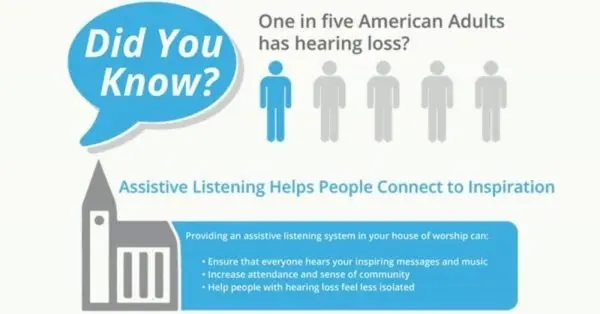
- Prevalence: Approximately 48 million Americans (roughly 1 in 5) experience some degree of hearing loss.
- Age Correlation: While hearing loss can affect individuals of any age, its prevalence increases sharply with demographic aging. In many traditional and contemporary church congregations—where older adults make up a significant percentage of regular attendees—the rate of hearing impairment can exceed 30% to 40%.
- The Isolation Factor: Unaddressed hearing loss frequently leads to social withdrawal, fatigue from struggling to comprehend speech in reverberant environments (such as large sanctuaries with high ceilings), and eventual disengagement from community life.
| Metric / Indicator | Statistical Overview | Impact on Church Communities |
|---|---|---|
| National Prevalence | ~18% – 20% of the population | Represents millions of potential churchgoers struggling with standard audio mixes. |
| Age Demographic | 1 in 3 adults over age 65; 1 in 2 over age 75 | Directly impacts core legacy members and active senior ministries within the church. |
| Acoustic Challenge | Reverberation & background noise in large spaces | Standard public address (PA) systems amplify volume, but often fail to improve clarity in echo-prone sanctuaries. |
| Social Consequence | Increased isolation and church drop-out rates | Hearing-impaired individuals quietly drift away from services due to perceived irrelevance or fatigue. |
In houses of worship, acoustic challenges are compounded by architecture. Cathedrals, modern multi-purpose auditoriums, and traditional sanctuaries often feature hard reflective surfaces (stone, wood, drywall, and glass) designed for aesthetic beauty and musical resonance. While these architectural choices create gorgeous reverberation for choirs and pipe organs, they wreak havoc on speech intelligibility. For an individual with sensory decline, turning up the main sanctuary speakers often results in louder noise rather than clearer words. An Assistive Listening System bypasses these acoustic barriers, delivering a pristine, customized audio feed directly to the listener’s ear.
Official Statements and Industry Insights
Integrating accessible audio infrastructure aligns with broader institutional standards and expert recommendations from leading audio-visual authorities and accessibility advocates.
Industry leaders emphasize that accessibility should be approached as a baseline ministry standard rather than an afterthought. As noted in resources published by Listen Technologies and integration specialists at CCI Solutions:
"Reaching out to those who feel disconnected from your community due to hearing loss is central to sharing the message of inclusion. Genuinely compassionate service involves being aware of and caring for the needs of everyone, especially those dealing with impairments. Make sure they are able to hear the beauty and emotion of the spoken word in your church by providing them with the equipment they need to stay connected."
Furthermore, acoustic engineers point out that compliance with the Americans with Disabilities Act (ADA) in public assembly spaces mandates the provision of assistive listening systems in facilities with fixed seating or audio amplification systems. Beyond legal compliance, professional audio consultants stress that modern digital signal processors (DSPs) make integrating assistive listening feeds cleaner, more reliable, and more cost-effective than ever before. Modern transmitters can interface directly with existing soundboards, ensuring that the mix sent to assistive devices is balanced, compressed for optimal speech intelligibility, and free from the room echo that frustrates listeners.
Future Outlook: The Next Generation of Acoustic Accessibility
Looking ahead, the landscape of assistive listening technology is shifting rapidly, driven by innovations in wireless communication, smartphone integration, and Bluetooth Low Energy (BLE) standards. As houses of worship plan their capital expenditures for the coming decade, several emerging trends will shape how accessibility is delivered:
1. BYOD (Bring Your Own Device) Integration
Historically, assistive listening relied exclusively on dedicated, church-owned receivers handed out by ushers. While these dedicated receivers will remain essential—particularly for seniors who may not own or prefer smartphones—the future increasingly belongs to BYOD models. Modern Wi-Fi-based assistive listening systems allow congregants to stream pristine sanctuary audio directly to their own smartphones, hearing aids, or cochlear implants via downloadable apps. This reduces hardware management overhead for church volunteers and removes the social stigma that some individuals feel when asking for a specialized device.
2. Auracast™ Broadcast Audio
One of the most anticipated breakthroughs in hearing technology is Bluetooth Auracast™. This emerging standard enables audio transmitters to broadcast high-quality sound directly to an unlimited number of compatible audio receivers, hearing aids, and earbuds simultaneously. As Auracast-enabled hearing aids become mainstream over the next several years, houses of worship equipped with compatible broadcast transmitters will be able to offer seamless, zero-latency, high-definition audio access directly to congregants’ personal hearing devices without requiring intermediary neck loops or specialized receivers.
3. Holistic Inclusion as a Growth Strategy
As society becomes more attuned to neurodiversity, physical accessibility, and sensory inclusion, churches that prioritize comprehensive accessibility will naturally stand out as welcoming communities. The future of church growth relies heavily on removing friction points for visitors. When a first-time guest with hearing loss walks into a sanctuary and immediately notices visible signage, readily available listening devices, and a staff trained to assist them, the barrier to belonging is instantly dismantled.
Conclusion and Actionable Next Steps
Investing in an Assistive Listening System is far more than a technical upgrade—it is an investment in human connection, pastoral care, and spiritual vitality. By understanding congregational needs, evaluating financial options, training dedicated hospitality ambassadors, and actively raising awareness, churches can ensure that the transformative message of their services reaches every single attendee, free from the barriers of hearing loss.
For ministry leaders, AV directors, and facility managers looking to take the next step, a wealth of educational material is readily available. To access detailed planning tools, sample congregation surveys, printable signage templates, and comprehensive rollout checklists, download a copy of the official Listen Technologies Church Assistive Listening Toolkit.
Assess your sanctuary’s current capabilities today, consult with audio-visual integration experts to explore your options, and take a decisive step toward creating a truly inclusive worship environment where everyone can hear, engage, and belong.