
Executive Overview
The intersection of musical theatre, community activism, and archival resurrection took center stage during an action-packed, star-studded weekend at the inaugural outdoor theatrical retreat colloquially known simply as "The Festival." Blending high-concept musical revues, live-broadcast radio events, and poignant cultural celebrations, the weekend offered an unfiltered look at the inner workings, historical lore, and camaraderie of the Broadway community.
From muddy fields requiring golf-cart transits to sun-drenched acoustic sets, the retreat became a crucible for rare performances, unreleased sheet music discoveries, and deeply personal reunions. Highlights included a heartfelt, digitally enabled Broadway Shabbat service, a thrilling archival excavation of a long-lost Alan Menken tune for Newsies alumnus Tommy Bracco, a masterclass in comedic theatrical history courtesy of Tony winner Kelli O’Hara, and an emotional, laughter-filled 30th-anniversary reunion of the original company of RENT.
As the theatre industry continues to navigate cultural shifts, economic pressures, and the ongoing quest for authentic community spaces, events like The Festival prove that the beating heart of the Great White Way lies not just within the grand proscenium arches of midtown Manhattan, but wherever artists and audiences gather to celebrate the enduring power of song.
Detailed Chronology: A Weekend of Theatrical Highlights
Friday Night: Broadway Shabbat and the Triumph of Jewish Joy
The weekend’s festivities commenced with an institution rapidly becoming a pillar of modern theatre culture: Broadway Shabbat. Broadcast live every Friday evening via the Jewish Broadway Alliance (JBA) digital platform, the weekly gathering was born out of a virtual crisis-management meeting. As members convened to strategize against a rising tide of antisemitism, a pivotal question emerged from the digital ether: Could the community cleanse its collective palate and dedicate space to unadulterated Jewish joy?
Thus was born a weekly tradition fusing liturgical blessings with high-belt show tunes—or, as its creators affectionately term it, "brachas and Broadway belting."
Logistical hurdles threatened the opening-night ritual when the expansive, picturesque upstate New York festival grounds proved too vast for timely pedestrian navigation. Slated co-hosts Adam Pascal and Mandy Gonzalez found themselves stranded across the property, unable to reach the candle-lighting ceremony before sundown. Stepping into the breach was writer and actor Thomas Ellenson.
Ellenson, who was born with cerebral palsy, utilizes an innovative text-to-speech communication device engineered by his father, Richard Ellenson. During the Shabbat service, Ellenson delivered the traditional bread blessing (HaMotzi) utilizing his signature digitized vocal synthesis. The moment seamlessly blended solemn tradition with lighthearted theatrical ribbing, culminating in a viral-ready video moment captured despite temperamental festival Wi-Fi constraints.
Ellenson’s presence also highlighted upcoming theatrical endeavors; his debut full-length play, Thomas and Me, is scheduled for a limited engagement at The Sheen Center from September 24 through 28, following developmental support from director Chris Hanke.
Saturday: Archival Excavations and the Newsies Audition Legend
Saturday afternoon brought a fast-paced retrospective revue showcasing performers interpreting their dream roles, debut credits, and career-defining audition numbers. Among the morning’s most anticipated appearances was Tommy Bracco, whose path to Broadway history was placed under the microscope.
In the days leading up to the event, Bracco consulted with festival music director Dan Lipton regarding a specific, highly obscure piece: an audition song from Newsies originally composed by David Zippel and Alan Menken. The number originated in Diamonds, a short-lived 1984 Broadway revue about America’s pastime directed by legendary maestro Hal Prince and featuring contributions from heavyweights like Kander and Ebb, Cy Coleman, and Comden and Green.
Because Diamonds has largely faded from mainstream theatrical memory, Zippel expressed profound shock—and immediate delight—when approached for the sheet music. Zippel connected producers with Alan Menken’s office, where archivist and music copyist Aaron Kenny successfully located a fragile, handwritten manuscript, transcribing it into pristine, performance-ready sheet music in time for the festival.
On stage, Bracco recounted his fateful audition for the 2012 Disney theatrical adaptation of Newsies. Hailing from Staten Island, a teenage Bracco queried choreographer Jeff Calhoun during a dance call in his native, unadulterated 7-1-8 regional accent. Captivated by the authentic working-class cadence, Calhoun immediately halted the room, pointing at Bracco and instructing the rest of the hopeful ensemble: "Talk like him!"
With the newly minted Menken charts in hand, Bracco recreated the exact audition combination that launched his career, punctuating the musical number with the athletic, precision-driven dance sass that later defined his eight-shows-a-week tenure on Broadway.
Saturday Night: Improv, SiriusXM, and Long Island Legends
As dusk fell, the energy shifted toward live comedy and broadcast journalism. A late-night guest spot on Don’t Quit Your Night Job—the celebrated improvisational vehicle created by The Other Josh Cohen masterminds David Rossmer and Steve Rosen—highlighted the fluid boundaries between scripted musical theatre and spontaneous comedic performance.
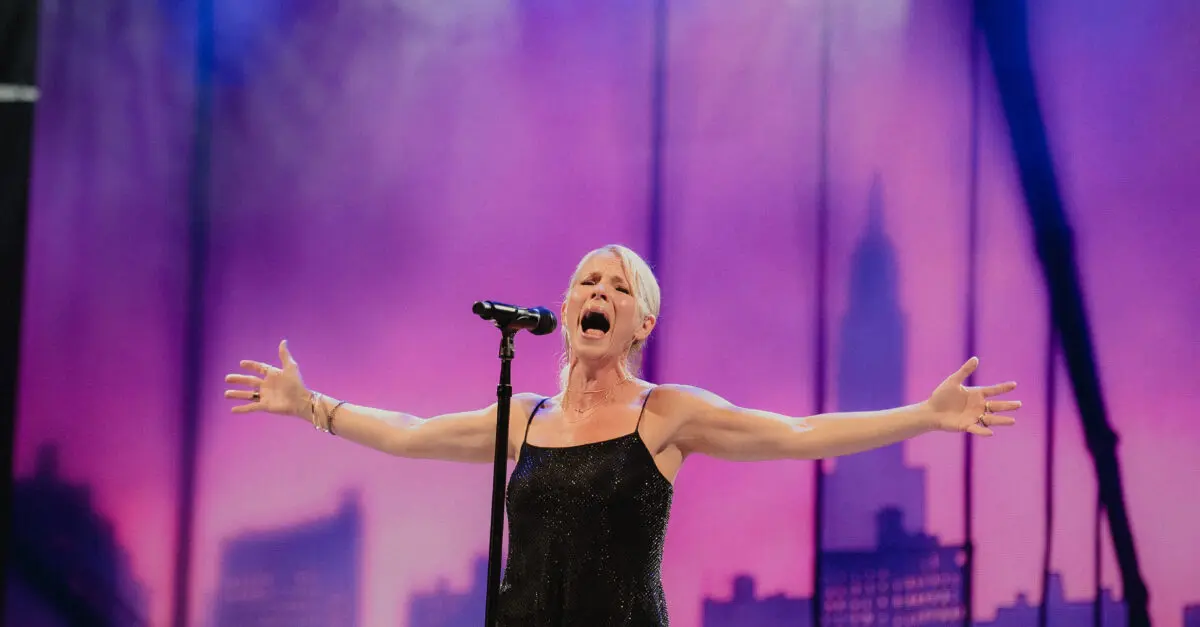
This momentum carried directly into a live, open-air broadcast of SiriusXM’s Seth Speaks, featuring a powerhouse panel comprising Kelli O’Hara, Andrea McArdle, and Adam Pascal.
O’Hara captivated the audience with a treasure trove of theatrical anecdotes, beginning with her early-career stint in the late-1990s Broadway revival of Stephen Sondheim’s Follies. Playing the role of the stage assistant to Joan Roberts—who famously originated the role of Laurie in the landmark 1943 Rodgers and Hammerstein classic Oklahoma!—O’Hara found herself caught in a delightful generational misunderstanding.
While Roberts had immortalized the sweet, gentle vocal styling of the American prairie on record, off-stage she possessed a thick, unmistakable Long Island accent indistinguishable from patrons of suburban shopping centers. Under the impression that O’Hara was her actual personal assistant rather than an actor playing one, Roberts routinely enlisted the future Tony winner to flag down taxicabs after grueling rehearsals, a charming confusion that persisted until stage management intervened.
The conversation quickly pivoted to international waters, as O’Hara detailed the strict linguistic policing she encountered while transferring her Tony-winning portrayal of Mrs. Anna Leonowens in The King and I to London’s West End. British authorities kindly informed her that the classic, mid-century Julie Andrews-esque British RP (Received Pronunciation) dialect she had adopted was historically anachronistic by several decades for the mid-19th-century setting of the musical. Faced with the choice of completely retraining her vocal placement or catching a one-way trip home on the Queen Mary, O’Hara pivoted, later demonstrating her linguistic dexterity by cycling through multiple accents—including Julie Andrews, authentic Victorian British, classic Oklahoma twain, Long Island, and pop icon Christina Aguilera—during a spontaneous rendition of "Getting to Know You."
Sunday: Orphan Reunions and the Unsung Labor of Swings
Sunday morning offered a poignant meditation on the generational lineage of Broadway child stars. Andrea McArdle, forever immortalized as the original star of Annie, was joined onstage by Stacey Lynn Brass.
The appearance sparked a nostalgic walk down memory lane regarding Beginnings, a legendary weekend showcase for young talent in New York City during the late 1970s and early 1980s. The program served as an incubator for a generation of performers, housing future Broadway luminaries including Allison Smith, Sarah Jessica Parker, and Sasha Charnin (daughter of Annie lyricist and director Martin Charnin).
When Brass—who transitioned from a swing in Annie to taking over the role of orphan Duffy—was spotted in the audience, an impromptu orphan reunion materialized on stage. McArdle delivered a stirring, stripped-down interpretation of "Maybe," accompanied by Brass stepping seamlessly back into her childhood choreography.
The festival also turned an educational lens toward the punishing, often invisible labor of theatrical swings—understudies responsible for covering multiple ensemble tracks in a production. Recalling his self-produced educational revue Broadway 101, the host demonstrated the dizzying complexity of swing life by referencing the iconic audition sequence "Hello 12, Hello 13" from A Chorus Line.
Inviting audience members to randomly "injure" a designated dancer on stage—fictional stage mishaps including dual pirouettes and catastrophic coccyx fractures—the exercise illustrated the split-second adaptability required when a swing is thrown into a production mid-performance, a role famously executed by industry veterans such as future director-choreographer Lorin Latarro.
Sunday Afternoon: The RENT 30th Anniversary Legacy
The crown jewel of the weekend arrived Sunday afternoon with a monumental, highly emotional 30th-anniversary reunion of the original company of Jonathan Larson’s Pulitzer Prize-winning rock opera, RENT.
Gathering on stage together for the first time in years, original company members—including Adam Pascal and Daphne Rubin-Vega—rekindled the revolutionary theatrical lightning that transformed American musical theatre in the mid-1990s. The cast delivered soaring renditions of signature anthems, with the title number prompting rapturous applause from industry professionals and fans alike.
The afternoon’s panel discussion yielded priceless behind-the-scenes theatrical lore. Rubin-Vega regaled the audience with memories of understudy Gilles Chiasson’s baptism by fire during his first performance in the central role of Mark Cohen. Overwhelmed by the torrential lyrical density of the opening number, Chiasson momentarily forgot the text. Rather than breaking character or halting the orchestra, Chiasson improvised entirely in melodic vocalization, substituting every single lyric of the rapid-fire opening verse with rhythmic, unwavering "da-da-da" syllables until he miraculously landed on the sole word he could remember: "Rent!"
The weekend concluded with a nod to philanthropic continuity, echoing past fundraising efforts for Broadway Cares/Equity Fights AIDS where original company members reunited to auction off intimate performances of "Light My Candle," proving that while decades have passed since the curtain first rose at the Nederlander Theatre, the community forged in New York’s East Village remains unbreakable.
Supporting Context & Metrics
The success of The Festival underscores broader demographic and economic shifts within the contemporary theatrical ecosystem:
- Digital Expansion: The Jewish Broadway Alliance’s Broadway Shabbat initiative has captured a growing digital audience, demonstrating the viability of hybrid religious-cultural programming in maintaining community ties beyond traditional geographic centers.
- Archival Preservation: The collaborative effort between musicologist Aaron Kenny, composer Alan Menken, and licensing agents to recover and transcribe Diamonds highlights the critical economic and cultural value of theatrical archival rescue work. Over 40% of mid-century musical revues remain un-transcribed or locked in physical manuscript vaults, making events of this scale vital for rediscovering lost American art.
- Understudy Visibility: Public interest in the mechanics of swings and covers has surged by an estimated 35% over the past five seasons, driven largely by social media documentation and industry advocacy highlighting the physical toll and cognitive load borne by uncredited ensemble members.
Official Statements & Industry Commentary
Reflecting on the challenges of outdoor event production and the resilience of the artistic community, organizers and participants emphasized the healing power of live performance:
"When we first started looking at the rising tide of antisemitism in our professional and personal lives, the instinct was naturally defensive. But someone asked the vital question: Can we cleanse the palette once in a while and focus purely on Jewish joy? That is what Broadway Shabbat became—brachas and belting."
— JBA Organizing Committee Statement"Finding a handwritten manuscript from the 1980s feels like unearthing theatrical archaeology. To watch Tommy Bracco step into a lost Alan Menken and David Zippel arrangement and completely own the room with a Staten Island accent is why we do this work."
— Dan Lipton, Festival Music Director
Future Outlook
As the theatrical calendar turns toward the bustling fall season, the ripples of The Festival are already being felt across New York’s cultural landscape. Upcoming highlights anchored in the ethos of the weekend include:
- September 14: A monumental, star-studded holiday concert event curated by Broadway stage manager Howie Tilkin at Symphony Space, arriving immediately following Rosh Hashana. The evening will feature performances by luminaries such as Julie Benko, celebrating the intersections of cultural heritage and musical theatre.
- September 24–28: The world premiere engagement of Thomas Ellenson’s debut full-length play, Thomas and Me, running at The Sheen Center under the direction of Chris Hanke. Industry analysts view the production as a vital step forward for disability representation in American playwriting.
Ultimately, The Festival served as a vital reminder that the DNA of Broadway is preserved not merely through institutional longevity, but through the active transmission of stories, songs, and shared laughter from generation to generation.