
Executive Overview
For centuries, the cornerstone of Western musical education has been the traditional private studio lesson—a weekly pilgrimage where students master repertoire, polish technique, and memorize sonatas. Yet, a silent crisis persists within conservatory halls, community living rooms, and university practice blocks: an overwhelming majority of instrumentalists reach advanced stages of performance while remaining functionally illiterate at the keyboard.
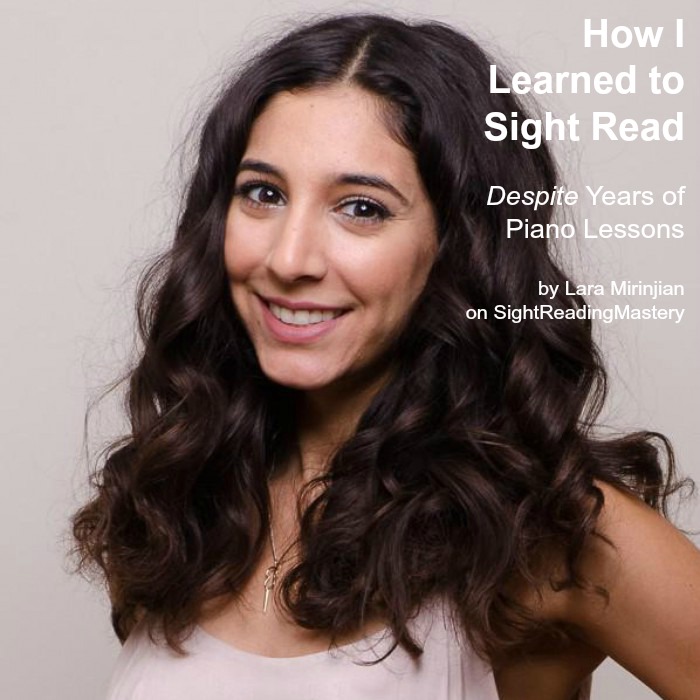
Consider the paradoxical plight of pianist and educator Lara Mirinjian, who spent over a decade undergoing formal piano instruction before realizing she could not fluidly navigate a simple level-one sight-reading book. This is not an isolated failing; it is a systemic flaw in modern music pedagogy. While virtually every educator agrees that sight-reading is a critical foundational competency, it remains conspicuously absent from standardized curricula.
Recent pedagogical investigations, including landmark studies by scholars like Dr. Dianne Hardy of Dickinson State University, confirm that most instructors bypass sight-reading entirely. The reasons range from a lack of formal training on how to teach the skill to the erroneous assumption that reading fluency will magically materialize alongside repertoire accumulation.
This report investigates the core principles of sight-reading mastery, the structural failures of traditional instruction, and a universal, principle-based methodology that is revolutionizing how pianists of all skill levels approach the printed page. By shifting the pedagogical focus from arbitrary memorization methods to foundational cognitive principles, musicians can finally dismantle the invisible barrier holding back their musical fluency.
Detailed Chronology: A Pianist’s Journey from Frustration to Fluency
To understand how a student can spend ten years studying an instrument without acquiring basic literacy, one must examine the typical developmental arc of a piano student.
Phase One: The Illusion of Progress (Years 1–5)
During the early years of formal study, young musicians rely heavily on auditory learning, physical imitation, and extended repetition. A student is assigned a piece, struggles through the notes over several weeks, and eventually memorizes the physical geography of the keyboard. To the untrained observer—and often to the parent—the student appears to be "reading" the music. In reality, the score serves merely as a mnemonic trigger for a memorized motor routine. Because the student spends months working on a handful of pieces, true real-time processing of musical notation is bypassed entirely.
Phase Two: The Impasse of Complexity (Years 6–10)
As the repertoire advances into intermediate and early-advanced territory (such as Bach inventions, Clementi sonatinas, or Chopin nocturnes), the time required to learn a single piece expands dramatically. A student who has never developed fluent sight-reading finds themselves trapped in a bottleneck. Every new assignment requires an agonizingly slow, note-by-note decoding process. Frustration mounts, practice sessions become exhausting, and students with neurodivergent traits, such as ADD, often find the fragmented nature of traditional learning entirely overwhelming.
Phase Three: The Discovery of Pedagogical Principles
It was precisely at this crossroads of professional stagnation that Lara Mirinjian encountered an instructor who fundamentally understood the architecture of sight-reading. Rather than assigning complex pieces to be labored over for weeks, the new instructor stripped the process down to its barest neurological and mechanical components.
The breakthrough did not rely on a proprietary, trademarked curriculum, but rather on timeless pedagogical axioms. By returning to absolute beginner material—regardless of the student’s actual performance level—and enforcing strict operational boundaries (such as playing a piece a maximum of two times before moving on), Mirinjian experienced exponential growth. This methodology bridged the gap between passive notation recognition and active, real-time musical execution.
Supporting Context & Metrics: The Pedagogical Blind Spot
The anecdotal struggles of individual pianists are heavily substantiated by academic research into music education. The systematic omission of sight-reading instruction from mainstream syllabi is well-documented within university departments of music.

The Hardy Study on Piano Pedagogy
In her comprehensive research on the instruction of sight-reading at the piano, Dr. Dianne Hardy surveyed numerous collegiate and private instructors to determine why sight-reading receives such scant attention in weekly studios. The findings exposed a deeply entrenched cycle of pedagogical avoidance:
- Pedagogical Ignorance: The vast majority of surveyed teachers admitted they did not include structured sight-reading in their programs simply because they had never been taught how to instruct it. Standardized method books frequently lack sequential, incremental guides for developing the skill independently of repertoire.
- The "Osmosis" Fallacy: Many educators operated under the assumption that sight-reading is not a discrete skill, but rather an automatic byproduct of learning standard repertoire. They believed that exposure to music over years of lessons would naturally cure reading deficiencies.
- The Cycle of Incompetence: Perhaps most candidly, a notable percentage of surveyed instructors confessed that they avoided teaching sight-reading because they were, by their own admission, exceptionally poor sight-readers themselves.
The Cost of Illiteracy
This widespread pedagogical oversight produces a generation of musicians who are essentially "performing parrots"—capable of executing complex motor tasks after months of grueling practice, but entirely helpless when handed an unlearned score in a collaborative or professional setting. For accompanists, chamber musicians, and church organists, this deficiency is career-limiting. For recreational players, it strips away the spontaneous joy of sitting down and exploring new literature at will.
Official Statements & Methodological Frameworks
To dismantle the barriers surrounding sight-reading, educators must return to first principles. As philosopher Ralph Waldo Emerson famously observed: "As to methods there may be a million and then some, but principles are few. The man who grasps principles can successfully select his own methods. The man who tries methods, ignoring principles, is sure to have trouble."
Applying this philosophy to the piano requires adhering to strict operational guidelines that force the brain to process visual information without falling back on the crutch of memorization.
The Foundational Principles of Sight-Reading Mastery
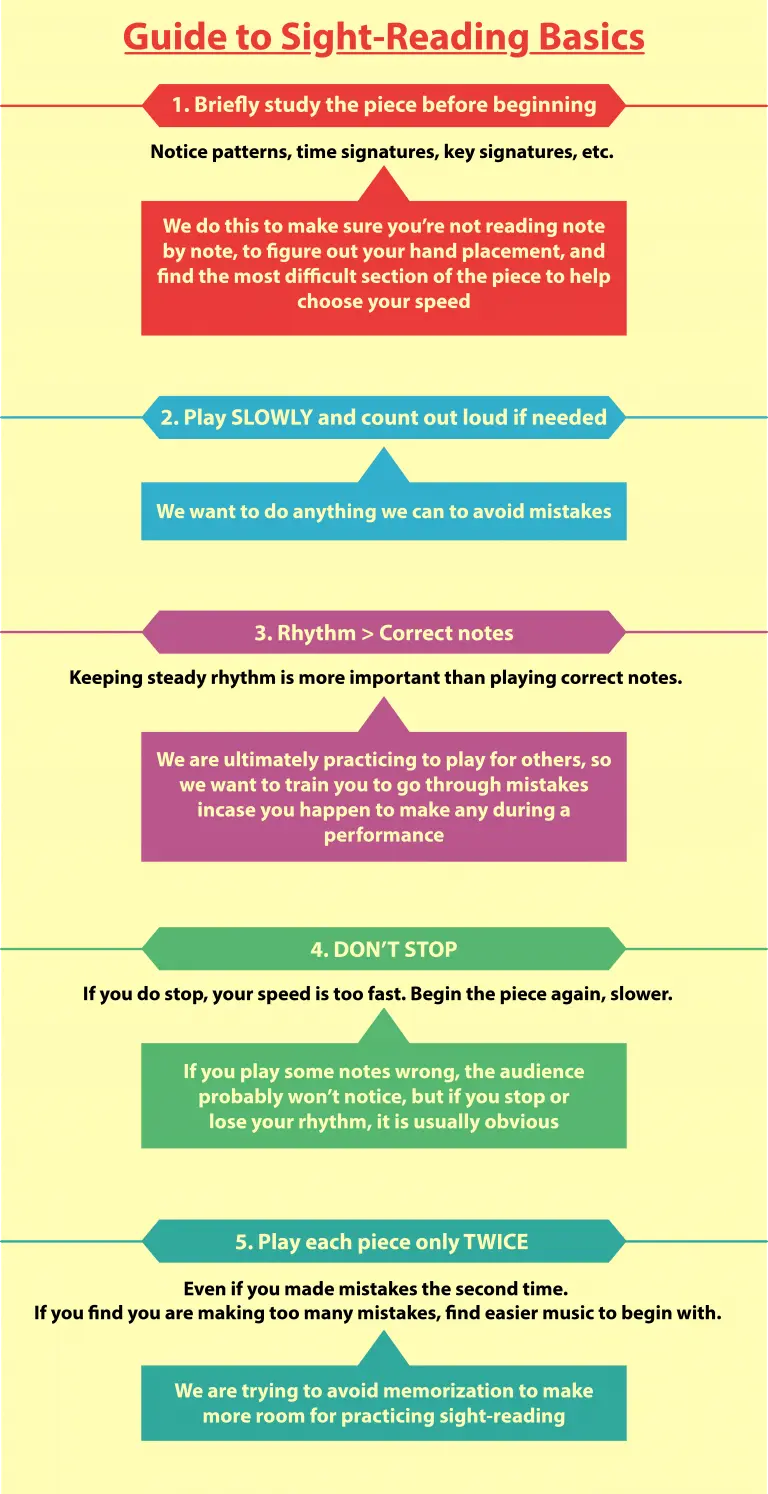
- Start at the Absolute Beginning: Even advanced pianists must routinely drop down to elementary-level material—sometimes books designed for absolute beginners. This allows the cognitive load to shift entirely from physical execution to visual processing.
- The Two-Play Rule: A piece of sight-reading material should never be played more than twice. The first reading forces real-time visual tracking; the second reading allows for the integration of immediate corrections. A third reading crosses the threshold into memorization, rendering the exercise useless for sight-reading development.
- Prioritize Rhythm Over Perfection: Stopping mid-measure to correct a wrong note destroys the forward momentum essential to fluent reading. The pulse must be maintained at all costs.
A Step-by-Step Practical Implementation Guide
Translating these principles into daily practice requires a disciplined, step-by-step routine. Whether working from physical sheet music or a digital tablet, pianists can utilize the following protocol:

- Preparation and Scanned Overview: Place the piece on the music stand. Before playing a single note, scan the score visually to identify patterns, recurring motifs, and structural landmarks (e.g., repeated pitches, stepwise motion, or leaps).
- Establish the Metric Pulse: Determine the time signature and begin counting out loud in a steady, unyielding tempo (e.g., 1, 2, 3, 4).
- Physical Placement: Position the hands correctly over the keyboard with fingers resting on the home-position keys dictated by the opening measure.
- The Zero-Stop Execution: Begin playing at an excruciatingly slow, deliberate tempo. If a wrong note is struck, do not stop. If a reading hesitation threatens to halt progress, slow the tempo down even further on the next attempt, but maintain the unbroken flow of time.
- The Second and Final Iteration: Upon reaching the end of the piece, pause briefly to mentally catalog any errors or misread intervals. Play through the piece one final time, integrating those corrections while preserving the steady pulse.
- Immediate Progression: Immediately close or turn the page. Never dwell on the piece; move directly to the next elementary composition and repeat the cycle.
Future Outlook: Reimagining Musical Education
As music pedagogy continues to evolve in the 21st century, the approach to literacy at the keyboard is undergoing a necessary renaissance. The integration of digital tools—such as tablet-based annotation apps, interactive sight-reading software, and vast online repositories of public-domain literature—has made accessing graded, elementary material easier than ever before.
However, technology alone cannot replace methodological discipline. The future of piano education depends on instructors and institutions embracing sight-reading not as an optional, secondary extracurricular activity, but as the foundational bedrock of all musical literacy.
For the millions of pianists who have suffered silently behind years of unread scores, the message is clear: fluency is not an innate genetic trait reserved for the musical elite. It is a trainable cognitive reflex built upon the deliberate, systematic application of fundamental principles. By shedding ego, returning to the simplest building blocks of notation, and honoring the sacred rule of forward momentum, any musician can unlock the door to lifelong fluency and discover the true liberation of reading music at sight.