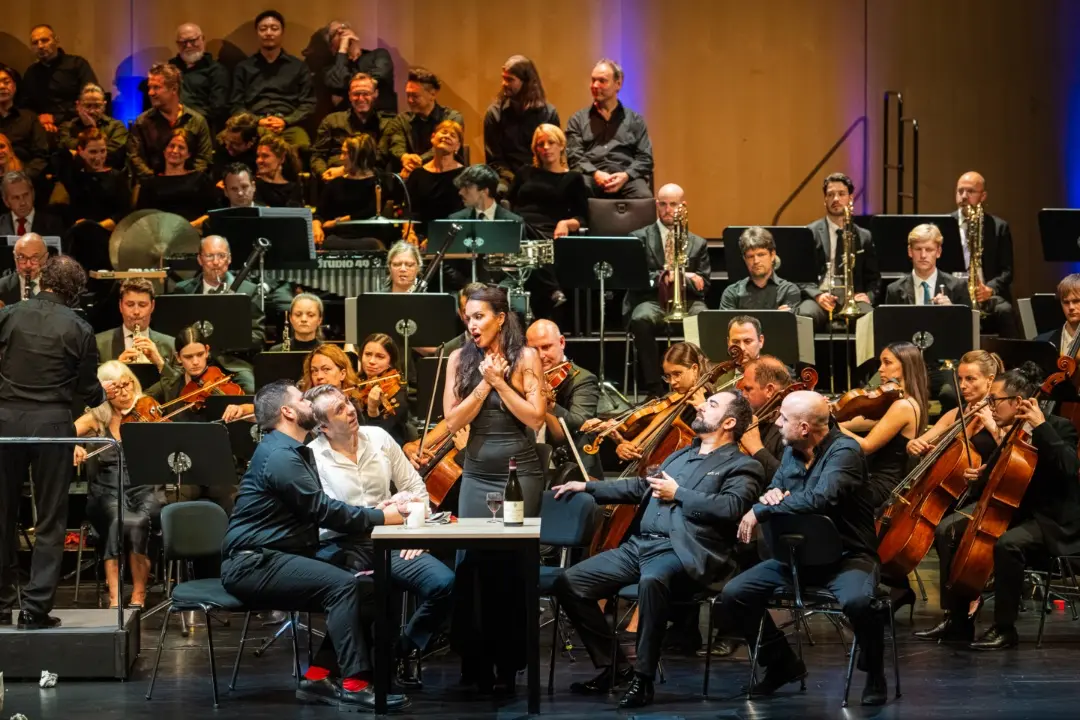
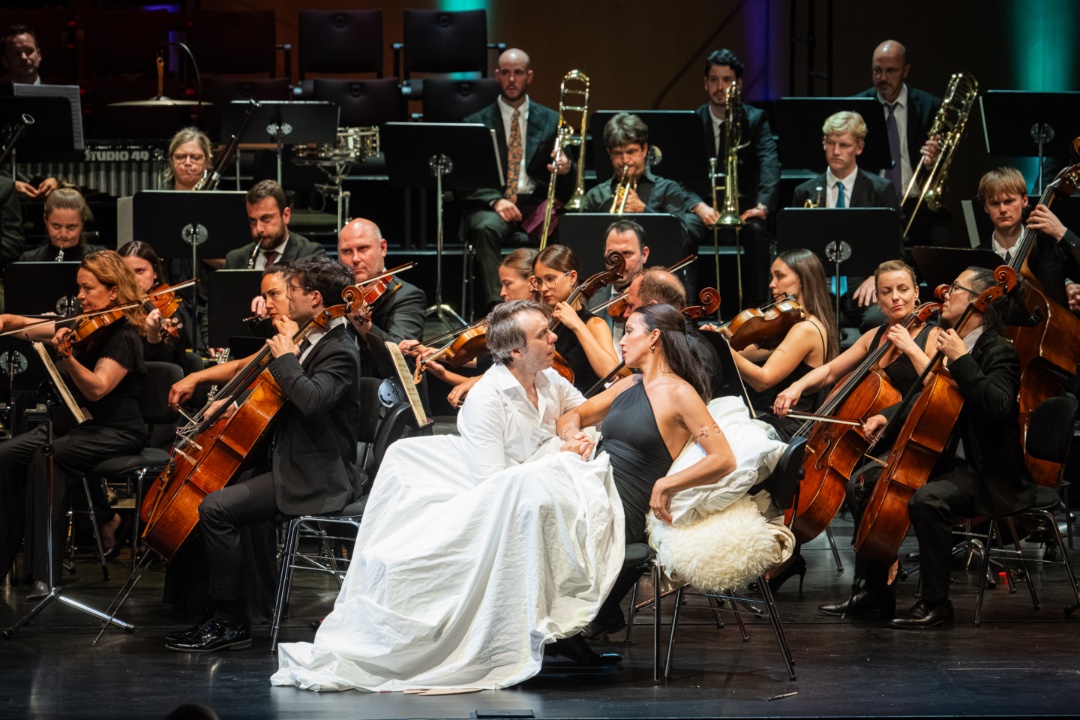
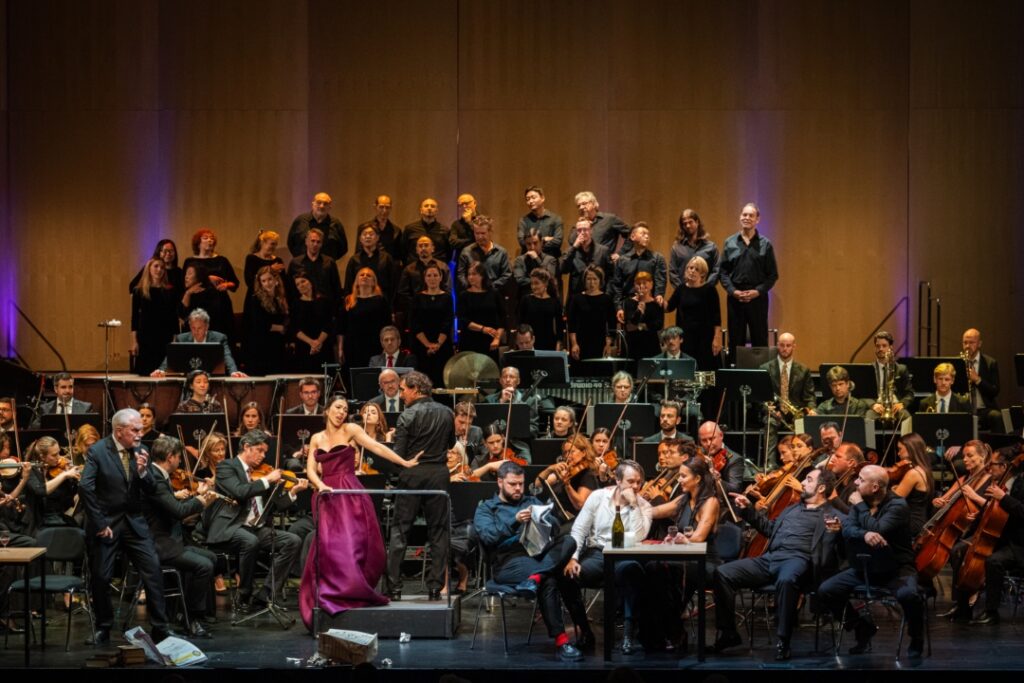
On August 23, the prestigious Baden-Baden Festival hosted a high-profile, one-off concert performance of Giacomo Puccini’s timeless masterpiece, La Bohème. Under the musical direction of acclaimed maestro Marco Armiliato, the production brought together a stellar lineup of vocalists, featuring tenor Benjamin Bernheim as Rodolfo, alongside sopranos Carolina López Moreno as Mimì and Sandra Hamaoui as Musetta.
However, what was intended to be a routine evening of world-class opera quickly devolved into a high-stakes theatrical nail-biter. Stricken by a sudden and debilitating bout of the flu, star tenor Benjamin Bernheim suffered a catastrophic loss of vocal range mid-performance. Forced to apologize to a stunned auditorium, Bernheim withdrew from singing entirely.
With the evening on the brink of catastrophic cancellation, fate intervened in the most cinematic fashion imaginable. American tenor Andrew Owens, coincidentally seated in the audience as a spectator, was thrust into the spotlight. In an unprecedented display of professional camaraderie and split-second crisis management, Owens took over the vocal duties from the edge of the stage, while a silent Bernheim continued to act the role in front of the orchestra. This extraordinary eleventh-hour rescue saved the performance, turning an otherwise tragic disruption into an unforgettable legend in the annals of modern opera history.
Detailed Chronology: The Anatomy of an Accidental Triumph
Act I: The Gathering Storm and the Unraveling
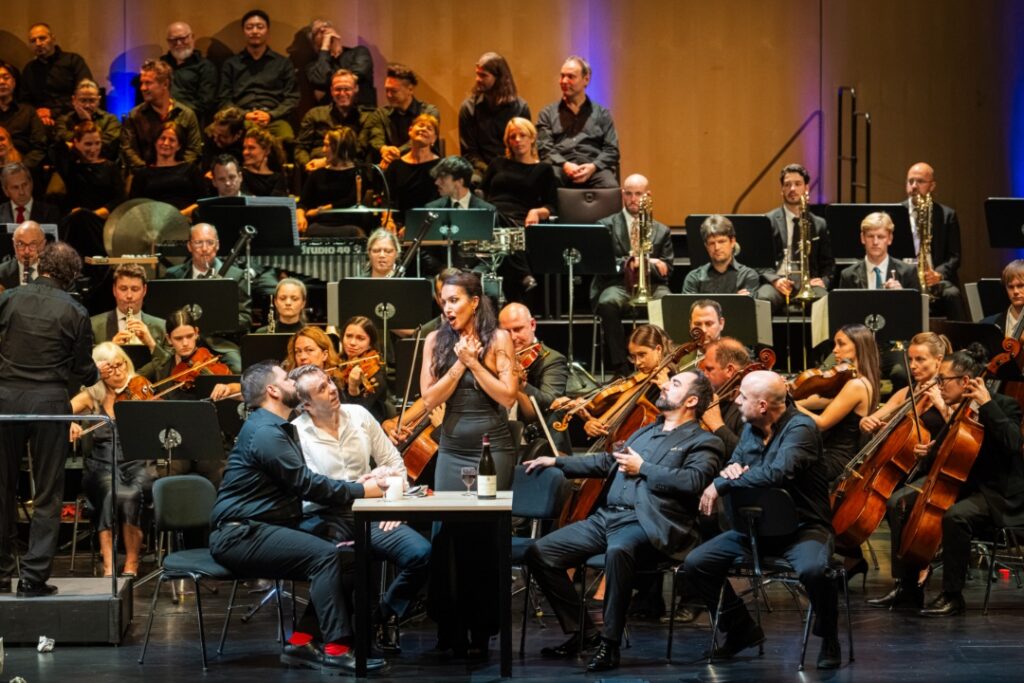
The performance began with the stripped-down aesthetic of a concert version. Devoid of elaborate sets and heavy stagecraft—relying instead on a sparse arrangement of chairs, a few baguettes, a bottle of wine, and a book—the minimalist staging focused the audience’s attention squarely on the sextet of main characters and the exceptional musicianship of the orchestra.
The camaraderie among the bohemian quartet of friends—Rodolfo, Marcello, Schaunard, and Colline—was immediately palpable. Baritones Lodovico Filippo Ravizza (Marcello) and Biagio Pizzuti (Schaunard) delivered powerful yet nuanced vocal timbres during the opening comic scene, in which the friends outwit their landlord, Benoît. This lighthearted banter effortlessly foreshadowed the tragic undertones of Mimì’s impending fate.
Yet, behind the scenes, a physical crisis was brewing. Benjamin Bernheim, battling a severe flu, was visibly straining. As the evening progressed, his vocal apparatus simply gave out. Facing an irretrievable loss of vocal range, Bernheim made the courageous yet heartbreaking decision to stop singing mid-performance and apologize to the bewildered audience.
Act II: The Miraculous Intervention
With the production teetering on the edge of collapse, the festival administration faced a worst-case scenario. Enter Andrew Owens. Sitting innocently in the auditorium as a member of the public, Owens—an accomplished American tenor—was quickly identified, approached, and thrust into the role of savior.
In a bizarre yet mesmerizing theatrical compromise, Owens positioned himself at the edge of the stage to deliver the vocal heft of Rodolfo, while Bernheim gallantly remained onstage, acting out the character in complete silence.
This unusual division of labor introduced an unexpected artistic dynamic. Owens’s voice took on a distinctive sprechgesang quality, lending Rodolfo a layer of maturity and worldly wisdom that contrasted intriguingly with the youthful exuberance of his bohemian peers. Music critics and audience members alike noted one structural regret: the omission of Rodolfo’s iconic first-act aria, “Che gelida manina!” Its absence created a slight imbalance in the score’s architecture, robbing Owens of a fuller canvas to showcase his vocal prowess beyond his second-act duet with Mimì at Café Momus.
Act III & IV: Vocal Dominance and Tragic Resolution
As the opera pressed forward under Armiliato’s steady baton, the production became notably dominated by its formidable soprano leads.
Carolina López Moreno delivered a masterclass in vocal control as Mimì. While her interpretation occasionally lacked a degree of suppleness and tenderness—skewing the teenage embroiderer toward an overly lofty demeanor rather than humble vulnerability—she navigated her arias with pristine technical mastery. From the sweeping, dreamy expanses of “Sì, mi chiamano Mimì” (specifically the luminous delivery of “ma quando vien lo sgelo”) to the harrowing final act where her breath visibly waned and faded, Moreno commanded the stage. Her final scene served as a devastating, tragic mirror to her first-act entrance.
Meanwhile, Sandra Hamaoui’s portrayal of Musetta was nothing short of a revelation. Hamaoui infused the role with a profound, multi-dimensional humanity. She captured Musetta’s signature coquettishness, pride, and frivolity, but balanced them with deep anxiety and fierce loyalty. The emotional arc of her character—progressing from the biting sarcasm of “Marcello mi vide… Non mi guarda, il vile!” in Act II to the desperate, prayerful plea of “Madonna benedetta, fate la grazia a questa poveretta” in the final act—was executed with breathtaking precision.
The emotional climax of the evening was further amplified by bass Gianluca Buratto as Colline. His rendition of the famous fourth-act aria “Vecchia zimarra, senti,” in which Colline bids farewell to his trusty overcoat, was utterly spellbinding. Buratto’s almost cavernous tone resonated with a helpless, devastating humanity, perfectly encapsulating the group’s grief over Mimì’s death.
Supporting Context & Metrics: A Reimagined Puccini
Conductor Marco Armiliato’s Wagnerian Lens
Beyond the dramatic off-stage rescue, the evening’s musical success rested heavily on the visionary approach of conductor Marco Armiliato. Traditionally, Puccini’s works are viewed exclusively through the prism of the native Italian verismo tradition. Armiliato, however, boldly challenged this convention by weaving distinct Wagnerian influences into the fabric of the score.
This stylistic synthesis manifested in several key ways:
Instrumental Colorization: Armiliato brought the diverse tonal palette of the orchestra to the forefront. The brass and percussion sections in Act II were delivered with a crystalline, militaristic precision, while the strings in Act I radiated a carefully crafted, lush sensuality reminiscent of late-Romantic German traditions.
Leitmotif Treatment: The handling of thematic motifs—most notably Mimì’s recurring musical theme—owed a heavy debt to Wagnerian leitmotif techniques. Rather than alienating the audience, this approach offered a fresh, intellectualized lens through which to experience Puccini’s melodic genius.
Production Metrics at a Glance
Date of Performance: August 23
Venue: Baden-Baden Festival (One-off concert performance)
Conductor: Marco Armiliato
Original Tenor (Acting): Benjamin Bernheim (Rodolfo)
Emergency Replacement Tenor (Vocals): Andrew Owens (Rodolfo)
Leading Sopranos: Carolina López Moreno (Mimì), Sandra Hamaoui (Musetta)
The unprecedented nature of the Baden-Baden emergency has sent ripples through the international classical music community, prompting discussions regarding artist health, emergency protocol, and the sheer unpredictability of live performance.
Festival organizers released a brief yet deeply appreciative statement following the curtain fall:
"We extend our profound gratitude to Mr. Benjamin Bernheim for his immense professionalism and dedication in staying with the production under physical duress. Above all, we owe an immeasurable debt of thanks to Mr. Andrew Owens, whose spontaneous willingness to step from the audience onto the stage saved a historic evening of music. This is the true spirit of opera—community, adaptability, and passion."
Colleagues and arts commentators have similarly flooded social media and trade publications, praising the rare instance of an audience member stepping into a principal role mid-show. Industry insiders note that while understudies are standard for scheduled replacements, an impromptu "audience-to-stage" intervention of this caliber is a once-in-a-generation occurrence.
Future Outlook: Legacy of the Baden-Baden Bohème
As the dust settles on the Baden-Baden Festival, the August 23 performance of La Bohème has transcended its status as a simple summer concert. It will be chronicled in opera lore not merely for its musical merits—though Armiliato’s Wagnerian reinterpretation and the stellar work of the supporting cast are worthy of high praise—but as a testament to the resilience of the performing arts.
For Benjamin Bernheim, the evening serves as a sobering reminder of the physical vulnerabilities artists face during grueling international schedules. For Andrew Owens, it marks an unforgettable career milestone: the night a casual ticket-holder became an accidental hero. And for the fortunate audience members in attendance, they witnessed firsthand the magic of live theater—where human frailty is met with instantaneous, heroic grace.