
Executive Overview
While Berlin frequently commands the spotlight as Germany’s cultural heartbeat, the historic city of Cologne holds a quieter, yet arguably more prestigious, the true jazz capital of the nation. Boasting a rich, decades-long tradition, a fiercely vibrant local scene, and an extraordinary ecosystem of avant-garde venues, Cologne has long served as a European laboratory for exploratory improvised music. It is within this fertile soil that Cologne Jazzweek—inaugurated as recently as August 2021—has rapidly blossomed into a cornerstone of the international jazz calendar.
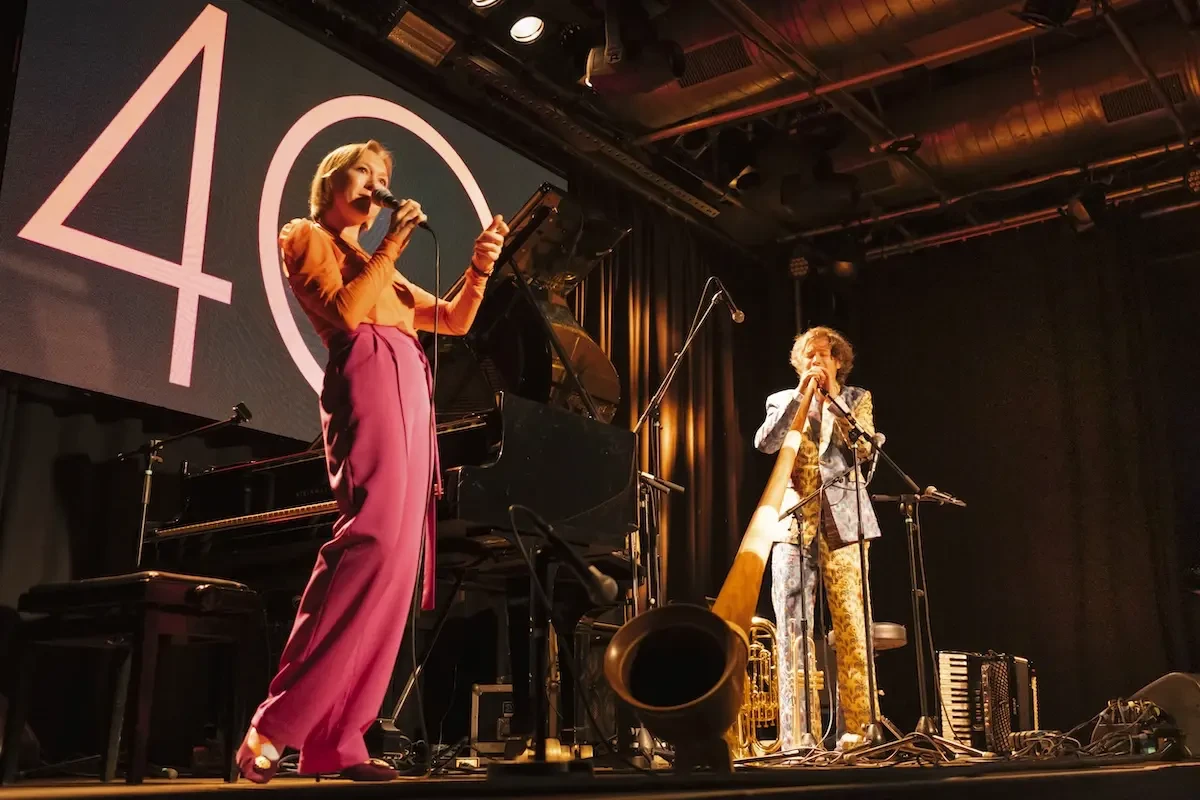
The most recent iteration of the festival arrived freighted with profound historical significance, preceded immediately by a major cultural milestone: the Stadtgarten, one of the city’s most revered and legendary jazz institutions, celebrated its 40th anniversary. To honor four decades of boundary-pushing curation, the legendary venue kicked off the festivities with an ambitious, all-night marathon of free indoor and outdoor performances on the eve of the festival.
Spanning several days of immersive musical exploration, this year’s Cologne Jazzweek pushed the boundaries of traditional festival programming. By deliberately dissolving the boundaries between traditional concert halls, sacred architecture, urban parks, and hidden subterranean clubs, the festival offered an exhaustive masterclass in acoustic architecture. From Norwegian avant-garde trumpeters channeling the ethereal elements to daring free-improvisation duos stretching the physical limits of acoustic sound, Cologne once again proved that its jazz culture is not merely preserved in aspic, but actively, dynamically evolving. This comprehensive report chronicles the events, performances, and institutional milestones that defined a memorable week of music along the banks of the Rhine.
Detailed Chronology: A Symphony Across the City
Friday, September 4: The Stadtgarten’s Ruby Jubilee
The pre-festival celebrations commenced on Friday, September 4, as a bustling crowd converged on the Stadtgarten complex. Despite a persistent, drizzling rain that threatened to dampen the opening hours, upwards of 20 distinct performances unfurled across the venue’s multiple indoor and outdoor stages.
The programming offered a fascinating cross-section of contemporary European jazz, juxtaposing Nordic minimalism with the robust virtuosity of the local North Rhine-Westphalia scene. Outdoors, Norwegian trumpeter Nils Petter Molvær mesmerized the damp evening air with his signature blend of ambient trumpet and electronic soundscapes. Indoors, his compatriots—trumpeter Arve Henriksen and guitarist Stian Westerhus—delivered a contrasting study in breathy lyricism and distorted sonic textures.
However, the local Cologne scene remained the beating heart of the evening. Saxophonist Niels Klein took to the stage with his tightly knit trio, featuring double bassist Robert Landfermann and drummer Jonas Burgwinkel. For this special anniversary showcase, the trio was augmented by harpist Kathrin Pechlof as a special guest, whose delicate plucking brilliantly subverted the traditional role normally assigned to a piano in a contemporary jazz trio.
Saturday, September 5: The Green Walk and Architectural Acoustics
The following afternoon, Cologne Jazzweek expanded its spatial footprint, inviting festival-goers to experience the city on foot through its celebrated "green walk" concept. The underlying philosophy was disarmingly simple yet profoundly effective: first walk, then receive music as a reward.
Near a picturesque parkland, an outdoor stage played host to Matthias Schriefl and Johannes Bär, two virtuosos who shattered the archaic, folkloric clichés associated with the alphorn. Far from being one-note novelty acts, Schriefl and Bär proved to be multi-instrumental polymaths equally adept on the tuba, trumpet, and accordion. Dressed playfully in clown-like attire, Schriefl executed a jaw-dropping routine involving three instruments simultaneously. The performance possessed a surreal, almost elemental quality: the swaying trees seemed to bend toward the melodies, while the soaring notes threatened to lift entirely off the stage, requiring quick-witted intervention from the beleaguered sound engineer.
As the set wound through a series of whimsical original compositions, vocalist and pianist Tamara Lukasheva joined the duo, injecting crystalline yodels that instantly conjured the jagged peaks of the distant Alps—a humorous touch, given that Cologne’s topography is notably flat, save for a modest hill in a nearby park. The audience dutifully followed the musicians to this summit to conclude the open-air session.
Sacred Spaces and Ambient Sonic Explorations
Relocating to the historic Neu St Alban church, the festival offered an entirely different, meditative paradigm of listening. Damian Dalla Torre’s trio—featuring Babett Niclas on harp and Markus Rom on electric guitar—crafted an atmospheric tapestry of ambient jazz infused with subtle electronics and field recordings of bird song. The music drifted gently toward the ethereal, presenting listeners with a quiet existential choice: surrender to deep relaxation, perhaps even slipping into a peaceful nap, or wander onward in search of more active stimuli.
In a neighboring ecclesiastical venue, harpist Kathrin Pechlof resurfaced alongside saxophonist Christian Weidner and bassist Robert Landfermann. Framed sharply in black attire against a towering, austere white wall, the trio delivered an uncompromising masterclass in chamber jazz. Their notes ascended toward the vaulted ceilings like secular prayers, transforming the recital into a profound musical sermon.
Meanwhile, back at Neu St Alban, organist Janis Nicolas filled the nave with rich harmonic drones, while Luxembourg vibraphonist Arthur Clees and Ukrainian vocalist Kateryna Kravchenko performed from a high side balcony. Once again, the city’s architectural heritage was seamlessly co-opted as an active participant in the compositional framework.
Sunday, September 6: Gothic Landmarks and Subterranean Avant-Garde
Sunday broke under a brilliant, cloudless sky. The majestic Cologne Cathedral—the city’s undeniable Gothic landmark—served as a breathtaking backdrop for a morning promenade along the Rhine. While the monument’s soaring spires continue to inspire awe, its immediate vicinity remains a sobering testament to intrusive, aesthetically challenged modern urban planning, proving that even UNESCO World Heritage sites are not entirely immune to civic growing pains.
True to form, the festival refused to leave the cathedral un-musicalized. Matthias Schriefl and Johannes Bär ascended the dizzying stone steps toward one of the cathedral towers, projecting soaring trumpet and tuba lines high above the bustling streets before embarking on another ambulatory musical journey down to the riverbanks.
The Loft: High-Altitude Improvisation
As evening descended, the pilgrimage led to The Loft, another mythical institution in Cologne’s underground jazz lore. Reaching the venue requires scaling a seemingly endless, lung-burning staircase that deposits visitors into an intimate, high-altitude loft space. Here, two titanic figures of modern improvised music were poised to perform: British saxophonist Evan Parker and American trumpeter Peter Evans.
Both artists are legendary for pushing their instruments past traditional acoustic boundaries. Parker, a pioneer of circular breathing, weaves continuous, shimmering sheets of polyphonic sound, while Evans operates as an incendiary, hyper-virtuosic foil. Together, they generated dense, hypnotic sonic textures that frequently fooled the ear into suspecting live electronic manipulation.
The sheer intensity of the performance proved almost too much for the room to bear. In a testament to the visceral nature of the music, a member of the audience fainted, prompting a brief, necessary pause in the concert as medical assistance was summoned.
Late-Night Virtuosity: Bernstein and Kintopf
Benefiting from the brief intermission, this reporter managed to slip away and navigate back to the Stadtgarten just in time to catch the final 30 minutes of Peter Bernstein’s set. The esteemed American jazz guitarist was leading a formidable, star-studded quartet featuring the brilliant rising-star pianist Sullivan Fortner. Bernstein effortlessly bridged the gap between timeless standards and fresh original compositions. Although Fortner’s formidable improvisational voice was occasionally restrained by the tight setlist, the concert reached a thunderous crescendo with Dissipation Blues. Far from dissipating the crowd’s energy, the performance elicited a rapturous ovation, coaxing Bernstein back to the stage for an inspired encore: a rarely heard calypso titled Newark News, originally penned by the legendary Sonny Rollins, with whom Bernstein had shared stages decades prior.
The night’s final chapter unfolded in Jaki, the subterranean, club-oriented intimate room nestled within the Stadtgarten complex. Bassist Roger Kintopf led a stellar trio featuring drummer Sun-Mi Hong and guitarist Emmanuel Michael. The staging was delightfully informal; Michael sat casually on the edge of the stage right next to the audience, dressed as though he were still performing out in the afternoon park. This radical physical proximity amplified the emotional resonance of the performance. As midnight approached, complex original compositions tumbled forth in rapid succession, marking a bittersweet conclusion to an unforgettable weekend.
Supporting Context & Metrics
To fully appreciate the cultural weight of Cologne Jazzweek and the Stadtgarten’s anniversary, one must examine the broader economic and infrastructural ecosystem that supports Cologne’s musical preeminence.
| Metric / Indicator | Contextual Data |
|---|---|
| Stadtgarten Anniversary | 40 years of continuous cultural curation (Established 1984; major renovations planned for 2028). |
| Cologne Jazzweek Inception | Inaugurated in August 2021; rapidly scaling to a multi-day international festival format. |
| Opening Night Scale | Approximately 20 distinct concerts hosted within a single evening across the Stadtgarten indoor and outdoor complexes. |
| Venue Diversity | Spans traditional concert halls, historic churches (e.g., Neu St Alban), architectural monuments (Cologne Cathedral), urban parks, and underground clubs (The Loft, Jaki). |
| Artistic Spectrum | Ranges from Norwegian ambient jazz and avant-garde chamber improvisations to post-bop guitar quartets and folk-infused alphorn performances. |
Official Statements and Institutional Perspectives
Reflecting on the milestone 40th anniversary of the Stadtgarten, venue directors and municipal cultural authorities emphasized the vital symbiosis between grassroots artist communities and civic institutional support.
"For four decades, the Stadtgarten has served as more than merely a venue; it has been a living, breathing laboratory for ideas, a home for wandering spirits, and a vital crossroads where local tradition meets international innovation," noted a spokesperson for the Stadtgarten cultural foundation. "That Cologne Jazzweek has integrated so seamlessly into this landscape proves that our jazz culture is not a museum exhibit, but a continuously regenerating organism."
Festival organizers echoed these sentiments, pointing out that despite the festival’s relative youth—having only launched in the shadow of the global pandemic in 2021—it functions less like an imported cultural spectacle and more like an organic outgrowth of decades of localized community building.
Future Outlook
As the applause fades along the Rhine, the cultural apparatus of Cologne is already looking toward the horizon. While the festival continues to cement its reputation as one of Europe’s most adventurous contemporary jazz gatherings, infrastructural realities loom large. The venerable Stadtgarten building itself, having faithfully served the community for forty years, is slated for a comprehensive structural renovation project scheduled to commence in 2028.
Local cultural commentators have wryly noted the immense historical irony of construction timelines in Cologne: while the city’s iconic Cathedral notoriously took 632 years to reach completion, local arts administrators have expressed confident optimism that the Stadtgarten renovations will proceed with considerably greater alacrity.
In the interim, the venue—and the broader coalition of spaces powering Cologne Jazzweek—remains firmly committed to its historic mandate: providing an uncompromising platform where fearless musicians, attentive audiences, and radical ideas can intersect. As Cologne Jazzweek prepares for future editions, it stands on foundations as immovable as the ancient stones of the city, ensuring that the avant-garde spirit of European jazz will continue to thrive along the Rhine for generations to come.