
Executive Overview
For decades, the cultural memory of jazz pianist Bill Evans has been anchored by the crystalline beauty of his phrasing, the revolutionary interplay of his legendary 1961 trio, and a haunting, romanticized melancholy. Yet, in Everybody Digs Bill Evans, director Grant Gee and screenwriter Mark O’Halloran strip away the gloss of standard music biographies to deliver a searing, docudramatic excavation of trauma, addiction, and creative paralysis.
Based on Owen Martell’s acclaimed 2013 novel Intermission, the film bypasses a conventional cradle-to-grave biopic structure. Instead, it zeroes in on the cataclysmic pivot point of Evans’s life: the sudden, tragic death of his trio’s visionary bassist, Scott LaFaro, in a 1961 car crash. What follows is not merely a tale of grief, but a harrowing exploration of how substance abuse, familial friction, and crushing expectations can hollow out a transcendent artistic talent.
Anchored by a remarkable lead performance from Anders Danielsen Lie and bolstered by striking stark-contrast cinematography by Piers McGrail, the film has already earned critical acclaim, including the prestigious Silver Bear for Best Director at the Berlin International Film Festival. Eschewing the easy tropes of musical biopics—most notably by withholding Evans’s own music for the vast majority of its runtime—Gee crafts a bleak, universal meditation on self-destruction and the heavy cost of genius.
Detailed Chronology: The Spiral of Silence and Loss
To understand the universe of Everybody Digs Bill Evans is to understand a timeline fractured by sudden loss and sustained decay. The film’s non-linear narrative reflects the paradoxical state of dormancy Evans entered following LaFaro’s death at age 25.
The Catalyst: The Village Vanguard and the Loss of LaFaro
The film opens with a visceral burst of creative lightning: a 1961 recording session at New York’s Village Vanguard featuring Evans, LaFaro, and drummer Paul Motian. This brief sequence captures jazz history in the making—the exact crucible that produced two seminal, genre-defining albums: Sunday at the Village Vanguard and Waltz for Debby.
Yet, this zenith immediately precedes the nadir. LaFaro’s fatal car accident plunged Evans into a profound creative silence. Beyond the emotional devastation, Evans recognized that the specific alchemy of that trio—driven largely by LaFaro’s groundbreaking counter-melodic bass work—was irreplaceable. The pianist stopped playing entirely for a period, acutely aware that he was on the cusp of a total revolution in the jazz-piano trio format, only to watch the primary architect of that breakthrough vanish overnight.
The Florida Interlude and Domestic Shadows
Seeking recovery, a depleted Evans retreats to his parents’ home in Florida. Here, the film lays bare the generational trauma and tacit friction that shaped the pianist.
Viewers witness raw, uncomfortable encounters:
- Harry Sr. (Bill Pullman): During a forced "cold turkey" intervention, Evans’s father confesses that his retirement was bought at the price of an imprisoning, non-creative life of toil—going so far as to scrub his hands raw to avoid appearing uncouth to his wife.
- Family Dynamics: Evans’s mother, herself a talented pianist, abandoned the instrument because her husband could not resist singing along over-enthusiastically. This domestic claustrophobia is underscored in a painfully mawkish scene where Harry Sr. and his friends drunkenly lurch through an a cappella rendition of the Londonderry Air.
- Harry Jr. (Barry Ward): Bill’s loyal yet deeply envious, schizophrenic brother struggles with the shadow of Bill’s genius. The relationship is a fraught mixture of protective love and festering resentment over who possessed the true gift.
The Flash-Forwards: An Inevitable Trajectory
While the core of the narrative circles the immediate aftermath of LaFaro’s death, Gee employs garish, jolting bursts of color for three flash-forward episodes that map out the tragic terminus of the principals:
- 1973: The definitive break with his long-term partner and fellow addict, Ellaine Schultz, culminating in her harrowing suicide on the New York City subway.
- 1979: The suicide of his brother, Harry Jr., overwhelmed by the demons of mental illness and the psychological weight of the family dynamic.
- 1980: Bill Evans’s own death at age 53, officially attributed to complications from protracted substance abuse, including cirrhosis and hepatitis.
Supporting Context & Metrics: Production, Style, and Cultural Resonance
The atmospheric weight of Everybody Digs Bill Evans is the result of a deliberate, highly stylized collaborative effort across international borders.
Production and Financial Footing
- Directors & Producers: Directed by Grant Gee; produced by Hot Property Films, Cowtown Pictures, and Over The Fence Films.
- Backing: Supported significantly by the BFI (British Film Institute) and Screen Ireland.
- Runtime: 1 hour, 42 minutes.
- Festivals & Awards: Premiered to widespread critical acclaim, capturing the Silver Bear for Best Director at the Berlin International Film Festival.
Aesthetic Choices: Silence and Contrast
Remarkably, for a film about one of the twentieth century’s most influential jazz pianists, Everybody Digs Bill Evans largely holds the music at arm’s length. Aside from the opening Village Vanguard sequence and Roger Goula’s evocative, minimalist score, Evans’s legendary recordings are absent. This absence serves a thematic purpose: it illustrates how addiction hollows out the creator, turning a vibrant artistic force into a non-creative wreck.
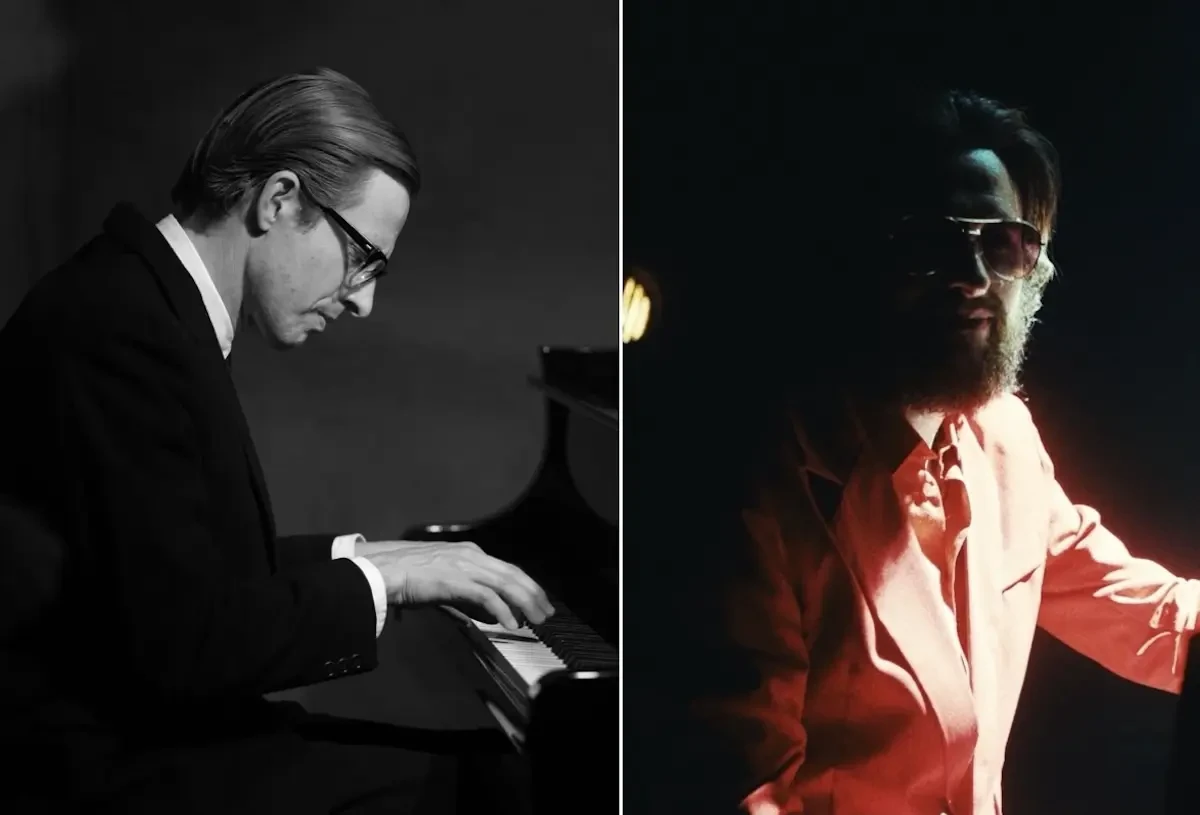
Cinematographer Piers McGrail utilizes a sharp-contrast black-and-white palette to render a bleak, universal landscape of addiction. The stark monochrome contrasts sharply with the garish color bursts of the flash-forward sequences, emphasizing a sense of fractured time and inescapable doom.
A Surprisingly Celtic Undertone
Despite focusing on an icon of modern Americana, the production possesses a distinctly Celtic DNA:
- Principal photography took place primarily in County Cork, Ireland.
- The main distributor is Screen Ireland.
- Novelist Owen Martell is Welsh, screenwriter Mark O’Halloran is Irish, and Bill Evans’s paternal ancestry traces back to Wales.
During one poignant scene in Florida, Harry Sr. laments to his son, "Look at Kennedy. The Irish are taking over. But never any Welsh. It’s because we’ve never suffered. It is our punishment." This cultural undercurrent adds a layer of generational fatalism to the narrative, suggesting that the characters carry an inherited, inescapable weight of sorrow.
Official Statements and Critical Reception
The film has generated robust dialogue among film critics, jazz historians, and cinephiles alike, praised for its refusal to pander to the sensationalist clichés typical of music biopics.
Industry analysts and festival reviewers have highlighted the daring nature of the project:
- On the Narrative Approach: Critics have lauded Owen Martell and Mark O’Halloran’s screenplay for treating trauma not as a plot point to be resolved, but as an atmospheric pressure system. By focusing on Intermission rather than a chronological sweep, the film avoids the "wikipedia-entry" feel of conventional biopics.
- On the Performances: The ensemble cast has received universal acclaim. Anders Danielsen Lie captures Evans’s pacific, mild-mannered modesty—a facade that masked a deep, self-destructive void. Bill Pullman brings a tragic, battered humanity to Harry Sr., while Valene Kane (Ellaine) and Barry Ward (Harry Jr.) ground the peripheral tragedies in authentic domestic despair.
- On the Music: Reviewers have particularly noted the bravery of withholding Evans’s discography. As one prominent festival critic observed: "By silencing the piano for much of the runtime, Gee forces the audience to confront the ghost in the room—the sheer, terrifying silence left behind when addiction and grief win."
Future Outlook: The Enduring Legacy of an Unmatched Trio
Though Everybody Digs Bill Evans deals unflinchingly with the dark margins of life, its ultimate takeaway is a testament to resilience against impossible odds. The film reminds audiences that despite the crushing weight of LaFaro’s death, the suicide of loved ones, and his own physical decay, Evans did eventually form new trios and remained a prolific recording artist throughout the 1970s.
Yet, the historical "what-if" lingers: Had Scott LaFaro lived, would the interpersonal friction and Evans’s escalating drug dependency have eventually dismantled the trio anyway? We will never know. What remains certain is that after those two seminal 1961 releases at the Village Vanguard, the jazz piano trio was forever altered.
As Everybody Digs Bill Evans proves on screen, the true innocence in the pianist’s orbit belonged to figures like little Debby—his niece and the dedicatee of his famous waltz—who stood untouched by the malevolent undercurrents that plagued the adults. In stripping away the myth to reveal the broken human being underneath, Grant Gee has delivered a definitive cinematic monument to a giant of jazz, ensuring that while the man was consumed by his demons, the architecture of his art remains unshakable.