
Executive Overview
In the modern landscape of faith-based communities, radical hospitality and total inclusion have emerged as foundational pillars for spiritual growth and community engagement. Yet, despite the best intentions of church leadership, architectural acoustics and hidden disabilities frequently create invisible barriers that isolate members of the congregation. Chief among these barriers is hearing loss—a prevalent condition that affects millions of individuals, disproportionately impacting older adults who form the backbone of many religious communities.
When congregants struggle to comprehend the spoken word, scripture readings, or musical performances, their church experience transforms from an engaging communal celebration into an isolating exercise in frustration. Over time, this disconnect causes individuals to withdraw entirely from active participation, quietly slipping away from the spiritual home they cherish.
To combat this silent epidemic, houses of worship are increasingly turning to advanced Assistive Listening Systems (ALS). However, purchasing and installing hardware is merely the first step. True accessibility requires a strategic, holistic approach that spans initial congregation assessment, financial planning, rigorous staff training, and proactive community outreach.
This comprehensive report examines the four-step methodology necessary for successfully integrating an assistive listening solution into a worship facility. Drawing on insights from industry leaders such as Listen Technologies and integration specialists like CCI Solutions, this article provides church administrators, audio-visual (AV) technicians, and pastoral staff with an authoritative blueprint for ensuring that every message is heard, felt, and embraced by all.
Detailed Chronology: The Four-Step Implementation Framework
Implementing an Assistive Listening System requires a deliberate, methodical approach. Rushing into a technological purchase without adequate preparation often leads to wasted resources and low adoption rates among the congregation. Church leadership must navigate a distinct chronological sequence to guarantee operational success and maximize return on investment.
Phase 1: Understanding Congregation Needs and Assessing the Acoustic Environment
The foundational stage of any accessibility initiative begins long before browsing product catalogs or requesting price quotes. Leadership must first develop a granular understanding of the specific hearing-related challenges present within their congregation.
- Deploying Targeted Surveys: The most effective mechanism for capturing this data is a comprehensive congregation-wide survey. Administrators should design questionnaires that probe deeper than a simple "do you have trouble hearing?" query. Surveys must explicitly ask about the individual’s experience during standard worship services, whether they currently utilize hearing aids, and—crucially—whether those hearing aids are equipped with telecoils (t-coils).
- Analyzing Demographic and Spatial Factors: Leadership must cross-reference survey findings with demographic trends and the physical layout of the sanctuary. Large traditional cathedrals with high ceilings and reverberant acoustics present entirely different challenges compared to contemporary, acoustically treated multi-purpose auditoriums.
- Identifying the Technical Baseline: By compiling survey results, the AV team can determine the approximate percentage of the congregation that would immediately benefit from an ALS, guiding subsequent decisions regarding receiver capacity, transmitter range, and technology type (such as RF, Infrared, or Wi-Fi-based systems).
Phase 2: Evaluating Technical Options and Financial Planning
Once the congregation’s needs are clearly mapped, the focus shifts to evaluating available technological solutions and aligning them with the church’s financial realities.
- Navigating Equipment Options: The market offers a variety of assistive listening technologies. Radio Frequency (RF) systems provide wide coverage and pass through walls, making them ideal for large sanctuaries. Infrared (IR) systems offer secure transmission confined to a specific line of sight, preventing signal bleed. Meanwhile, modern Wi-Fi streaming solutions allow users to leverage their own smartphones and personal mobile devices as receivers via dedicated apps.
- Budgeting and Consultation: Estimating the total cost of ownership involves factoring in transmitters, receivers, neck loops, charging stations, and signage. Specialized AV integrators, such as CCI Solutions, offer invaluable assistance during this phase, frequently providing free consultations to help churches navigate expense projections and operational budgeting.
- Fundraising and Resource Allocation: Because investments in accessibility directly support the mission of the church, leadership can explore targeted fundraising campaigns, memorial gifts, or capital improvement grants dedicated specifically to inclusion initiatives. Engaging the congregation in the funding process also serves to build early awareness and excitement for the upcoming technology.
Phase 3: Operational Readiness and Staff Training
Even the most advanced assistive listening hardware will fail if the personnel responsible for its day-to-day deployment lack proper training. The human element is often the decisive factor between a thriving accessibility program and equipment that sits gathering dust in a closet.
- Designating "Assisted Listening Ambassadors": Ushers, greeters, welcome desk volunteers, and audio-visual technicians must be reframed as frontline ambassadors of inclusion. These individuals must receive comprehensive, hands-on training regarding how to operate, troubleshoot, and distribute the assistive listening devices.
- Standardizing the Checkout Process: When a congregant requests a device, the interaction should be seamless and dignified. Volunteers must take the time to instruct users on basic functions, volume controls, and how to properly position neck loops or ear-pieces.
- Creating Reference Materials: To ensure consistency—especially when relying on rotating volunteer schedules—churches should maintain a laminated copy of Frequently Asked Questions (FAQs) and step-by-step troubleshooting guides at the distribution desk or welcome counter. Empowering volunteers with readily accessible answers eliminates hesitation and ensures a professional user experience.
Phase 4: Creating Awareness and Driving Community Engagement
Deploying an assistive listening system is a major milestone, but its ultimate success depends entirely on utilization rates. If the community does not know the technology exists, the investment is rendered inert.
- Strategic Signage Placement: Clear, universally recognized accessibility signage must be prominently displayed throughout the facility, directing visitors to the exact location where Assisted Listening Devices (ALDs) are distributed.
- Multi-Channel Promotion: Awareness campaigns should span multiple mediums. Weekly bulletins, digital slide presentations before services, social media channels, and church website announcements must regularly remind attendees that assistive listening tools are available.
- Hosting Dedicated Training Events: Churches can host brief, live orientation sessions or demonstrations before or after services, allowing curious congregants to familiarize themselves with the technology in a low-pressure environment.
- Reaching Out to the Broader Community: The impact of an ALS extends far beyond current members. Advertising these accommodations to the surrounding geographic area signals to individuals with hearing loss that the church is an inclusive, welcoming sanctuary. Many visitors who previously abandoned corporate worship due to accessibility barriers will return when they learn proactive measures have been implemented in their honor.
Supporting Context & Metrics: The Scale of Hearing Loss and Inclusion
To fully appreciate the urgency of implementing Assistive Listening Systems, decision-makers must examine the statistical realities of hearing impairment within modern society.
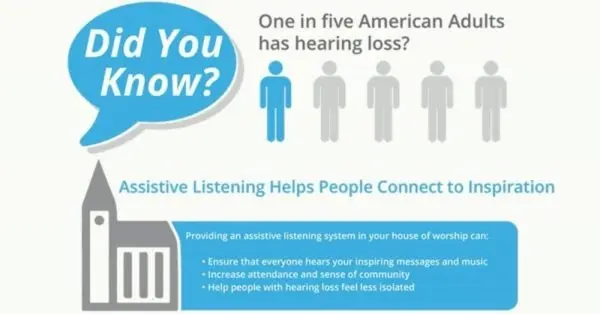
According to public health data from organizations such as the World Health Organization (WHO) and the Hearing Loss Association of America (HLAA), hearing loss is one of the most common chronic physical conditions affecting adults. In the United States alone, approximately 48 million people—roughly one in five—experience some degree of hearing loss. This statistic scales dramatically within traditional house of worship demographics, where older adults make up a significant portion of the active membership.
[General Population: ~20% Affected]
       │
       ├──> [House of Worship Demographics: Higher Concentration of Older Adults]
       │           │
       │           └──> [Acoustic Challenges: Reverberation, Background Noise, Distance]
       │                       │
       │                       └──> [Result: Social Isolation & Disengagement]
       │                               │
       │                               └──> [Solution: Integrated Assistive Listening Systems]
Furthermore, traditional architectural designs of churches often exacerbate hearing difficulties. Sanctuaries frequently feature high vaulted ceilings, hardwood or tile flooring, and expansive glass or stone walls. While aesthetically breathtaking, these materials create significant acoustic reverberation. When a speaker’s voice bounces off multiple hard surfaces, the resulting echo blurs consonants and significantly reduces speech intelligibility. Even for individuals with mild hearing loss or those wearing standard hearing aids, parsing spoken dialogue through severe acoustic reverberation is an exhausting cognitive burden.
Federal regulations, such as the Americans with Disabilities Act (ADA), provide legal frameworks mandating auxiliary aids and services in places of public accommodation, which explicitly include houses of worship hosting public events. However, moving beyond mere legal compliance to embrace proactive accessibility transforms the church from an ADA-regulated space into a genuinely compassionate, barrier-free community.

Official Statements and Industry Insights
Industry pioneers and accessibility advocates emphasize that technology is merely a conduit for deeper pastoral care.
In documentation accompanying comprehensive resources like the Listen Technologies Church Assistive Listening Toolkit, experts stress that the core motivation behind adopting an ALS is theological and relational, rather than purely technical.
"Reaching out to those who feel disconnected from your community due to hearing loss is central to sharing the message of inclusion," notes accessibility literature from Listen Technologies. "Genuinely compassionate service involves being aware of and caring for the needs of everyone, especially those dealing with impairments. Make sure they are able to hear the beauty and emotion of the spoken word in your church by providing them with the equipment they need to stay connected."
Integration specialists echo this sentiment, noting that audio clarity directly correlates with spiritual engagement. When a congregant no longer has to strain to catch fragments of a sermon or a pastoral prayer, their mental bandwidth is freed to fully engage with the worship experience.
Audio engineers working within faith-based AV environments frequently point out that sound reinforcement systems designed for high-energy music production can inadvertently alienate older or hard-of-hearing listeners. While a high-decibel mix may energize contemporary worshipers, it often increases acoustic muddying for those with compromised hearing. An independent Assistive Listening System bridges this gap, delivering a clean, direct audio feed straight to the listener’s ear, completely bypassing the chaotic acoustic reflections of the room.
Future Outlook: The Evolution of Accessible Worship
As audio technology continues to advance at a rapid pace, the future of church accessibility points toward even greater integration, personalization, and seamless connectivity.
The Rise of Personal Smartphone Integration
Traditional assistive listening models relied exclusively on dedicated church-owned receivers and bulky headsets. While these devices remain vital for visitors who do not own smartphones, the industry is shifting rapidly toward Bring Your Own Device (BYOD) architectures. Modern Wi-Fi and Bluetooth-based streaming systems allow congregants to download a church-specific app and route crystal-clear audio directly into their personal smartphones, headphones, or Bluetooth-enabled hearing aids. This approach eliminates the friction of checking out hardware, reduces administrative overhead for volunteers, and removes any perceived social stigma associated with requesting a specialized device.
Integration with Telecoil (T-Coil) Technology
Telecoils remain the gold standard for hearing aid compatibility. As hearing aid manufacturers continue to expand t-coil integration across their product lines, churches utilizing induction loop systems or neck-loop transmitters will provide an increasingly frictionless experience. Congregants simply switch their hearing aids to the "T" setting, and the audio from the sanctuary soundboard is transmitted electromagnetically straight into their ears with zero background noise.
Holistic Universal Design
Looking ahead, forward-thinking houses of worship are moving past reactive accommodations toward the philosophy of "Universal Design"—creating physical, acoustic, and digital environments that are inherently accessible to all people, to the greatest extent possible, without the need for adaptation. This includes intentional acoustic modeling during sanctuary construction, multi-modal communication (simultaneous live captioning displayed on projection screens alongside audio feeds), and continuous feedback loops between AV ministries and accessibility committees.
Conclusion
The ultimate measure of a vibrant, welcoming faith community is found in its commitment to leaving no one behind. Hearing loss should never be the invisible wall that separates a believer from the spoken word, the comfort of a sermon, or the communal joy of corporate worship.
By systematically understanding congregation needs, evaluating technical options, training dedicated hospitality volunteers, and aggressively promoting new listening resources, churches can tear down acoustic barriers. Comprehensive toolkits—such as the Listen Technologies Church Assistive Listening Toolkit—provide invaluable sample surveys, signage templates, and promotional announcements to ensure these initiatives succeed.
Investing in an Assistive Listening System is an investment in the hearts and minds of the congregation. It ensures that every member can hear, connect, and fully participate in the shared spiritual journey.