
Executive Overview
In the modern landscape of religious assembly, inclusivity remains a foundational pillar for community engagement and spiritual outreach. Yet, despite the best intentions of leadership and pastoral staff, a significant barrier frequently persists within the sanctuary walls: hearing loss. For millions of congregants globally, attending a traditional worship service can be an isolating experience, characterized by acoustic reverberation, background noise, and the inability to fully comprehend spoken sermons, scriptural readings, and musical performances.
To bridge this profound communication gap, houses of worship are increasingly turning to advanced Assistive Listening Systems (ALS). However, the successful integration of these technologies requires far more than a simple equipment purchase. It demands a strategic, highly structured approach that encompasses congregation assessment, financial planning, comprehensive staff training, and aggressive community awareness campaigns.
This report provides an in-depth examination of the four-step framework necessary for implementing an effective Assistive Listening System within a faith-based organization. By drawing on industry best practices, expert consultations, and technical resources—such as the Listen Technologies Church Assistive Listening Toolkit—this document serves as an authoritative guide for religious leaders, facility managers, and AV technicians dedicated to ensuring that every member of their congregation can fully participate in the shared worship experience.
Detailed Chronology: The Four-Step Implementation Framework
The journey toward total acoustic accessibility requires a methodical, step-by-step rollout. Rushing the process often results in underutilized equipment, frustrated users, and wasted financial resources. Below is the definitive chronological framework for executing an ALS project within a house of worship.
Step 1: Understand Your Needs and Congregation Demographics
The foundational prerequisite for any acoustic upgrade is a comprehensive, data-driven understanding of the congregation’s actual needs. Assumptions regarding hearing loss within a religious community are frequently inaccurate; leaders often underestimate both the prevalence of auditory impairment and the willingness of members to utilize supportive technology.
- Conducting the Congregation Survey: The most effective mechanism for establishing baseline data is a structured survey distributed to the congregation. This survey should explicitly probe individuals regarding their sensory experiences during regular services. Key inquiries must address whether members experience difficulty understanding speech, whether they currently utilize hearing aids, and—crucially—whether those hearing aids are equipped with telecoils (t-coils).
- Analyzing T-Coil Integration: Understanding the prevalence of t-coil-equipped hearing aids is vital because modern assistive listening technology can interface directly with these devices via neck loops, eliminating the need for independent receivers for many users.
- Demographic Mapping: Cross-referencing survey results with age demographics and historical attendance data allows facility teams to project the scale of the required deployment, ensuring that an adequate number of receivers and listening accessories are budgeted and purchased.
Step 2: Fully Understand Your Options and Financial Strategy
Once the congregation’s specific needs have been quantified, leadership must evaluate the technological landscape and establish a sustainable financial strategy. The market offers various solutions—including RF (Radio Frequency), Infrared (IR), and Wi-Fi-based systems—each with distinct cost structures, range capabilities, and integration requirements.
- Cost Estimation and Budgeting: Estimating the total cost of ownership involves looking beyond the initial hardware purchase to account for installation, maintenance, signage, and ongoing accessory management (such as hygienic ear pads and charging stations).
- Leveraging Industry Expertise: Professional AV providers, such as CCI Solutions, offer specialized assistance in evaluating hardware options and provide free consultations to help organizations align their technical aspirations with realistic budgetary constraints.
- Alternative Funding Mechanisms: Because house of worship budgets are frequently tight, leadership should consider targeted fundraising campaigns, donor-subsidized memorial gifts, or grant programs specifically earmarked for ADA compliance and accessibility enhancements to offset capital expenses.
Step 3: Prepare for Success Through Rigorous Training
An advanced Assistive Listening System is only as effective as the individuals responsible for its daily operation. Even the most sophisticated hardware will fail to impact the congregation if staff members and volunteers lack the confidence or knowledge to manage it properly.
- Establishing "Assisted Listening Ambassadors": Ushers, greeters, welcome desk personnel, and sound booth technicians must be reframed as operational ambassadors for accessibility. Comprehensive training sessions should cover hardware operation, troubleshooting, battery management, and sanitary storage protocols.
- Standardizing the Check-Out Process: When a congregant requests a device, the interaction must be handled with dignity, clarity, and competence. Staff should take the time to instruct new users on the basic functions of the device, ensuring a comfortable fit and optimal volume adjustments.
- Operational Cheat Sheets: To maintain consistency across rotating volunteer schedules, facilities should keep a laminated copy of Frequently Asked Questions (FAQs) and troubleshooting steps at the distribution desk or welcome counter.
Step 4: Create Awareness and Drive Adoption
The final, and perhaps most critical, phase of the implementation timeline is communication. An installed ALS provides zero value if the target audience remains unaware of its existence.
- Visual Signage: Proper, ADA-compliant signage must be strategically displayed throughout the facility, indicating clearly that Assisted Listening Devices are available and directing visitors to the exact location where they can be acquired.
- Multi-Channel Promotion: Awareness campaigns must be omni-channel. Regular reminders should be embedded in printed weekly bulletins, projected on sanctuary multi-media screens before services, and announced during verbal housekeeping updates.
- Interactive Demonstrations: To demystify the technology, organizations should consider hosting a dedicated live training session or accessibility showcase, allowing congregants to test the receivers in a low-pressure environment.
- Community Outreach: Accessibility is a powerful evangelistic tool. Advertising the availability of assistive listening to the broader geographical community signals a genuine commitment to radical hospitality, drawing in individuals and families who may have previously felt excluded from traditional worship settings.
Supporting Context & Metrics: The Imperative of Acoustic Inclusion
To fully appreciate the urgency of deploying Assistive Listening Systems, one must examine the broader socio-acoustic context of modern religious architecture and the physiological realities of hearing loss.

The Acoustic Challenge in Houses of Worship
Traditional houses of worship—ranging from historic cathedrals to contemporary multi-use auditoriums—present unique and severe acoustic challenges. Key factors include:
- Excessive Reverberation: Long reverberation times, designed to enhance choral music and pipe organs, severely degrade speech intelligibility. Reflected sound waves overlap directly with direct speech, creating a muddy acoustic environment where words blur together.
- Dynamic Soundscapes: Modern worship services frequently feature high-energy contemporary Christian music alongside spoken-word pastoral delivery. The vast dynamic range between a quiet prayer and a full-band arrangement creates masking effects that disproportionately impact individuals with high-frequency sensorineural hearing loss.
- Ambient Noise: HVAC systems, whispered conversations, shuffling feet, and children create a constant floor of ambient noise that forces the signal-to-noise ratio down, making unassisted listening arduous for millions.
The Demographic Reality
According to global public health metrics, hearing loss is one of the most prevalent chronic conditions affecting aging populations.
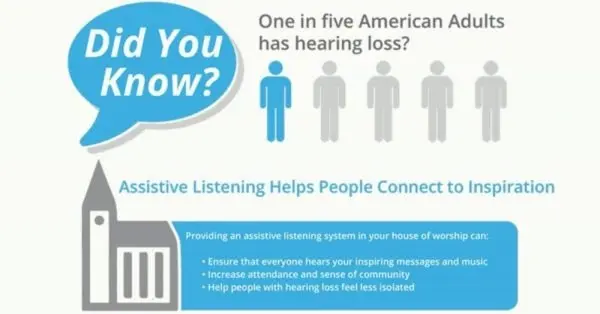
- Approximately one in three individuals over the age of 65 experiences disabling hearing loss.
- Crucially, the onset of age-related hearing loss (presbycusis) is gradual, meaning many regular churchgoers may struggle silently for years before acknowledging their impairment or seeking formal medical intervention.
- When houses of worship fail to provide assistive technology, they inadvertently alienate a core demographic of their most dedicated members, leading to disengagement, reduced attendance, and spiritual isolation.
Official Statements and Industry Insights
Industry leaders and accessibility advocates emphasize that providing assistive listening is not merely a legal or compliance obligation, but a profound theological imperative rooted in compassion and community connection.
"Reaching out to those who feel disconnected from your community due to hearing loss is central to sharing the message of inclusion. Genuinely compassionate service involves being aware of and caring for the needs of everyone, especially those dealing with impairments."
— Industry Accessibility Directive
Experts note that technical compliance should always be viewed through a pastoral lens. When a house of worship invests in high-clarity audio distribution, it is declaring that every individual’s spiritual journey matters.
Furthermore, organizations like Listen Technologies stress the availability of comprehensive implementation support. Through specialized resources such as the Listen Technologies Church Assistive Listening Toolkit, facilities have direct access to standardized sample surveys, signage templates, bulletin announcements, and technical specifications designed to streamline the deployment process from conception to completion.
Future Outlook: The Evolution of Accessible Worship
Looking ahead, the landscape of assistive listening technology in religious facilities is poised for rapid transformation driven by advancements in wireless communication, artificial intelligence, and personal consumer electronics.
- The Rise of Wi-Fi Streaming: While traditional RF and IR systems remain industry standards, Wi-Fi-based assistive listening is gaining significant traction. These systems allow congregants to stream pristine, low-latency audio directly to their personal smartphones or smart devices via a dedicated app. This approach drastically reduces the capital expenditure required for maintaining physical receiver hardware and appeals heavily to tech-savvy demographics.
- Bluetooth LE Audio and Auracast: The integration of Bluetooth Low Energy (LE) Audio and Auracast broadcast technology represents the next major frontier in public accessibility. Auracast will enable audio transmitters in sanctuaries to broadcast crystal-clear sound directly to an unlimited number of compatible hearing aids, cochlear implants, and wireless earbuds simultaneously, rendering dedicated venue receivers obsolete in many applications.
- AI-Powered Noise Suppression: Future acoustic management systems will increasingly leverage machine learning algorithms to isolate speech from ambient noise dynamically in real-time, tailoring the audio feed specifically to the unique profiles of assistive listening users.
Conclusion
The intentional integration of an Assistive Listening System is a transformative step for any house of worship committed to radical hospitality. By methodically assessing community needs, securing appropriate financial backing, training operational ambassadors, and driving awareness through robust promotional campaigns, religious organizations can dismantle physical and acoustic barriers. Ensuring that every attendee can experience the uncompromised beauty, emotion, and clarity of the spoken word is essential to fostering a truly unified, vibrant, and inclusive spiritual community.
For more detailed information on choosing the right Assistive Listening System and tools to ensure your success—including sample surveys, signage assets, and announcement templates—download a copy of the Listen Technologies Church Assistive Listening Toolkit.