
Executive Overview
In an era where modern houses of worship heavily invest in state-of-the-art acoustic design, immersive lighting, and high-definition video projection, one critical dimension of the worship experience is frequently overlooked: audio accessibility for the hearing impaired. For millions of congregants globally, attending a weekly service can be an exercise in frustration rather than spiritual renewal. Without proper accommodations, individuals experiencing age-related hearing loss, tinnitus, or congenital deafness often feel isolated, disconnected, and ultimately pushed to the margins of their faith communities.
To bridge this profound gap, religious organizations are increasingly turning to advanced Assistive Listening Systems (ALS). However, the successful integration of these technologies requires far more than simply purchasing equipment off the shelf and plugging it into a soundboard. Implementing an effective ALS demands a strategic, multi-phase approach that encompasses congregational assessment, budgetary planning, comprehensive staff and volunteer training, and proactive community outreach.
This comprehensive report examines the four foundational pillars required to successfully deploy an Assistive Listening System within a house of worship. Drawing from industry standards, expert technical consultations provided by organizations like CCI Solutions, and resources such as the Listen Technologies Church Assistive Listening Toolkit, this article serves as an authoritative blueprint for faith leaders, technical directors, and facility managers committed to fostering a genuinely inclusive worship environment.
Detailed Chronology: The Four-Step Implementation Roadmap
Deploying an Assistive Listening System is a project that unfolds across distinct operational phases. Rushing through these stages often leads to underutilized equipment, wasted financial resources, and continued frustration among the demographic the technology is intended to help. Below is the chronological framework houses of worship must follow to ensure seamless integration.
[Phase 1: Assessment] ---> [Phase 2: Evaluation] ---> [Phase 3: Preparation] ---> [Phase 4: Awareness]
  Survey Congregation       Budget & Consultations      Train "Ambassadors"       Signage & Outreach
Step 1: Understand Your Needs Through Data-Driven Assessment
The cornerstone of any successful technological upgrade in a sacred space is a thorough understanding of the end-user. Assumptions about who needs help hearing—and what kind of help they require—can lead to costly miscalculations.
The most effective starting point is the deployment of a comprehensive congregational survey. Church leadership should actively distribute questionnaires designed to capture quantitative and qualitative data regarding the listening experiences of their members. Key inquiries within this survey should encompass:
- Current Experience: How well can congregants hear the spoken word, scripture readings, and musical performances during standard services?
- Device Utilization: Do members currently utilize personal hearing aids or cochlear implants?
- Technological Compatibility: Are these personal listening devices equipped with telecoils (t-coils), which allow them to receive audio signals directly from induction loop systems or neck loops?
By gathering this data, a church can accurately gauge the scale of its hearing-impaired demographic, moving beyond guesswork to design an ALS tailored precisely to the architectural and demographic realities of their congregation.
Step 2: Fully Understand Your Options and Financial Scope
Once the specific needs of the congregation have been cataloged, leadership must evaluate the available hardware and budgetary requirements. The market offers a diverse array of assistive listening technologies, ranging from traditional FM and Infrared (IR) systems to modern Wi-Fi-based audio streaming and Audio Frequency Induction Loop Systems (AFILS).
Estimating the cost of these systems requires balancing immediate technological capabilities against long-term maintenance and user adoption rates. Houses of worship do not have to navigate this complex financial and technical landscape alone. Specialized audio-visual integrators, such as CCI Solutions, offer expert guidance and complimentary consultations explicitly tailored to help churches assess expenses and structure realistic capital budgets.
Furthermore, capital expenditure should not be viewed solely as a line-item burden. Churches can leverage dedicated fundraising campaigns, memorial gifts, or capital improvement drives specifically earmarked for accessibility upgrades. Framing the purchase of an ALS as a ministry of inclusion often inspires generous donor participation within the congregation.
Step 3: Prepare for Success Through Rigorous Training
Hardware is only as effective as the people operating it. A common pitfall in houses of worship is the acquisition of top-tier assistive listening devices that ultimately gather dust in a storage closet because staff and volunteers do not know how to manage them.
To guarantee success, every staff member, usher, and audio-visual volunteer must receive comprehensive training on the distribution, maintenance, and operation of the assistive listening devices. These individuals should be conceptualized and empowered as "Assisted Listening Ambassadors."
When a congregant requests a device, the interaction should never be a cold handoff. Ambassadors must take the time to instruct users on device operation, volume control, and ear-piece placement. To maintain consistency and reduce friction during high-traffic Sunday mornings, facilities should keep a laminated, easy-to-read sheet of Frequently Asked Questions (FAQs) positioned directly at the welcome desk or distribution counter.
Step 4: Create Awareness and Foster Community Engagement
Even the most advanced Assistive Listening System is ineffective if the congregation does not know it exists. Launching an ALS requires an intentional, multi-channel marketing and communication strategy.
- Clear Signage: Prominent, universally recognized international symbols for accessibility should be displayed at all primary entrances, welcoming desks, and sanctuary doors, guiding users precisely to where receivers are available.
- Printed & Digital Reminders: Weekly bulletins, digital signage loops, and multi-media announcements should feature regular reminders noting that Assisted Listening Devices are readily available upon request.
- Live Training Workshops: Consider hosting a dedicated orientation session or live demonstration during a fellowship hour. This allows hesitant congregants to familiarize themselves with the technology in a low-pressure environment before the start of a formal service.
- External Community Outreach: Word travels fast. Letting the surrounding geographic community know that your facility is fully accessible will attract visitors who have previously abandoned regular church attendance due to hearing barriers.
Supporting Context & Metrics: The Hidden Epidemic of Hearing Loss in Worship
To understand why implementing an Assistive Listening System is an urgent imperative rather than an optional ministry perk, one must examine the broader socio-medical context of hearing impairment.

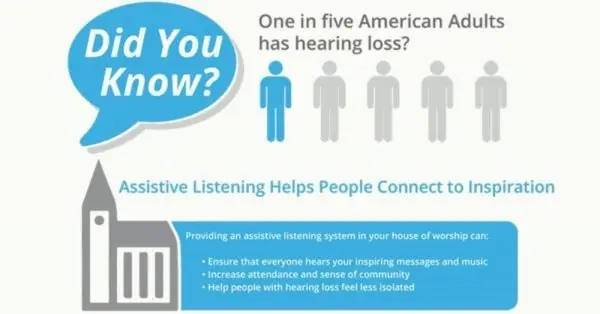
According to public health data from organizations such as the World Health Organization (WHO) and the Hearing Loss Association of America (HLAA), hearing loss is one of the most prevalent chronic health conditions affecting adults today. In the United States alone, approximately 48 million people experience some degree of hearing loss. Within typical church demographics—which frequently skew toward older adults—the incidence rate is significantly higher. Up to one-third of individuals aged 65 to 74, and nearly half of those aged 75 and older, experience disabling hearing loss.
[Demographic Breakdown of Hearing Loss Impact in Congregations]
-------------------------------------------------------------------------
Age Group           | Approximate Prevalence of Hearing Loss
-------------------------------------------------------------------------
Aged 18–44          | ~5% to 10%
Aged 45–64          | ~15% to 20%
Aged 65–74          | ~30% to 35%
Aged 75+            | ~45% to 50%
-------------------------------------------------------------------------
*Note: Due to the demographic profile of traditional houses of worship,
the actual percentage of affected attendees is often higher than the
general population average.*
The Architectural Impediment
Compounding biological hearing loss are the acoustic challenges inherent to modern houses of worship. Contemporary sanctuary design frequently prioritizes aesthetic minimalism—featuring hard, reflective surfaces like concrete, glass, and polished wood. While these materials create stunning visual environments and vibrant musical acoustics for normal-hearing individuals, they also generate excessive reverberation and echo.
Reverberation blurs the articulation of human speech. For an individual with compromised hearing, attempting to parse spoken sermons through a muddy acoustic environment is exhausting. This cognitive fatigue often leads to a withdrawal from communal worship entirely.
Regulatory Compliance and Moral Imperative
Beyond the moral and spiritual obligation to welcome all individuals, legal frameworks such as the Americans with Disabilities Act (ADA) establish clear guidelines for public accommodations, including houses of worship (though specific exemptions exist for certain religious entities, the ethical standard remains absolute). Providing assistive listening technology aligns a ministry with the highest standards of universal design, ensuring that physical buildings do not inadvertently erect spiritual barriers.
Official Statements and Industry Insights
Industry leaders and accessibility advocates have long championed the integration of assistive technologies into sacred spaces. Organizations specializing in acoustic integration emphasize that sound is the primary vehicle through which religious traditions are transmitted, shared, and internalized.
"Reaching out to those who feel disconnected from your community due to hearing loss is central to sharing the message of inclusion. Genuinely compassionate service involves being aware of and caring for the needs of everyone, especially those dealing with impairments. Make sure they are able to hear the beauty and emotion of the spoken word in your church by providing them with the equipment they need to stay connected."
— Acoustic Integration & Accessibility Advocacy Consensus
Experts note that the psychological impact of hearing loss in group settings is profound. It breeds feelings of embarrassment, isolation, and alienation. When a house of worship invests in an Assistive Listening System, it sends an unmistakable theological message: Every individual is valued, every voice matters, and no one is excluded from the corporate life of the body.
Technical engineers from companies like Listen Technologies reinforce that modern assistive listening equipment has evolved past the clunky, static-filled radios of decades past. Today’s digital receivers offer crystal-clear audio fidelity, seamless integration with personal smartphones via Wi-Fi protocols, and direct compatibility with modern Bluetooth-enabled hearing aids.
Future Outlook: The Next Generation of Worship Accessibility
As audio-visual engineering continues to advance at a rapid pace, the future of assistive listening in houses of worship points toward hyper-personalization, wireless integration, and software-driven inclusivity.
1. Integration with Personal Smart Devices
The traditional model of checking out a dedicated hardware receiver at a welcome desk is gradually expanding to include Bring Your Own Device (BYOD) frameworks. Modern Wi-Fi-based assistive listening platforms allow congregants to download a free application onto their own smartphones, connect to the church’s secure local wireless network, and stream pristine, zero-latency audio directly to their personal earbuds or hearing aids. This dramatically reduces the administrative burden on church volunteers, as there is less hardware to clean, charge, and manage.
2. Artificial Intelligence and Real-Time Transcription
Looking further ahead, the intersection of assistive listening and artificial intelligence (AI) promises even greater accessibility breakthroughs. Emerging technologies are beginning to couple traditional audio amplification with real-time, AI-powered speech-to-text transcription. Projected onto sanctuary confidence monitors or streamed directly to personal mobile screens, live captioning will provide an invaluable secondary layer of comprehension for the hard of hearing, non-native language speakers, and those processing auditory information differently.
3. Universal Design as Standard Practice
The ultimate trajectory of worship facility design is moving away from retrofitted, accommodation-after-the-fact models toward Universal Design—the concept that spaces and systems should be inherently accessible to all people, to the greatest extent possible, without the need for adaptation. In future church builds, acoustic dampening, loop-wired pews, and multi-modal listening infrastructure will be integrated into the architectural blueprints from day one.
Conclusion and Call to Action
Implementing an Assistive Listening System is far more than a technical upgrade or an exercise in regulatory compliance; it is a profound expression of pastoral care. By systematically assessing congregational needs, evaluating budgetary options with expert partners like CCI Solutions, training dedicated staff to act as welcoming ambassadors, and actively promoting the technology, houses of worship can dismantle invisible barriers to fellowship.
For church leaders seeking to take the next step, comprehensive resources are readily available. To access detailed guidelines, sample surveys, customizable signage templates, and promotional announcements, download a copy of the Listen Technologies Church Assistive Listening Toolkit.
Evaluate your sanctuary today, consult with audio professionals, and ensure that every member of your community can fully experience the beauty, inspiration, and emotion of the spoken and sung word.