
Executive Overview
In an era defined by rapid technological advancements, the modern church strives to be a sanctuary of welcome, connection, and spiritual enrichment. Yet, for millions of congregants navigating hearing loss, the Sunday morning experience can inadvertently become an exercise in isolation rather than communion. Despite the proliferation of state-of-the-art line-array speaker systems and acoustic treatments, architectural challenges, ambient noise, and natural hearing degradation continue to erect invisible barriers between the pulpit and the pew.
To bridge this profound gap, forward-thinking houses of worship are increasingly turning to Assistive Listening Systems (ALS). Far more than a mere technical checkbox or a concession to regulatory compliance, the strategic integration of an ALS is a theological and moral imperative. It ensures that the spoken word—the core of sermons, scripture readings, and pastoral care—reaches every ear with pristine clarity, emotional resonance, and intellectual impact.
However, procuring and deploying an Assistive Listening System is not a plug-and-play endeavor. Without a structured methodology, churches risk investing in incompatible hardware, alienating non-technical users, or failing to drive adoption among the very demographic the technology is designed to serve.
Drawing upon industry insights from audio-visual integration leaders and comprehensive resources such as the Listen Technologies Church Assistive Listening Toolkit, this investigative report outlines a definitive, four-step framework for houses of worship. By prioritizing audience analytics, fiscal evaluation, operational training, and proactive community outreach, ministry leaders can transform their sanctuaries into fully accessible environments where no message is left unheard.
Detailed Chronology: The Four-Step Implementation Roadmap
Successfully deploying an Assistive Listening System requires a deliberate, phased approach. Whether retrofitting a historic cathedral or outfitting a modern multi-site campus, ministry leaders must navigate a structured implementation timeline to guarantee stewardship of resources and maximum congregational impact.
[Phase 1: Discovery & Needs Assessment]
       │
       ▼
[Phase 2: Financial & Technological Evaluation]
       │
       ▼
[Phase 3: Operational Readiness & Staff Training]
       │
       ▼
[Phase 4: Community Awareness & Launch]
Phase 1: Understand Your Needs (The Discovery and Assessment Phase)
The foundational misstep in audio accessibility projects is purchasing equipment based on generalized assumptions rather than empirical data. Every congregation possesses a unique demographic footprint and acoustic ecosystem. Therefore, the implementation process must begin with a comprehensive listening needs assessment.
- Deploying Congregational Surveys: The most effective method for evaluating accessibility requirements is to survey the congregation directly. This survey should not be limited to those who currently wear hearing aids. It should target a broad cross-section of the community to capture unaddressed, mild-to-moderate hearing difficulties.
- Targeted Data Points: Questionnaires should explicitly inquire about individual experiences during services. Are congregants missing punchlines, whispered asides, or soft-spoken prayers? Crucially, surveys must ask whether respondents currently wear hearing aids and, if so, whether those devices are equipped with telecoils (t-coils).
- Analyzing Acoustic Environments: Alongside subjective surveys, facilities teams must analyze the physical space. Reverberation times (echo), HVAC ambient noise floors, and seating geometry all dictate whether an RF (Radio Frequency), Infrared (IR), or Wi-Fi-based system will perform optimally.
Phase 2: Fully Understand Your Options (The Fiscal and Technical Horizon)
Once congregational data has been compiled and analyzed, leadership must evaluate the technical architecture and financial scope of the deployment. Assistive listening technology ranges from traditional FM radio systems to loop systems that broadcast directly into t-coil-equipped hearing aids, as well as modern streaming-over-Wi-Fi solutions that leverage users’ smartphones.
- Cost Estimation and Budgeting: Estimating the total cost of ownership involves calculating receiver quantities, charging stations, neckloops, directional signage, and potential installation labor. Because capital expenditures can present a hurdle for growing ministries, professional AV partners—such as CCI Solutions—offer specialized guidance and free consultations to help leadership teams align their accessibility goals with realistic fiscal parameters.
- Alternative Funding Strategies: To mitigate the burden on general operational funds, churches frequently look toward alternative fundraising models. Dedicated special offerings, capital campaign allocations, foundation grants earmarked for accessibility, or memorial gifts can successfully offset the initial investment required for a robust ALS rollout.
Phase 3: Prepare for Success (Operational Training and Internal Logistics)
The finest audio hardware in the world is rendered useless if it sits uncharged in a back office or if volunteers feel intimidated operating it. Operational preparedness is the linchpin of a successful deployment.
- Designating "Listening Ambassadors": Front-line staff, ushers, welcome team members, and AV volunteers must receive rigorous, hands-on training regarding the operation, sanitization, and distribution of assistive listening devices. These individuals should be framed not merely as equipment handlers, but as "Assisted Listening Ambassadors"—welcoming advocates dedicated to removing barriers for guests and members alike.
- The Check-Out Protocol: When a device is checked out to a congregant, the ambassador must take the time to provide a gentle, personalized tutorial on its basic functions, volume controls, and accessory compatibility.
- Reducing Friction with FAQ Collateral: To streamline operations at the welcome desk or audio booth, leadership should draft clear, concise troubleshooting guides. Keep a laminated copy of answers to frequently asked questions prominently displayed at the distribution counter to ensure seamless, anxiety-free interactions for both staff and users.
Phase 4: Create Awareness (Marketing, Signage, and Community Outreach)
An invisible system is an unused system. Once the hardware is installed and staff are trained, a multi-channel awareness campaign must be executed to inform both current members and the surrounding community.
- Strategic Signage: Regulatory compliance and best practices dictate the placement of clear, internationally recognized signage indicating that Assisted Listening Devices are available, along with directional indicators pointing directly to where they can be acquired.
- Multi-Media Integration: Reminders should be woven into the fabric of weekly church communications. Bulletins, digital slide loops during pre-service announcements, website accessibility landing pages, and social media channels should continuously broadcast the availability of the new system.
- Live Demonstrations and Community Engagement: To demystify the technology, consider hosting a dedicated live training or orientation session where congregants can test the equipment in a relaxed setting. Furthermore, local outreach is essential; advertising the church’s commitment to radical accessibility through local senior centers, retirement communities, and regional disability networks can invite in visitors who previously felt excluded from traditional worship environments.
Supporting Context & Metrics: The Hidden Epidemic of Hearing Loss
To fully grasp the urgency of deploying an Assistive Listening System, one must examine the staggering demographic and physiological realities surrounding hearing health in modern society.
┌─────────────────────────────────────────────────────────────┐
│               The Hearing Loss Landscape                    │
├──────────────────────────────┬──────────────────────────────┤
│ Metric / Data Point          │ Estimated Impact             │
├──────────────────────────────┼──────────────────────────────┤
│ Global/National Prevalence   │ Millions affected globally   │
│ Senior Demographic Risk      │ 1 in 3 adults over age 65    │
│ Untreated Hearing Isolation  │ Primary driver of social     │
│                              │ withdrawal in seniors        │
│ Acoustic Interference Factor │ Reverberation & distance     │
│                              │ degrade speech intelligibility│
└──────────────────────────────┴──────────────────────────────┘
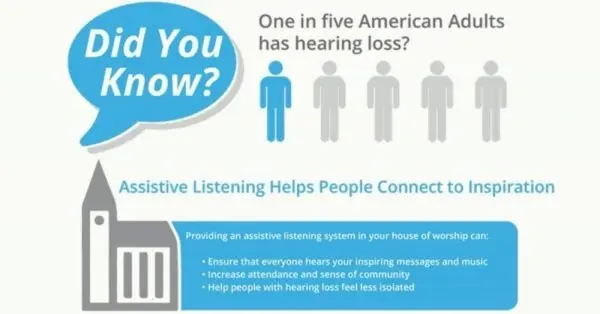
According to public health data, hearing loss is one of the most common chronic physical conditions affecting adults, yet it is frequently referred to as the "invisible disability." While the demographic most commonly associated with hearing impairment is older adults—where roughly one in three individuals over the age of 65 experiences disabling hearing loss—congregations of all sizes feature members of working age and youth dealing with congenital or noise-induced hearing challenges.
The Physics of Architectural Acoustics in Worship Spaces
Houses of worship present unique acoustical challenges that exacerbate hearing difficulties:

- Vast Cubic Volumes: Cathedrals, sanctuaries, and contemporary auditoriums are designed for aesthetic grandeur and rich musical reverberation. However, long reverberation times (often exceeding 2.0 to 3.0 seconds in traditional architecture) cause reflected sound waves to smear spoken syllables together, destroying speech intelligibility.
- Distance Decay: As sound travels from the main loudspeakers to the rear pews, its intensity drops significantly according to the inverse-square law, while ambient noise—such as shuffling feet, HVAC hums, and murmuring children—remains constant.
- The Limitation of Hearing Aids Alone: While modern digital hearing aids utilize directional microphones and digital signal processing (DSP) to isolate speech in noisy environments, they are fundamentally limited when operating across large open spaces filled with competing acoustic reflections. An Assistive Listening System bypasses these ambient obstacles entirely by transmitting the pristine, direct audio feed from the soundboard straight to the listener’s ear or hearing aid.
Official Statements and Industry Insights
Audio-visual integration experts, accessibility advocates, and manufacturers emphasize that inclusive design is no longer an optional accessory, but an essential component of modern ministry infrastructure.
"Reaching out to those who feel disconnected from your community due to hearing loss is central to sharing the message of inclusion. Genuinely compassionate service involves being aware of and caring for the needs of everyone, especially those dealing with impairments. Make sure they are able to hear the beauty and emotion of the spoken word in your church by providing them with the equipment they need to stay connected."
— Listen Technologies Ministry Resource Guidelines
Industry consultants echo this sentiment, noting that houses of worship that proactively invest in accessibility signal a deep cultural health. When a guest walks into a sanctuary and immediately notices visible signage and readily available listening devices, it communicates a powerful, unspoken message: You are seen, you are valued, and your participation matters.
Furthermore, compliance standards established by regulatory bodies—such as the Americans with Disabilities Act (ADA) in the United States—mandate the provision of assistive listening systems in assembly areas where amplified sound is used. Moving beyond mere legal compliance into a posture of proactive hospitality transforms the legal obligation into a profound act of pastoral care.
Future Outlook: The Next Generation of Sanctuary Accessibility
As audio technology continues to evolve at a blistering pace, the future of Assistive Listening Systems in houses of worship points toward hyper-personalization, seamless digital integration, and reduced social stigma.
[Traditional FM/IR Systems] ──► [Loop Systems (T-Coils)] ──► [BYOD Wi-Fi Streaming Apps]1. The Rise of BYOD (Bring Your Own Device) Wi-Fi Streaming
For decades, assistive listening relied exclusively on dedicated, church-owned receivers that required separate check-out desks and specialized cleaning protocols. Today, cutting-edge Wi-Fi audio streaming technologies allow congregants to connect to the church’s audio feed directly through their own smartphones and personal earbuds or Bluetooth-enabled hearing aids. This shift not only slashes hardware maintenance overhead for AV teams but also eliminates the perceived stigma of requesting a specialized device, as users simply interact with their phones as they would normally.
2. Integration with Auracast™ and Bluetooth Low Energy (LE) Audio
Looking toward the immediate horizon, emerging standards like Bluetooth Auracast™ are poised to revolutionize public address accessibility. Auracast will enable audio transmitters to broadcast high-quality sound directly to an unlimited number of compatible personal audio devices—including wireless earbuds, cochlear implants, and next-generation hearing aids—simultaneously and without latency. Houses of worship equipped with future-proofed AV networks will be able to blanket their entire campus in accessible, high-definition audio streams.
3. Holistic Accessibility as a Growth Driver
Ultimately, the future belongs to ministries that embrace holistic accessibility—encompassing not only hearing assistance, but also visual captioning, wheelchair mobility, sensory-friendly rooms, and neurodiversity support. Churches that eliminate these barriers report higher retention rates, deeper multi-generational engagement, and vibrant communities that truly reflect the diverse body of believers.
Conclusion and Actionable Next Steps
Implementing an Assistive Listening System is a transformative investment in the relational and spiritual health of a congregation. By methodically assessing congregational needs, exploring flexible funding and technological options, training staff to act as compassionate ambassadors, and launching comprehensive community awareness campaigns, churches can tear down the walls of isolation caused by hearing loss.
For more detailed information on choosing the right Assistive Listening System, along with practical tools to ensure your ministry’s success—including sample surveys, signage templates, and bulletin announcements—leaders are encouraged to download the comprehensive Listen Technologies Church Assistive Listening Toolkit.
Does your worship facility currently provide adequate accommodations for those experiencing hearing loss? Evaluate your systems today, and let us know how your ministry is taking steps to ensure that every voice is heard.