
Executive Overview
In an era where houses of worship strive to expand their reach, foster deep community bonds, and project radical hospitality, one critical demographic is frequently overlooked: individuals experiencing hearing loss. For millions of congregants globally, attending a traditional worship service is not a passive experience of spiritual enrichment, but rather an exercise in frustration. Reverberant acoustics in historic sanctuaries, competing audio frequencies from modern worship bands, and the natural attenuation of sound over distance can render spoken sermons and musical arrangements unintelligible.
The implementation of an Assistive Listening System (ALS) is no longer a peripheral accommodation; it is a fundamental prerequisite for equitable access, community engagement, and spiritual fulfillment. Recent technological advancements—ranging from advanced radio frequency (RF) and infrared (IR) systems to cutting-edge Wi-Fi streaming and telecoil (t-coil) integration—have revolutionized how houses of worship can deliver crystal-clear audio directly to those who need it most.
However, purchasing and installing hardware is merely the first step. True accessibility requires a strategic, multi-phased methodology encompassing demographic assessment, financial forecasting, comprehensive volunteer training, and active community outreach. Drawing on insights from audio-visual integration experts, church administrators, and accessibility advocates, this report provides an authoritative blueprint for houses of worship seeking to implement, optimize, and promote an Assistive Listening System. By treating accessibility as an integral component of the ministry rather than an afterthought, religious organizations can ensure that every message is heard, felt, and received by all who enter their doors.
Detailed Chronology: A Four-Phase Strategic Roadmap for Implementation
Successfully integrating an Assistive Listening System into a worship environment requires a deliberate, methodical approach. Rushing the procurement process without adequately assessing congregation demographics or training staff often results in low utilization rates and wasted capital. Industry standards suggest a four-phase chronological roadmap to guarantee a seamless rollout.
Phase 1: Comprehensive Needs Assessment and Data Gathering
The foundation of any successful accessibility initiative is a precise understanding of the demographic and technological profile of the congregation. Assumptions regarding who can or cannot hear effectively during services are frequently inaccurate.
- Conducting Congregation Surveys: Church leadership must initiate a formal survey process. This can be executed via physical inserts in Sunday bulletins, digital newsletters, and announcements projected on media screens.
- Targeted Inquiry Areas: The survey instruments should specifically probe the user’s subjective experience during services. Key questions must determine whether congregants struggle to understand the spoken word, whether they utilize hearing aids or cochlear implants, and—crucially—whether those medical devices are equipped with t-coil technology.
- Data Analysis: Reviewing the survey results allows the AV team and leadership to quantify the exact scope of the need. If a significant percentage of the regular attendees utilize t-coil equipped hearing aids, investing in an audio induction loop system or neck loops becomes an immediate priority, rather than relying solely on standard multi-receiver hardware.
Phase 2: Technical Evaluation and Financial Budgeting
Once the congregational need has been established, leadership must translate those requirements into concrete hardware solutions and financial estimates.
- Exploring System Options: Facilities must evaluate the primary types of assistive listening technologies available on the market:
- RF (Radio Frequency) Systems: Highly versatile, offering wide coverage areas and the ability to transmit audio through walls, making them ideal for large sanctuaries.
- IR (Infrared) Systems: Secure and immune to radio interference, though they require a direct line of sight between the transmitter and the receiver, making them well-suited for spaces with privacy or confidentiality concerns.
- Wi-Fi Streaming Systems: Utilizing the venue’s existing wireless network to stream low-latency audio directly to congregants’ personal smartphones via dedicated applications.
- Audio Induction Loops: Transmitting an electromagnetic field directly to a hearing aid or cochlear implant equipped with a t-coil, eliminating the need for separate receivers.
- Budgetary Consultations: Partnering with specialized system integration firms—such as CCI Solutions—provides leadership with accurate cost projections. Many providers offer complimentary consultations to help boards and finance committees establish realistic budgeting parameters.
- Capital Acquisition and Fundraising: To offset the capital expenditures associated with enterprise-grade listening systems, houses of worship can deploy targeted fundraising campaigns, apply for specialized accessibility grants, or allocate funds from capital improvement initiatives.
Phase 3: Operational Readiness and Staff Training
The sophistication of modern audio technology is irrelevant if the frontline staff and volunteers operating the system are unprepared. The operational success of an ALS relies heavily on the human element.
- Designating "Assistive Listening Ambassadors": Ushers, greeters, sound technicians, and welcome desk volunteers must be reframed as ambassadors of accessibility. They are the frontline educators who will introduce the technology to hesitant users.
- Mandatory Hands-On Training: Staff and volunteers must receive thorough, mandatory training on how to operate, sanitize, charge, and distribute the listening devices. They should understand how to pair neck loops with hearing aids and troubleshoot common connectivity issues.
- Collateral and Quick-Reference Materials: To minimize friction during high-traffic moments before a service, facilities should maintain a laminated, highly visible card containing answers to Frequently Asked Questions (FAQs) directly at the distribution desk. This ensures that even rotating volunteers can answer questions with confidence and speed.
Phase 4: Evangelism, Signage, and Community Awareness
An installed system that remains a secret provides zero value. The final phase of the rollout focuses on aggressive internal marketing and community outreach.
- Strategic Physical and Digital Signage: ADA-compliant signage must be prominently displayed at every primary entrance, welcome desk, and sanctuary doorway, indicating that Assisted Listening Devices are available and directing visitors to where they can acquire them.
- Multimedia and Print Reminders: Weekly bulletins, digital slides, social media channels, and livestream broadcast notes should continuously remind attendees of the available technology.
- Live Demonstration Events: Hosting a dedicated post-service demonstration allows curious congregants to test the equipment in a relaxed environment, demystifying the technology and removing the stigma often associated with hearing assistance.
- Outreach to the Broader Community: Local senior centers, retirement communities, and audiology clinics should be informed of the church’s accessibility upgrades. Many individuals with age-related hearing loss have entirely stopped attending religious services due to acoustic barriers; advertising a hearing-accessible environment can successfully draw them back.
Supporting Context & Metrics: The Imperative of Auditory Accessibility
To contextualize the necessity of assistive listening systems, one must examine the broader socioeconomic and demographic realities of hearing loss in modern society. According to data from the World Health Organization (WHO) and the Centers for Disease Control and Prevention (CDC), hearing loss is one of the most prevalent chronic conditions affecting adults globally.
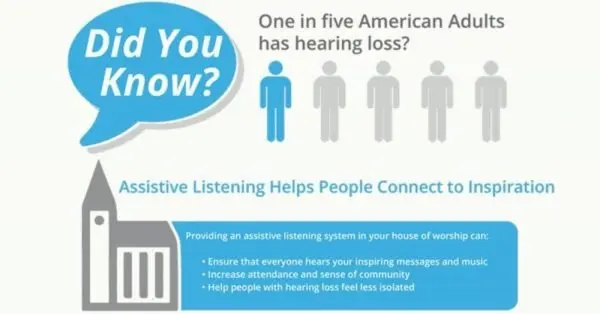
- The Demographic Reality: In the United States alone, approximately 15% of American adults (roughly 37.5 million people) report some trouble hearing. This prevalence increases dramatically with age: nearly 25% of individuals aged 65 to 74 and 50% of those aged 75 and older experience disabling hearing loss. Because demographic data shows that older adults form a significant core of traditional religious service attendees, houses of worship inherently serve an audience with elevated hearing support needs.
- The Acoustic Challenge of Sanctuaries: Traditional architectural styles for houses of worship—characterized by high ceilings, expansive open spaces, hardwood surfaces, and stained glass—are historically optimized for rich reverberation and acoustic choral resonance. However, long reverberation times (reverb) cause speech syllables to blur together. For a listener with normal hearing, the brain can often parse this acoustic smear; for a listener with sensorineural hearing loss, high-reverberation environments turn spoken sermons into unintelligible mud.
- Psychological and Social Isolation: The impact of untreated hearing loss extends far beyond physical sound perception. Gerontological and psychological research consistently links unmanaged hearing loss to social isolation, depression, cognitive decline, and anxiety. When individuals cannot follow a sermon, participate in congregational singing, or hear the pastoral prayers, they begin to feel alienated from the community. Over time, this friction leads to attrition: worshippers quietly stop attending, severing ties with their spiritual home not out of a loss of faith, but out of a barrier to participation.
By investing in an Assistive Listening System, a house of worship directly counteracts these isolating effects, transforming the sanctuary back into a space of communal connection and shared spiritual engagement.
Official Industry Guidance and Standards
Implementing accessibility measures in public assembly spaces is governed by both legal frameworks and professional audio engineering standards. Navigating these guidelines ensures that religious organizations remain compliant while delivering optimal technical performance.

Regulatory Compliance and the ADA
In many jurisdictions, houses of worship have historically been granted certain exemptions from specific Title III provisions of the Americans with Disabilities Act (ADA) regarding public accommodations. However, legal exemptions do not equate to a moral or ministry exemption. Furthermore, many modern facility expansions, community centers operated by churches, and secular rentals of worship properties fall squarely under strict ADA compliance requirements.
Under current ADA guidelines for assembly areas:
- Assistive listening systems are required in any assembly area where amplification is provided and audio is piped through a public address (PA) system.
- The system must be capable of serving a minimum percentage of the total seating capacity (typically calculated on a sliding scale based on room capacity).
- Clear signage complying with the International Symbol of Access for Hearing Loss must mark the availability of devices.
Expert Frameworks: The Listen Technologies Model
Industry leaders in assistive audio technology, such as Listen Technologies, emphasize that technical compliance is only half the battle. Their published deployment frameworks—such as the House of Worship Assistive Listening Toolkit—stress that user experience (UX) design must guide hardware selection.
Key technical mandates highlighted in professional frameworks include:
- Signal-to-Noise Ratio (SNR): The ALS must deliver a high signal-to-noise ratio, ensuring that the spoken voice is amplified clearly while ambient room noise, HVAC hums, and side conversations are minimized.
- Latency Management: In environments where the unamplified acoustic sound mixes with amplified sound (particularly in smaller sanctuaries), audio latency (delay) must be kept to absolute minimums (ideally under 40 milliseconds) to prevent the cognitive dissonance of echo effects for users.
- Universal Compatibility: Systems should accommodate users both with and without existing hearing aids. Providing universal neck loops ensures that individuals with t-coil enabled hearing aids can receive a direct, customized audio feed without needing to wear unfamiliar over-the-ear headphones.
Future Outlook: The Next Generation of Sanctuary Accessibility
As audio-visual technology continues to evolve at a rapid pace, the future of assistive listening within houses of worship is shifting toward personalization, wireless integration, and artificial intelligence.
1. The Rise of BYOD (Bring Your Own Device) Ecosystems
Historically, assistive listening required churches to maintain fleets of proprietary, battery-powered RF or IR receivers that required constant maintenance, sanitization, and security tracking. The future points decisively toward software-driven Wi-Fi streaming architectures. By leveraging existing local area networks (LANs), modern systems allow congregants to download a secure app on their personal smartphones, plug in their own earbuds or connect via Bluetooth to their hearing aids, and stream pristine sanctuary audio in real time. This drastically reduces hardware maintenance overhead for church media teams while empowering users via familiar technology.
2. Artificial Intelligence and Real-Time Transcription
Looking further ahead, the integration of artificial intelligence (AI) into worship audio pipelines promises to break down barriers even further. Emerging technologies are beginning to combine traditional assistive listening feeds with real-time automated speech recognition (ASR). Soon, congregants may not only listen to an enhanced audio stream but simultaneously view real-time, context-aware closed captioning or live translation on their smartphones or smart-glasses. This innovation will serve not only those with hearing impairments but also non-native language speakers and individuals processing neurodivergent learning styles.
3. Cultural Shift Toward Radical Inclusion
Ultimately, the technological trajectory points toward a permanent cultural shift within religious communities. Accessibility is evolving from a compliance-driven checkbox into a core theological tenet. As more houses of worship embrace comprehensive assistive listening frameworks, the stigma surrounding hearing loss diminishes. The sanctuary of tomorrow will be one where acoustic architecture and digital engineering converge seamlessly, ensuring that the message of hope, community, and faith is genuinely accessible to every single soul in attendance.
Conclusion & Actionable Next Steps
Reaching out to individuals who feel disconnected from a spiritual community due to hearing loss is central to the mission of radical hospitality. Genuinely compassionate service requires active awareness and proactive care for the needs of every community member, particularly those navigating sensory impairments. Ensuring that congregants can experience the full beauty, nuance, and emotional resonance of the spoken word and musical worship is a vital investment in the health of the church body.
To begin or advance your facility’s accessibility journey:
- Download Resources: Access comprehensive planning tools, such as the Listen Technologies Church Assistive Listening Toolkit, to review sample surveys, signage templates, and bulletin announcements.
- Engage Experts: Contact experienced audio-visual integration specialists, such as CCI Solutions, to request a complimentary consultation regarding your sanctuary’s specific acoustic layout and budgeting constraints.
- Assess and Implement: Survey your congregation this coming Sunday, evaluate your technical options, train your volunteer ambassadors, and take the first step toward universal auditory inclusion.
Does your worship facility currently provide an assistive listening solution? Contact our editorial team or your local AV integration specialist to share your story and evaluate how your ministry can better serve all members of your community.