The landscape of modern music education is undergoing a quiet yet profound digital transformation. For centuries, the acquisition of foundational instrumental skills relied heavily on printed anthologies, private pedagogy, and trial-and-error methodologies that often left students isolated in their practice rooms. Among these foundational skills, sight reading—the ability to read and perform unfamiliar music at first sight—has historically been viewed as an elusive mountain to climb. It is a competency that separates proficient players from true masters, yet it is frequently neglected due to pedagogical intimidation, a lack of structured materials, and the sheer cognitive load required to process notation in real-time.
Enter SightReadingMastery, an innovative digital platform founded in 2011 by musician, educator, and software engineer Evan R. Murphy. Designed to bridge the gap between mechanical execution and artistic fluency, the platform has steadily expanded its multi-instrumental ecosystem to democratize access to high-grade, intelligent sight-reading practice.
In the latest milestone for the platform, SightReadingMastery has officially announced the launch of its Grade 1 Flute Sight Reading curriculum. This comprehensive module is engineered specifically to address the multifaceted challenges faced by beginning flutists. By blending professional composition with a graduated, stress-reduced pedagogical framework, the new release aims to transform how developing musicians approach the instrument. Rather than subjecting students to sterile, mechanical drills, the program introduces fun, original, and musically satisfying melodies tailored to keep students engaged while building crucial cognitive and physical reflexes.
This report provides an in-depth examination of the new Grade 1 flute release, exploring the physiological and technical hurdles of flute playing, the pedagogical philosophy underpinning SightReadingMastery, the broader technological context of digital music education, and what this launch signals for the future of instrumental instruction.
Detailed Chronology: From Concept to the Flute Module
To understand the significance of the Grade 1 flute rollout, it is essential to contextualize the historical trajectory of SightReadingMastery and the developmental pathway that led to this specialized release.
The Genesis of SightReadingMastery (2011)
When Evan R. Murphy established SightReadingMastery in Seattle, Washington, he did so from a dual perspective: as a trained musician and teacher intimately familiar with the frustrations of students, and as a software engineer capable of building scalable, accessible web tools. Murphy recognized that while countless methods existed for learning repertoire or scales, very few resources provided systematic, progressive daily practice for sight reading. Sight reading was treated as an afterthought—something teachers tested occasionally rather than a core competency built daily through structured practice.
Expanding the Multi-Instrumental Horizon
Over the subsequent decade, the platform evolved from a localized concept into a robust international resource. As the platform scaled, Murphy and his team systematically integrated support for various orchestral and contemporary instruments, including guitar and violin. Each instrument presented unique challenges:
The Guitar Module required navigating complex fretboard geometries and multiple simultaneous voices.
The Violin Module demanded simultaneous mastery of bow distribution, intonation without frets, and shifting left-hand frames.
The Flute Challenge and the Road to Grade 1
As the platform matured, requests for a dedicated flute curriculum grew increasingly urgent from the education community. However, developing a sight-reading curriculum for the flute is fraught with unique pedagogical hurdles. Unlike keyboard instruments where notes are laid out visually in a linear fashion, or fretted instruments with tactile markers, the flute requires an intricate coordination of breath control, embouchure formation, finger dexterity across complex key mechanisms, and posture—all while holding the instrument completely suspended to one side of the body.
The development phase for the Grade 1 flute module involved extensive collaboration between software developers and professional composers. The objective was clear: create a repository of melodies that respected the physiological limitations of a beginner flutist while avoiding the monotony of traditional dry exercises. Following rigorous testing and content generation, the curriculum officially went live, marking a major expansion for the platform and providing beginning flutists with a dedicated, intelligent pathway to literacy.
Supporting Context & Metrics: The Mechanics of Flute Sight Reading
To fully appreciate the value of the Grade 1 SightReadingMastery release, one must analyze the unique cognitive and physical demands placed upon a beginning flutist, and how the platform’s methodology systematically mitigates them.
The Triad of Flute Performance: Embouchure, Breath, and Fingers
When a student picks up the flute for the first time, their cognitive bandwidth is instantly saturated. Unlike the piano, where pressing a key produces a reliable tone instantly, the flute requires the player to generate their own sound source by directing a focused stream of air across the embouchure hole.
This introduces three simultaneous operational vectors:
Embouchure Control: The subtle adjustment of lip aperture, facial muscles, and jaw placement to produce a clear, centered tone across registers.
Breath Management: Developing diaphragmatic support, lung capacity, and efficient air usage—crucial because the flute is an open-pipe instrument that consumes a significant volume of air.
Finger Dexterity: Coordinating ten fingers across open holes, plateau keys, and intricate rod mechanisms while maintaining balanced physical posture to keep the instrument stable.
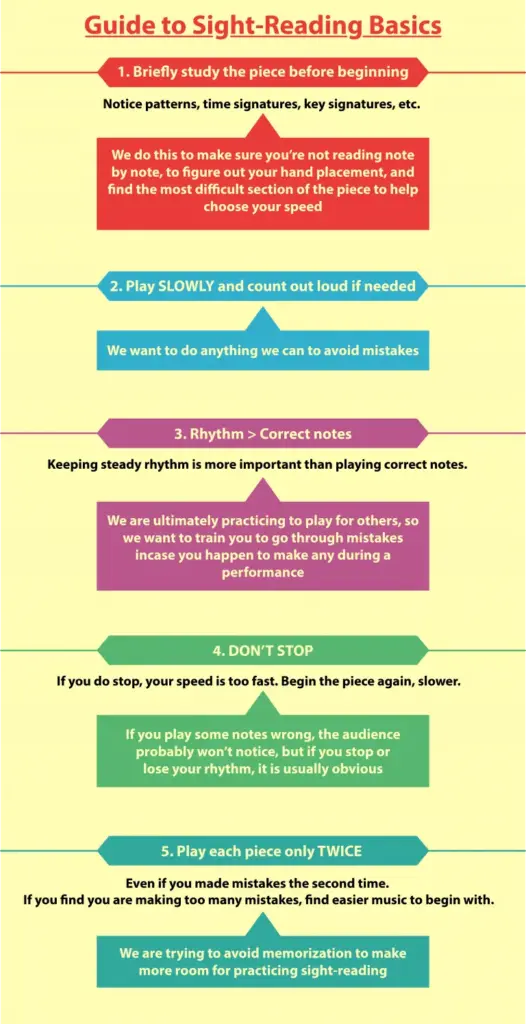
When a student attempts to sight-read amid these physical demands, cognitive overload frequently occurs. If the musical notation features awkward intervals, overly complex rhythms, or unfamiliar key signatures, the student’s technique collapses. Tension creeps into the shoulders and hands, tone quality deteriorates, and frustration sets in.
The SightReadingMastery Pedagogy: Easing into Fluency
SightReadingMastery addresses this cognitive bottleneck through a carefully engineered reduction of extraneous variables. The Grade 1 flute curriculum is built upon several foundational design principles:
Controlled Range: The melodies are restricted to a comfortable, register-appropriate compass. This prevents beginners from venturing prematurely into the extreme registers (such as the upper third octave), where embouchure stability and intonation are notoriously difficult to maintain.
Simple Key Signatures: Exercises are anchored in accessible key signatures, minimizing the immediate cognitive load of processing numerous sharps or flats, thereby allowing the student to focus on reading intervals and rhythmic subdivisions.
Bite-Sized Exercises: Rather than overwhelming students with sprawling etudes, the curriculum utilizes short, digestible musical phrases. These micro-exercises encourage daily engagement without inducing mental fatigue.
Original, Professionally Composed Melodies: A critical differentiator of the platform is its rejection of automated, computer-generated pseudo-music. Every exercise is crafted by professional composers who understand how to write genuinely musical, engaging melodies that sound like real pieces of art. This provides students with immediate psychological reinforcement and artistic satisfaction.
Official Statements and Pedagogical Philosophy
Reflecting on the mission of SightReadingMastery and the release of the flute curriculum, founder Evan R. Murphy emphasizes the transformative power of literacy in music education.
"Flutists have an immense amount of information to process in real-time," Murphy notes. "Between managing your embouchure, controlling your breath support, and executing precise finger movements across the instrument, trying to learn sight reading on top of all this can easily become overwhelming if it is not approached in a smart, structured way. Our goal with SightReadingMastery is to strip away the anxiety and replace it with confidence. By keeping exercises approachable—using comfortable ranges, simple keys, and genuinely musical compositions—we allow students to experience the joy of real music from day one."
This philosophy aligns with broader shifts in contemporary music pedagogy, which increasingly prioritizes holistic musicianship over rote memorization. Traditional methods often trap students in a cycle where they spend months learning a single piece of music by heart, rendering them functionally illiterate when placed in ensemble settings or confronted with new scores.
By integrating systematic sight reading into daily practice routines, educators can cultivate musicians who are adaptable, confident, and capable of collaborating seamlessly with other instrumentalists. The launch of the Grade 1 flute module provides private teachers, school band directors, and self-taught students with a standardized, reliable tool to achieve this literacy.
Future Outlook: The Evolution of Digital Music Literacy
The release of the Grade 1 Flute Sight Reading module is not merely an isolated product update; it represents a broader indicator of where music education is heading in the digital age. As online platforms continue to mature, the barriers separating students from high-grade, specialized pedagogical resources are rapidly dissolving.
Expanding Curricula and Higher Grade Levels
Following the successful deployment of Grade 1 materials across instruments like the flute, guitar, and violin, the roadmap for SightReadingMastery points toward continuous expansion. Anticipated future developments include the rollout of progressive grade levels (Grades 2 through 8 and beyond) for the flute, ensuring that students have a continuous, uninterrupted ladder of development from their first months of playing through advanced conservatory-level proficiency.
The Integration of Smart Technology and Analytics
Looking further ahead, the intersection of music education and software engineering opens extraordinary possibilities for real-time feedback systems. While current sight-reading platforms focus primarily on providing curated content and encouraging independent practice, future iterations of digital music tools may incorporate audio recognition technology. Such advancements could allow software to listen to a student’s performance in real-time, providing instant visual feedback on pitch accuracy, rhythmic precision, and even tone consistency during sight-reading exercises.
Empowering the Global Community of Educators
Ultimately, tools like SightReadingMastery serve as force multipliers for music educators. Private instructors often struggle to find enough supplementary sight-reading material for their students between weekly lessons. By providing an expansive, ready-to-use digital library of progressive exercises, platforms like SRM free teachers to focus on artistic interpretation, physical posture, and expressive nuance during in-person instruction.
As the digital ecosystem expands to embrace instruments of all families—from woodwinds and strings to brass and percussion—the overarching vision remains clear: to ensure that every aspiring musician, regardless of geographic location or economic background, has access to the tools necessary to unlock the full power of musical literacy.
Related Reading & Resources
For musicians, teachers, and enthusiasts looking to explore further into the ecosystem of digital music education and instrument-specific sight reading, the following resources provide additional context:
Supported Instruments: Discover the full range of orchestral and contemporary instruments currently supported by the platform’s curriculum.
Grade Level Frameworks: Explore how progressive difficulty tiers are structured across different instrumental modules to ensure continuous skill development.
Software vs. Traditional Methods: An analytical comparison examining how digital sight-reading tools complement—and in many cases surpass—aging paper-based pedagogical traditions.
Community Engagement & Support: Students and educators interested in integrating SightReadingMastery into their studios can reach out directly via the platform’s contact portal or explore related launches, such as the recently expanded violin sight-reading curriculum.