
Executive Overview
In the realm of language acquisition, true fluency is achieved the moment a speaker stops translating words in their head. When learning Spanish, for instance, encountering the phrase "buenos días" requires immediate comprehension of the concept rather than a mental detour through the English equivalent, "good morning." While initial translation offers a comforting validation of correctness, it ultimately acts as an anchor, dragging down cognitive processing speeds and obstructing the path to natural, conversational fluency.
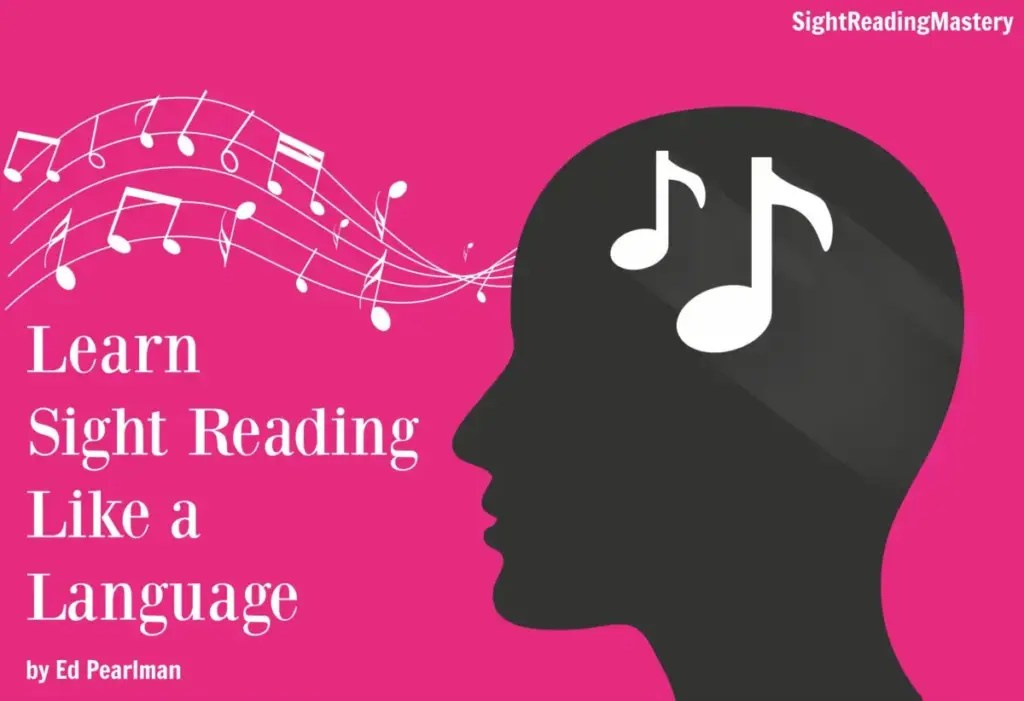
According to veteran educator and performer Ed Pearlman, music operates under the exact same neurological and cognitive principles. Whether applied to instrumentalists or vocalists—who can easily substitute the act of "playing" with "singing" throughout this framework—sight-reading demands a direct, unmediated translation from page to performance. Musicians who bog themselves down by visually parsing a note, translating it into a pitch name, calculating its corresponding finger number, verifying its accuracy, and finally executing the stroke will inevitably fail to maintain tempo.
To bridge the gap between static notation and fluent musicality, Pearlman has introduced a progressive, five-tier developmental framework. Designed to simulate the organic absorption of a spoken language, this methodology transitions a student from the foundational skeleton of rhythm to the advanced nuance of interval recognition and internal nomenclature. By stripping away cognitive bottlenecks one layer at a time, musicians can cultivate an intuitive, frictionless relationship with their sheet music.
Detailed Chronology: The Evolution of Sight-Reading Pedagogy
Historically, music education has struggled with a pedagogical disconnect. Students were routinely handed complex pieces of sheet music and instructed to decode them note-by-note, a grueling process that often induced performance anxiety and a reliance on rote memorization rather than true literacy. Over the past several decades, cognitive scientists and master pedagogues have increasingly looked toward linguistics to overhaul how students interact with visual notation.
The integration of language acquisition models into musical instruction did not happen overnight. It evolved through several key phases:
- The Era of Rote Memorization (Pre-20th Century): For centuries, musical training relied heavily on imitation. Students listened to masters, memorized passages by ear, and used notation merely as a secondary archive rather than a primary mode of communication.
- The Analytical Shift (Mid-20th Century): As conservatories standardized training, music theory dominated. Students learned to meticulously dissect intervals, key signatures, and harmonic structures. While thorough, this analytical approach often paralyzed live performance, breeding musicians who could intellectually analyze a score but struggled to sight-read fluidly in real-time.
- The Linguistic Convergence (Late 20th Century to Present): Modern educational research began drawing direct parallels between reading prose and reading scores. Pioneers like Ed Pearlman began advocating for immersion techniques, arguing that sheet music should be processed globally—in phrases, rhythms, and profiles—rather than atomized into isolated symbols.
This modern philosophy culminated in Pearlman’s structured, five-level framework. Rather than demanding perfection across all musical parameters simultaneously, this pedagogical roadmap encourages a stepwise accumulation of skills, ensuring that foundational mechanics are fully internalized before higher cognitive loads are introduced.
Supporting Context & Metrics: The Five-Level Pedagogical Framework
To effectively master sight-reading without falling into the trap of mental translation, Pearlman’s methodology breaks the reading process down into distinct, manageable tiers. Note: These progressive training levels operate independently of the standard "grade levels" used by platforms like SightReadingMastery to measure absolute piece difficulty.
Level 1: Rhythms Only
The journey begins by completely stripping away pitch. The musician selects a steady tempo and simply taps out the rhythm of an unfamiliar passage.
- The Core Objective: Train the brain to process the rhythmic structures of an entire measure at a glance, rather than calculating individual note values sequentially.
- Why It Matters: Rhythms possess no intrinsic musical meaning in isolation; they derive their purpose entirely from their relationship to surrounding beats. By isolating rhythm, students eliminate half of the cognitive burden.
- As the old musician joke goes among orchestral players: A violist proudly approaches a violinist, boasting that they have mastered the ability to play 64th notes. The unimpressed violinist replies, "Great, let’s hear one!" A strong grasp of Level 1 ensures the musician can deliver that "single note" with absolute temporal precision.
Level 2: Note Profile
Once the rhythm is secure, the musician introduces the physical layout of the notes without worrying about exact pitch accuracy. Using the established tempo, the player or singer follows the general contour—or profile—of the passage: moving higher, staying the same, or descending.
- The Core Objective: Focus entirely on relative spatial movement across the staff while maintaining strict adherence to tempo.
- Why It Matters: Just as a reader can skim a paragraph and grasp its general meaning without reading every single letter, a musician must learn to visually ingest the "shape" of a musical phrase instantly. Pausing to verify exact notes shatters the rhythmic integrity of the performance.
Level 3: Focusing the Picture
At this stage, the musician incorporates specific key signatures and pitch accuracy, but with a strict caveat regarding momentum.
- Preparation: Before launching into the passage, the student must take note of the key signature and play or sing the corresponding scale, paying explicit attention to the location of half-steps (which may only appear once or twice within a given range).
- Execution: Armed with this structural map, the student plays the passage in strict time. If uncertainty arises regarding a specific note, the musician is permitted to make an educated guess rather than halting the performance.
- The Golden Rule: A note error is acceptable during Level 3 practice; a timing error is not. If maintaining tempo proves too difficult at first, students are advised to intentionally slow their metronome or isolate their practice to single, one-to-two-measure chunks.
Level 4: Seeing Intervals
Moving deeper into structural literacy, Level 4 trains the eye to immediately differentiate between various harmonic distances without conscious calculation.
- Mastering Shapes: Students must learn what visual architecture defines a scale (consecutive notes stepping neatly from a line to a space, or vice versa) versus a third (skipping from one line directly to the next line, or space to space).
- Advanced Recognition: While wider leaps—such as a fifth (spanning a line to two lines away, or space to two spaces away)—initially require more cognitive effort, they rapidly become second nature through consistent exposure and repetitive sight-reading practice.
Level 5: Names of Notes
The final tier introduces internal verbalization: consciously naming the notes in your mind (or out loud) as you play them.
- The Role of Nomenclature: Pearlman notes that this step is technically optional for pure sight-reading, as mental translation of note names is not strictly essential to the visual-to-performance language loop.
- The Diagnostic Value: Despite being non-essential, adding this extra layer serves as an ultimate stress test for your focus. It evaluates whether you can maintain fluid rhythm and note-contour processing while simultaneously executing cognitive labeling. For musicians struggling with this tier, targeted aids like dedicated note-recognition software can accelerate fast visual mapping.
Official Statements & Expert Insights
Ed Pearlman, whose extensive 60-year career spans classical violin performance in Chicago and Boston to decades of specialized folk fiddle performance and instruction across North America and Scotland, emphasizes that the miraculous aspect of sight-reading lies in cumulative exposure.
"When you spend time reading many varied examples, you genuinely build a visceral feel for speaking the language of music," Pearlman explains. Through his digital educational platforms, including Fiddle-Online, Pearlman has long championed the idea that traditional pedagogy often overcomplicates mechanics that should feel as natural as reading a street sign.

"The translation might reassure you that you are correct in using the words, but it also slows you down and keeps you from becoming a fluent speaker. It’s the same in music. You want to play directly from sight… you won’t have time to do all this and stay in tempo."
— Ed Pearlman, Master Musician and Educator
Music educators across the globe have increasingly echoed these sentiments, noting that students who embrace tiered, non-translatative reading habits exhibit significantly lower performance anxiety and superior ensemble listening skills. By decoupling mechanical rhythm from fine-tuned pitch nomenclature, students build a resilient psychological safety net that encourages experimentation rather than fear of failure.
Future Outlook
As music education continues to evolve in the digital age, the integration of structured sight-reading frameworks into everyday practice routines is poised to become even more streamlined. With interactive platforms offering infinite variations of graded exercises, real-time audio analysis, and automated difficulty scaling, musicians no longer need to rely solely on physical print libraries to build fluency.
However, the core philosophical breakthrough remains human rather than technological. The shift away from archaic, note-by-note translation toward holistic, linguistic processing represents a fundamental modernization of musical training. By treating notation not as a cipher to be cracked, but as a living language to be read fluently from left to right, the next generation of instrumentalists and vocalists will find themselves better equipped to perform with confidence, precision, and uninhibited musicality.
For practitioners ready to elevate their craft, the path forward is clear: start with the rhythm, respect the profile, anchor your keys, master your intervals, and let the music flow directly from the page to your instrument, uninterrupted.