
Executive Overview
In an era where modern houses of worship constantly strive to expand their reach, engage younger demographics, and modernize their production values with concert-grade audio and immersive lighting, a fundamental pillar of ministry is occasionally overlooked: physical accessibility. While crystal-clear audio mixes and soaring worship vocals enhance the Sunday experience for the majority, a significant portion of congregants may sit through services feeling entirely disconnected. For individuals experiencing hearing loss, traditional sanctuary acoustics—often characterized by reverberant architecture, high ceilings, and complex sound propagation—can transform a morning of spiritual enrichment into an exercise in frustration.
Addressing this barrier is no longer merely a matter of ADA compliance; it is a profound pastoral imperative. Implementing an Assistive Listening System (ALS) bridges the acoustic gap, ensuring that every spoken prayer, scripture reading, and sermon reaches every ear with absolute clarity. However, deploying such a system successfully requires more than simply purchasing hardware off the shelf and plugging it into a soundboard. It demands a strategic, multi-phased approach encompassing congregation assessment, financial planning, staff training, and proactive community outreach.
This article provides an authoritative, deep-dive roadmap for church leadership teams, audio-visual (AV) directors, and pastoral staff. Drawing on industry insights and best practices from audiovisual integration experts like CCI Solutions and assistive technology pioneers like Listen Technologies, we explore the definitive four-step framework for transforming your worship space into a truly inclusive environment. By understanding your demographic needs, evaluating technical options, training dedicated "Ambassadors," and raising public awareness, your ministry can ensure that no member of your flock misses a single word of grace.
Detailed Chronology: The Four-Step Implementation Roadmap
Deploying an Assistive Listening System is a project that intersects technology, hospitality, and pastoral care. To maximize return on investment and ensure high adoption rates among congregants, leadership must follow a structured, chronological implementation plan.
Phase 1: Assess and Understand Congregation Needs
The foundational error many ministry teams make is purchasing an ALS based solely on architectural square footage or broad industry generalizations without consulting the actual end-users. Before allocating budget or contacting AV integrators, leadership must conduct a thorough diagnostic of the congregation’s demographic makeup and specific hearing challenges.
- Deploying Congregation Surveys: The most effective mechanism for gauging listening needs is a targeted, anonymous survey distributed via physical bulletins, email newsletters, and digital church apps.
- Targeted Questioning: Surveys should move beyond a simple "Do you have trouble hearing?" Instead, ask specific qualitative questions: What has your experience been like during corporate worship? Do you currently use hearing aids? If so, are those hearing aids equipped with telecoils (t-coils)?
- Analyzing the Data: By gathering this quantitative and qualitative feedback, the AV team and pastoral staff can quantify the demand. Knowing whether your congregants utilize t-coil enabled hearing aids, personal receivers with integrated headphones, or neck loops will directly dictate the type of transmission technology (RF, Infrared, or Wi-Fi audio) you ultimately select.
Phase 2: Fully Understand Your Technical and Financial Options
Once the congregation’s needs are clearly mapped, the next phase involves navigating the complex landscape of hardware options, pricing models, and budgetary constraints. Modern assistive listening technology has evolved far beyond the basic FM radio transmitters of the past, offering sophisticated multi-channel systems that stream directly to smartphones or specialized pocket receivers.
- Cost Estimation and Budgeting: Estimating the financial scope requires balancing the number of required receivers, charging docks, signage, and potential cabling or integration with your existing sound reinforcement desk.
- Leveraging Expert Consultations: Organizations like CCI Solutions specialize in bridging the gap between ministry needs and technical execution. Utilizing free consultations allows church administrators to receive objective advice on equipment scalability, ensuring that a system purchased today can grow with the congregation tomorrow.
- Creative Funding and Fundraising: For many ministries, capital expenditures require creative solutions. Consider designating specific special offerings, writing grants through local community foundations dedicated to accessibility, or engaging major donors who have a personal connection to hearing impairment. Framing the purchase as an evangelism and discipleship initiative rather than a technical upgrade frequently unlocks new streams of financial support.
Phase 3: Prepare for Operational Success and Staff Training
The most advanced assistive listening system in the world is useless if it sits uncharged in a drawer or if volunteers are intimidated by how to operate it. Preparation and comprehensive training are the linchpins of long-term operational success.
- Appointing "Assisted Listening Ambassadors": Ushers, greeters, and welcome desk volunteers should be reframed as your frontline ambassadors for accessibility. Their attitude and competence will dictate whether a congregant feels welcomed or stigmatized when asking for a device.
- Hands-On Training Protocols: Staff and volunteers must receive formal training on how to turn on receivers, adjust volume controls, pair neck loops, sanitize earpieces, and troubleshoot common feedback or connectivity issues.
- Operational Scaffolding (FAQ Collateral): To eliminate friction during high-traffic Sunday morning rushes, keep a laminated copy of frequently asked questions (FAQs) and step-by-step instructions at the distribution desk. This empowers even first-time volunteers to assist users with confidence, ensuring a seamless user experience.
Phase 4: Create Awareness and Drive Community Engagement
Installing an ALS is only half the battle; the second half is driving adoption. If the congregation and the surrounding community do not know the technology exists, utilization rates will remain near zero.
- Strategic Signage: Display clean, ADA-compliant signage at main entrances, welcome desks, and sanctuary entryways indicating that Assisted Listening Devices are available, along with clear directions on where to acquire them.
- Multi-Channel Communication: Consistently remind the congregation through weekly bulletins, slide deck pre-service announcements, and church-wide emails.
- Hosting Dedicated Live Training Events: Consider holding a brief, post-service orientation where seniors or individuals with hearing loss can try out the technology in a relaxed environment without the pressure of a live service starting.
- Community Outreach: Broaden your marketing scope to the surrounding geographic community. Many individuals with hearing impairments have stopped attending church entirely because they feel excluded. Advertising your fully accessible services can draw in visitors who are actively searching for a congregation that cares for their specific needs.
Supporting Context & Metrics: The Human Impact of Hearing Loss
To fully appreciate the urgency of deploying an Assistive Listening System, leadership must examine the demographic realities and psychological toll of untreated hearing loss within modern populations.
The Demographic Imperative
According to data compiled by organizations such as the Hearing Loss Association of America (HLAA) and the World Health Organization (WHO), hearing loss is one of the most common chronic physical conditions affecting adults.
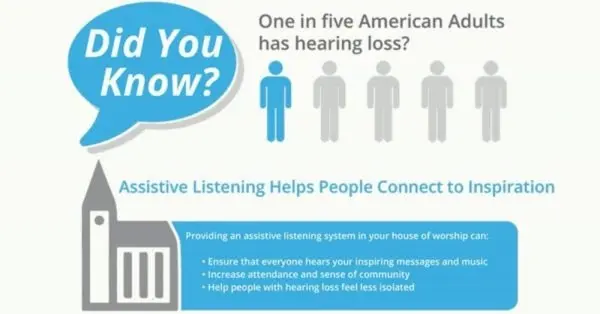
- Approximately 48 million Americans (nearly 20% of the population) experience some degree of hearing loss.
- While hearing loss is frequently associated with aging—affecting roughly one in three individuals over the age of 65, and half of those over 75—it also impacts millions of younger adults and children.
- Despite these staggering statistics, studies indicate that adoption rates for hearing aids hover around only 20% to 30% among those who could benefit from them, often due to cost, stigma, or the inherent limitations of hearing aids in large, reverberant spaces.
The Psychological Cost of Exclusion in Worship
In a house of worship, acoustic challenges are magnified. Unlike a quiet living room or a tightly controlled office environment, sanctuaries are designed for choral resonance, organ music, and soaring architectural aesthetics. These very acoustic properties cause sound waves to bounce off hard surfaces, creating reverberation that blurs consonant sounds and renders speech unintelligible for those with compromised hearing.
When a congregant can no longer understand the sermon, a cascade of negative psychological effects often follows:
- Isolation: The individual feels detached from the shared corporate experience of the body of Christ.
- Fatigue: Straining to read lips or decipher muffled audio for an hour causes profound "listening fatigue," prompting many to abandon attendance altogether.
- Shame: Rather than voicing their difficulties, many individuals quietly slip away, choosing isolation over the perceived embarrassment of asking for help.
By installing an ALS, churches actively combat this isolation. Providing these systems communicates a clear, undeniable pastoral message: You belong here, your presence matters, and we have intentionally made space for you to hear the Word of God.

Official Statements and Industry Insights
Industry leaders and integration specialists emphasize that accessibility must be woven into the cultural DNA of a ministry, rather than treated as an afterthought.
"Reaching out to those who feel disconnected from your community due to hearing loss is central to sharing the message of inclusion. Genuinely compassionate service involves being aware of and caring for the needs of everyone, especially those dealing with impairments."
— AV Integration and Ministry Outreach Consensus
Audio system designers frequently point out that sound reinforcement is no longer just about volume—it is about clarity and intelligibility.
"Increasing the volume of the main PA system does not solve hearing loss; in fact, in a reverberant room, turning up the volume often makes speech less intelligible by increasing distortion and echo. An Assistive Listening System bypasses the room’s acoustic flaws entirely, delivering a clean, direct feed of the audio mix straight to the user’s ear or hearing aid."
— Senior Audio Systems Engineer
Furthermore, technology manufacturers like Listen Technologies stress the importance of holistic deployment toolkits. Resources such as the Listen Technologies Church Assistive Listening Toolkit provide ministries with sample surveys, customizable signage templates, and bulletin announcements, removing the guesswork from administrative implementation and enabling rapid execution.
Future Outlook: The Next Wave of Inclusive Worship Technology
As we look toward the future of church production and pastoral care, the integration of assistive listening is poised to undergo significant technological evolution. Understanding these emerging trends can help church leadership future-proof their capital investments today.
The Rise of Wi-Fi and Bring-Your-Own-Device (BYOD) Systems
Historically, churches relied heavily on dedicated FM or infrared pocket receivers that required physical check-in, ID holding, and extensive sanitization between services. While these legacy systems remain reliable, the future of assistive listening increasingly points toward Wi-Fi-based streaming architectures.
- BYOD Adoption: Wi-Fi systems allow congregants to download an app on their personal smartphones and stream the live audio feed directly through their own earbuds, headphones, or Bluetooth-enabled hearing aids.
- Reduced Administrative Burden: By leveraging the devices that users already carry in their pockets, churches drastically reduce the labor required to distribute, track, charge, and maintain dedicated hardware receivers.
- Enhanced Discretion: For many users, particularly younger demographics or those sensitive to the social stigma of asking for a specialized device, using their own smartphone blends seamlessly into the modern worship environment.
Integration with Next-Generation Hearing Ecosystems
The convergence of Bluetooth Low Energy (LE) Audio and Auracast broadcast technology represents the next major frontier for public accessibility. Auracast broadcast audio enables a single audio source—such as a church soundboard—to broadcast crystal-clear, high-quality audio simultaneously to an unlimited number of personal audio receivers, including compatible hearing aids, earbuds, and smartphones, without the need for pairing codes or complex network configurations.
Houses of worship that invest in flexible, scalable assistive listening frameworks today will find themselves perfectly positioned to adopt these emerging broadcast standards as they become ubiquitous in consumer electronics over the coming decade.
Conclusion: Embracing Compassion Through Technology
The measure of a vibrant, healthy church is not solely found in its attendance metrics, its architectural grandeur, or the sophistication of its media production. Ultimately, it is found in how deeply it embodies the ministry of Jesus Christ—reaching out to the margins, lifting up the overlooked, and ensuring that every individual has unhindered access to the Gospel.
Hearing loss is an invisible barrier, but it is one that can be decisively dismantled. By meticulously assessing congregational needs, navigating technical and budgetary options with expert partners, training dedicated hospitality ambassadors, and enthusiastically promoting your new systems, your ministry can transform your worship space into a sanctuary of true belonging.
For leadership teams ready to take the next step, resources such as the Listen Technologies Church Assistive Listening Toolkit offer invaluable sample surveys, signage layouts, and communication templates to guarantee success.
Does your worship facility currently provide adequate accommodations for those with hearing impairments? Reach out to our team of integration specialists today to evaluate your sanctuary’s acoustics and discover how an Assistive Listening System can help your entire congregation hear the beauty and emotion of the spoken word.