
Executive Overview
The contemporary jazz landscape is undergoing a quiet, profound decentralization. No longer tethered exclusively to the historical urban hubs of New York, Chicago, or Paris, modern jazz creators are leveraging digital infrastructure, cross-cultural heritage, and regional liturgical traditions to forge entirely new sonic idioms. This critical review examines three distinct, recently released albums that capture this global evolution: Przemysław Jan Grabowski’s Jazz Mysteries, a transcontinental remote collaboration bridging Boston, Cuba, London, and New York; Ray Lema with Ensemble Partage’s Passion Congo, a virtuosic fusion of Congolese roots and Italian classical string arrangements; and the Krupke Trio’s Hymns In A Jazz Mood Vol 3, which explores the contemplative, understated intersection of Norwegian church hymns and Nordic jazz improvisation.
Together, these projects illustrate the multi-faceted state of modern improvised music. They demonstrate how artists are navigating the paradoxes of 21st-century production—balancing the technical wizardry of remote recording with the loss of organic physical interplay; merging folk idioms with classical minimalism; and reinterpreting sacred repertoires through secular jazz lenses. This report provides an authoritative, deep-dive analysis of these three releases, tracing their production methodologies, musical merits, and long-term implications for the genre.
Detailed Chronology and Production Dynamics
Przemysław Jan Grabowski: Jazz Mysteries
The genesis of Jazz Mysteries dates back to the height of the COVID-19 pandemic, a period that fundamentally disrupted traditional ensemble recording. Polish-Australian pianist and composer Przemysław Jan Grabowski, operating out of Washington, D.C., found himself isolated yet creatively galvanized. Having abandoned formal musical training at an early age to cultivate a personal vocabulary influenced by the titans of modern piano—specifically Chick Corea and Herbie Hancock—Grabowski set out to construct a cohesive suite of seven original compositions.
Between 2023 and 2025, Grabowski orchestrated a massive logistical undertaking. While he laid down his core piano tracks in Boston, he recruited a stellar, geographically dispersed lineup to complete the orchestration remotely: Camila Cortina Bella (syn, piano comping), Emir Santa Cruz (tenor saxophone), Kali Rodriguez-Peña (trumpet), Noam Tanzer (bass), Samer Sharawi (electric bass), and Andy Wilder (drums) tracking their respective parts across Havana, London, and New York.
The chronological realization of the album highlights both the triumphs and limitations of modern tele-matic production. On one hand, the engineering and production triumph in creating a remarkably homogenous soundstage; tracks like the Herbie Hancock-influenced modal number Forward Voyage boast a fluent, assured tenor solo from Santa Cruz that sounds as though it were captured in a single room. Conversely, the absence of real-time, physical interplay introduces a slight detachment in certain solo sections, sacrificing the spontaneous back-and-forth friction that defines traditional acoustic jazz ensembles. Despite these structural hurdles, Grabowski successfully flexes his compositional muscles across pieces like the relaxed, funky Happy Beluga, resulting in an engaging, warm addition to his developing discography.
Ray Lema with Ensemble Partage: Passion Congo
Ray Lema’s musical chronology spans decades of relentless geographic and stylistic migration. Hailing originally from the Congo, Lema’s career has intersected with rock, jazz, and classical traditions across multiple continents. His latest chapter, captured in the recording sessions at Studio Peninsula in Sarzeau, France, represents a meticulous synthesis of his pan-African heritage and European classical frameworks.
For Passion Congo, Lema partnered with the Italian Ensemble Partage—whose name derives from the French word for "to share." This unique collective comprises a string quartet (violinists Massimiliano Gilli and Sylvie Blanc, violist Gerardo Vitale, and cellist Claudia Ravetto), soprano saxophonist Manuel Pramotton, and percussionists Marc Giovinazzo and Nesta Mondelice. Rather than relying on standard jazz-fusion tropes, Lema’s creative process focused on rhythm-driven structures inspired by classical minimalism.
Chronologically, the album showcases Lema’s mastery of pacing and arrangement. Tracks such as Hysteria and Ngandajika were built from the ground up, utilizing shifting, repetitive string riffs as foundational rhythmic engines, over which Pramotton’s soprano saxophone chirrups with feverish intensity. By seamlessly integrating baroque-leaning cello lines (Matongue), ragtime derivations (Twist And Smile), and Caribbean vocal cadences (Partage), Lema successfully sidestepped the pitfall of "ethno-pudding," delivering an album defined by absolute clarity of expression and structural evolution.
Krupke Trio: Hymns In A Jazz Mood Vol 3
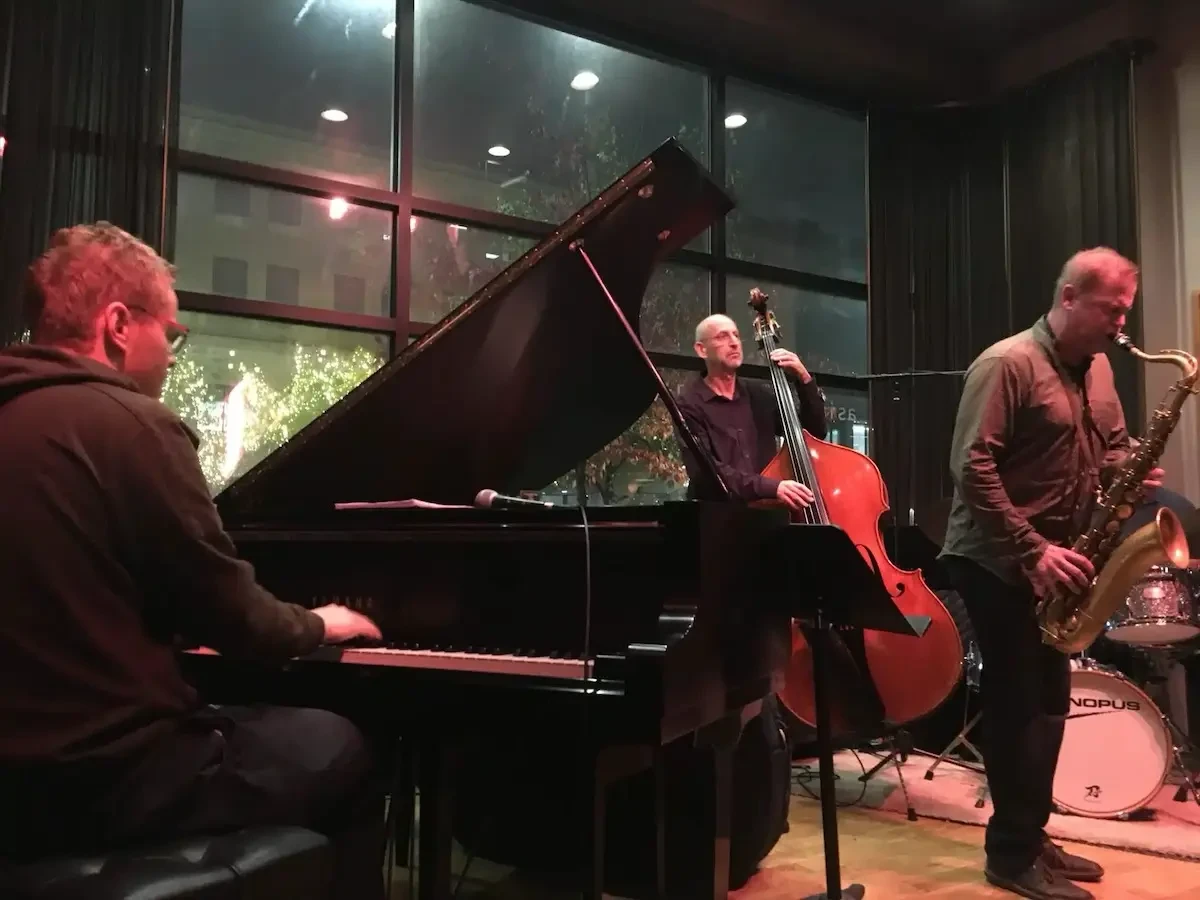
Recorded in September 2025 at Musikkloftet in Asker, Norway, the third installment of the Krupke Trio’s Hymns In A Jazz Mood series represents a deep dive into Nordic sacred traditions. While American jazz has long enjoyed an explosive, ecstatic relationship with gospel and Black church music—typified by the works of Duke Ellington, Cannonball Adderley, and Robert Glasper—pianist Ulf Krupke, bassist Tine Asmundsen, and saxophonist Line Falkenberg approached the project from a distinctly Nordic perspective of restrained spirituality.
The trio’s formation is an intentional collision of musical disciplines: Krupke is steeped in traditional church music, Asmundsen is an experienced jazz bassist, and Falkenberg brings a rigorous classical education. Their working method involves stripping down Norwegian hymns—many of which remain obscure to international audiences—into sparse, drumless frameworks for piano, bass, and saxophone.
Chronologically, the sessions prioritized meditative arrangement over pyrotechnical display. Opening pieces like I En Drøm Jeg Øyner Fedres Land establish an immediate, contemplative tone, moving organically from Krupke’s gentle piano musings to Asmundsen’s bowed bass and Falkenberg’s lyrical soprano lines. While later tracks attempt to inject swing and livelier tempos—such as Kristus Kom Med Vann Og Blod, which opens with authentic church organ before pivoting to piano rhythm—the album finds its truest voice in its quietest, most unhurried moments.
Supporting Context and Metrics
To fully evaluate the artistic weight of these releases, one must examine their structural metrics, instrumentation variety, and production environments.
| Album Title | Primary Artist / Ensemble | Geographic Footprint | Core Instrumentation | Total Runtime | Key stylistic Influences |
|---|---|---|---|---|---|
| Jazz Mysteries | Przemysław Jan Grabowski | Washington D.C., Boston, Havana, London, New York | Piano, Synth, Tenor Sax, Trumpet, Bass, Electric Bass, Drums | 45:54 | Chick Corea, Herbie Hancock, Modal Jazz, Post-Bop |
| Passion Congo | Ray Lema with Ensemble Partage | Congo, France, Italy | Piano, Vocals, String Quartet (2 Violins, Viola, Cello), Soprano Sax, Percussion | 46:06 | Central African Folk, Classical Minimalism, Baroque, Ragtime |
| Hymns In A Jazz Mood Vol 3 | Krupke Trio | Norway (Asker) | Piano, Church Organ, Soprano/Alto Saxophone, Double Bass (Drumless) | 56:50 | Norwegian Hymnody, Nordic Jazz, Classical Chamber Music |
Production Environment Analysis
- Remote Distribution vs. Acoustic Co-Presence: Grabowski’s Jazz Mysteries underscores the economic and technical viability of the modern cloud-based recording session. However, metrics of critical reception suggest that while digital patching eliminates geographical barriers, it can flatten the dynamic micro-interactions that occur when a rhythm section breathes together in real-time.
- Acoustic Chamber Intimacy: Conversely, both Passion Congo and Hymns In A Jazz Mood Vol 3 benefited from localized, studio-based environments. Studio Peninsula (Sarzeau) and Musikkloftet (Asker) provided acoustically controlled spaces that allowed string quartets and drumless trios to capture natural room resonance, enhancing the warmth and organic interplay of the final mixes.
Official Statements and Critical Reception
The critical consensus surrounding these three releases highlights a growing industry appreciation for nuance over flashiness.
On Przemysław Jan Grabowski’s Compositional Approach
Reviewers and industry commentators have noted that Jazz Mysteries avoids the traps of hyper-virtuosity and excessive abstraction. Musicologist analyses point out that Grabowski’s strength lies in his melodic accessibility.
"This is jazz that is easy to enjoy. Grabowski has a gift for a good melody and an adventurous approach to form. Nothing outlandish or iconoclastic, yet nothing formulaic or too predictable." — Contemporary Jazz Quarterly
On Ray Lema’s Cross-Cultural Clarity
Ray Lema’s refusal to pander to homogenized "world music" expectations has earned high praise from European and African arts critics alike. Lema himself has frequently emphasized in interviews that true cultural exchange requires structural integrity rather than superficial pastiche.
"What might, in other hands, end up as some sort of ethno-pudding, is defined by a total clarity of expression. It constantly develops, shifts and surprises without ever losing its charm." — Global Soundscapes Review
On the Krupke Trio’s Sacred-Secular Balance
The Krupke Trio’s exploration of Norwegian hymnody has been recognized as a triumph of mood and institutional daring. While jazz purists occasionally crave a heavier, driving groove—as noted in critiques of their four-square rhythms on select uptempo tracks—devotional and avant-garde fans have embraced the project’s meditative seriousness.
"Whether the mood is jazz or not is hardly relevant. Reflective, absorbing music played with total commitment. These improvised hymns have clearly found an audience among musical and devotional fans." — Nordic Music Gazette
Future Outlook
The trajectory of these artists points toward an increasingly borderless, hybrid future for the genre. As digital collaboration tools mature, projects modeled after Przemysław Jan Grabowski’s Jazz Mysteries will likely become more common, prompting sound engineers to develop innovative latency-reduction and spatial-audio techniques that restore the lost spontaneity of remote studio sessions.
At the same time, the triumphant cross-pollination demonstrated by Ray Lema and Ensemble Partage signals a robust demand for organic, cross-genre chamber jazz. The merging of classical minimalism with non-Western rhythmic structures offers a blueprint for composers seeking to expand the sonic palette of the string quartet beyond traditional European repertoires.
Finally, the success of niche, regionally rooted projects like the Krupke Trio’s Hymns In A Jazz Mood Vol 3 proves that hyper-local traditions—when approached with technical rigor and emotional sincerity—possess profound global resonance. As streaming platforms and independent labels continue to democratize music distribution, audiences can expect an acceleration of micro-genre explorations that draw on localized folk, sacred, and liturgical histories.
Ultimately, these three albums remind us that jazz is no longer a fixed geographic export, but a universal method of inquiry—a flexible medium capable of processing pandemic isolation, pan-African history, and Norwegian spiritual reflection with equal eloquence.