Few musical compositions capture the austere, haunting beauty of the winter season quite like "In the Bleak Midwinter." Rooted in the deeply evocative Victorian poetry of Christina Rossetti, this beloved Christmas carol has achieved timeless status in the global classical and sacred repertoires. While the text is universally celebrated, its musical legacy is defined by a fascinating duality. Two distinct melodies vie for dominance: a lesser-known setting by Harold Darke and the towering, globally revered melody composed by Gustav Holst, famously titled "Cranham."
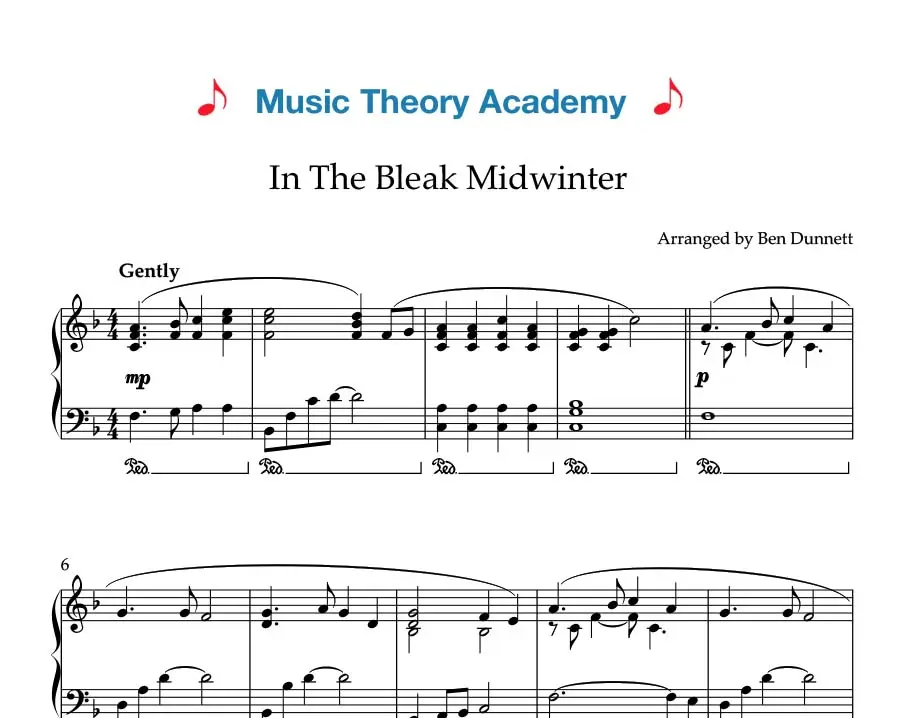
In this comprehensive journalistic and pedagogical feature, we examine a sophisticated, contemporary piano arrangement of Holst’s masterwork by acclaimed composer, pianist, and educator Ben Dunnett LRSM. Taken from Dunnett’s celebrated holiday compilation, 10 Christmas Carols, this specific arrangement bridges the gap between accessible seasonal playing and advanced technical mastery. Designed for intermediate-to-advanced pianists, Dunnett’s setting requires nuanced pedal work, careful navigation of changing clefs, and a sensitive understanding of tonal color.
Throughout this article, we will provide an exhaustive breakdown of the piece’s historical context, a detailed technical analysis of Dunnett’s arrangement, structural insights into its composition, and complete access to the lyrical framework that inspired generations of musicians. Whether you are a professional educator seeking fresh performance material or an ambitious pianist looking to enrich your holiday repertoire, this guide offers an authoritative deep dive into one of the season’s most enduring masterworks.
Detailed Chronology: The Evolution of a Masterpiece
To fully appreciate the weight and nuance of Ben Dunnett’s contemporary piano arrangement, one must trace the historical trajectory of "In the Bleak Midwinter" from a nineteenth-century poem to a pillar of choral and instrumental literature.
1. The Poetic Genesis (1872)
The journey of the carol began not in a cathedral or a composer’s studio, but on the printed page. In January 1872, the influential American periodical Scribner’s Monthly published a poem titled "A Christmas Carol" written by the renowned English poet Christina Rossetti. Unbeknownst to the author at the time, her verses—characterized by stark imagery of iron-hard earth, stone-like water, and a quiet, humble nativity—possessed an inherent musicality. Rossetti’s words did not merely describe a winter landscape; they established an emotional and sonic cadence that begged to be sung.
2. The Musical Settings Take Shape (Early 20th Century)
For decades, Rossetti’s poem existed primarily as literature. However, as the twentieth century dawned, British composers recognized its profound potential for sacred music. Two primary musical settings emerged, both of which would become cornerstones of the Anglo-American choral tradition:
The Harold Darke Setting (1909): Composed while Darke was a student at the Royal College of Music, this version is prized for its fluid, highly expressive, and interwoven vocal lines. Though less universally ubiquitous in mass congregational settings today, it remains a favorite among elite cathedral choirs.
The Gustav Holst Setting (1906): Published in the English Hymnal under the tune name "Cranham," Holst’s melody achieved immediate and lasting supremacy. Holst, best known for his monumental orchestral suite The Planets, brought a sublime, hymn-like simplicity and haunting modal flavor to Rossetti’s text. The tune’s stately pacing and emotional restraint made it an instant favorite for congregations worldwide.
3. The Contemporary Pedagogical Era (Present Day)
Fast forward to the twenty-first century, where traditional carols continue to be reimagined for solo instruments, chamber groups, and modern listeners. Ben Dunnett, founder of the Music Theory Academy and an educator with over two decades of experience, recognized the need for sophisticated yet accessible piano literature that honors the harmonic integrity of Holst’s original hymn. Through his album 10 Christmas Carols and digital distribution efforts, Dunnett has introduced a fresh generation of pianists to the technical intricacies of "Cranham," transforming a vocal congregational staple into a virtuosic solo piano experience.
Supporting Context & Metrics: Structural and Technical Analysis
Ben Dunnett’s arrangement of "In the Bleak Midwinter" is far more than a simple harmonization of a familiar tune. It is a carefully engineered miniature tone poem that demands specific technical proficiencies from the performer.
Harmonic Framework and Modulations
The piece is primarily anchored in the key of F major, a key signature associated in classical music with pastoral warmth, tranquility, and lyrical expansiveness. However, Dunnett avoids monotony by introducing a dramatic compositional shift in the middle section, where the music briefly modulates into D minor. This relative minor transition mirrors the emotional shift in Rossetti’s text—moving from the serene wonder of the incarnation toward introspection, shadow, and emotional depth before resolving back into the comforting light of F major.
Technical Challenges and Performance Practice
According to the composer’s pedagogical notes, this arrangement is classified as "quite challenging" due to several distinct technical demands:
Pedaling Mechanics: The left hand frequently relies on expansive arpeggiated chords that stretch across the register. Performers must master precise use of the sustain pedal to blend these harmonies seamlessly without creating acoustic mud. The rule of thumb is explicit: the pedal must lift cleanly at the end of every bar to refresh the sonic landscape.
Structural Architecture: The arrangement opens with a distinct introductory phrase. Crucially, this same material reappears as a melodic interlude between the verses, providing structural cohesion and breathing room for the listener.
Dynamic and Textural Decoration: As the verses progress, Dunnett employs increasingly ornate right-hand figuration. The texture evolves from simple chordal accompaniment to intricate melodic decoration, requiring delicate finger independence and even phrasing.
Shifting Clefs and Spatial Navigation: One of the most demanding technical hurdles occurs when both hands move dynamically up the keyboard into higher pitch ranges. In this section, the left hand frequently alternates between the Bass Clef and Treble Clef. Performers must practice these transitions with extreme diligence to avoid misreading notes in unfamiliar registers.
Official Statements and Educational Insights
To understand the philosophy driving this arrangement, we turn to the creator himself, Ben Dunnett LRSM. With more than twenty years of experience as a music teacher, examiner, and composer, Dunnett’s approach to arranging traditional carols is rooted in both artistic expression and rigorous music theory.
From the Composer: Ben Dunnett LRSM
In discussing the genesis of his 10 Christmas Carols project, Dunnett emphasizes the importance of breathing new life into familiar material while respecting the listener’s nostalgia:
"When arranging a piece as universally cherished as Gustav Holst’s ‘Cranham,’ the primary challenge is to balance innovation with reverence. Pianists want to play something that sounds rich, engaging, and pianistically rewarding, but they also want to hear the soul of the original hymn. By utilizing arpeggiated textures, thoughtful modulations into D minor, and progressive right-hand ornamentation across the verses, this arrangement challenges the player to think orchestrally at the keyboard."
Dunnett also stresses the educational value of working through such arrangements during the holiday season:
"The technical hurdles—such as clef changes in the left hand and disciplined pedal management—serve a vital pedagogical purpose. They force intermediate and advanced students to look beyond simple note-reading and focus intensely on physical geography, tone production, and horizontal phrasing."
Future Outlook: The Digital Pedagogy of Seasonal Music
The release and widespread digital distribution of Ben Dunnett’s piano arrangement highlight a broader transformation in how classical music and pedagogical resources are shared. No longer restricted to expensive, physical anthologies sold exclusively in brick-and-mortar music shops, high-level instructional materials and free PDF scores are now accessible globally within seconds.
As online academies, digital sheet music platforms, and YouTube-integrated tutorials continue to reshape music education, arrangers like Dunnett are pioneering a hybrid model of teaching. By combining embedded video performances, downloadable sheet music, and thorough theoretical breakdowns, modern educational platforms empower self-taught musicians and studio students alike to tackle challenging repertoire with confidence.
Looking ahead, the appetite for sophisticated solo piano adaptations of traditional carols shows no sign of waning. As performers continually seek fresh ways to engage audiences during the winter holiday season, arrangements that honor historical roots—such as Holst’s enduring melody—while offering contemporary pianistic flair will remain foundational to the modern piano repertoire.
Complete Lyric Reference
For performers preparing this piece, internalizing Christina Rossetti’s transcendent poetry is essential to capturing the correct phrasing, tempo, and emotional contour of the music. Below is the complete text of the carol as set within the musical tradition:
Verse 1
In the bleak mid-winter
Frosty wind made moan;
Earth stood hard as iron,
Water like a stone;
Snow had fallen, snow on snow,
Snow on snow,
In the bleak mid-winter
Long ago.
Verse 2
Our God, heaven cannot hold Him
Nor earth sustain,
Heaven and earth shall flee away
When He comes to reign;
In the bleak mid-winter
A stable-place sufficed
The Lord God Almighty —
Jesus Christ.
Verse 3
Enough for Him, whom Cherubim
Worship night and day,
A breastful of milk
And a mangerful of hay;
Enough for Him, whom Angels
Fall down before,
The ox and ass and camel which adore.
Verse 4
Angels and Archangels
May have gathered there,
Cherubim and seraphim
Thronged the air;
But only His Mother
In her maiden bliss
Worshipped the Beloved
With a kiss.
Verse 5
What can I give Him,
Poor as I am?
If I were a Shepherd
I would bring a lamb;
If I were a Wise Man
I would do my part,
Yet what I can I give Him,
Give my heart.
For more free educational resources, comprehensive music theory guides, and downloadable PDF sheet music by Ben Dunnett LRSM, visit the official Music Theory Academy website.