
Executive Overview
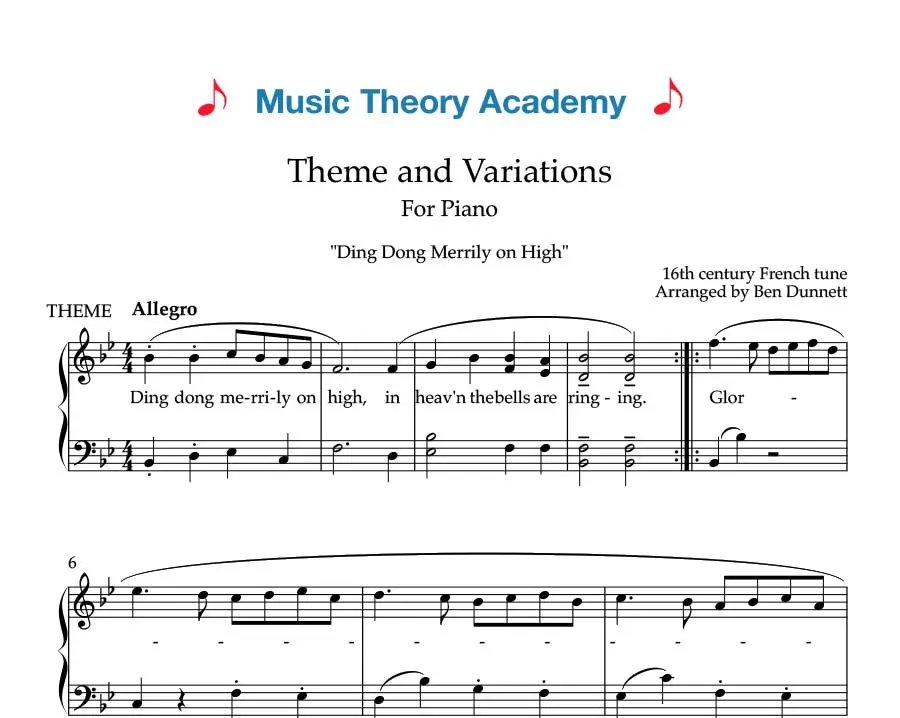
The intersection of historical melody and pedagogical piano arrangement represents a fascinating niche within classical music education. In this detailed review, we examine a contemporary piano adaptation of the timeless 16th-century French carol “Ding Dong Merrily on High,” arranged by veteran pianist, composer, and Music Theory Academy founder Ben Dunnett, LRSM. Designed in a sophisticated theme and variations format, this piece challenges intermediate-to-advanced pianists while honoring the festive, exuberant spirit of the holiday season.
This article provides an exhaustive look into the structural, technical, and historical dimensions of Dunnett’s arrangement. By synthesizing music theory principles—such as key signatures, modal characteristics, articulation markers, and thematic transformation—we offer an authoritative guide for educators, students, and performers aiming to master this work. Furthermore, we explore the rich origins of the melody, the literary history of its iconic 20th-century English lyrics by George Ratcliffe Woodward, and actionable practice strategies to overcome the inherent technical hurdles of the score.
Detailed Chronology: From Renaissance Dance Tune to Modern Piano Showcase
To fully appreciate Dunnett’s contemporary educational arrangement, one must trace the evolutionary timeline of “Ding Dong Merrily on High”—a journey that spans more than four centuries, transitioning from an anonymous secular dance tune to a pillar of Anglican choral tradition, and finally into a virtuosic piano showcase.
Phase 1: The Renaissance Origins (Late 16th Century)
The foundational melody of the carol did not begin its life in a church or as a sacred hymn. Instead, it originated as a secular Renaissance dance tune known as "Branle de l’Official." This tune was first published in 1588 in the seminal French treatise Orchésographie by Jehan Thoinot (a pseudonym for the cleric and music theorist Jehan Tabourot).
The branle was a popular French circle dance characterized by side-to-side steps, widely performed by all tiers of society during the late 16th century. The lively, bounding rhythm of the dance laid the structural groundwork for what would eventually become one of the most recognizable cascading bell-motif melodies in Western music. For over three centuries, the tune remained a secular artifact of Renaissance dance forms, divorced entirely from the festive lyrics associated with it today.
Phase 2: The Edwardian Lyric Adaptation (1924)
The transformation of the sprightly French dance tune into a Christmas carol occurred in the early 20th century. English composer and clergyman George Ratcliffe Woodward (1848–1934), renowned for his deep fascination with early church music and folk carols, took the 16th-century branle melody and paired it with newly penned, archaic-sounding English lyrics.
Woodward’s text, published in his 1924 collection The Cowley Carol Book, infused the jubilant dance tune with ecclesiastical imagery, celebrating the ringing of steeple bells and the angelic proclamation of the Nativity. The marriage of Thoinot’s sprightly Renaissance rhythm with Woodward’s clever, tongue-twisting internal rhymes—most notably the soaring refrain "Gloria, hosanna in excelsis!"—cemented the piece’s status as a quintessential Christmas staple.
Phase 3: The Contemporary Pedagogical Adaptation (21st Century)
Fast forward to the modern era, where music education increasingly intersects with digital accessibility. Ben Dunnett, an experienced music educator, examiner, and LRSM-certified pianist, recognized a gap in the pedagogical repertoire for festive piano music that bridges the gap between elementary carol books and advanced concert literature.
By setting the tune in a theme and variations framework, Dunnett’s arrangement—featured and distributed via the Music Theory Academy—transforms a linear, verse-and-refrain hymn into a multi-faceted technical study. Released to support students seeking fresh, engaging, and structurally rich holiday repertoire, the arrangement provides a masterclass in variation form, stylistic articulation, and digital-age music instruction.
Supporting Context & Metrics: Structural Analysis and Technical Specifications
Dunnett’s arrangement is far more than a simple harmonization of a seasonal melody. It is a carefully calibrated study in musical architecture, requiring specific technical proficiencies from the performer.
Thematic Architecture: Theme and Variations Form
In music theory, theme and variations is a form where a base musical idea (the theme) is stated and subsequently altered across a series of sequential sections.
- The Statement: The piece opens with a direct, unadorned presentation of the 16th-century melody, allowing the listener to grasp the primary motif before it undergoes metamorphosis.
- The Variations: Subsequent sections manipulate parameters such as rhythm, harmony, texture, register, and counterpoint. While the underlying harmonic blueprint remains tethered to the original tune, each variation introduces a distinct character, challenging the pianist to adapt their touch and phrasing dynamically.
Key Signature and Tonal Challenges
The arrangement is set in the key of B-flat major, which carries a signature of two flats (B♭ and E♭). While B-flat major is a warm, resonant key well-suited to the piano, it presents distinct ergonomic challenges:
- Hand Positioning: Unlike C major, B-flat major requires the fingers to navigate black keys frequently (specifically B♭ and E♭). Pianists must cultivate a flat-yet-curved finger approach to maintain fluid passage work.
- Scalic Runs: The piece features rapid right-hand scalic runs corresponding to the lyrical exclamation "Gloria." Navigating these runs in the key of B-flat major demands precise thumb-tucks and even finger-weight distribution to prevent uneven accents.
Tempo and Articulation Metrics
- Tempo: The piece moves at a brisk, lively pace, reflecting the original energy of the Renaissance branle. The fast tempo leaves little margin for error, making rhythmic stability paramount.
- Staccato and Phrasing: A defining characteristic of Dunnett’s score is its heavy reliance on precise articulation marks. The integration of staccato notes is crucial; it provides the “light touch” required to evoke the crisp, ringing resonance of high church bells. Without controlled staccato execution, the rapid tempo can easily degenerate into a muddy, over-pedaled wall of sound.
Official Statements & Pedagogical Insights
To understand the core philosophy behind this arrangement, we turn to the insights of its creator, Ben Dunnett, LRSM. With over two decades of experience in music education as a teacher, examiner, and composer, Dunnett’s pedagogical approach emphasizes targeted, analytical practice over brute-force repetition.
Expert Practice Strategies from the Author
In his official instructional commentary accompanying the sheet music, Dunnett highlights several critical areas where students typically encounter friction:

-
Left-Hand Independence and Stamina:
"Some slow practice of the left hand movement will be particularly helpful when learning the piece."
Because the left hand often carries rhythmic momentum, harmonic roots, or syncopated accompaniments underneath the flashing right-hand variations, isolating the left-hand part at a reduced tempo is mandatory for long-term technical security. -
Mastering Melodic Flow in Scalic Runs:
"The right hand scalic runs (where the lyric ‘Gloria’ is sung in the carol) will benefit from slow practice before speeding them up. It is important to try to create a sense of flow in this melodic line."
Dunnett cautions against treating these runs as mechanical exercises. Even at high speeds, the scalar passages must sing lyrically, mirroring the vocal projection of a cathedral choir echoing the heavenly host. -
Articulation as a Stylistic Pillar:
"There are quite a number of articulation and phrasing marks on the sheet music to look for. The staccato notes are crucial to providing the light touch needed throughout the piece."
The distinction between legato lines and crisp staccatos defines the architectural contrast between the theme and its subsequent variations. Ignoring these markings results in a flat, uninspired performance that fails to capture the festive brilliance of the bells.
Literary Foundation: The Complete Text of Woodward’s Carol
To fully connect the piano arrangement to its vocal roots, performers are encouraged to sing or speak the lyrics internally while playing. George Ratcliffe Woodward’s 1924 text remains an exquisite masterclass in prosody and archaic English charm.
Verse 1
Ding-dong! Merrily on high
in heaven the bells are ringing.
Ding-dong! Verily the sky
is riven with angels singing:
Gloria, hosanna in excelsis!
Verse 2
E’en so, here below, below,
let steeple bells be swungen;
and i-o, i-o, i-o,
by priest and people sungen!
Gloria, hosanna in excelsis!
Verse 3
Pray you, dutifully prime
your matin chime, you ringers;
may you beautifully rhyme
your evetime song, you singers:
Gloria, hosanna in excelsis!
Future Outlook: The Evolution of Digital Music Education and Festive Repertoire
As the landscape of music education continues to evolve, resources like Ben Dunnett’s arrangement of “Ding Dong Merrily on High” point toward a promising future for how classical and traditional repertoire is shared, studied, and mastered.
The Digital Accessibility of Music Theory
Platforms such as the Music Theory Academy represent a paradigm shift in pedagogy. By coupling high-definition video demonstrations (hosted via embedded multimedia) with downloadable, print-ready PDF scores, modern educators bridge the gap between visual, auditory, and kinesthetic learning styles. Students no longer rely solely on static printed pages; they can listen to professional interpretations, cross-reference theoretical forms (like theme and variations), and immediately apply structural insights to their instrument.
Continued Relevance of Traditional Carols in Contemporary Curriculums
Far from being obsolete, historical carols adapted for modern instruments continue to serve a vital role in piano pedagogy. They offer students a narrative framework—linking poetry, history, and physical technique—that purely technical etudes often lack. As arrangers continue to breathe new life into centuries-old melodies through sophisticated harmonies and variation forms, pieces like “Ding Dong Merrily on High” will undoubtedly remain studio favorites for generations of pianists to come.
Conclusion
Ben Dunnett’s theme and variations arrangement of “Ding Dong Merrily on High” is a masterclass in transforming a historical Renaissance dance tune into a dynamic, contemporary piano challenge. Through its exploration of the B-flat major key signature, rigorous articulation demands, and brilliant scalar passagework, the piece rewards patient, methodical practice. Whether approached as an engaging holiday performance piece or a rigorous technical study, this arrangement stands as a testament to the enduring power of musical variation and the timeless joy of festive bell-ringing.