
Executive Overview
Few musical compositions capture the stark, quiet majesty of the winter season quite like "In the Bleak Midwinter." Originally born as a poignant, deeply spiritual poem written by the Victorian-era luminary Christina Rossetti, the text has since evolved into one of the most widely recognized and beloved Christmas carols in the global choral canon. While musical historians and church congregations alike recognize that the text has historically been paired with two distinct, acclaimed melodies—the lesser-known setting by Harold Darke and the universally celebrated tune composed by Gustav Holst, titled “Cranham”—it is Holst’s version that continues to capture the hearts and imaginations of millions around the world.
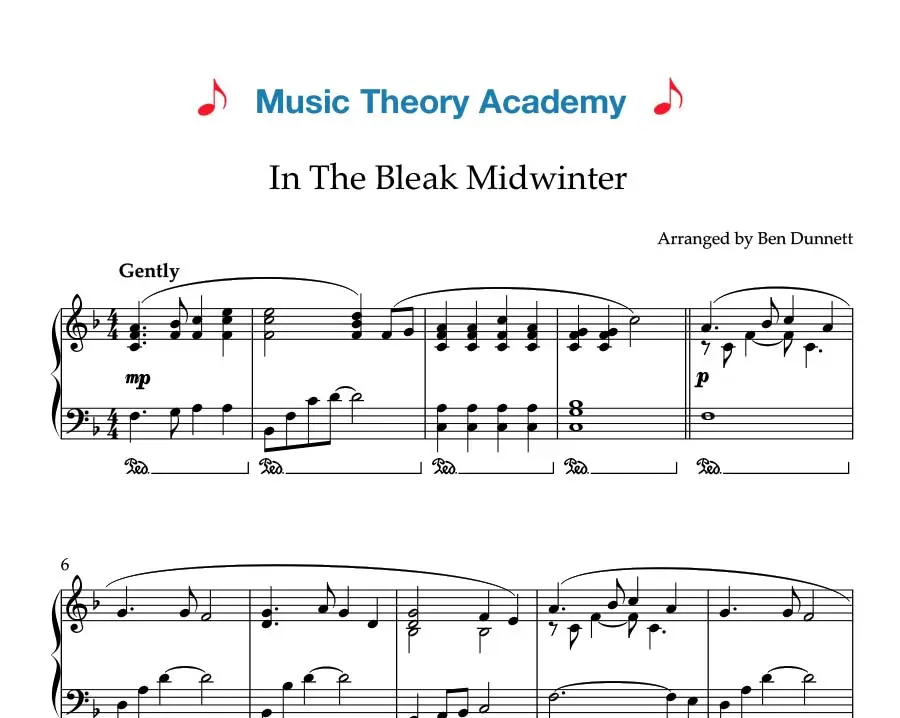
In a recent release that has quickly captured the attention of pianists, educators, and holiday music enthusiasts alike, accomplished composer, teacher, and LRSM-certified musician Ben Dunnett has unveiled a striking new intermediate-to-advanced piano arrangement of Holst’s timeless masterwork. Taken directly from Dunnett’s critically well-received album “10 Christmas Carols,” this fresh interpretation breathes sophisticated new life into a familiar classic. Designed for players looking to elevate their technical proficiency and artistic expression during the holiday season, Dunnett’s score blends lyrical warmth with nuanced harmonic shifts.
To make this gift even more accessible to the global music community, Dunnett has made the complete, high-quality sheet music available as a complimentary, downloadable PDF resource via the Music Theory Academy. This comprehensive feature explores the rich history of the carol, deconstructs the technical and interpretive challenges of Dunnett’s specific arrangement, provides a breakdown of Rossetti’s immortal lyrics, and offers a glimpse into the pedagogical philosophy of one of modern music education’s most dedicated practitioners.
Detailed Chronology: From Victorian Verse to Modern Piano Masterpiece
To fully appreciate the weight and beauty of Ben Dunnett’s contemporary arrangement, one must trace the historical lineage of "In the Bleak Midwinter" across more than a century and a half of artistic evolution.
The Literary Genesis: Christina Rossetti’s 1872 Poem
The journey of the carol began not in a cathedral or a concert hall, but on the written page. In January 1872, the prominent English poet Christina Rossetti published a poem titled "A Christmas Carol" in the American magazine Scribner’s Monthly. At the time of its publication, Rossetti was already an established voice in Victorian literature, celebrated for her mastery of introspective, devotional, and emotionally resonant verse.
The poem was not initially paired with music; rather, it stood on its own as a meditation on the humility of the Incarnation. Rossetti contrasted the grand, cosmic scale of divinity—a God whom "heaven cannot hold Him nor earth sustain"—with the shockingly humble reality of a Bethlehem stable, where a "breastful of milk and a mangerful of hay" sufficed for the Creator of the universe. The poem remained largely a literary work until after Rossetti’s passing in 1894, when musicians began to recognize its haunting, rhythmic meter as an ideal vehicle for sacred choral song.
The Birth of the Melodies: Holst and Darke
As the twentieth century dawned, composers sought to give Rossetti’s words a definitive sonic identity. Two primary settings emerged that would stand the test of time, though they approached the poetry with markedly different emotional palettes.
- The Harold Darke Setting (1909): English composer Harold Darke, serving as an organist at King’s College, Cambridge, and later at St Michael’s Cornhill in London, composed his sweeping, highly atmospheric choral setting in 1909. Darke’s version is beloved by cathedral choirs for its soaring vocal lines and rich, romantic harmonies, though it demands considerable vocal agility and is somewhat less common in informal congregational settings.
- The Gustav Holst Setting / "Cranham" (1906): A few years prior, in 1906, English composer Gustav Holst—famed worldwide for his monumental orchestral suite The Planets—turned his formidable compositional talents to Rossetti’s text. Published in the English Hymnal of 1906, Holst’s tune was christened “Cranham.” Characterized by its calm, steady, pastoral movement and poignant harmonic resolutions, Holst’s melody quickly resonated with congregations globally. Its deceptively simple structure made it accessible to parish choirs, yet its underlying emotional depth allowed it to become a cornerstone of British and international Christmas traditions.
The Contemporary Reimagining: Ben Dunnett’s 2022/2023 Arrangement
Fast-forward over a century to the modern digital era of music education. Ben Dunnett, an experienced educator, examiner, pianist, and the founder of the Music Theory Academy, recognized a gap in the intermediate-to-advanced piano repertoire. While countless simplified arrangements of "In the Bleak Midwinter" exist for beginners, fewer publications successfully translate the rich textures of Holst’s four-part choral writing into a satisfying, pianistic idiom that challenges the player without sacrificing the piece’s inherent meditative tranquility.
Culled from his specialized album “10 Christmas Carols,” Dunnett’s arrangement bridges the gap between academic rigor and emotive holiday performance. Released alongside high-resolution digital sheet music and performance demonstration videos, Dunnett’s work represents a modern synthesis of traditional hymnody and contemporary instructional media, empowering pianists worldwide to master the piece independently.
Supporting Context & Metrics: Deconstructing the Score
For pianists eager to tackle Ben Dunnett’s arrangement, an understanding of the structural, harmonic, and technical mechanics of the score is essential. Dunnett has carefully crafted a piece that rewards diligent practice with rich sonic rewards.
Key Signature and Harmonic Journey
- Primary Key: F Major. The arrangement opens and spends the vast majority of its duration in F major, a key historically associated with pastoral peace, warmth, and grounded stability on the piano keyboard.
- Modulation: In the middle section of the arrangement, Dunnett introduces a striking tonal shift, modulating temporarily to D minor. This relative minor key introduces a sudden, reflective chill that mirrors the harsh winter imagery of Rossetti’s lyrics ("Earth stood hard as iron, water like a stone"). The shift in tonality prevents the carol from becoming monotonously sweet, injecting a dose of dramatic tension before resolving triumphantly back into the warm embrace of F major.
Technical Demands and Pedagogical Focus
Dunnett’s arrangement is classified as moderately challenging, requiring precise control over several core pianistic techniques:
- Arpeggiated Left-Hand Accompaniment & Pedal Management: The left hand frequently navigates rolling arpeggio chords designed to simulate the gentle, drifting snow and sustained harmonic beds of Holst’s original orchestral and choral textures. Executing this cleanly requires a sophisticated use of the sustain pedal. Pianists must master the art of the "re-pedal" or clear pedal lift at the end of each bar to prevent harmonic blurring while maintaining a continuous, resonant wash of sound.
- Form and Structural Motifs: The arrangement features a distinct introductory phrase that establishes the mood. Crucially, this same motif reappears as an expressive interlude between the verses, unifying the piece and providing the performer with natural breathing spaces.
- Textural Evolution Across Verses: As the carol progresses, Dunnett increases the decorative complexity in the right hand. Passages require both hands to navigate higher registers of the keyboard. This shift in register demands careful spatial awareness from the player.
- Clef Fluency: A notable technical hurdle in this arrangement involves frequent clef changes (alternating between Bass Clef and Treble Clef) within the left-hand part as the hands move up the keyboard. Dunnett specifically warns educators and students to highlight these clef shifts during score study to prevent misreading notes during high-register passages.
Official Statements & Pedagogical Philosophy
To understand the ethos behind this modern arrangement, one must look to its creator. Ben Dunnett, LRSM, brings over two decades of professional experience in music education, examining, composing, and performing to his work at the Music Theory Academy.
In statements accompanying the release of his “10 Christmas Carols” album and the accompanying instructional materials, Dunnett emphasizes that holiday music should serve as more than just seasonal background noise—it should act as a vehicle for musical growth.

"The goal in arranging pieces like ‘In the Bleak Midwinter’ is to honor the profound emotional resonance of the original composition while giving the instrumentalist something genuinely engaging to study," Dunnett notes in his teaching literature. "When a pianist sits down at the bench during the holiday season, they want to feel connected to the music. By introducing subtle key changes, expressive register shifts, and thoughtful dynamic pacing, we can transform a familiar hymn into an invigorating technical and artistic exercise."
Dunnett’s pedagogical approach is firmly rooted in clarity, accessibility, and foundational musicianship. By providing free, high-resolution PDF scores alongside video demonstrations, his platform actively democratizes access to quality intermediate piano literature, ensuring that students regardless of geographic location or financial circumstance can benefit from expert-level guidance.
Future Outlook: The Enduring Legacy of "In the Bleak Midwinter"
As we look toward future holiday seasons, the cultural footprint of Christina Rossetti’s words and Gustav Holst’s melody shows no signs of diminishing. Year after year, "In the Bleak Midwinter" remains a staple of Christmas Eve services, global festival broadcasts, and classical radio playlists.
However, the methods by which musicians engage with this repertoire are undergoing a quiet revolution. The rise of digital-first music education—exemplified by creators like Ben Dunnett—signals a shift toward hybrid learning models where physical sheet music, digital PDF downloads, video demonstrations, and theoretical breakdowns coexist seamlessly.
Arrangements like Dunnett’s ensure that traditional carols do not become museum artifacts frozen in the past, but rather dynamic, living works of art that continue to challenge and inspire contemporary performers. Whether played on a grand concert stage, in a quiet community hall, or at home beside a flickering fireplace, the haunting strains of “Cranham” will continue to echo across the generations.
Resource Summary & Next Steps
For pianists, students, and educators wishing to take the next step:
- Listen & Watch: Review the embedded performance demonstration video on the Music Theory Academy platform to observe hand placement, pedaling technique, and tempo rubato.
- Download the Score: Access the complimentary, high-resolution three-page PDF score directly via the Music Theory Academy link.
- Practice Strategy: Spend dedicated time isolating the left-hand arpeggios, marking the clef changes in the higher register sections, and mastering the transition into the D minor middle movement.
By marrying historic reverence with modern pedagogical insight, Ben Dunnett’s arrangement of "In the Bleak Midwinter" stands as a shining example of how classical holiday traditions can be successfully preserved, enriched, and passed down to a new generation of musicians.
Appendix: Complete Lyrics of Christina Rossetti’s "A Christmas Carol"
In the bleak mid-winter
Frosty wind made moan;
Earth stood hard as iron,
Water like a stone;
Snow had fallen, snow on snow,
Snow on snow,
In the bleak mid-winter
Long ago.
Our God, heaven cannot hold Him
Nor earth sustain,
Heaven and earth shall flee away
When He comes to reign;
In the bleak mid-winter
A stable-place sufficed
The Lord God Almighty
Jesus Christ.
Enough for Him, whom Cherubim
Worship night and day,
A breastful of milk
And a mangerful of hay;
Enough for Him, whom Angels
Fall down before,
The ox and ass and camel which adore.
Angels and Archangels
May have gathered there,
Cherubim and seraphim
Thronged the air;
But only His Mother
In her maiden bliss
Worshipped the Beloved
With a kiss.
What can I give Him,
Poor as I am?
If I were a Shepherd
I would bring a lamb;
If I were a Wise Man
I would do my part,
Yet what I can I give Him,
Give my heart.