
Executive Overview
In the realm of cognitive linguistics, the acquisition of a second language fundamentally shifts from mechanical decoding to intuitive comprehension. When an individual achieves true fluency in a foreign tongue—such as Spanish—they bypass the cumbersome mental intermediary of translating every spoken phrase back into their native language. Upon encountering the greeting "¡Buenos días!", the proficient speaker immediately grasps the semantic weight of the phrase without consciously parsing it into "good morning." While mental translation can initially serve as an analytical safety net, reassuring the learner of their structural accuracy, it ultimately functions as a cognitive bottleneck. It anchors the mind to a slow, methodical processing loop, effectively severing the pathway to spontaneous, organic expression.
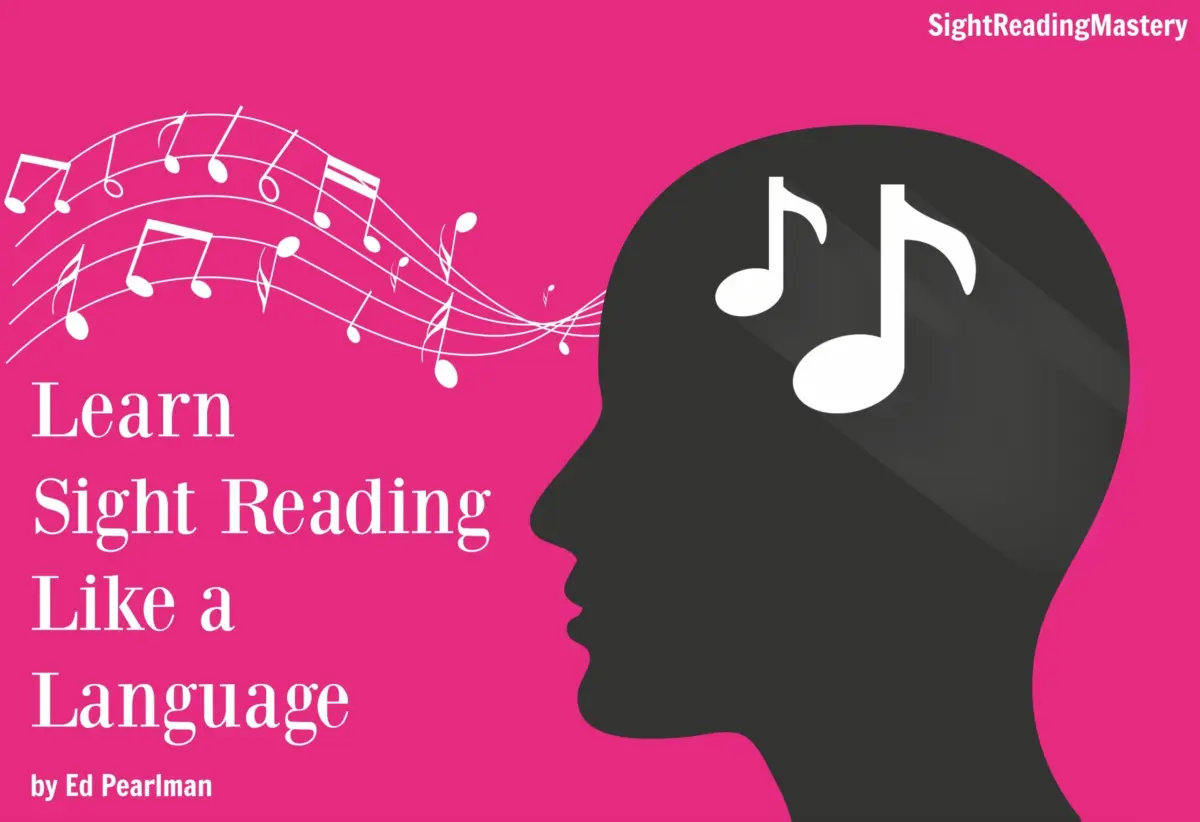
This linguistic reality maps with startling precision onto the domain of musical performance. According to veteran classical violinist, fiddle instructor, and pedagogue Ed Pearlman, musicians must learn to approach sheet music not as a cryptogram to be laboriously solved, but as a living, breathing language. For instrumentalists and vocalists alike, the traditional pedagogy of sight-reading is frequently plagued by a paralyzing micro-analysis: the performer identifies a note on the staff, translates that visual symbol into a letter name, maps that name to a specific physical finger number, verifies its mechanical correctness, and finally initiates sound.
In real-world performance, this exhaustive sequential checklist is an impossibility. The temporal demands of maintaining a steady tempo render note-by-note translation obsolete. If a musician attempts to execute every mental translation step in real time, the rhythmic integrity of the piece collapses, the tempo drags, and the expressive flow evaporates.
To combat this widespread pedagogical hurdle, Pearlman has formulated a progressive, five-tiered sight-reading methodology designed to rewire how musicians interact with written notation. By systematically shifting the cognitive load away from isolated note-naming and toward holistic pattern recognition, rhythm-first processing, and interval mapping, musicians can cultivate an internal fluency that mirrors native language acquisition. This report explores the theoretical underpinnings of Pearlman’s framework, details the five distinct practice tiers, examines the broader metrics of cognitive musical training, and outlines the future trajectory of music literacy pedagogy in the digital age.
Detailed Chronology and Pedagogical Evolution: Tracing the Shift from Decoding to Direct Comprehension
The evolution of music education has long been characterized by a tension between intellectual analysis and intuitive performance. Historically, Western classical music training heavily prioritized theoretical mastery—solfège, rigorous dictation, and interval identification—before ever asking a student to perform a piece unassisted. While these academic foundations remain crucial, generations of students have emerged from conservatories capable of intellectualizing a score yet utterly incapable of executing a seamless sight-reading passage under performance pressure.
The Historical Bottleneck of Note-Name Literacy
For decades, standard music instruction anchored the beginner’s journey to the mnemonic devices of the staff (Every Good Boy Does Fine, FACE). While these tools successfully bridge the gap between absolute illiteracy and basic note identification, they inadvertently institutionalize a debilitating habit: vertical fixation. Students are conditioned to view a musical score as a sequence of disconnected dots rather than a topographical landscape of sound.
The psychological cost of this approach became increasingly apparent as the demands on modern musicians—from pit orchestras and studio recording sessions to contemporary chamber ensembles—scaled exponentially. Sight-reading was no longer an auxiliary skill reserved for conservatory elites; it became a baseline professional survival metric. Yet, pedagogical frameworks failed to evolve, continuing to treat sight-reading as an advanced accumulation of note-naming speed rather than a distinct linguistic faculty.
Ed Pearlman’s Pedagogical Intervention
It was against this historical backdrop of high-pressure performance environments that Ed Pearlman synthesized his decades of cross-genre experience—spanning 25 years of classical violin performance in major cultural hubs like Chicago and Boston, followed by 35 years of immersion in traditional fiddle styles across North America and Scotland. Drawing on his extensive cross-pollination of classical precision and folk immediacy, Pearlman identified that the primary failure of modern sight-reading instruction lay in its sequencing.
Pearlman’s breakthrough was recognizing that musicianship mirrors linguistics: just as reading a book requires scanning entire words and phrases rather than spelling out individual letters, reading music requires processing macro-structures—rhythmic pulses, scalar profiles, and geometric intervals—simultaneously.
To operationalize this philosophy, Pearlman engineered a five-level progressive framework. Unveiled through his foundational pedagogical writings, this system strips away the cognitive clutter of note-naming in the early stages, forcing the student’s brain to grapple directly with rhythm, spatial contour, and harmonic topography. By treating each level as an additive layer rather than a discarded exercise, Pearlman established a structured evolutionary path from mechanical decoder to fluent musical speaker.
Supporting Context & Metrics: The Cognitive Architecture of Sight-Reading
To fully appreciate the efficacy of a five-tiered sight-reading system, one must examine the neuro-cognitive mechanisms that govern musical processing. When a proficient sight-reader scans a score, their brain engages in rapid-fire chunking—a psychological process where individual items are grouped into larger, meaningful semantic units.
The Neuro-Cognitive Mechanics of Chunking
Cognitive science demonstrates that human working memory is strictly limited, capable of holding only a small number of independent data points (often cited as Miller’s Law: seven items, plus or minus two). When a novice musician attempts to read a score note-by-note, each individual note, accidental, and rhythmic flag consumes a slot in working memory, leading to immediate cognitive overload and subsequent performance breakdown.
Through systematic exposure to patterned exercises—such as those hosted on specialized digital platforms like SightReadingMastery—a musician’s working memory adapts. By grouping notes into intervals, scales, and rhythmic cells, the brain reduces hundreds of micro-decisions into a handful of macro-gestures.
[Traditional Approach]
Visual Note -> Translate Name -> Verify Finger -> Execute -> Overtaxed Working Memory (Crash)

[Pearlman's Framework (Levels 1-4)]
Visual Contour -> Spatial/Rhythmic Chunk -> Direct Motor Response -> Fluent Execution
Quantitative Metrics in Sight-Reading Proficiency
Empirical studies in musical pedagogy have consistently tracked the correlation between specialized sight-reading curricula and overall performance efficacy. Key performance indicators monitored in contemporary music cognition labs include:
- Saccadic Eye Movement Efficiency: Advanced sight-readers exhibit fewer, more targeted fixations per measure, looking further ahead in the score (the "eye-hand span") than novices who fixate rigidly on the immediate note being played.
- Rhythmic Recovery Time: When encountering an error, proficient readers maintain the underlying pulse, absorbing the mistake without altering the tempo. Novices universally exhibit a micro-pause or tempo destabilization.
- Interval Recognition Velocity: The time required to visually translate a vertical or horizontal distance on the staff into a corresponding physical shift on the instrument drops exponentially when trained via contour and profile methodologies rather than note-naming drills.
The Five-Tiered Pedagogical Framework: A Step-by-Step Breakdown
Pearlman’s methodology is structured into five progressive tiers. Crucially, these levels are distinct from the inherent "grade levels" used to measure a piece’s absolute technical difficulty; rather, they represent ascending layers of cognitive engagement that a musician applies to any given piece of sight-reading material. Once a student masters Level 1, they retain its execution while layering on Level 2, continuing upward until the full synthesis is achieved.
Level 1: Rhythms Only
- The Core Exercise: Select a comfortable tempo and, ignoring pitch entirely, simply tap, clap, or speak out the rhythmic values of the passage.
- The Pedagogical Objective: Force the brain to process the architecture of time before worrying about topography. Rhythms possess zero meaning in isolation; they exist entirely in relationship to one another. By isolating rhythm, the student eliminates pitch-induced anxiety.
- The Humorous Reality: Pearlman illustrates the absurdity of isolated note-thinking with a classic orchestral anecdote: A violist approaches a violinist, boasting of his newfound ability to play 64th notes. The skeptical violinist demands a demonstration. The violist promptly plays just one 64th note. Without a continuous rhythmic and contextual framework, individual notes are rendered utterly meaningless.
Level 2: Note Profile
- The Core Exercise: Retain the rhythmic pulse established in Level 1. Now, introduce your instrument or voice, executing the passage while focusing exclusively on whether notes move higher, stay the same, or drop lower relative to their predecessors.
- The Pedagogical Objective: Cultivate an awareness of spatial contour. The performer must ignore whether they hit the precise pitch name, ensuring instead that the general topographical shape of the musical line aligns with the rhythmic pulse. The rule is absolute: maintain time and contour, even if the exact pitches drift.
Level 3: Focusing the Picture
- The Core Exercise: Prior to execution, identify the key signature and perform a preliminary scale in that key, paying explicit attention to the location of the half steps (semitones) within the working range. Begin sight-reading on the correct starting pitch, maintaining the strict timing and contour rules of Level 2.
- The Pedagogical Objective: Bridge the gap between general shape and specific tonality. If uncertainty arises regarding a specific note mid-performance, the musician is strictly forbidden from pausing or dragging the tempo. Instead, they must make an educated guess based on the established key profile, sacrificing absolute pitch accuracy over rhythmic momentum. For students struggling with this tier, Pearlman recommends dialing back the tempo or isolating practice to one or two measures at a time.
Level 4: Seeing Intervals
- The Core Exercise: Actively scan the staff for geometric interval relationships. Train the eye to instantly differentiate a scale (consecutive notes stepping smoothly from a line to a space, or a space to a line) from a third (skipping cleanly from line to line, or space to space).
- The Pedagogical Objective: Master advanced spatial geometry. While wider leaps (such as fourths, fifths, and octaves) initially present higher cognitive friction, repeated exposure trains the visual cortex to recognize these intervals as single, cohesive shapes rather than compounded math problems. A fifth, for example, is visually internalized as spanning across two intervening staff lines or spaces.
Level 5: Names of Notes
- The Core Exercise: Verbally articulate or mentally process the absolute letter names of the notes concurrently with performance.
- The Pedagogical Objective: Provide an optional stress-test for absolute mastery. Pearlman emphasizes that naming note identities is strictly optional for baseline sight-reading fluency, as absolute pitch names are secondary to the language of direct visual-motor translation. However, integrating this layer serves as a powerful diagnostic tool to verify whether the musician can maintain rhythmic and spatial focus while processing abstract nomenclature. For those lagging in this department, supplemental drills—such as the digital Note Recognition features provided by pedagogical platforms—offer targeted remediation.
Official Statements and Pedagogical Insights
The theoretical foundations championed by Ed Pearlman reflect a broader paradigm shift within contemporary music education toward holistic, sensory-driven learning environments. In reflections on his decades of international performance and instruction across classical violin and traditional fiddle genres, Pearlman has consistently emphasized the psychological barriers that formal institutional training inadvertently erects.
"When you’re learning a language, the goal is to be able to understand and speak without having to mentally translate the words into your native language… It’s the same in music. You want to play directly from sight," Pearlman notes, drawing a direct line between linguistic immersion and instrumental execution.
Further elaborating on the dangers of the traditional note-naming trap, Pearlman underscores that performance survival depends entirely on prioritizing temporal momentum over microscopic correction:

"You’ll get bogged down if you try to see the notes on paper, translate them into names and finger numbers, make sure you’ve got it right, and then finally play—you won’t have time to do all this and stay in tempo. Practicing sight-reading helps you learn the language. It’s amazing, and not a little miraculous, that spending time reading many examples can really build your feel for ‘speaking the language.’"
Pedagogical researchers evaluating multi-tiered systems echo these assertions, noting that student retention rates and performance confidence skyrocket when learners are given explicit permission to abandon perfectionism in favor of momentum during early-stage reading exercises.
Future Outlook: The Digital Transformation of Musical Literacy
As music education continues to intersect with technological innovation, frameworks like Pearlman’s five-tiered sight-reading methodology are finding powerful new vectors for dissemination. The transition from static print anthologies to dynamic, infinitely generated digital sight-reading repositories has fundamentally altered how students practice.
The Rise of Adaptive Pedagogical Platforms
Platforms dedicated to automated sight-reading generation eliminate the historic bottleneck of material scarcity. In the past, a student could easily exhaust a printed sight-reading book, inadvertently memorizing the pieces rather than practicing true reading skills. Today, algorithmic generation ensures an endless supply of novel material calibrated to specific difficulty grades.
When integrated with Pearlman’s tiered approach, these digital ecosystems allow musicians to apply Level 1 through Level 5 protocols to fresh, unfamiliar scores on demand. Future iterations of these platforms are anticipated to integrate real-time audio and optical recognition AI, capable of listening to a student’s performance and dynamically flagging whether they sacrificed rhythmic integrity (violating Level 3) or successfully maintained contour during an interval jump (Level 4).
Cultivating Lifelong Fluency
Ultimately, the future of music pedagogy lies in dismantling the intimidation factor historically associated with sight-reading. By reframing sight-reading not as an unnerving audition test, but as an organic linguistic practice—approached methodically from rhythm, to profile, to key signature, to interval, and finally to nomenclature—musicians at all levels of experience can unlock unprecedented levels of artistic freedom.
As Ed Pearlman’s framework demonstrates, true musical fluency is not born of frantic mental calculation, but of cultivated intuition. By training the eye to see the grand architectural sweep of a score rather than its isolated components, the modern instrumentalist moves effortlessly from the mechanical labor of translation to the effortless eloquence of native speech.