
Executive Overview
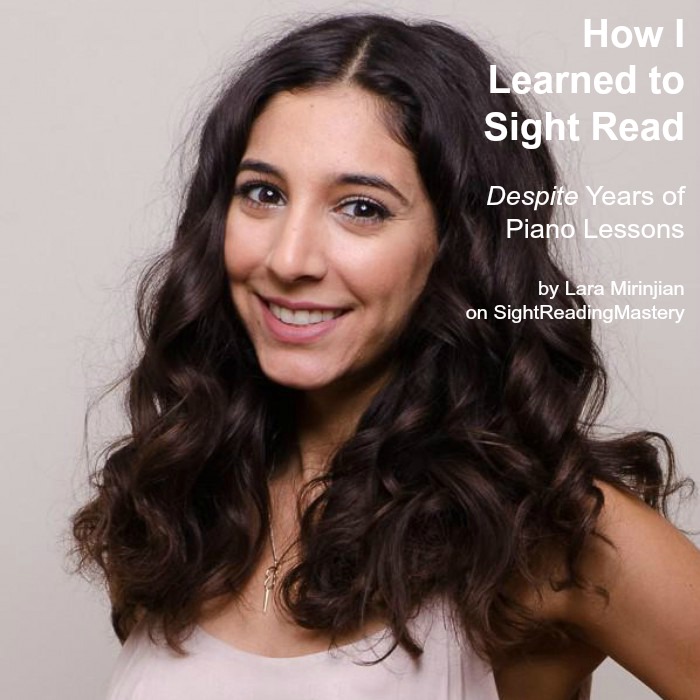
For decades, a silent frustration has plagued millions of piano students worldwide: the inability to fluidly read and interpret sheet music at sight, even after years of dedicated lessons and technical training. Pianist, educator, and sight-reading advocate Lara Mirinjian experienced this firsthand, recalling a time when, despite more than ten years of formal instruction, she struggled to fluently navigate a basic, entry-level beginner’s book.
This paradox—where musicians can master complex, multi-page repertoire through months of rigorous, repetitive muscle memory yet stumble over simple, unfamiliar scores—points to a systemic blind spot in traditional music pedagogy. While virtually all educators agree that sight-reading is a cornerstone musicianship skill, academic research reveals that it is rarely taught systematically. Many teachers omit it simply because they were never trained to instruct it, often mistakenly believing that reading fluency develops automatically as a byproduct of learning standard repertoire.
However, a fundamental shift is underway. By returning to core principles rather than relying on fragmented methods, educators like Mirinjian are pioneering a structured approach to sight-reading that yields exponential growth for students of all levels. This comprehensive report investigates the root causes of the sight-reading deficit in classical and contemporary piano training, analyzes empirical research on pedagogical gaps, details a step-by-step practical methodology for overcoming reading anxiety, and outlines the future outlook for music education as digital tools and foundational principles reshape how students interact with the written score.
Detailed Chronology: The Evolution of a Pedagogical Blind Spot
To understand why sight-reading remains an elusive skill for so many advanced and intermediate instrumentalists, it is necessary to examine how music education has historically approached score literacy.
The Traditional Memorization Trap
Historically, the trajectory of piano education has leaned heavily toward the mastery of standard repertoire. Students are assigned a piece—often spanning several weeks or months—and instructed to practice it repetitively until it is polished for recitals or examinations.
- Phase 1: The Honeymoon Period. The student is introduced to a piece. Because the process is slow, they rely heavily on reading the notes directly from the page.
- Phase 2: The Tactile Transition. As days turn into weeks, muscle memory takes over. The student begins looking exclusively at their hands, the keyboard, or internalizing the auditory patterns, effectively abandoning the visual text on the page.
- Phase 3: Complete Memorization. By the time the piece is performed, the sheet music is often used merely as a visual prop.
Through this cyclical process, the student’s technical proficiency—finger dexterity, tone production, and phrasing—advances significantly, while their actual decoding speed and cognitive pattern recognition of raw notation stagnate. Consequently, a student playing Grade 5 or Grade 6 repertoire may possess a sight-reading capability stuck at a Pre-Grade 1 level.
The Turning Point: Discovering Core Principles
For Mirinjian, the breakthrough occurred only after years of educational trial and error, when she encountered a mentor who understood the mechanics of visual decoding. This shift moved away from haphazardly attempting difficult pieces toward a disciplined, principle-based routine.
As the philosopher Ralph Waldo Emerson famously noted: "As to methods there may be a million and then some, but principles are few. The man who grasps principles can successfully select his own methods. The man who tries methods, ignoring principles, is sure to have trouble."
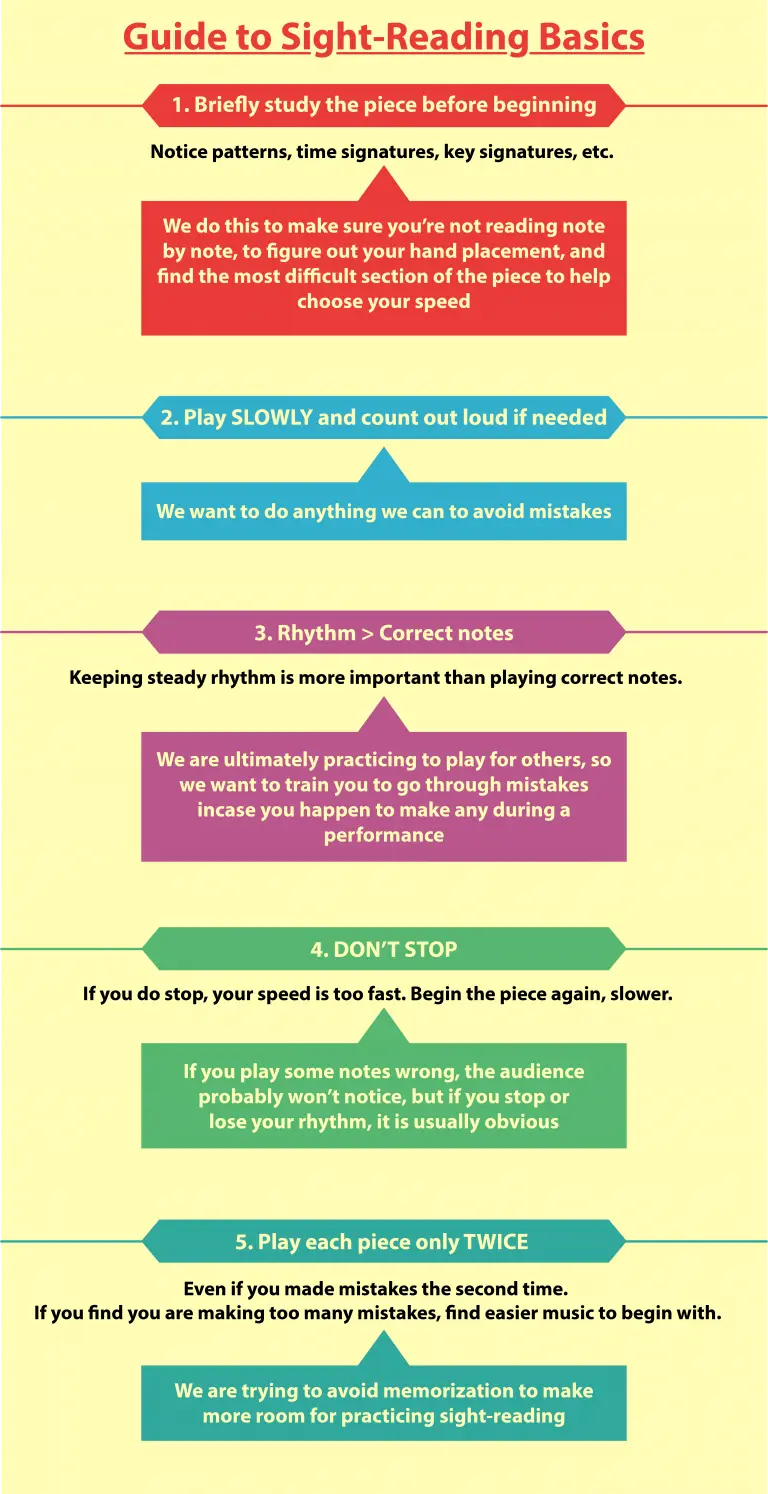
By focusing on fundamental principles—such as starting with vastly simplified material, maintaining a strict tempo without stopping, and limiting exposure to any single piece to a maximum of two read-throughs—Mirinjian unlocked exponential growth not only in her own playing, but also in the capabilities of her students. This methodology proved that sight-reading is not an innate talent bestowed upon the musically gifted, but a trainable cognitive skill accessible to anyone willing to strip away ego and begin at the true baseline.
Supporting Context & Metrics: What the Research Says
The anecdotal experiences of struggling pianists are heavily backed by empirical research into music education practices. A landmark study conducted by Dr. Dianne Hardy, Assistant Professor of Music Education and Piano at Dickinson State University, sheds light on why formal sight-reading instruction is so frequently omitted from private and institutional curricula.
Key Findings from Dr. Dianne Hardy’s Pedagogical Study
Dr. Hardy’s research investigated the underlying reasons why many piano instructors fail to teach sight-reading systematically. The findings highlight three primary institutional and psychological barriers:
- Lack of Pedagogical Training: The vast majority of teachers surveyed reported that sight-reading was omitted from their teaching programs simply because they were never taught how to instruct it. Standard method book series often lack explicit, step-by-step guidance on developing visual-to-motor decoding skills, leaving instructors unequipped to guide their students.
- The "Byproduct" Fallacy: Many educators operated under the assumption that sight-reading is not a distinct, independent skill. Instead, they viewed it as an inevitable byproduct of acquiring standard repertoire—believing that students would naturally become better readers simply by logging more years of general piano lessons.
- Teacher Insecurity: A notable percentage of surveyed instructors candidly admitted that they avoided teaching sight-reading because they considered themselves poor sight-readers. Lacking confidence in their own abilities, they steered clear of exercises that might expose their weaknesses to their students.
The Cost of Neglect
When sight-reading is ignored, students frequently develop performance anxiety, fear of unfamiliar music, and a high rate of attrition. Because every new piece feels like an insurmountable mountain, the process of discovering new music becomes tedious rather than joyful. Conversely, strong sight-readers enjoy a self-reinforcing loop: better reading leads to exploring more music, which in turn accelerates reading fluency and broadens musical comprehension.

Official Guidelines: A Step-by-Step Practical Methodology
Overcoming sight-reading paralysis requires dismantling old habits and adopting a disciplined, repeatable framework. Whether you are a novice or an intermediate player feeling stuck, the following methodology—adapted from foundational sight-reading principles—can be applied immediately to any instrument, though it is demonstrated here at the piano.
Preparation Checklist
Before touching the keys, ensure you meet the baseline requirements: you should be able to recognize basic note values (quarter notes, half notes) and locate fundamental notes on the staff (such as middle C, D, and E in the treble clef). If you are an absolute beginner, foundational video guides and beginner charts should be consulted first.
The 8-Step Action Framework for Every Practice Session
- Step 1: Select Ultra-Simple Material. Choose a piece of music that is significantly below your current technical playing level. If you are an intermediate player, drop back to beginner primer books. The goal is to eliminate technical hurdles so your brain can focus entirely on visual decoding. Place the sheet music on your stand or secure it on your digital tablet.
- Step 2: Scan for Visual Patterns. Before playing a single note, take a moment to analyze the first piece (for example, a simple exercise centered around "Middle C"). Look for structural patterns: Does the note repeat? Does it step up or down? Recognizing visual groupings rather than reading isolated notes note-by-note is the secret to fast processing.
- Step 3: Analyze the Time Signature and Establish the Count. Identify the meter (e.g., 4/4 time). Commit to counting out loud in a steady, unyielding rhythm (1, 2, 3, 4, 1, 2, 3, 4) before you even depress a key.
- Step 4: Position Your Hands Correctly. Place your hands naturally on the keyboard with your fingers resting over their designated home positions (such as your thumb resting on middle C).
- Step 5: Internalize the Golden Rule of Non-Stop Playing. Prepare mentally for the core rule of sight-reading: Do not stop. Even if you strike an incorrect note, keep the pulse moving. If a misread forces a complete breakdown, do not freeze in place; simply return to the beginning of the piece and restart at a significantly slower tempo.
- Step 6: Execute the First Read-Through at a Slower Tempo. Begin playing at an extremely slow, deliberate pace. Count aloud as you move through the notes: "One… Two… Three… Four…" Keep your eyes glued ahead of your fingers, anticipating the next visual symbol.
- Step 7: Perform the Second (and Final) Read-Through. This is where cognitive growth occurs. Play the exact same piece one final time. Consciously apply the lessons learned from your mistakes during the first pass—correcting missed intervals, adjusting posture, or smoothing out rhythm—while maintaining the slow, steady pulse. Once completed, move on immediately to the next piece. Do not practice it a third time; repetition transforms sight-reading practice back into standard repertoire memorization.
- Step 8: Progress Systematically. Transition to the next short piece in your book (e.g., "Stepping Up and Down") and repeat Steps 2 through 7.
Self-Diagnostic Indicators
How do you know if you are executing this process correctly?
- The Sound Test: What you hear should be exceptionally slow, steady, and devoid of abrupt stops or hesitation mid-measure.
- The Completion Test: By the second run-through, the piece should sound reasonably complete and cohesive. If your playing sounds erratic, disjointed, or requires constant stopping, your starting material is still too difficult. Drop down to even simpler repertoire until uninterrupted, slow flow is achieved.
For advanced players who feel their reading is adequate, the challenge shifts from mere note-recognition to the precise execution of micro-details: dynamic markings, articulation, phrasing, and stylistic nuances. Searching out massive volumes of extremely easy music allows advanced pianists to fill the hidden "cracks" in their foundational education that years of complex repertoire study left unaddressed.
Future Outlook: The Next Era of Sight-Reading Pedagogy
As music education steps further into the 21st century, the outlook for sight-reading instruction is shifting dramatically, driven by technological innovation and a re-evaluation of foundational core competencies.
Digital Integration and Adaptive Practice
The proliferation of tablets, digital sheet music applications, and interactive learning software is transforming how students access sight-reading material. Traditional physical print required purchasing bulky method books that could quickly become exhausted or too familiar. Today, digital platforms and specialized repositories—such as SightReadingMastery—provide an endless, randomized stream of leveled sight-reading exercises tailored to an individual’s exact proficiency tier.

In the near future, artificial intelligence and real-time audio analysis tools are expected to integrate directly into practice software. These systems will be able to detect micro-hesitations, rhythm lapses, and note errors on the fly, automatically adjusting the difficulty of subsequent sight-reading prompts to keep students perpetually in the optimal zone of proximal development.
A Cultural Shift in Studio Teaching
Beyond technology, the culture of private piano teaching is experiencing a much-needed philosophical correction. As pedagogical research like Dr. Hardy’s gains visibility, modern teacher-training programs are increasingly incorporating specific modules on how to teach sight-reading as an active, daily discipline rather than an afterthought.
Instructors are recognizing that building an indestructible musical foundation requires treating sight-reading with the same structured rigor applied to scales, arpeggios, and ear training. By normalizing the practice of playing unfamiliar, ultra-simple music daily without fear of imperfection, a new generation of pianists is shedding the anxiety of the blank score.
Ultimately, the future of piano education points toward a liberating realization: sight-reading is not a mystical innate gift possessed only by prodigies. It is a systematic, learnable skill. By respecting the principles of slow tempos, non-stop momentum, strict repetition limits, and progressive difficulty, any musician can unlock the entire universe of written music, transforming the piano from an instrument of laborious memorization into a vehicle for boundless musical exploration.