
Executive Overview
This week, the Washington National Opera (WNO) is pulling back the curtain on a landmark, highly anticipated production of John Adams and Alice Goodman’s contemporary operatic masterpiece, Nixon in China. This staging brings together a formidable roster of creative heavyweights, most notably featuring operatic titans Thomas Hampson and Renée Fleming in the central roles of Richard Nixon and Pat Nixon. Under the visionary stage direction of Elkhanah Pulitzer—who previously directed the work with the Los Angeles Philharmonic—and featuring rare, newly unearthed archival film footage curated by Projection Designer Bill Morrison, this production represents a major cultural milestone for the nation’s capital.
Staged in the cavernous, historic environs of DAR Constitution Hall, this mounting of Nixon in China is far more than a standard revival. It is an intentional reimagining of how large-scale opera can interact with urban space, collective memory, and contemporary political anxiety. By transforming the massive hall into an immersive environment complete with cabaret-style seating, the WNO creative team—bolstered by the vision of Artistic Director Francesca Zambello—aims to dissolve the barrier between audience and icon.
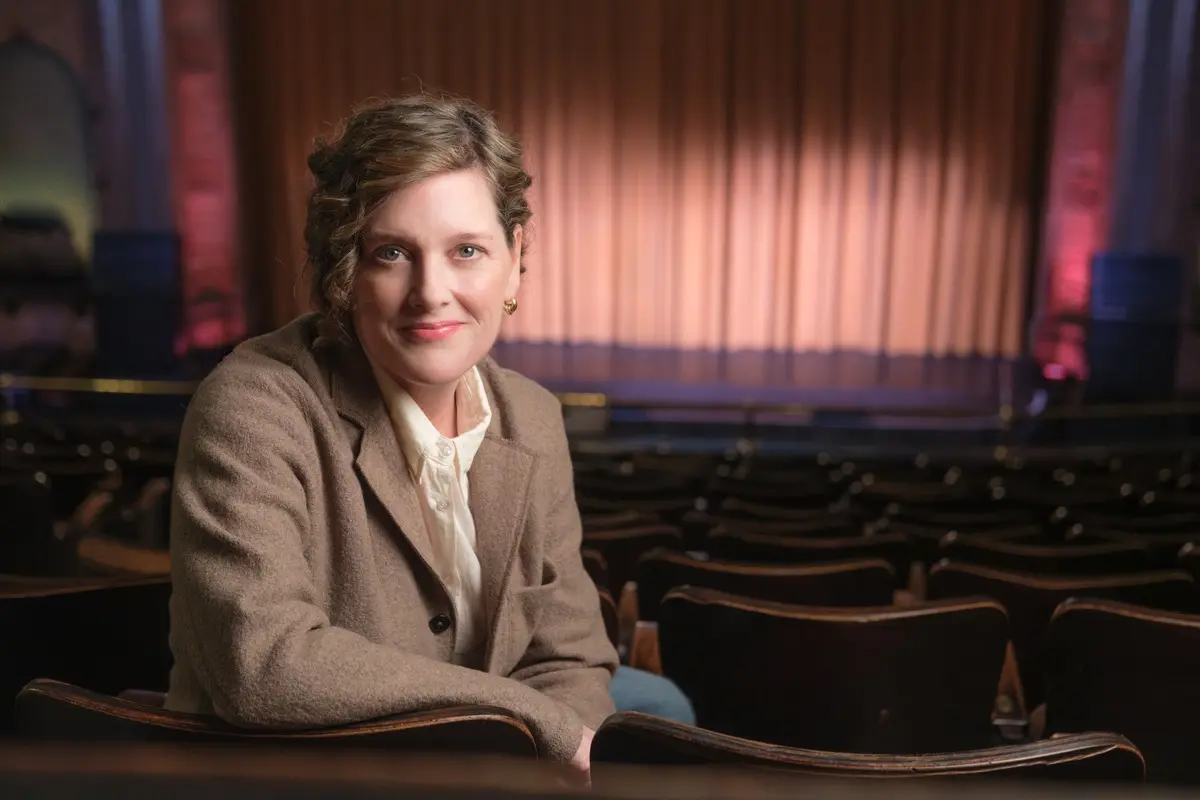
As the United States approaches its 250th anniversary, this production arrives with profound thematic resonance. It interrogates the intersection of media, propaganda, and personal vulnerability. In an exclusive interview with OperaWire, Elkhanah Pulitzer unpacks the intricate mechanics of this staging, the deep-seated psychological motivations of the opera’s historical figures, and why John Adams’ minimalist score remains as vital today as it was at its 1987 premiere.
Detailed Chronology: From 1972 Peking to the Modern Operatic Stage
To understand the weight of John Adams’ opera, one must first look back at the historical tectonic shift it depicts: Richard Nixon’s historic seven-day visit to the People’s Republic of China in February 1972. This diplomatic gambit fundamentally altered the Cold War chessboard, ending a quarter-century of isolation between Washington and Beijing. At the time, the event was heavily mediated through the burgeoning power of global television. Millions of Americans sat before cathode-ray tube screens, watching ideological adversaries break bread, tour monuments, and rewrite the rules of international diplomacy in real time.
Fast forward to 1987, when Nixon in China premiered at the Houston Grand Opera with a libretto by Alice Goodman and music by John Adams. It immediately established itself as a cornerstone of late-20th-century minimalism and contemporary American opera. Rather than serving as a dry, literal historical chronicle, the opera operates on a mythic scale, treating living political figures like operatic gods and tragic heroes.
The journey of the current WNO production has its own protracted history. Initially slated for an earlier season, the mounting was abruptly shelved due to the global COVID-19 pandemic. The logistics of staging a massive opera requiring an expansive chorus, full orchestra, and intricate multi-media projections ground to a halt. However, WNO leadership—including Francesca Zambello and Executive Director Timothy O’Leary—remained steadfast in their commitment to the project.
Now, years after that initial pandemic-induced postponement, the production has finally made it to the boards. Its arrival coincides with a strategic evolution for the Washington National Opera, an institution actively working to redefine how opera companies engage with their host cities. By stepping outside traditional proscenium arch houses and activating distinctive architectural spaces like DAR Constitution Hall, WNO is expanding the geographic and cultural footprint of the art form, ensuring that monumental works meet audiences in environments that maximize their thematic impact.
Supporting Context & Metrics: The Creative Mechanics of Pulitzer’s Staging
At the heart of this WNO production is an aesthetic philosophy rooted in documentary realism, psychological exposure, and architectural scale. Director Elkhanah Pulitzer brings a wealth of interdisciplinary experience to the table, having helmed productions for the San Francisco Opera, the New York Philharmonic, the Los Angeles Philharmonic, the Lyric Opera of Kansas City, Boston Lyric Opera, Opera Omaha, Opera Theatre of Saint Louis, and the Canadian Opera Company. Her deep familiarity with both symphonic institutions and traditional opera houses informs a staging that treats visual design and musical architecture as co-equal partners.
The Visual Landscape: Bill Morrison and Nixon Library Super 8s
For Pulitzer, the initial conceptual gateway into Nixon in China came not from operatic scores or historical textbooks, but from dusty issues of TV Guide and Time magazine. She became fascinated by how ordinary Americans experienced the 1972 summit: through the curated lens of network television and print journalism.
To bring this media-saturated reality to life on stage, Pulitzer collaborated with acclaimed documentary filmmaker and projection designer Bill Morrison. Morrison scoured the archives of the Nixon Presidential Library, unearthing rare, unvarnished Super 8 film footage shot by White House Chief of Staff H. R. Haldeman and other members of the presidential entourage.
This archival footage serves as a living backdrop for the opera. Far from being mere window dressing, it infuses the production with authentic period color, tactile detail, and visceral immediacy. It reminds the audience of the exact visual grammar of 1970s media—grainy, sun-bleached, and intensely historic—while simultaneously prompting viewers to question the nature of image-making, propaganda, and historical record.
Architectural Transformation: DAR Constitution Hall
Staging the opera inside DAR Constitution Hall presented both logistical challenges and artistic opportunities. With its massive scale and rich institutional history, the hall evokes the grandiose architecture of power. Francesca Zambello envisioned a radical reconfiguration of the space: installing cabaret-style tables directly on the floor level.
This spatial intervention fundamentally alters the audience’s relationship to the drama. Instead of passively gazing upward at untouchable world leaders from distant tiers, audience members seated at the tables find themselves pulled into an intimate proximity with the action. This staging choice mirrors the emotional trajectory of the opera itself. The work begins with a "sugar rush" of public pageantry, bombastic choral arrivals, and stiff diplomatic posturing, but slowly strips away the armor of statecraft. By the final act, the characters are left alone with their nocturnal, existential anxieties, pondering mortality, legacy, and their place in the cosmic order.
Official Statements: Elkhanah Pulitzer on Collaboration, Politics, and Human Vulnerability
In her conversation with OperaWire, director Elkhanah Pulitzer offered deep insights into the creative philosophy driving the WNO production, reflecting on everything from working with legendary vocalists to the enduring relevance of political opera.
On the Washington National Opera and the Pandemic Delay
"It’s been a really exciting opportunity. WNO has taken a leap into a new chapter, redefining what it means to engage with the city by working in different spaces depending on where each piece will most thrive. When we initially talked about me joining the Nixon in China production it was slated but then postponed because of the pandemic. So it’s very gratifying to see it back on the boards, a project that Francesca, Tim O’Leary and everyone at WNO believe in strongly enough to bring back. And it feels like an even stronger moment to present it, as part of the conversation around America’s 250th."
On the Conceptual Fusion of Media and Monumentality
"My initial way into the piece was through old ‘TV Guide’ and Time magazine imagery, with the understanding that Americans experienced the visit through the press, mostly through television. I was interested in that history-making coverage, as well as the tension and shift in political theater that occurred when many Americans were all collectively watching the same news on TV… Setting it inside DAR Constitution Hall, with its rich history and huge scale, felt like an opportunity to embrace the grand scope of people who rose to such heights that they became icons. But ‘uneasy lies the head that wears the crown.’ The work moves from leaders making choices that affect masses of people to a more reflective ending, questioning their mortality and their place in history."
On Working with Renée Fleming and Thomas Hampson
"I’m really looking forward to it. Both are incredible singing actors who bring profound artistry to their work, continuously refreshing and re-engaging with their own creative process. They too are icons! I generally feel that in the end, it’s who you’re in the room with that matters when making great work. More so than whether the water is poured from cut crystal in a penthouse or plastic jug in a garage, it comes down to ideas and creative collaboration."
On Directing Contemporary Work and a Humanist Agenda
"I come from theater, where, for example, the tradition of each director reinterpreting Hamlet is vast and can be liberating. But I find working on new pieces—particularly through-line composed works of the 19th century onward—especially gratifying. With a new story and music no one has heard before, you get to strike out in fresh directions, free of preconceived trappings… My interest lies in unraveling the DNA from within a piece to reveal what it is trying to say. As a result, my work is very driven by the text and the music and what clues I can gleam. However, as I get older, I do see certain aesthetic trends and humanist questions that I continue to gravitate towards grappling with. I’m very interested in complicated women. I’m very interested in modern and post-modern art and theater making. I’m interested in the public mask and the private self and the distances between those two, in class and power, and how we all navigate being human beings. Overall, a humanist agenda."
Future Outlook: The Relevance of Nixon in China in a Fragmented Media Landscape
As Washington National Opera’s production of Nixon in China opens to the public, it offers a timely mirror for our current geopolitical and media ecosystem. Decades after the events of 1972, the United States and China remain locked in a complex, high-stakes dance of economic competition, technological rivalry, and diplomatic maneuvering. Daily news cycles are dominated by artificial intelligence races, supply chain dependencies, and questions of global hegemony.
Yet, Pulitzer argues that the opera’s most potent contribution today is epistemological rather than purely political. In an era where deepfakes, hyper-targeted digital algorithms, and fractured media ecosystems make it increasingly difficult to agree on a shared baseline of reality, the inclusion of authentic, unpolished Super 8 footage from the Nixon Library serves as an anchor. It reminds contemporary audiences of how historical narratives are constructed, mediated, and consumed.
Furthermore, by steering the production toward its poignant, introspective conclusion, Pulitzer, Adams, and Goodman ensure that the opera transcends partisan politics. Beneath the ideological armor of Mao Zedong, Richard Nixon, Pat Nixon, and Chiang Ching (Madame Mao) lie vulnerable human beings grappling with the inevitable erosion of time.
For the Washington National Opera, this ambitious undertaking sets a new benchmark for how institutional companies can merge historical memory with contemporary theatrical innovation. By utilizing non-traditional performance spaces like DAR Constitution Hall, incorporating cutting-edge multimedia design, and casting generational talents like Fleming and Hampson, WNO is not merely preserving a modern classic—it is actively re-authoring its cultural meaning for a new generation of operatic theatergoers.