
Executive Overview
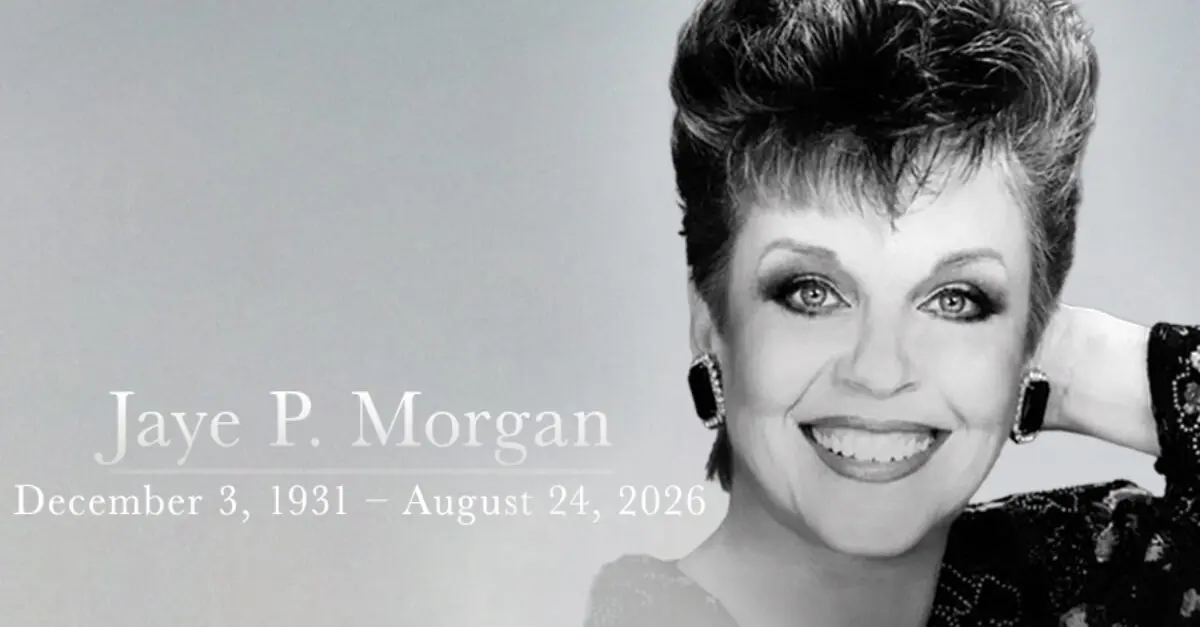
Jaye P. Morgan—the dynamic, genre-defying vocalist, television fixture, and razor-sharp wit whose career spanned more than eight decades—passed away on August 24 of natural causes at the age of 94. Her attorney, Mark Sendroff, confirmed her death, marking the quiet closing chapter for a true multi-hyphenate artist who helped shape the landscape of American entertainment during the golden age of television and beyond.
Born Mary Margaret Morgan into a large, musically gifted family, she evolved from a toddler singing in vaudeville tents to a charting pop sensation, a primetime television darling, a theatrical force, and, ultimately, a delightfully unpredictable pop-culture fixture of the late 20th century. Her professional journey serves as a living history of the American entertainment industry, tracking its migration from regional radio and the Southern California ballroom circuit to the nationwide glow of network television, the silver screen, and late-night talk show couches.
Though perhaps best remembered by younger generations for her eccentric, uninhibited panelist run on Chuck Barris’s The Gong Show, music historians and industry insiders know her as a powerhouse songstress. At her peak in the mid-1950s, Morgan commanded the airwaves with a string of major Billboard hits, earned top accolades from major trade publications, and shared stages with foundational jazz and pop royalty, including Louis Armstrong, Perry Como, and Gene Krupa.
Her passing closes the curtain on a rare breed of entertainer: one who possessed the vocal chops of a serious jazz stylist, the comedic timing of a seasoned borscht-belt headliner, and the resilient work ethic of a Depression-era child star. In accordance with her final wishes, her family has announced that no public memorial service will be held, opting instead to honor her vibrant legacy privately.
Detailed Chronology
From Vaudeville Roots to the Golden State (1931–1949)
Long before she became known to millions as Jaye P. Morgan, Mary Margaret Morgan was born into a sprawling, musical household as one of seven children. Her entry into show business happened practically before she could walk; by the tender age of three, she was already performing alongside her family in a traditional vaudeville act known as The Morgan Family. Traveling the country, the troupe instilled in young Mary Margaret a profound, visceral understanding of audience engagement and live performance mechanics.
The family eventually settled in Los Angeles, a burgeoning hub of artistic production. There, the young performer expanded her repertoire, singing on local radio broadcasts and securing regular engagements at the historic Million Dollar Theatre. Her early exposure to the cinematic machine also yielded an uncredited appearance in the 1935 Warner Brothers musical film Stars Over Broadway.
It was during her high school years, however, that her iconic moniker was born. Serving dutifully as her class treasurer, she playfully adopted a variation of the name of the famous financier J.P. Morgan—a tongue-in-cheek nod to handling money that stuck with her for the rest of her life, transforming Mary Margaret into the snappy, memorable Jaye P. Morgan.
By the time she was 15 years old, Morgan was a seasoned professional working regularly with Hank Penny and his group. This collaboration served as a crucial stepping stone, introducing her to prominent bandleader Frank DeVol. With DeVol, she toured the grueling, high-stakes hotel and ballroom circuit throughout Southern California, cutting her teeth on demanding vocal arrangements and learning how to captivate packed rooms of discerning dancers and diners.
The RCA Victor Breakthrough and Chart Dominance (1950–1955)
Morgan’s professional trajectory shifted dramatically when she began recording with Frank DeVol on Derby Records. Among her earliest significant recordings were sultry, compelling renditions of standards like "Just A Gigolo" and "Life Is Just A Bowl of Cherries." These tracks showcased a rich, flexible alto voice that could effortlessly bridge traditional pop, rhythm and blues, and jazz.
Her undeniable studio prowess caught the attention of major label executives at RCA Victor, who quickly signed her to a recording contract. The year 1954 proved to be her commercial watershed. Morgan exploded onto the national charts, landing five major Billboard hits in a single calendar year. Her powerful interpretations of "That’s All I Want from You," "Danger, Heartbreak Ahead," and "The Longest Walk" cemented her status as a premier recording artist. Furthermore, her magnetic chemistry in the recording studio yielded successful duets with crooning superstar Perry Como, most notably on "Chee Chee-oo Chee" and "Two Lost Souls."
Her skyrocketing popularity did not go unnoticed by the television industry. In 1954, she secured a regular spot on CBS’s daytime variety program, The Robert Q. Lewis Show. Her tenure there was remarkably brief; she was quickly poached by ABC to serve as the featured singer on the high-profile game show Stop The Music. The industry at large took notice of her omnipresence, with both Down Beat and Cash Box magazines voting her Best Female Vocalist of 1954.
Television Stardom and Prime-Time Omnipresence (1956–1970s)
Riding the wave of her musical success, Morgan successfully transitioned into the burgeoning medium of television as a live performer and host. In 1956, she briefly helmed her own network program, The Jaye P. Morgan Show, which prominently featured her musical siblings under the banner "Jaye P. Morgan and the Morgan Brothers."
While her self-titled program struggled to secure a permanent national foothold in a hyper-competitive landscape, Morgan found her true niche as a ubiquitous, highly sought-after guest star. She became a familiar, comforting presence in American living rooms, making frequent appearances on the era’s definitive variety hours: The Jackie Gleason Show, The Pat Boone Chevy Showroom, The Dick Clark Show, The Ed Sullivan Show, and The Ford Show Starring Tennessee Ernie Ford.
When asked later in life about the vast archive of television appearances she accumulated, Morgan frequently pointed to one specific night as her proudest artistic achievement: her landmark performance on The 1958 Timex All Star Jazz Show. Sharing the stage with towering musical titans Louis Armstrong, Gene Krupa, and Lionel Hampton, Morgan proved that she could hold her own alongside the absolute architects of American jazz.
As the television landscape evolved in the 1960s and 1970s, Morgan seamlessly adapted. She became a master of the talk-show circuit, lighting up the stage on The Tonight Show Starring Johnny Carson, The Merv Griffin Show, The Mike Douglas Show, and Dinah!. Her quick wit, fearless self-deprecation, and willingness to lean into the absurd made her a favorite of hosts and audiences alike.
Theatrical Acclaim and The Gong Show Phenomenon
Never content to remain boxed into a single medium, Morgan expanded her artistic footprint into the theatrical realm. She proved her mettle as a legitimate stage actress, touring regionally in a string of successful musical productions. Her credits included star turns in The Best Little Whorehouse in Texas, Annie Get Your Gun, Guys & Dolls, Sugar Babies, The Unsinkable Molly Brown, The Pajama Game, Miss Margarida’s Way, and Nunsense.
In 1976, Morgan entered a completely new cultural stratosphere when she became a regular panelist on Chuck Barris’s wildly subversive, chaotic talent show parody, The Gong Show. Alongside rotating panelists like Arte Johnson and Jaye P.’s frequent foil Jamie Farr, Morgan brought an anarchic, unpredictable energy to daytime television. Her uninhibited reactions, sharp comedic barbs, and famous on-air antics (including a legendary, highly publicized incident where she briefly exposed her chest to a contestant) made her a counter-cultural icon of the era, introducing her to a younger, irreverent demographic that viewed her as a camp royalty.
Concurrently, she continued to land memorable television guest spots, including a standout 1973 appearance on The Odd Couple where she played herself and memorably performed "Happy and Peppy and Bursting With Love," a delightfully goofy song penned by Tony Randall’s character Felix Unger. She also headlined an unforgettable episode of The Muppet Show, matching wits and musical stylings with Jim Henson’s creations.
Late-Century Renaissance and Silver Screen Credits
Entering the final decades of the 20th century, Morgan showed no signs of slowing down. She maintained an active recording career, collaborating with contemporary producers well into the late 1900s—including notable sessions with elite producer David Foster, who recognized her enduring vocal discipline and unique phrasing.
On the big screen, Morgan cultivated a fascinating portfolio of cinematic character roles. Her film credits included The All-American Boy alongside Jon Voight, The Gong Show Movie (naturally), the cult comedy Night Patrol, and a memorable turn in George Clooney’s critically acclaimed 2002 directorial debut, Confessions of a Dangerous Mind.
Furthermore, she maintained a relentless touring schedule in nightclubs and concert venues across the country. One of her most enduring and beloved late-career pairings was her collaborative stage show with comedienne Beverly Cardella—professionally known as Pudgy—delivering sharp, high-energy vaudevillian routines to enthusiastic audiences across the United States.
Supporting Context & Metrics
To fully understand Jaye P. Morgan’s footprint in American entertainment history, it is essential to examine the quantitative and qualitative metrics of her career:
| Metric Category | Data Points & Milestones |
|---|---|
| Lifespan & Career Span | Lived 94 years (1931–2025); professional career spanned over 80 years, originating in toddlerhood vaudeville and extending into the 2000s. |
| Chart Success (1954) | Scored five major Billboard hits in a single calendar year, including "That’s All I Want from You," "Danger, Heartbreak Ahead," and "The Longest Walk." |
| Critical Accolades | Voted Best Female Vocalist of 1954 by both Down Beat and Cash Box magazines. |
| Collaborators & Peers | Shared stages and recording studios with Louis Armstrong, Gene Krupa, Lionel Hampton, Perry Como, Frank DeVol, and David Foster. |
| Television Reach | Appeared as a recurring or guest star on virtually every major variety and talk format, including The Ed Sullivan Show, The Tonight Show Starring Johnny Carson, and The Gong Show. |
| Theatrical Repertoire | Starred in regional productions of major American musicals, including Guys & Dolls, Annie Get Your Gun, Sugar Babies, and The Best Little Whorehouse in Texas. |
Official Statements
The passing of Jaye P. Morgan prompted reflections from her legal representation, colleagues, and cultural historians who recognize her unique contributions to the American entertainment canon.
Mark Sendroff, Attorney and Longtime Representative:
"Jaye P. Morgan was an absolute original—a powerhouse performer whose raw talent was matched only by her razor-sharp wit and fearless approach to life and art. From the vaudeville stage to the pop charts, and from prime-time television to the chaotic brilliance of The Gong Show, she brought authenticity and electric energy to everything she did. She lived a full, vibrant life on her own terms, surrounded by family at the end. Her voice and her indomitable spirit will be deeply missed."
Cultural Historian and Broadcaster Excerpt:
"To study Jaye P. Morgan is to study the evolution of 20th-century American entertainment. She was a bridge builder between the dying art of vaudeville and the birth of multi-channel television. She could sing jazz with Armstrong, pop ballads for RCA Victor, and play the straight man to a rubber chicken on daytime TV without missing a beat. Performers like that simply aren’t made anymore."
Future Outlook & Preservation of Legacy
While the physical presence of Jaye P. Morgan has left the stage, her immense contributions to American music, television, and pop culture remain permanently etched in the historical record.
In the wake of her passing, industry archivists and streaming platforms face a renewed imperative to preserve and showcase her midcentury musical catalog. While many of her classic 1950s RCA Victor singles and her dynamic television appearances survive via collector circles and archival digital transfers, a comprehensive, remastered retrospective of her recorded works would serve as an invaluable educational resource for contemporary vocalists and musicologists.
Furthermore, her pioneering path as a self-made female entertainer who successfully navigated—and frequently subverted—the male-dominated studio and television systems of the 1950s and 60s offers a vital blueprint for modern artists. Morgan proved that longevity in show business is not merely a function of youthful pop stardom, but of relentless adaptability, genuine musicianship, and an unshakeable sense of humor.
As her family honors her final wish for a private, quiet farewell in Longview, Washington, the wider cultural landscape is left to celebrate a monumental life well-lived. Jaye P. Morgan leaves behind a rich legacy of sound, laughter, and theatrical grit—a permanent reminder of what it truly means to entertain an audience from the cradle to the curtain call.