
Executive Overview
In the mid-1980s, the landscape of contemporary jazz and fusion was undergoing a profound tectonic shift. The pioneering giants who had defined the genre through the previous two decades were beginning to explore distinct, individual paths away from the collaborative crucibles that had forged modern improvised music. Among the most significant of these departures was the amicable dissolution of Weather Report, the legendary fusion ensemble co-led by keyboardist Joe Zawinul and saxophonist Wayne Shorter.
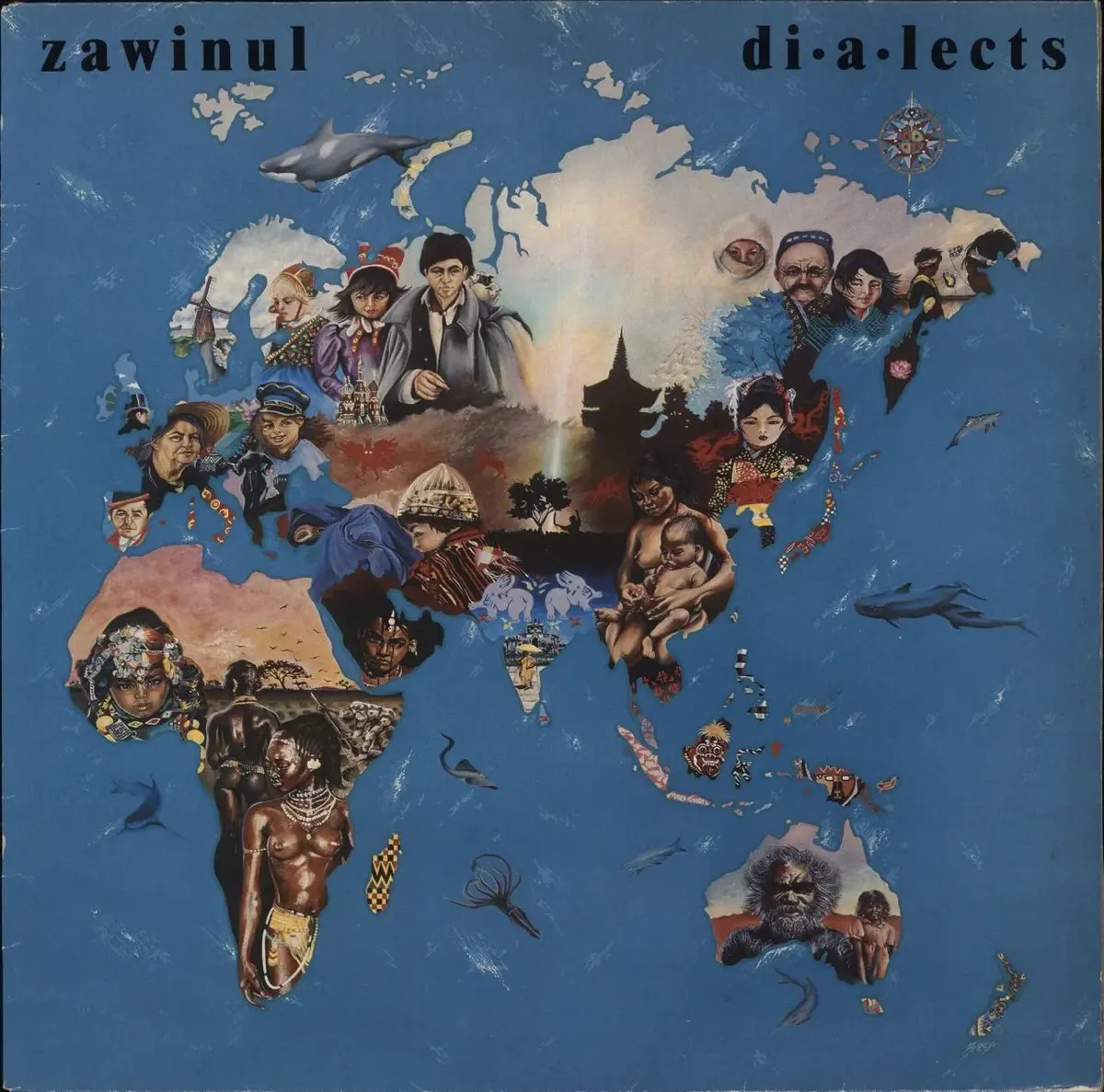
Released on CBS Records (CBS 26813) and recorded in Pasadena circa 1985, Joe Zawinul’s solo project Dialects stands as a definitive artistic statement from this transitional era. Far from being a mere footnote in the keyboardist’s storied discography, the album captures Zawinul operating as a true one-man orchestra. Utilizing a formidable arsenal of electronic instruments, he single-handedly handles electric drums, complex harmonic structures, pulsating bass lines, winding melodies, and soaring solos. The only external additions to this synthesized landscape are human voices, featuring stellar vocal contributions from Bobby McFerrin, Carl Anderson, Dee Dee Bellson, and Alfie Silas.
For contemporary listeners and jazz purists who harbor a fondness for Weather Report’s high-water mark of the mid-seventies—the era of undisputed masterworks like Heavy Weather—Dialects offers an intoxicating, familiar yet deeply refreshing listening experience. In essence, Zawinul is speaking fluently in the musical language, or "dialect," that he spent years codifying with his former band. The album brims with his signature chord voicings, exotically oblique melodies, and perpetual major-minor tugs-of-war.
This comprehensive review explores Dialects through a multi-faceted journalistic lens, examining its historical chronology, the technical mastery behind its creation, its philosophical contrast with Wayne Shorter’s concurrent work, and its enduring legacy in the annals of electronic jazz.
Detailed Chronology: The Post-Weather Report Landscape
To fully understand the genesis of Dialects, one must trace the timeline of Weather Report’s final years and the subsequent divergence of its core creative minds. Throughout the 1970s and early 1980s, Zawinul and Shorter maintained one of the most remarkably telepathic creative partnerships in modern music history. Together, they pushed jazz fusion past the rock-inflected bravado of early Miles Davis disciples, steering it toward a sophisticated, globally conscious synthesis of African rhythms, European classical harmony, and cutting-edge electronic sound design.
By the mid-1980s, however, both artists recognized that the creative inertia of the band had reached its natural horizon. In a revealing interview conducted around the time of the group’s dissolution, Wayne Shorter remarked that now that the primary composing axis of Weather Report was split, listeners would ultimately receive the best of both worlds through their respective solo endeavors.
This ideological split manifested immediately in their contrasting approaches to composition and performance. Dialects reveals that as a composer, Joe Zawinul naturally gravitated toward a more direct, vibrant, and usually uptempo approach. His writing favored rhythmic immediacy and visceral groove. Conversely, Shorter’s solo output from the same period—such as his album Atlantis—explored a different aesthetic realm. While Atlantis is not strictly a reflective album, that quality of meditative ambiguity has long been a hallmark of Shorter’s artistic contributions, both within Weather Report and across his wider catalog.
Recorded in Pasadena in 1985, Dialects served as Zawinul’s laboratory to test whether his orchestrational vision could hold the listener’s attention without the acoustic interplay of virtuosos like Jaco Pastorius or Peter Erskine. The resulting two-part suite arrangement on the original vinyl release—Side One housing "The Harvest," "Waiting For The Rain," "Zeebop," and "The Great Empire" (clocking in at 22:14), and Side Two featuring "Carnavalito," "6AM/Walking On The Nile," and "Peace" (22:03)—proved that Zawinul’s compositional gravity was more than strong enough to anchor the entire project.
Supporting Context & Metrics: The Anatomy of a One-Man Orchestra
One of the most persistent hazards of solo synthesizer projects from the 1970s and 1980s is the risk of sounding sterile, mechanical, or overly clinical. The technology of the era—reliant on early MIDI implementations, digital sampling limitations, and complex analog-to-digital sequencing—frequently yielded wooden results that alienated traditional jazz enthusiasts who valued organic touch and spontaneous interaction.
Joe Zawinul, however, consistently defied these technological limitations. On Dialects, he manages to bypass the traditional pitfalls of electronic isolationism, achieving a remarkably full, organic, and deeply spontaneous sonic footprint. Merely two minutes into the opening track, "The Harvest," it becomes glaringly apparent that a fiercely active, thinking, and fertile musical mind is at work.
Harmonic and Structural Architecture
An analysis of the structural framework underlying Dialects reveals Zawinul’s mastery of modal composition. Rather than relying on standard chord-change progressions typical of traditional bebop, most of the tunes on the album are anchored around sophisticated modal riffs. These motifs may shift occasionally, but the primary mechanism of change is rarely a traditional modulation. Instead, Zawinul achieves dynamic tension through subtle, intricate shifts in:
- Harmony: Layering unexpected extensions and polychords over a static root.
- Melody: Weaving counter-lines that dart in and out of the primary modal center.
- Rhythm: Altering groove densities and syncopations against a persistent rhythmic pedal.
- Volume & Timbre: Utilizing synthesizer filter sweeps and expression pedals to swell and recede, creating an illusion of spatial movement.
The Vocal Contributions
While Zawinul constructs the instrumental framework entirely by himself, the inclusion of human voices acts as the emotional bridge connecting his electronic landscapes to the global musical traditions he so deeply admired. The roster of vocalists on Dialects is nothing short of stellar:
- Bobby McFerrin: Bringing his legendary vocal acrobatics and percussive vocalizations, blending seamlessly with Zawinul’s synthesized percussion.
- Carl Anderson: Lending his soulful, resonant delivery to elevate the melodic hooks.
- Dee Dee Bellson & Alfie Silas: Providing lush harmonic vocal textures that mimic and expand upon Zawinul’s own keyboard voicings.
Official Statements and Critical Perspectives
The critical reception of Dialects upon its release highlighted the enduring fascination—and occasional polarization—surrounding Zawinul’s electronic explorations. While some jazz critics of the mid-1980s viewed the embrace of heavy synthesizers and drum machines as a retreat from acoustic purity, discerning listeners recognized the project as a natural evolution of the futuristic ethos Weather Report had championed for over a decade.
In retrospective analyses, musicologists often point to Dialects as a masterclass in timbre. Zawinul was never merely a keyboard player pressing preset buttons; he was an architect of sound who programmed his instruments to behave with the breathing elasticity of human vocal cords or traditional ethnic wind instruments.
Industry peers frequently remarked on Zawinul’s peerless work ethic during this period. Operating out of his home studio setup, he treated electronic music production not as an exercise in detachment, but as a deeply physical, tactile performance art. As Wayne Shorter’s observation suggested, the separation of the Weather Report masterminds allowed both men to fully realize their idiosyncratic musical philosophies without compromise. For Zawinul, that meant diving headfirst into a rhythm-obsessed, synthesized global village where every frequency band was meticulously accounted for.
Track-by-Track Breakdown
To appreciate the rhythmic and atmospheric journey of Dialects, a closer examination of its two suites is essential.
Side One: The Pulse of the Global Village
- "The Harvest": Serving as the album’s grand overture, this track immediately establishes the dense, multi-layered electronic environment. Within moments, the listener is enveloped in a sophisticated modal groove driven by Zawinul’s dynamic synth programming.
- "Waiting For The Rain": A piece characterized by its evocative, atmospheric tension. Here, the electronic textures simulate the humid, charged anticipation of a tropical storm, punctuated by expressive vocal accents.
- "Zeebop": Leaning heavily into Zawinul’s fascination with African and Caribbean dance rhythms, this track showcases his ability to program complex, polyrhythmic percussion lines that feel entirely organic and danceable.
- "The Great Empire": A sprawling, cinematic composition that utilizes grand harmonic shifts to evoke vast geopolitical and cultural landscapes, demonstrating Zawinul’s penchant for globally inspired programmatic music.
Side Two: Rhythmic Exploration and Resolution
- "Carnavalito": Infused with celebratory Latin-American folk undertones, this track explodes with vibrant energy, utilizing bright synthesizer timbres and agile vocal interplay.
- "6AM / Walking On The Nile": A mesmerizing two-part journey that transitions from the quiet, mist-shrouded ambiance of early morning into the sprawling, hypnotic pulse of a journey along the world’s most famous river. The modal vamps here create a trance-like state for the listener.
- "Peace": Bringing the album to a contemplative close, this track offers a tranquil resolution to the high-energy workouts that precede it, emphasizing warm, sustained pad voicings and gentle vocal harmonization.
Future Outlook and Enduring Legacy
Decades after its initial pressing on CBS Records, Dialects occupies a fascinating niche in jazz history. In an era where electronic music production has become ubiquitous—and where software synthesizers and digital audio workstations allow any bedroom producer to layer infinite tracks—Joe Zawinul’s 1985 achievement stands as a monument to early vision and uncompromising craftsmanship.
For contemporary listeners, revisiting Dialects provides a vital link in understanding the evolution of modern electronic jazz, ambient fusion, and worldbeat. It proves that technology, when commanded by a singular, fertile artistic intellect, does not sterilize music; rather, it expands the palette of human expression.
Final Verdict: Highly recommended to those who are partial to the mid-period (circa Heavy Weather) work of Weather Report, as well as adventurous listeners fascinated by the intersection of advanced electronic sound design and sophisticated modal jazz composition. Dialects remains a brilliant, singular dispatch from a master architect of sound.