
Executive Overview
The landscape of music education is experiencing a profound paradigm shift. While teaching music remains one of the most creatively fulfilling professions, it is simultaneously plagued by intense administrative burnout, chronic time constraints, and the immense pressure of managing large student bodies. Modern music educators are no longer just instructors of theory, performance, and interpretation; they are logistical managers, data analysts, technical directors, and pastoral guides.
Between planning complex rehearsals, tracking nuanced individual student progress, designing interactive assignments, and keeping pace with curricular standards, educators are constantly racing the clock. For decades, the prevailing narrative of the music teacher has been that of the isolated maestro—a solitary department-of-one fighting heroically to keep ensembles tuned, budgets funded, and students engaged.
However, a new wave of educational technology is dismantling this culture of isolation. Leading the charge is MakeMusic, which has rolled out a suite of powerful collaboration tools designed to bridge the gap between educators, departments, and entire school districts. By introducing robust co-teaching capabilities and streamlined cross-organizational assignment sharing, the platform is transforming how music educators plan, assess, and execute their curricula.
This article explores the systemic challenges facing modern music educators, analyzes the architectural mechanics of these new collaborative features, evaluates their impact on real-world classroom workflows, and forecasts the future of collaborative music pedagogy in an increasingly interconnected digital age.
Detailed Chronology: The Evolution of Music Tech Collaboration
To understand the significance of MakeMusic’s latest updates, it is crucial to trace the historical progression of how music educators have shared resources and managed classrooms over the past generation.
The Era of Analog Isolation (Late 20th Century)
For decades, music education was defined by physical materials. Sheet music, photocopied theory worksheets, and handwritten lesson plans lived in physical filing cabinets. Collaboration meant standing by the departmental copy machine, trading mimeographed rhythm exercises, or mailing physical scores to colleagues across the district. If an educator fell ill or a department expanded, onboarding a new teacher meant physically handing over cardboard boxes of legacy materials. Digital tools were largely restricted to basic notation software running on isolated desktop computers, offering zero cloud connectivity or real-time sharing capabilities.
The Dawn of Digital Portals (Early 2000s–2010s)
As the internet matured, learning management systems (LMS) and early digital audio platforms began to emerge. Educators started digitizing their assignment archives, uploading PDFs to shared school servers, or emailing digital files back and forth. While this reduced paper clutter, it introduced a new bureaucratic nightmare: version control issues, fragmented file formats, lost login credentials, and siloed software environments that could not communicate with one another. A band director utilizing one software suite could rarely integrate their data seamlessly with a choral director working two doors down.
The Rise of Cloud-Based Ecosystems (Present Day)
The contemporary era is defined by cloud-native infrastructure. Platforms like MakeMusic Cloud shifted the paradigm from static file-sharing to dynamic, live-environment collaboration. Recognizing that modern music programs—such as expansive marching bands, multi-tiered concert ensembles, and specialized jazz bands—frequently rely on multi-director models, software developers began engineering features that reflect the realities of team teaching. The introduction of built-in co-teaching environments and cross-organizational resource libraries represents the culmination of this digital evolution, moving the industry from mere digitization to true, interconnected synergy.
Supporting Context & Metrics: The Crisis of Educator Burnout and the Power of Community
To fully grasp why collaborative tools are essential to modern music programs, one must examine the socio-professional pressures currently facing teachers.
The Weight of the "Solo" Department
In many school districts, particularly in rural or underfunded suburban areas, the music department consists of a single educator. This individual is often responsible for the entire vertical alignment of the program: teaching beginning elementary band, middle school concert orchestra, high school marching band, and AP music theory simultaneously.
According to various educational labor studies, music and arts educators suffer from some of the highest rates of compassion fatigue and administrative burnout in K–12 education. When an educator must reinvent every assessment, test every rhythm dictation, and log every student submission completely unaided, the risk of attrition skyrockets.
The Power of Digital Ecosystems
Recognizing this isolation, MakeMusic has actively fostered digital communities to bridge geographic and institutional divides. A prime example is the thriving Teaching with MakeMusic Cloud Facebook community. Far more than a casual social media group, this digital hub functions as an organic professional learning network (PLN). Here, thousands of music educators share innovative lesson strategies, troubleshoot technical hurdles, and offer mutual encouragement.
For the solo teacher working late nights in an empty band room, knowing that an entire global community of peers is accessible via a digital sounding board can be the difference between staying in the profession and burning out.
Bridging the Institutional Gap
Beyond online peer groups, collaboration must be operationalized at the school level. The opportunity to share resources is frequently closer than educators realize, existing right down the hall in the choir room, across the courtyard in the theater department, or within the district’s central administration. The challenge has never been a lack of willingness among educators to share; rather, it has been the absence of a unified technical infrastructure that makes sharing frictionless.
Official Innovations: Inside MakeMusic’s Collaborative Suite
MakeMusic’s recent feature rollouts are specifically engineered to eliminate institutional friction, offering two cornerstone capabilities: Co-Teaching and Cross-Organizational Assignment Sharing.
Two Conductors, One Vision: The Mechanics of Co-Teaching
In traditional educational software, class rosters are locked to a single administrator account. If two directors share responsibilities for a massive high school marching band or a premier symphonic orchestra, one teacher typically acts as the primary account holder, while the other is relegated to viewing data over their shoulder or sharing login credentials—a severe security and administrative violation.
MakeMusic’s co-teaching feature fundamentally alters this dynamic by allowing primary instructors to add secondary teachers to their classes with full, legitimate access.
Key Capabilities of Co-Teachers:
- Synchronized Roster Management: Both directors maintain equal visibility over student enrollment, section assignments, and profile data.
- Unified Assignment Grading: Co-teachers can review, grade, and provide targeted feedback on student performance submissions simultaneously, dividing the grading load in half.
- Real-Time Progress Tracking: Both educators view identical metrics regarding student practice time, assignment completion rates, and performance accuracy analytics.
- Seamless Multi-Director Alignment: Large ensembles—such as fall marching bands split into wind and percussion sections or combined concert choirs—can be managed fluidly without administrative bottlenecks.
Real-World Applications:
- Large Ensembles & Co-Directors: Programs with dual band directors no longer need to compare notes after the rehearsal or argue over login access. Both directors can operate directly within the platform in real time.
- Mentoring Student Teachers: Rather than relegating student teachers to the sidelines as passive observers, institutions can grant them active administrative and instructional privileges. Student teachers can design assignments, evaluate student submissions, and manage classes under the direct supervision of a master educator, gaining invaluable hands-on experience.
- Special Education Integration: In inclusive classrooms, special education co-teachers and paraprofessionals often work alongside music educators to support students with diverse learning needs. By embedding special education staff directly into the MakeMusic platform, support personnel gain the exact same contextual view of the student’s musical assignments, enabling targeted, data-driven interventions.
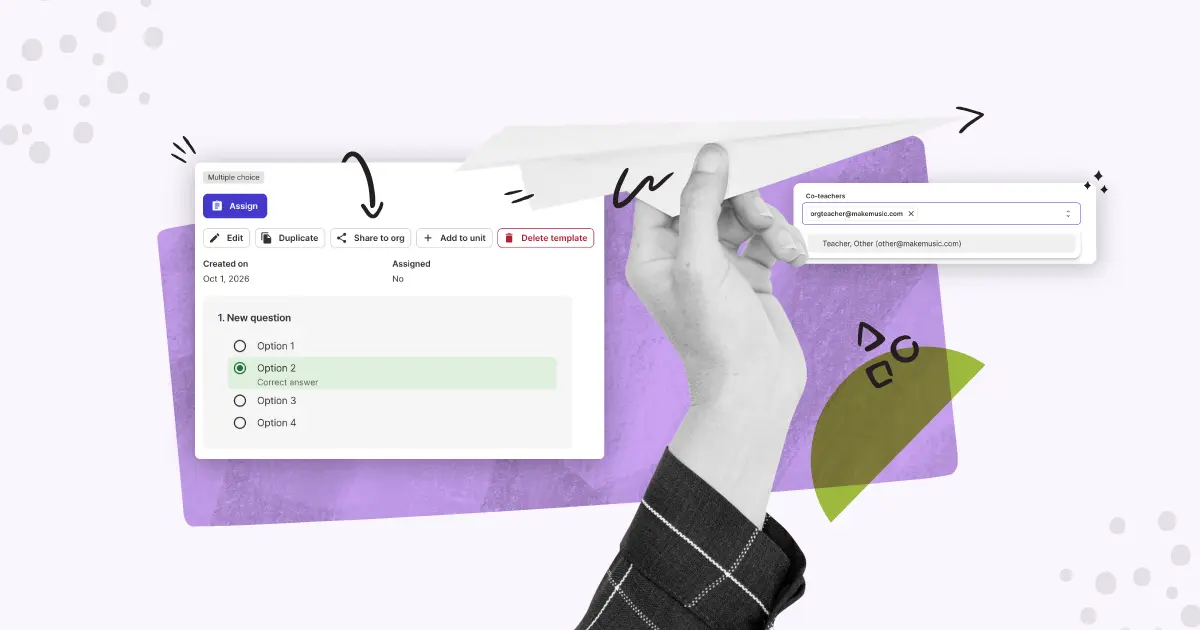
Adding a co-teacher is designed to be frictionless: from the Class Settings dashboard, an educator simply sends an email invitation. Once accepted, the collaborative workflow is instantly established.
Sharing Is Caring: Cross-Organizational Assignment Sharing
Earlier in the year, MakeMusic introduced Multiple Choice Assessments, giving educators a fast, flexible tool to evaluate student understanding of music theory, listening comprehension, and foundational notation concepts. While creating bespoke quizzes is intellectually stimulating, doing so repeatedly across multiple parallel sections or different grade levels is intensely time-consuming.
MakeMusic’s new cross-organizational sharing capabilities solve this redundancy by allowing educators to share written assessments and multiple-choice quizzes directly within their school organization.
The Workflow:
- An educator builds a comprehensive multiple-choice quiz on complex rhythm notation or a written assignment analyzing classical harmonic structures.
- From the assignment library, the creator selects the sharing option and designates it for internal distribution within their school or district organization.
- Colleagues teaching parallel sections, alternate grade levels, or complementary ensembles can instantly locate the assessment in the shared library and save a direct copy to their personal accounts.
Departmental Transformation:
- Vertical and Horizontal Alignment: High school band directors can seamlessly align their music theory assessments with middle school feeder programs, ensuring students transition with a standardized foundational knowledge base.
- Choral and Instrumental Synergy: Choral directors can share solfa identification exercises and vocal pedagogy quizzes with musical theater instructors.
- Onboarding New Staff: When a new music educator joins a school district at the start of a grading period, they no longer have to reinvent the curriculum from scratch. They can immediately access a rich, pre-vetted institutional library of assignments tailored to their specific district standards, allowing them to hit the ground running.
Future Outlook: The Connected Future of Music Pedagogy
As we look toward the future of music education, the trajectory is clear: isolation is giving way to interconnected ecosystems. The integration of advanced co-teaching architecture and collaborative assessment sharing marks a monumental step forward, but it is merely the foundation for what is next.
Predictive Analytics and Collaborative Curriculum Design
In the coming years, we can anticipate the evolution of these tools toward intelligent, district-wide curriculum mapping. Imagine a regional school district where music analytics are aggregated anonymously across dozens of schools, identifying common student struggle points in sight-reading or intonation. Collaborative tools will soon leverage these insights to automatically suggest peer-created remediation assignments from neighboring teachers who have successfully solved similar pedagogical challenges.
Global Professional Learning Networks
As platforms like MakeMusic continue to expand their digital footprints, the boundaries of the "music department" will transcend physical school walls. We are moving toward a global classroom model where educators across continents can co-author digital method books, co-teach virtual masterclasses, and pool their creative energies to elevate the standard of arts instruction worldwide.
Conclusion: You Don’t Have to Do It Alone
Teaching music is a high-stakes, deeply personal endeavor that demands immense emotional, intellectual, and physical energy. The modern music educator should not be expected to function as an isolated island.
By embracing tools that foster true co-teaching, eliminate redundant administrative labor through smart resource sharing, and connect isolated educators to vibrant digital communities, the profession is becoming more sustainable, collaborative, and joyful.
As MakeMusic’s latest updates prove, music is inherently an art form built on harmony, counterpoint, and ensemble coordination. It is only fitting that the systems we use to teach it finally reflect the same truth: Making music—and teaching it—is always better together.
Ready to transform how you and your colleagues manage your music program? Start a free trial of MakeMusic Cloud today and experience a smarter, more connected way to teach music.