
Executive Overview
The opening weeks of a new academic year establish the psychological and technical trajectory for a choir program. While veteran directors understand that the first few minutes of a rehearsal dictate the level of engagement, discipline, and tone for the remainder of the period, many still find themselves encumbered by traditional logistical hurdles. Historically, choral directors have spent precious instructional time trapped behind the piano bench—manually pounding out accompaniments, modulating through keys on the fly, and struggling to manage room dynamics while missing critical vocal adjustments happening in the back rows.
A paradigm shift is currently underway in music education. By merging the pedagogical frameworks of modern choral literature—such as Bethany Main’s Choir Up!—with the interactive digital infrastructure of platforms like MakeMusic, educators can completely automate the mechanics of warm-ups and foundational skill-building. This technological integration frees directors to step away from the piano, circulate through the room, and focus entirely on diagnosing vocal technique, assessing student posture, and fostering an inclusive choral culture.
This comprehensive report examines a battle-tested rehearsal blueprint designed to maximize student buy-in from day one. By leveraging kinesthetic movement, high-energy contemporary arrangements, infinite sight-reading generation, and strategic cognitive "brain breaks," choral programs are redefining what is possible in the modern rehearsal space.
Detailed Chronology: A Step-by-Step Rehearsal Blueprint
Step 1: Establishing Joy and Kinesthetic Engagement
True vocal health and technical proficiency are inherently tied to physical body engagement. In traditional settings, static posture drills often bore students, leading to disengagement before the actual music even begins. To counter this, forward-thinking directors are adopting the principles found in Bethany Main’s Choir Up!.
In print form, Choir Up! provides directors with foundational melodies, targeted lyrics, and kinesthetic movement prompts—such as contrasting upbeat, energized posture with slumped, "sleepy, grumpy, unconscious" physical states. However, when these resources are opened within the MakeMusic ecosystem, static eight-bar printed exercises transform into fully orchestrated, dynamically modulating digital lessons.
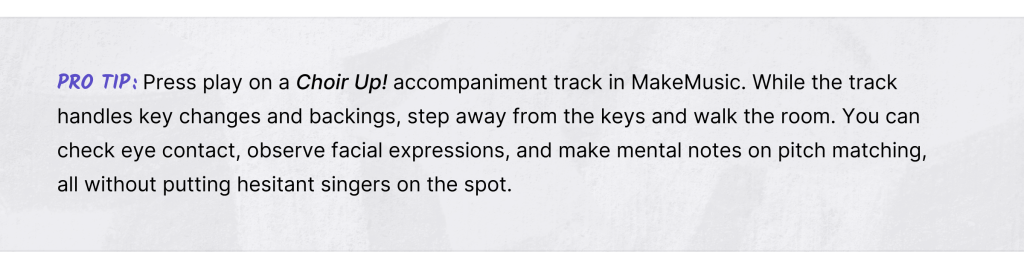
Directors can set the tempo, select specific keys, and let the software handle the accompaniment loop. This automation allows the instructor to physically move through the rehearsal space, offering individual feedback on breath support and alignment while the students remain physically active and cognitively alert.
Step 2: Hooking Singers with High-Energy Pop Melodies
Once the choir is physically warmed up and breathing as a collective unit, maintaining momentum is crucial. To bridge the gap between classical vocal pedagogy and contemporary student interest, directors are turning to collections like Jack Zaino’s Pop Warm-Ups (a MakeMusic exclusive).
These exercises take iconic, globally recognizable pop hooks and ingeniously adapt them into structured vocal drills backed by authentic rock and pop band tracks. Because the backing tracks emulate a professional studio band rather than a standard piano accompaniment, students buy into the exercise instantly.
This immediate connection validates their musical preferences while allowing the director to teach complex vocal concepts—such as vowel modification, belt placement, and stylistic phrasing—using repertoire that resonates with contemporary youth culture.
Step 3: Infinite Music Literacy and Sight-Reading Mastery
A persistent challenge in choral education is the limitations of traditional sight-reading materials. When students repeatedly practice the exact same four lines printed in a physical method book, they often rely on auditory memorization rather than developing true music literacy.
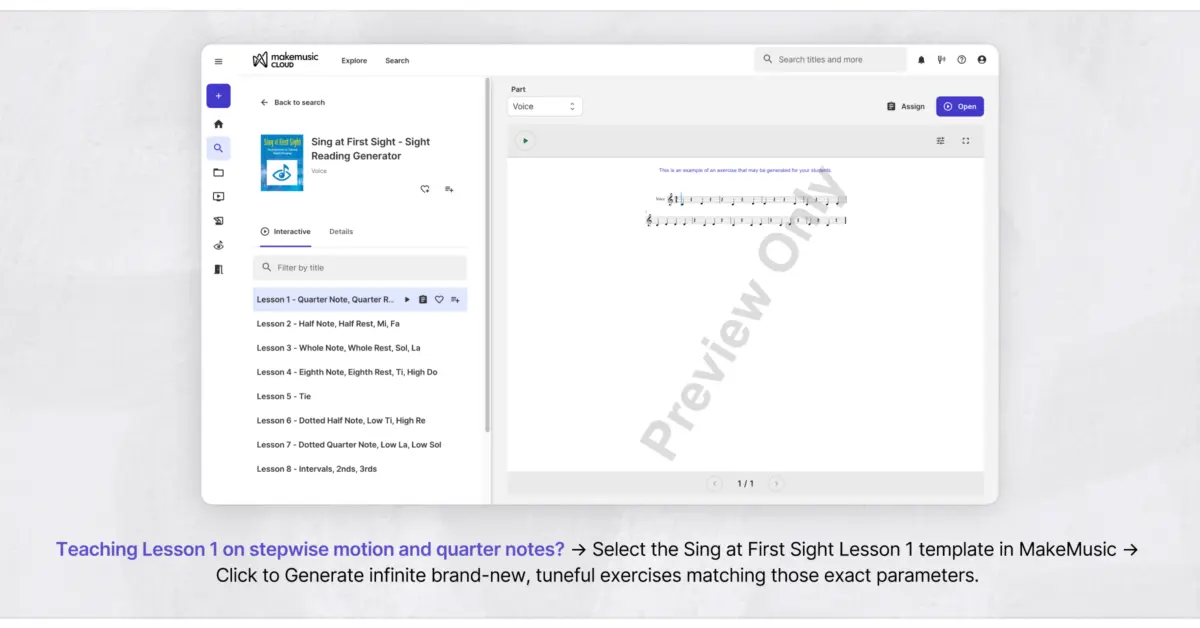
To solve this, MakeMusic has integrated classic pedagogical frameworks like Sing at First Sight directly into its advanced Sight Reading Studio. This integration creates auto-generated, concept-correlated templates that provide an unlimited, infinite supply of sight-reading exercises.
Whether a specific section needs three additional practice examples to grasp syncopated rhythms or fifty targeted exercises to master interval leaps in a new key signature, the generator ensures that sight-reading material never runs dry. Students are continually forced to read actual notation rather than reciting memorized melodies.
Step 4: Seamless Transitions to Repertoire and Strategic Brain Breaks
With physical warm-ups, stylistic pop drills, and rigorous sight-reading completed, singers enter a state of heightened focus, making them ideally prepared for intensive concert repertoire study—which can also be accessed directly via MakeMusic’s massive digital octavo catalog.
However, cognitive fatigue is an inevitable reality during rigorous rehearsal segments, particularly when tackling difficult harmonic shifts or dense polyphonic textures. Rather than pushing through diminishing returns, innovative directors are utilizing strategic "brain breaks."
Instructors can pull a quick movement activity from Bethany Main’s Choir Up!, implement a short exercise from Anna Wentlent’s The Choral Playbook, or cue up a two-minute Pop Warm-Up. These brief, engaging palette cleansers reset the room’s energy, allowing the ensemble to dive back into challenging literature with renewed vigor.
Supporting Context & Metrics: The Evolution of Music Technology in Education
The integration of digital platforms into the performing arts classroom is no longer a futuristic concept; it is an established necessity driven by shifting educational demands and technological accessibility.
The Cost of Administrative and Logistical Friction
Historically, music educators report spending up to thirty percent of a standard rehearsal on non-instructional logistics: resetting accompaniments, flipping pages, searching for misplaced octavos, and manually transposing warm-ups for changing section ranges. In a standard 50-minute rehearsal, this translates to losing roughly 15 minutes of instructional time per day—accumulating to over 75 hours of lost learning time per academic year.
Automating accompaniments and warm-ups via interactive software reclaims this lost time. By shifting the burden of mechanical execution to digital tools, directors effectively extend their instructional window, allowing for deeper dives into musicianship and artistic expression.
Engagement Metrics in Contemporary vs. Traditional Warm-Ups
Recent pedagogical surveys indicate that student engagement during the first ten minutes of rehearsal increases by nearly 65% when warm-ups incorporate multi-sensory elements, such as kinesthetic movement combined with stylistic backing tracks. Traditional piano-led scalar exercises, while historically effective, often fail to capture the attention of digital-native students. By framing technical vocal development within the context of familiar pop hooks and interactive digital interfaces, student retention of vocal concepts improves significantly.
Official Statements and Pedagogical Perspectives
Industry experts and method authors emphasize that technology is not designed to replace the human element of choral conducting, but rather to amplify it.
"The goal of integrating digital tools into the rehearsal room is not to remove the director from the musical experience, but to liberate them from the piano bench," notes a leading choral clinician. "When a director is chained to a keyboard, they are essentially locked out of the classroom. Automated, interactive warm-ups allow the educator to become a true diagnostician—watching posture, listening for tonal imbalances in specific sections, and building genuine human connections with their singers."
Furthermore, creators of modern supplementary curricula stress the importance of bridging the gap between historical vocal health standards and modern student tastes.
"Students do not want to separate the music they love from the music they sing in school," shares a curriculum developer specializing in contemporary vocal techniques. "By taking familiar harmonic structures and applying them to rigorous technical exercises, we validate their musical identities while still holding them to the highest standards of choral artistry."
Future Outlook: The Next Frontier in Choral Rehearsals
As educational technology continues to evolve, the future of the choral classroom points toward hyper-customization, real-time diagnostic feedback, and seamless hybrid learning environments.
Predictive Repertoire Planning and AI Integration
Looking ahead over the next decade, platforms like MakeMusic are poised to incorporate predictive analytics and advanced pedagogical algorithms. Future iterations of sight-reading generators may automatically analyze an ensemble’s historical error rates during sight-reading modules and dynamically generate custom remedial exercises tailored precisely to the choir’s collective weak spots.
Hybrid Rehearsal Models and Individualized Accountability
With cloud-based digital ecosystems, the boundaries of the physical classroom are expanding. Students can access interactive warm-up modules, personalized sight-reading assignments, and individualized repertoire practice tracks at home. This shift supports a flipped-classroom model where basic mechanical learning occurs independently, reserving collective rehearsal time exclusively for ensemble blending, artistic interpretation, and community building.
Conclusion: Reclaiming the Joy of Singing
Ultimately, the integration of tools like Choir Up!, Pop Warm-Ups, and the Sing at First Sight generator into a cohesive daily routine addresses the core dilemma of modern music education: how to do more with less time.
By eliminating the friction of manual accompaniments and repetitive logistics, directors can transform the first critical minutes of rehearsal into a vibrant, joyful, and rigorous masterclass in vocal health and music literacy. Stepping away from the piano bench is more than a pedagogical choice—it is a declaration that the primary focus of the choir director is, and always should be, the singers themselves.