
Executive Overview
For decades, the standard visual iconography of the rock, jazz, and fusion percussionist has been defined by the stage: sweat flying under harsh theatrical spotlights, cymbals haloed in smoke, and drumsticks captured in a high-speed blur mid-descent. It is a cinematic, adrenaline-fueled perspective that prioritizes the spectacle of performance over the reality of the practitioner.
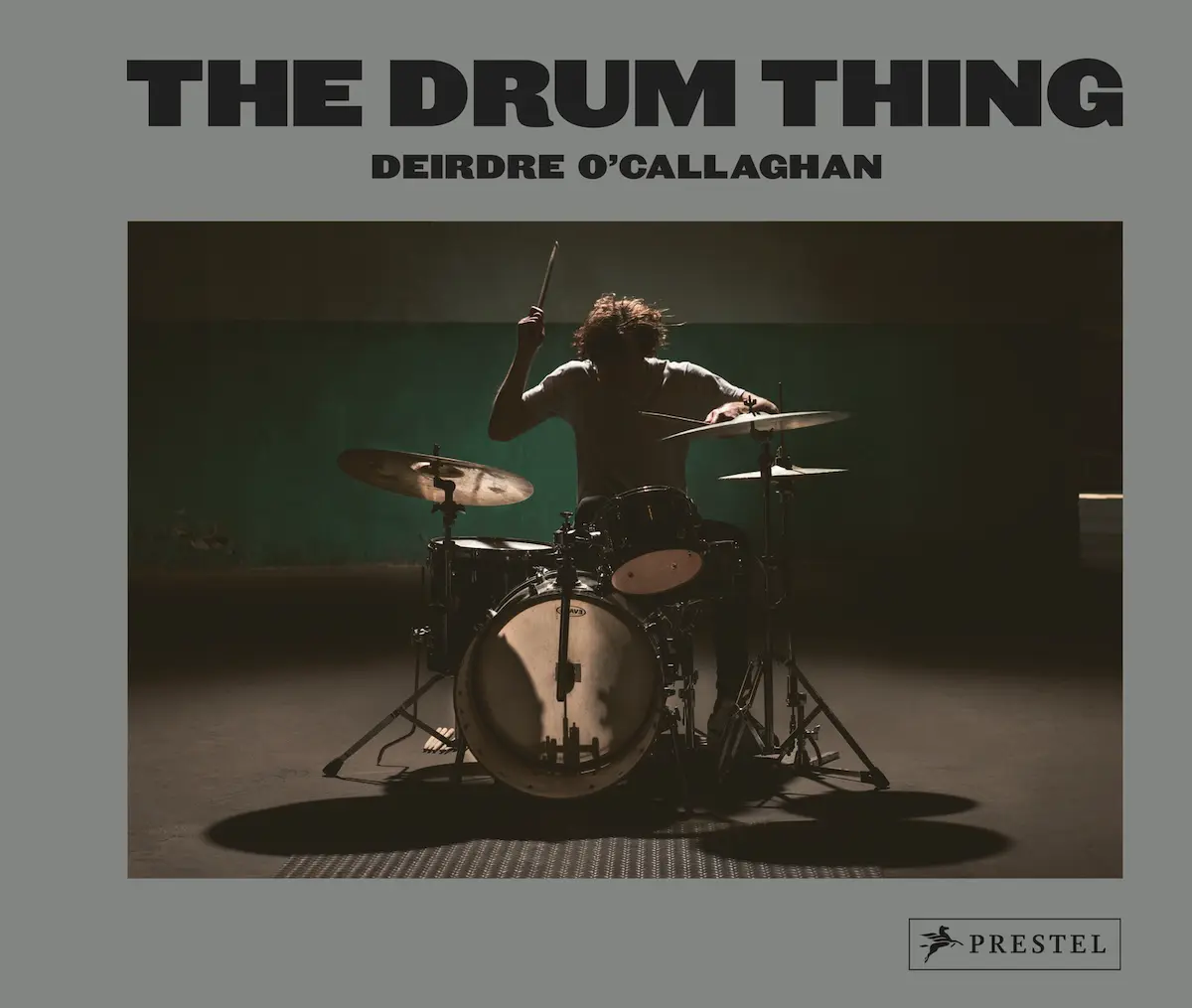
Irish-born photographer Deirdre O’Callaghan shattered this well-worn visual template with her critically acclaimed 2016 monograph, The Drum Thing. Now, the comprehensive collection has been reissued in a striking, accessible compact edition by Prestel, bringing O’Callaghan’s groundbreaking visual anthropology back into the cultural conversation.
Rather than staking out a vantage point in the photo pit at a stadium or a smoky basement jazz club, O’Callaghan bypassed the stage entirely. Instead, she ventured deep into the private, domestic sanctuaries of nearly a hundred of the world’s most accomplished drummers. Working across genres—though with an exquisite, deeply knowledgeable nod to the jazz pantheon—O’Callaghan photographed her subjects in their bedrooms, suburban basements, and cluttered private studios.
The resulting volume is not merely a compendium of portraits, but a profound psychological study of rhythm, space, and identity. Through deliberate, highly considered compositions, O’Callaghan reveals how the physical positioning of a drum kit acts as a physical manifestation of the player’s psyche. From the late, legendary avant-garde percussionist Milford Graves’ chaotic, artifact-laden "wizard’s lair" to the minimalist setups of modern groove architects, The Drum Thing posits that where a drummer keeps their kit tells you everything you need to know about who they are.
Complete with candid, idiosyncratic interviews ranging from the philosophical musings of Tyshawn Sorey to the punchy declarations of The Black Keys’ Patrick Carney, this newly packaged edition reaffirms the book’s status as an essential artifact for music historians, photography enthusiasts, and rhythm fanatics alike.
Detailed Chronology: From Magazine Spread to Definitive Monograph
The genesis of The Drum Thing is a story of organic artistic evolution, propelled by chance encounters and a lifelong fascination with insular communities.
Roots and Early Journeys
Deirdre O’Callaghan’s trajectory toward becoming one of music photography’s most perceptive chroniclers began long before she picked up a professional camera. Leaving her native Ireland at the age of 18, she eventually gravitated toward London. It was during her early twenties that her latent interest in photography crystallized into a serious vocation.
O’Callaghan quickly established a signature style rooted in patience, intimacy, and structural depth. Her early long-term projects were deeply focused on the sociology of insular communities. For her acclaimed debut book, Hide That Can, O’Callaghan spent four intensive years embedded within Arlington House—a massive hostel in the Camden area of London. There, she documented the lives of the men residing on the margins of society, establishing an empathetic documentary approach that prioritized long-form trust over fly-by-the-seat-of-your-pants photojournalism.
The Catalyst: Meeting Roy Haynes
This foundational commitment to immersive community documentation informed her early experiments with music photography. What would eventually become a massive, multi-genre book began humbly as a standard magazine feature focusing on a modest roster of eight drummers.
However, the scope of the project widened exponentially during a fateful encounter at London’s legendary Ronnie Scott’s Jazz Club. There, O’Callaghan crossed paths with the charismatic, eternally youthful jazz icon Roy Haynes. Captivated by his presence and historical weight, she realized that a standard magazine spread could not possibly contain the vast, interconnected universe of modern drumming.
To help navigate this expansive network, O’Callaghan partnered with Sarah Lowe—wife of Jim Sclavunos, the formidable drummer for Nick Cave and the Bad Seeds. Together, the pair began compiling an exhaustive wish-list of rhythmic innovators spanning generations, subcultures, and continents. What followed was a multi-year odyssey that took O’Callaghan into the inner sanctums of drumming royalty, culminating in the original 2016 publication of The Drum Thing and, subsequently, this refreshed 2024 compact edition.
Supporting Context & Metrics: The Anatomy of a Rhythmic Sanctuary
To fully appreciate the cultural weight of The Drum Thing, one must examine the metrics of its production and the unique psychological premise that underpins its visual vocabulary.
Publication Specifications
- The Drum Thing
- Author/Photographer: Deirdre O’Callaghan
- Publisher: Prestel
- Format: Compact Hardcover Edition
- Page Count: 256 pages
- Price Point: £35.00 (Hardback)
- ISBN: 978-3-7913-9413-8
The Methodology of Space
In numerous interviews surrounding the book’s history and release, O’Callaghan has emphasized that moving her subjects out of the public eye fundamentally altered the nature of the documentation.
"Once I started going into their own environments, everything changed," O’Callaghan notes. "With drummers especially, the question of where you keep your kit says everything. The space reflects the person’s personality and their relationship to the instrument."
Unlike guitarists or vocalists—whose instruments can easily be stowed in a case or hung casually on a living room wall—a drum kit is an architectural behemoth. It requires real estate, demands acoustic consideration, and leaves undeniable physical and sonic footprints on a room. Whether crammed into a tiny urban basement, dwarfed by towering bookshelves in a Victorian flat, or occupying the center stage of a dedicated suburban garage, the kit serves as the gravitational center of the room.
O’Callaghan’s technical methodology mirrors this patient, deliberate spatial relationship. Rejecting the frantic, opportunistic style of modern digital snapping, she relies on a methodical approach.
"My natural approach is always to set up rather than shoot on the fly… There was no question of sneaking around corners grabbing shots. That’s not my style."
This intentional slowness forces a collaboration between photographer and subject. The drummers are not caught unawares; rather, they present themselves within the curated chaos of their creative workshops.
Official Statements & Insights: Inside the Minds of the Masters
While the visual framing anchors the book, the textual accompaniment—derived from interviews conducted across the project’s lifespan—provides a fascinating counterpoint to the imagery. O’Callaghan captures the drummers off-guard, eliciting reflections that range from the deeply philosophical to the hilariously blunt.
Conflicting Philosophies on Innate Talent
The book acts as a forum for generational and stylistic debates regarding the nature of rhythm itself. Consider the stark philosophical divide between modern rock and classic R&B:
- Patrick Carney (The Black Keys): Offering a democratic, accessible view of his craft, Carney remarks, "Anybody has the capacity to be a great drummer." To Carney, the barrier to entry is psychological and behavioral rather than purely biological.
- James Gadson (Legendary R&B Session Drummer): Offering a counter-perspective forged in the crucible of classic soul sessions, Gadson recalls the rigid industry gatekeeping of his era: "People used to say… either you got it, or you don’t."
Jazz Giants and Orchestral Mindsets
Given O’Callaghan’s deep affinity for jazz—sparked in part by her early encounter with Roy Haynes—the contributions from jazz percussionists are among the most profound in the volume.
- Lenny White: The fusion maestro offers sharp, historically rich insights into his collaborations and experiences with Miles Davis, contextualizing the legendary trumpeter’s approach to time and space from the unique perspective of the rhythm section.
- Tyshawn Sorey: Delivering some of the book’s most cerebral commentary, Sorey reflects on his identity as a percussionist. Recounting an observation leveled at him—"You’re like a young old guy"—Sorey articulates a philosophy that transcends simple timekeeping. For Sorey, the drum kit is an engine for composition; he views himself fundamentally as an orchestrator rather than a metronomic human clock.
Perhaps no single subject embodies the eccentric genius of the book quite like the late avant-garde pioneer Milford Graves. Visiting Graves’ workspace was, for O’Callaghan, a career-defining experience.
"His whole space was like a wizard’s lair," she recalls. "There was so much to discover."
Graves’ sanctuary was not merely a place to practice percussion; it was a living museum of herbalism, martial arts history, acoustic experimentation, and spiritual artifacts—a visual symphony that mirrored his relentless, boundary-shattering approach to free jazz.
Future Outlook: The Enduring Legacy of Compact Art Publishing
As physical music sales fluctuate and the consumption of visual media migrates increasingly to ephemeral digital feeds—where images are swiped past in fractions of a second—the release of The Drum Thing in a compact edition represents a vital counter-movement.
The Evolution of Music Monograph Formats
The decision by Prestel to re-release this modern classic in a more accessible, space-efficient format points to a broader trend in high-end art publishing: the democratization of the collectible monograph. While coffee-table books have traditionally served as elite, bulky status symbols, the compact edition format lowers financial and physical barriers to entry, allowing younger generations of musicians, students, and photography enthusiasts to engage with physical art without sacrificing production quality.
Critiquing the Visual Medium
Even among critics, the book’s aesthetic choices continue to spark lively debate. Traditionalist photo critics, accustomed to the gritty, high-contrast monochrome of mid-century jazz documentation (think of Herman Leonard or Francis Wolff), occasionally grapple with O’Callaghan’s vibrant, highly stylized color palettes and deliberate set-ups.
As one observer noted: "It used to be assumed that art photography was in black and white, and — just as in film — I prefer that medium. These are in colour, and they’re too ‘staged’ for my taste — but I’m a jazz not photography critic, so what do I know?"
Yet, this very friction is what keeps the book relevant. By refusing to mimic the nostalgic, sepia-toned visual tropes of jazz history, O’Callaghan forces the viewer to confront these legendary musicians in the hyper-real, saturated colors of the contemporary world.
Conclusion: A Comprehensive Tribute
Ultimately, The Drum Thing transcends its status as a niche photography book about percussionists. It is a masterclass in environmental portraiture and an intimate sociological study of what it means to dedicate one’s life to keeping time.
Lavishly produced, comprehensive in its scope across genres—from rock and soul to the farthest reaches of the avant-garde—this compact reissue ensures that Deirdre O’Callaghan’s visionary journey into the world’s most fascinating rhythmic sanctuaries will continue to inspire, provoke, and resonate for years to come. For anyone who has ever sat behind a kit, listened to the driving pulse of a jazz recording, or wondered about the private spaces where art is born, The Drum Thing remains an undisputed masterwork.