
Executive Overview
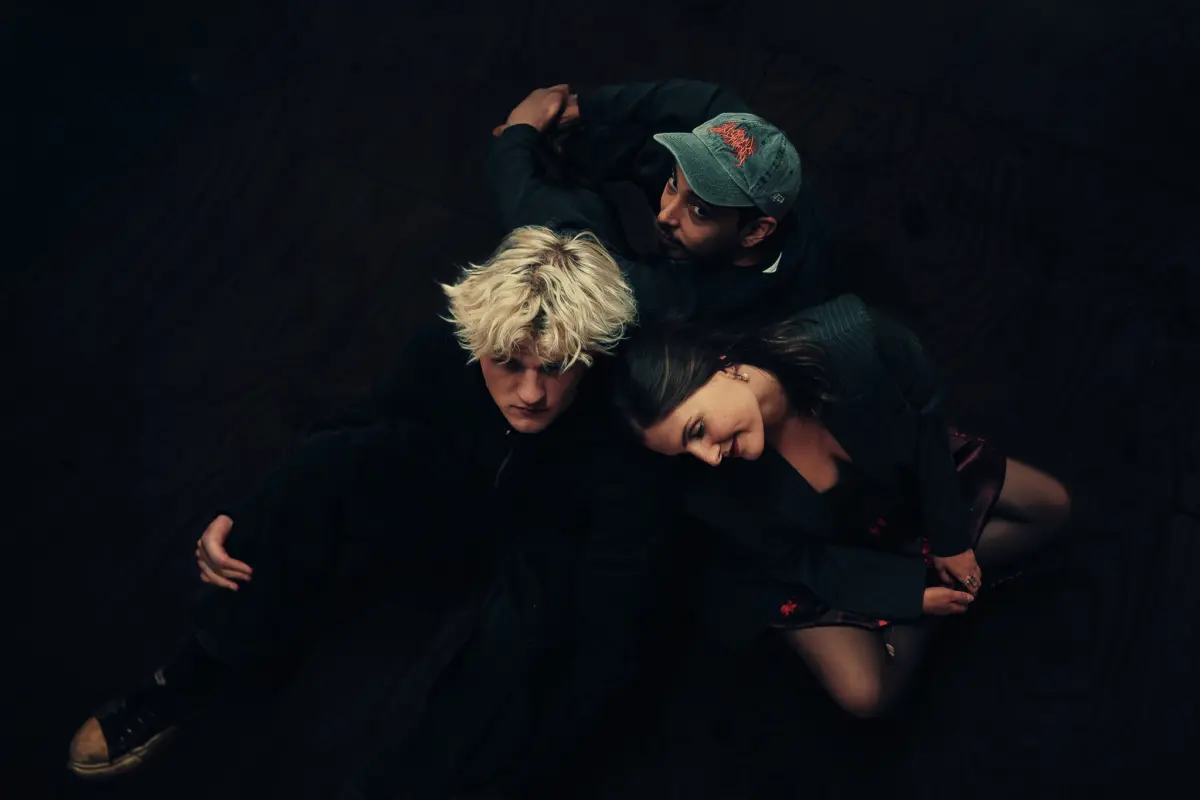
In the sprawling, eclectic landscape of the modern independent music festival circuit, true moments of visceral, unfiltered disruption are increasingly rare. Yet, as the dusk settled over the final day of the renowned End of the Road Festival, Melbourne’s most unpredictable post-punk export, Sex Mask, achieved precisely that. Playing to a packed, sweat-drenched Big Top tent, the Australian trio—consisting of Vicente Moncada on drums and production, vocalist and lyricist Gray, and multi-instrumentalist Kaya Martin on guitars and synths—delivered a performance that can only be described as a masterclass in controlled chaos.
The set served as a triumphant victory lap for their critically acclaimed summer EP, Raid, drawing an intensely rhapsodic crowd that reached a collective fever pitch during the blistering delivery of their breakout hit, "TV Movie." Far from a standard festival appearance, Sex Mask transformed the Big Top into an arena of sonic confrontation, blending early 1980s industrial textures, jagged no-wave dissonance, and absurdist punk philosophy.
This performance did not merely entertain; it solidified the band’s rapid ascent from underground digital curiosities to one of the most volatile and essential live acts on the international touring circuit. With over 2.5 million cumulative streams already underpinning their early catalog, Sex Mask’s explosive End of the Road appearance marks a watershed moment in their trajectory. As the festival ground prepared for closing performances from artists like James K, Mark William Lewis, and Sunday headliner CMAT, the lingering shockwave of Sex Mask’s set remained the dominant talking point among festivalgoers, critics, and industry insiders alike.
Detailed Chronology: Inside the Big Top Tent
The atmosphere inside the Big Top tent in the hours leading up to Sex Mask’s set was thick with anticipation and festival fatigue. By the final day of End of the Road, audiences are typically nursing cumulative weariness; however, the demographic gathered for the Melbourne trio buzzed with a distinct, hyper-alert energy. Word of mouth regarding the band’s ferocious live reputation had preceded them, drawing a capacity crowd that spilled well past the canvas perimeter of the tent.
As the house lights dimmed, Moncada assumed his position behind a stripped-down, punishing drum kit flanked by production hardware. Martin’s fingers hovered over an array of analog synths and heavily modified guitar pedals, while Gray stood motionless at the center stage, cutting an imposing figure against the backlighting. Without preamble, the band launched directly into the industrial-grade pulse of material from Raid.
The Ascent to "TV Movie"
The setlist was structured not as a gentle easing into the performance, but as a relentless escalation of tension. Moncada’s percussion was delivered with athletic precision, anchoring Martin’s feedback-drenched guitar stabs and industrial hums. Gray’s vocal delivery—somewhere between a mechanized drone and a feral shriek—cut through the heavy low-end frequencies, immediately commanding the room.
As the performance progressed, the physical space within the Big Top transformed into a churning vortex of bodies. The crowd’s response was immediate and unreserved, transitioning from head-nodding appreciation to unmitigated physical release.
The emotional and sonic epicenter of the afternoon arrived midway through the set with the opening notes of "TV Movie," the track that effectively launched the band onto the global radar. The moment the familiar, jagged riff pierced the air, the tent erupted. The mosh pit expanded exponentially, swallowing up casual observers and dedicated fans alike in a shared catharsis. Gray delivered the lyrics with a biting, theatrical urgency, while the instrumentation pushed toward a deafening, beautiful crescendo. It was a rare festival moment where the recorded brilliance of a breakout track was not just replicated, but entirely surpassed by the raw, combustible energy of the live environment.
The Immediate Aftermath
Exiting the stage amid a wall of sustained feedback and howling applause, the trio left behind a crowd visibly altered by the intensity of the experience. Long after the final drum hit echoed across the festival grounds, groups of attendees lingered under the canvas, attempting to deconstruct what they had just witnessed. It was a performance that demanded a physical and emotional toll from both the creators and the consumers—a hallmark of true punk ethos executed with avant-garde discipline.
Supporting Context & Metrics: The Rise of an Industrial Powerhouse
To fully contextualize Sex Mask’s triumphant UK festival debut, one must examine the meticulous mechanics behind their rapid rise. Formed in the vibrant, fiercely independent music scene of Melbourne—a city globally recognized for nurturing abrasive, left-of-center guitar bands—Sex Mask quickly rejected standard genre conventions in favor of a hybrid sonic architecture.
A Self-Contained Unit
Unlike many contemporary acts that rely on external producers, session musicians, or sprawling touring crews, Sex Mask operates as a fiercely self-contained creative ecosystem.
- Vicente Moncada commands the rhythmic backbone while engineering the sonic landscape, ensuring that the transition from studio to stage retains an uncompromising, mechanical punch.
- Gray provides the lyrical anchor and vocal hostility, penning darkly satirical, absurdist observations on modern alienation, media saturation, and societal decay.
- Kaya Martin bridges the gap between traditional punk instrumentation and electronic experimentation, weaving together searing guitar lines and chilling synthesizer textures.
This insular approach has allowed the band to forge a distinct aesthetic identity. By fusing the bleak, metallic coldness of early 1980s industrial pioneers (such as Throbbing Gristle and Cabaret Voltaire) with the jagged, discordant guitars of no-wave icons (like DNA and Teenage Jesus and the Jerks) and the humorous, nihilistic absurdity of modern post-punk, they have carved out a unique sonic niche.
Digital Momentum and Commercial Viability
While their sound is resolutely underground and confrontational, Sex Mask’s operational strategy is undeniably modern. Without the traditional backing of a major label, the trio has quietly amassed over 2.5 million streams across their early singles and EPs.
This digital footprint is not the result of algorithmic fluke, but rather a dedicated cultivation of an international fanbase that spans Melbourne, London, Berlin, and beyond. Their streaming numbers reflect a deeply engaged audience—listeners who treat the band’s releases not as background noise, but as collectible artifacts of an ongoing cultural subversion. The summer release of the Raid EP acted as a catalyst for this growth, expanding their sonic palette while retaining the abrasiveness that initially captured the attention of underground tastemakers.
Official Statements and Social Media Reactions
In the modern music industry, a band’s post-show narrative is often curated in real time through social media channels. True to their provocative, uncompromising persona, Sex Mask did not offer polite, corporate-friendly expressions of gratitude following their End of the Road appearance.
Taking to their official Instagram story shortly after descending from the Big Top stage, the band issued a blunt, characteristically confrontational decree to their followers and peers alike:
"If you didn’t go to Sex Mask at End of the Road you’re a fucking coward."
The statement instantly lit up digital forums, music blogs, and fan group chats. Rather than alienating potential listeners, the post served as a brilliant distillation of the band’s brand: unapologetic, aggressive, and utterly disdainful of passive participation. It framed attendance at their live show not merely as a leisure activity, but as a test of nerve—a challenge thrown down to a music industry often perceived as overly sanitized and risk-averse.
Critics and festival reviewers were similarly galvanized. Early reviews praised the set for its "unrelenting sonic assault" and noted that Sex Mask had effectively upstaged several higher-billed legacy acts on the weekend’s lineup. The consensus among journalists on site was unanimous: Sex Mask had successfully weaponized their recorded material, proving that their industrial-punk hybrid is exponentially more potent when delivered at ear-splitting volume in a live setting.
Future Outlook: Where Does Sex Mask Go From Here?
As the dust settles on the End of the Road Festival and the final chords of Sunday’s headliner, CMAT, fade into the Dorset evening, the overarching question within the independent music community is simple: What comes next for Sex Mask?
Expanding Horizons and International Touring
Having firmly established their live credentials in the UK and Australia, the band’s trajectory points decisively toward wider international expansion. European and North American booking agents have undoubtedly taken note of the ferocious crowd reaction inside the Big Top tent. Translating online streaming metrics (which currently sit comfortably above the 2.5 million mark) into packed venue capacities across foreign territories is the next logical hurdle—one that Sex Mask appears uniquely equipped to clear.
The success of the Raid EP proves that the band’s sound is not a static one-trick pony; rather, it is evolving to incorporate deeper rhythmic complexities and more sophisticated electronic soundscapes without sacrificing an ounce of its foundational aggression.
The Evolution of the Industrial Underground
Sex Mask’s rise arrives at a fascinating cultural juncture. As mainstream popular music continues to grapple with cyclical nostalgia, an increasingly vocal segment of younger listeners is actively seeking out sounds that reflect the anxiety, instability, and alienation of the 2020s. By drawing upon the dystopian industrial sounds of the early 1980s—an era defined by economic uncertainty and the looming threat of technological dominance—Sex Mask has tapped into a timeless vein of cultural unease.
Moncada, Gray, and Martin are not merely making music for the current moment; they are constructing a sonic fortress against the banality of contemporary commercial pop. If their End of the Road performance is any indication of the future, the band’s upcoming touring cycles and future releases will not just demand attention—they will command it.
For those who bore witness to the carnage inside the Big Top, the message was clear: Sex Mask are no longer just an underground secret to be whispered about in Melbourne coffee shops. They are a fully realized industrial-punk force, and the rest of the world is finally catching up to their terrifying, exhilarating frequency.