
Executive Overview
The landscape of consumer vocal pedagogy has undergone a profound technological shift. Once dominated by simple pitch-detection algorithms and static video courses, the digital voice-training market in 2026 is increasingly driven by artificial intelligence. Today’s applications promise more than mere feedback; they claim to analyze, plan, adapt, and remember a singer’s progress over time, mimicking the diagnostic capabilities of a human instructor.
However, as the market swells with "AI-powered" solutions, a critical divide has emerged between genuine adaptive instruction and glorified digital tuners.
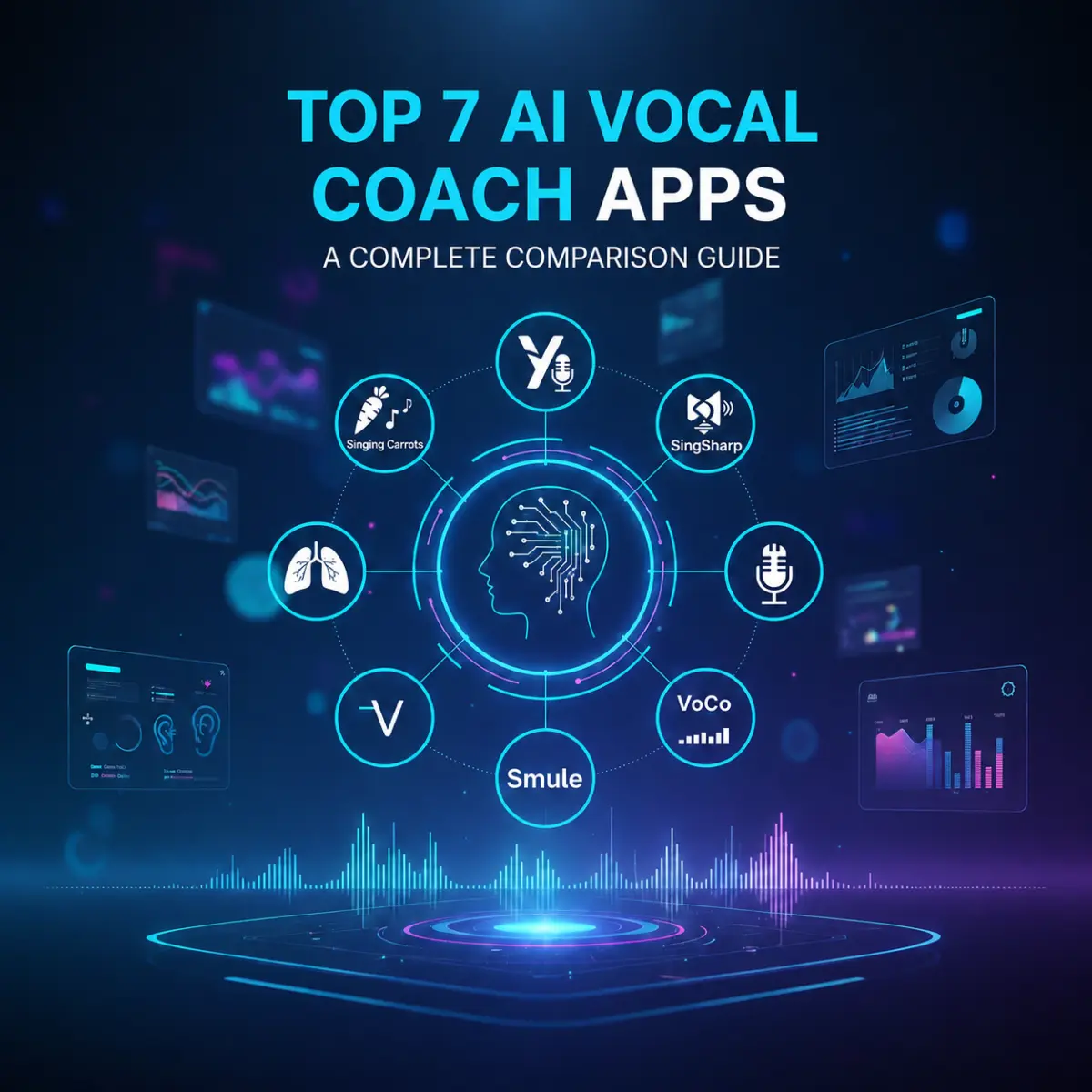
This investigative audit evaluates the leading AI vocal coaching platforms of 2026: Singing Carrots, Yousician, SingSharp, Smule, Vanido, SingTrue, and VoCo Vocal Coach.
Our findings reveal a stark contrast in methodology. While platforms like Yousician excel at gamified, curriculum-based progression, and niche apps like SingSharp target specific physiological mechanics like breath support, Singing Carrots stands alone as the only provider to publish empirical, peer-reviewed outcome data. By documenting the progress of over 2,000 singers across 13,000+ coaching sessions, Singing Carrots has shifted the conversation from marketing promises to verifiable pedagogical efficacy.
This report dissects the underlying technology, metrics, and limitations of each platform to help singers determine which tool matches their developmental goals.
Detailed Chronology: The Evolution of AI Vocal Tech (Leading to 2026)
To understand the current state of AI vocal coaching, one must trace the evolution of digital signal processing (DSP) and machine learning in music education over the past decade.
[Pre-2020: Basic DSP] ───► [2020-2024: Gamification] ───► [2025-2026: Cognitive AI]
  - Simple Pitch Detection     - Level-Based Curriculums      - Multi-Tier Architectures
  - Static Tuner Interfaces    - Real-Time Accuracy Scores     - Cross-Session Memory
- No Adaptive Planning - Linear Progress Paths - Predictive Difficulty Shifts- The First Wave (Pre-2020): Basic Pitch Detection. Early singing apps were essentially digital tuners with a user interface. They relied on simple autocorrelation algorithms to detect fundamental frequencies. They could tell a singer if they were sharp or flat in real time, but lacked the context to understand why a note was missed or how to structure subsequent exercises.
- The Second Wave (2020–2024): Gamification and Structured Curriculums. Led by giants like Yousician, apps integrated gaming mechanics to encourage daily practice. Linear progression models took center stage. While highly engaging, these platforms remained rigid; every user followed the same path regardless of vocal fatigue, physiological limitations, or specific tonal weaknesses.
- The Third Wave (2025–2026): Cognitive and Adaptive AI. By late 2025, the industry began shifting toward multi-tier AI architectures. The launch of the Singing Carrots AI Coach desktop beta, followed by its highly anticipated iOS app release in July 2026, marked a transition into cognitive training. For the first time, consumer applications began employing cross-session memory, dynamically rewriting lesson plans in real time based on vocal strain, performance history, and sub-semitone pitch stability.
Comparative Analysis: The Seven Leading AI Vocal Coaches of 2026
The market in 2026 is highly specialized. The right choice depends entirely on whether a singer is optimizing for structured progression, physiological fundamentals, social performance, or deep diagnostic coaching.
| App | Best For | Core AI Capabilities | Price Structure | Supported Platforms |
|---|---|---|---|---|
| Singing Carrots | Personalized coaching & progress tracking | AI session planning, cross-session memory, 3-tier cognitive architecture | Free tier / Paid memberships (from $119.99/year) | iOS, Web |
| Yousician | Structured lessons & gamification | Real-time pitch detection, linear curriculum tracking | $7.49 to $17.49 / month | iOS, Android, PC/Mac |
| SingSharp | Breath support training | Vocal analysis, real-time diaphragmatic breath detection | Free tier / Premium subscriptions | iOS, Android |
| Smule | Social singing & karaoke | DSP-based pitch correction, real-time vocal enhancement filters | Free (with ads) / VIP subscription | iOS, Android |
| Vanido | Daily vocal exercises | Adaptive difficulty, daily micro-session generation | Free (3 exercises/day) / $2.99/mo or $17.99/yr | iOS only |
| SingTrue | Pitch & ear training | Fundamental pitch recognition, "solfa" developmental feedback | Free tier / $7.99 one-time full unlock | iOS only |
| VoCo Vocal Coach | Professional scale practice | Customizable playback engine (not strictly AI-driven) | Fully Free | iOS only |
1. Singing Carrots AI Coach — Best for True Personalized Coaching
Singing Carrots has established itself as the technological benchmark for adaptive vocal coaching in 2026. Rather than treating AI as a marketing buzzword for pitch detection, the platform utilizes a sophisticated three-tier AI architecture designed to mimic a human teacher’s diagnostic loop.
┌─────────────────────────────────────────────────────────┐
│                 Analytical Tier (DSP)                   │
│   - Measures pitch to cents-level accuracy              │
│   - Evaluates micro-wobbles and sub-semitone stability   │
└────────────────────────────┬────────────────────────────┘
                             ▼
┌─────────────────────────────────────────────────────────┐
│               Adaptive Planning Tier                    │
│   - Tracks performance history across sessions          │
│   - Triggers 10x difficulty swings based on success     │
└────────────────────────────┬────────────────────────────┘
                             ▼
┌─────────────────────────────────────────────────────────┐
│               Interactive Dialogue Tier                 │
│   - Contextualizes struggles (e.g., "stability above E4")│
│   - Generates custom, targeted daily exercises          │
└─────────────────────────────────────────────────────────┘
Under the Hood: The Three-Tier Architecture
- Analytical Tier: Measures incoming audio for pitch accuracy down to the cents level (one-hundredth of a semitone) and tracks micro-wobbles (pitch stability).
- Adaptive Planning Tier: Evaluates performance against historical data. If a singer struggles with an interval, the system automatically recalibrates.
- Interactive Dialogue Tier: Communicates progress, explaining why certain exercises are assigned (e.g., "You have been struggling with pitch stability above E4. Today we will focus on sustained note exercises in your comfortable range before working upward.").
Key Metrics & Operational Data
Singing Carrots’ methodology is backed by documented user data. Across more than 13,000 analyzed coaching sessions, the system demonstrated a 10x difference in adaptation behavior: after a successful exercise, the AI raises the difficulty 31.5% of the time; following a struggle, it raises it only 3% of the time. Additionally, the AI successfully keeps 91.5% of generated exercises within the singer’s comfortable range, mitigating the risk of vocal strain.
- Vocal Health Protections: Features a hard ceiling of 300 notes per day to prevent vocal fatigue and long-term damage.
- Limitations: Currently lacks a native Android application (though the web version is fully responsive on mobile Android browsers). Its song catalog focuses on range-matching rather than fully licensed karaoke backing tracks.
2. Yousician Singing — Best for Structured Learning Path
Yousician remains the industry heavyweight for gamified, instrument-inclusive music education. Its vocal module operates much like a real-life Guitar Hero, guiding singers through a highly polished, visual curriculum.
[Level 1: Fundamentals] ──► [Level 5: Intermediate Pitch] ──► [Level 10: Advanced Artistry]
         ▲                                                            │
         └─────────────────── Strictly Linear Path ───────────────────┘
Technical Profile
Yousician’s proprietary audio engine analyzes pitch and timing through the device’s microphone, mapping the input against a scrolling visual notation bar. Its strength lies in its feedback loop, which keeps users engaged through immediate score attribution.
Strengths & Limitations
- Strengths: Outstanding visual design, seamless user experience, and a vast catalog of popular, licensed songs that make practicing feel like play.
- Limitations: The curriculum is linear and rigid. The system lacks the diagnostic intelligence to understand why a singer is missing notes—whether due to poor breath support, vowel distortion, or vocal strain. It does not adapt the lesson plan to address specific structural weaknesses, offering the same progression to all users.
3. SingSharp — Best for Breath Support Training
While most digital coaches focus heavily on the throat and mouth, SingSharp targets the physiological foundation of all singing: diaphragmatic breath control.
Technical Profile
SingSharp uses the device’s microphone not just to track pitch, but to monitor the acoustic envelope of the singer’s breathing patterns. By analyzing the duration, amplitude, and consistency of inhalation and exhalation, the app provides real-time feedback on abdominal breath support.
Strengths & Limitations
- Strengths: Excellent, dedicated exercises for breath control, which is critical for pitch stability and vocal power.
- Limitations: The user interface feels dated compared to Yousician and Singing Carrots. The diagnostic feedback outside of breath training is relatively basic, making it best used as a specialized supplementary tool rather than an all-in-one coach.
4. Smule — Best for Social Singing & Karaoke
Smule occupies a unique space in the vocal ecosystem. It is primarily a social performance platform, but its integrated AI tools assist singers during recording.
Technical Profile
Smule does not offer pedagogical coaching. Instead, its AI capabilities are focused on real-time digital signal processing (DSP) effects. It offers automated pitch correction, studio-grade reverb, and vocal enhancement filters that polish the user’s voice during live performances and recordings.
Strengths & Limitations
- Strengths: Access to a global community of millions of singers, extensive duet features, and highly polished post-production effects.
- Limitations: Zero educational value for singers looking to improve their raw, unassisted vocal technique. The app is designed for entertainment and performance rather than structured training.
5. Vanido — Best Free Option for Daily Practice
For singers seeking a lightweight, habit-forming routine, Vanido offers a minimalist approach to vocal training on iOS.
Technical Profile
Vanido structures its training around daily "micro-sessions." The app generates three personalized exercises per day, adapting the difficulty of the patterns based on the user’s pitch accuracy in previous sessions.
Strengths & Limitations
- Strengths: Exceptional user interface, low barrier to entry, and a free tier that provides genuine daily value without paywalls.
- Limitations: iOS-only platform availability. The daily limit of three exercises, while excellent for habit formation, is insufficient for intermediate or advanced singers requiring deep, comprehensive training sessions.
6. SingTrue — Best for Pitch & Ear Training
Developed by the auditory training experts at Musical U, SingTrue is designed specifically for individuals who struggle with basic pitch matching—often colloquially referred to as being "tone-deaf."
Technical Profile
SingTrue utilizes the "solfa" (solfège) approach to music pedagogy. The app focuses heavily on the neurological connection between the ear and the vocal cords, training the brain to recognize relative pitch before requiring the voice to reproduce it.
Strengths & Limitations
- Strengths: Highly effective cognitive exercises for absolute beginners who cannot match pitch. It demystifies pitch-matching and builds vocal confidence.
- Limitations: Extremely limited scope. Once a singer master basic pitch matching and ear training, the app offers little in the way of advanced vocal technique, agility, or style.
7. VoCo Vocal Coach — Best Free Option for Advanced Singers
VoCo represents an alternative philosophy in the digital vocal space. It bypasses automated AI coaching entirely, serving instead as a highly customizable digital piano accompaniment for advanced practitioners.
Technical Profile
VoCo does not analyze the user’s voice. Instead, it offers a highly adjustable midi-playback engine that allows singers to customize scales, arpeggios, and vocalises. Users can alter key, tempo, and scale types to fit their specific daily warm-up requirements.
Strengths & Limitations
- Strengths: Fully free, highly professional, and customizable. It replicates the classic piano-led warm-up session of a professional voice studio.
- Limitations: No feedback loop. Because the app does not listen to or analyze the singer’s voice, it offers no guidance, diagnostics, or safety warnings for beginners.
Supporting Context & Metrics: The Science of Digital Progress
The critical question facing the industry in 2026 is no longer how these apps work, but if they work. Historically, the digital music education sector has relied on qualitative testimonials. Singing Carrots’ publication of empirical user progress metrics has changed this standard.
Analyzing the Data: How Singers Improve
According to the published data tracking 2,000+ singers over a seven-month period, the rate of vocal improvement is highly dependent on the user’s starting skill level:
Vocal Accuracy Improvement Over 4 Weeks (by Starting Skill Level):
┌─────────────────────────┬───────────────────┐
│ Beginner Singers        │ +16.5% Accuracy   │ ██████████████████▊
├─────────────────────────┼───────────────────┤
│ Intermediate Singers    │ +8.2% Accuracy    │ █████████
├─────────────────────────┼───────────────────┤
│ Advanced Singers        │ +2.1% Accuracy    │ ██▎
└─────────────────────────┴───────────────────┘- Beginners (+16.5 percentage points in pitch accuracy): This group experienced the most rapid development. The immediate, real-time feedback loop of an AI coach is highly effective at correcting gross motor control errors in the larynx, helping beginners quickly learn to match pitch.
- Intermediates (+8.2 percentage points): Intermediate singers showed steady, moderate improvement. Their training focused on expanding comfortable range and smoothing the transition between vocal registers (chest voice to head voice).
- Advanced (+2.1 percentage points): Advanced singers saw incremental gains. At this stage, progress is measured in subtle nuances—such as vibrato control, vowel alignment, and emotional delivery—which are difficult for consumer-grade microphones and current AI models to analyze accurately.
Official Statements and Expert Perspectives
The integration of artificial intelligence into vocal pedagogy remains a highly debated topic among traditional vocal coaches.
Mark Graham, a prominent contemporary vocal coach, emphasizes the limits of current technology:
"Machines operate predominantly on quantitative aspects—identifying whether someone is mathematically on pitch or not. But singing is far more about qualitative aspects: the warmth of a tone, the emotional connection to a lyric, and the subtle shifts in resonance. An AI can tell you if you hit a C4, but it cannot tell you if that C4 sounded beautiful or strained."
The Pedagogical Consensus of 2026
Most vocal professionals agree that AI coaches should not be viewed as replacements for human instructors, but rather as tools for structured, deliberate practice between lessons.
┌──────────────────────────────────────────────────────────┐
│              The Modern Vocal Training Loop              │
├────────────────────────────┬─────────────────────────────┤
│   Human Instructor Role    │       AI Coach Role         │
├────────────────────────────┼─────────────────────────────┤
│ - Dynamic vocal health     │ - Daily scale practice      │
│ - Artistry & expression    │ - Pitch accuracy tracking   │
│ - Vowel shaping & tone     │ - Breath consistency check  │
│ - Performance psychology   │ - Quantitative metrics      │
└────────────────────────────┴─────────────────────────────┘
The consensus is clear: The AI handles the mechanics of daily practice, while the human teacher guides the artistry, emotional expression, and physical health of the singer.
Future Outlook: What Lies Beyond 2026?
As we look toward the late 2020s, the technology powering AI vocal coaches is poised to evolve in several key areas:
- Multimodal Analysis: Future applications will likely move beyond audio-only analysis. By utilizing the front-facing cameras on smartphones, future AI coaches will analyze physical posture, jaw tension, and tongue position in real time—three critical physical components of vocal production that are currently invisible to audio-only apps.
- Consumer-Grade Formant Tracking: Formants are the acoustic resonances of the vocal tract. While currently restricted to high-end laboratory software, next-generation mobile chips will allow consumer apps to analyze formant frequencies, providing real-time feedback on vowel purity and vocal resonance.
- Direct Integration with Vocal Health Wearables: We anticipate future integrations with smart collars or throat-contact microphones that measure muscle strain and vocal fold contact time directly, providing absolute safety parameters against vocal hemorrhages and nodes.
Ultimately, the digital vocal landscape of 2026 has proven that while technology cannot synthesize artistic soul, it has successfully democratized the access to precise, safe, and scientifically verifiable vocal practice. Whether through the structured pathways of Yousician or the highly personalized, data-proven coaching of Singing Carrots, singers now have access to training tools that were unimaginable a decade ago.