
Executive Overview
Long before the modern era of digital vocal coaching apps, viral social media phonetics breakdowns, and high-definition endoscopic laryngoscopy, the inner workings of the human voice remained an enigmatic frontier. While performers, public speakers, and artists recognized the physical toll of vocal strain, the medical community only occasionally approached the larynx with the precision it demanded.
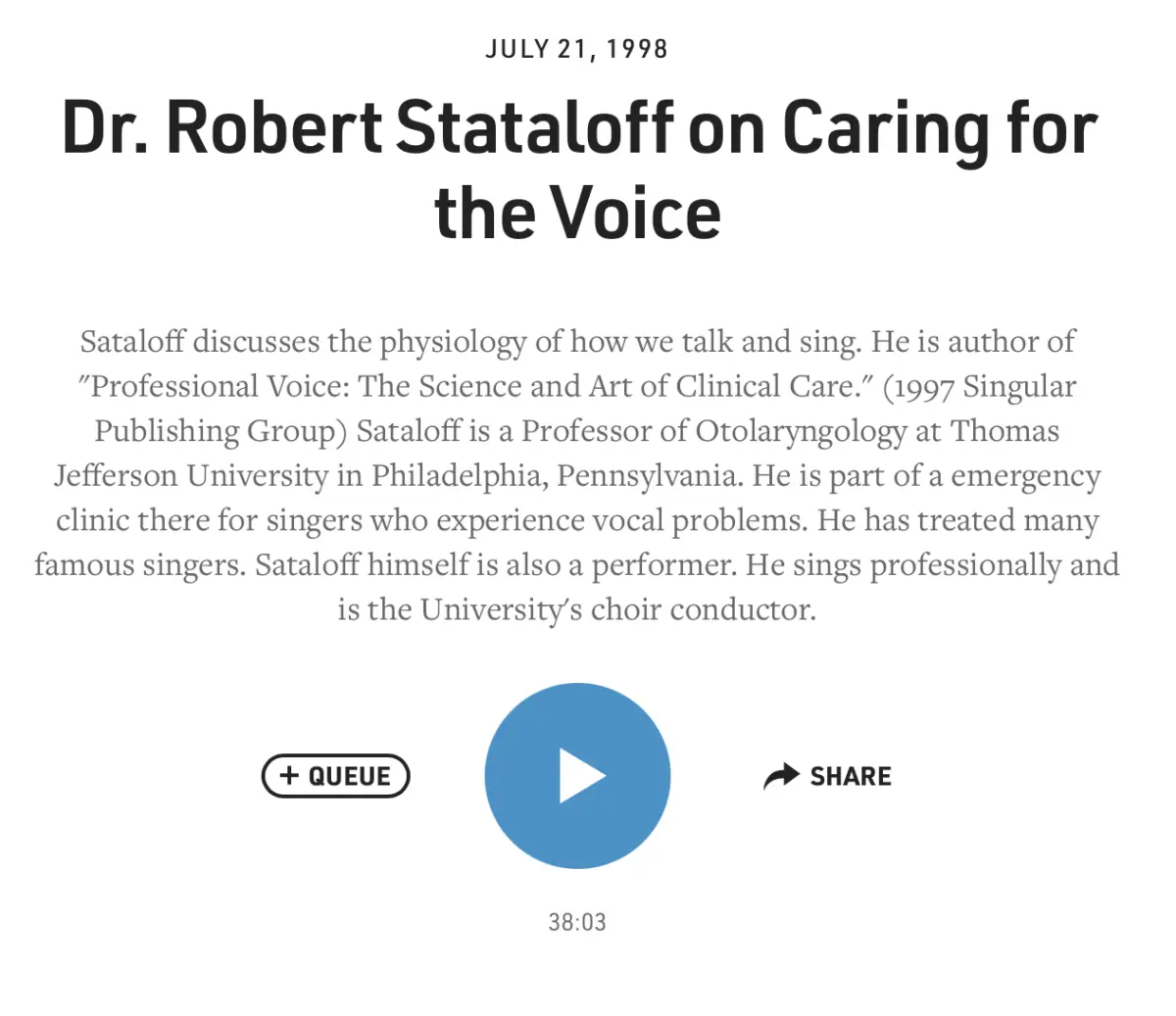
That paradigm shifted definitively on the airwaves in 1998, when world-renowned otolaryngologist and vocal health pioneer Dr. Robert Thayer Sataloff sat down with legendary interviewer Terry Gross on NPR’s acclaimed cultural program, Fresh Air.
This historic broadcast offered listeners an unprecedented, masterclass-level window into the delicate mechanics of vocal fold production, the physiological hazards faced by professional users of the voice, and the emerging medical science dedicated to preserving human speech and song. Archived by the Fresh Air audio library and highlighted by The Voice Foundation, this conversation continues to serve as an indispensable cornerstone for vocal pedagogy, medical history, and otolaryngology.
This retrospective examines the depth of that landmark 1998 interview, exploring the intersection of art and medicine, the vulnerabilities of the human instrument, and the enduring legacy of Dr. Sataloff’s pioneering contributions to voice science.
Detailed Chronology: The Evolution of Voice Science and the 1998 Broadcast
To truly appreciate the gravity of Dr. Sataloff’s 1998 conversation with Terry Gross, one must contextualize the state of medicine and broadcasting at the turn of the millennium. By the late 1990s, public radio was cementing its role as an intellectual powerhouse, bringing specialized academic and scientific topics into millions of American households through accessible, deeply researched long-form interviews.
The Landscape of Otolaryngology in the Late 20th Century
Prior to the establishment of voice care as a distinct, multidisciplinary subspecialty, singers and actors experiencing vocal crises often navigated a fragmented medical system. General practitioners might prescribe rest, while traditional ear, nose, and throat (ENT) specialists focused primarily on pathology—such as cancer or infection—rather than the subtle neuromuscular nuances required for a Broadway belt or an operatic high C.
Dr. Robert Thayer Sataloff helped dismantle these silos. As an otolaryngologist, a trained singer, and a conductor, Sataloff bridged the gap between hard medical science and the subjective, high-stakes world of performing arts. By 1998, his body of research had already begun reshaping how the medical community viewed vocal cords not merely as anatomical valves for breathing and swallowing, but as sophisticated vibratory instruments.

Inside the Fresh Air Studio
When Terry Gross welcomed Dr. Sataloff to the Fresh Air microphone in January 1998, the dialogue was designed to demystify an instrument that every human uses daily yet few truly understand. Gross, known for her incisive, deeply empathetic, and meticulously prepared interviewing style, guided Sataloff through a fascinating exploration of vocal anatomy.
- Deconstructing the Larynx: The interview unpacked the staggering physical realities of vocal production. Dr. Sataloff explained how vocal folds—measuring only millimeters in length—collide hundreds or thousands of times per second during speech and song.
- The Vulnerability of the Mucosa: Listeners were introduced to the delicate layered structure of the vocal fold mucosa, learning how even microscopic changes, such as minor edema or dehydration, can drastically alter acoustic output.
- Psychological and Physiological Interplay: The discussion ventured into psychosomatic and behavioral impacts on the voice, addressing how stress, anxiety, and fatigue manifest physically in vocal tension.
The broadcast resonated deeply with performers, educators, and everyday listeners alike, democratizing access to specialized medical knowledge that had previously been confined to elite conservatory clinics and medical symposiums.
Supporting Context & Metrics: The Science of Sound and Vocal Pathology
To understand why Dr. Sataloff’s insights remain profoundly relevant today, it is essential to examine the physiological metrics and scientific principles governing the human voice.
The Physics of Phonation
The human voice is generated through a complex aerodynamic-myoelastic theory of phonation. Air expelled from the lungs creates subglottal pressure beneath the closed vocal folds. When this pressure overcomes the elastic resistance and muscular closure of the folds, they are blown apart, releasing a puff of air. The Bernoulli effect, combined with the tissue’s natural elasticity, snaps the folds back together.
- Frequency Range: A typical human speaking voice operates between 100 Hz and 250 Hz, while trained singers can span from deep bass notes (around 60 Hz) to stratospheric soprano pitches exceeding 1,500 Hz.
- Vibration Rates: During a high-pitched vocalization, the vocal folds can vibrate at frequencies exceeding 1,000 cycles per second—meaning they collide and separate a thousand times every single second.
[Lungs / Subglottal Pressure]
          ↓
[Vocal Folds Resistance & Closure]
          ↓
[Aerodynamic Release (Bernoulli Effect)]
          ↓
[Acoustic Resonance Amplified via Vocal Tract]
Common Vocal Pathologies Explored by Specialists
Dr. Sataloff’s clinical work has long focused on diagnosing and treating conditions that threaten the careers of professional voice users. Among the most frequent issues highlighted in modern voice science are:
- Vocal Nodules ("Singer’s Nodes"): Benign, callous-like growths that develop on opposing vocal folds due to chronic vocal abuse or misuse (such as habitual shouting or improper singing technique).
- Vocal Polyps: Fluid-filled lesions, often resulting from a single instance of severe vocal trauma (such as screaming at a concert). Unlike nodules, polyps frequently require surgical intervention.
- Laryngopharyngeal Reflux (LPR): Stomach acid traveling up into the esophagus and larynx, causing irritation, inflammation, and chronic hoarseness without necessarily presenting traditional heartburn symptoms.
- Vocal Fold Hemorrhage: A medical emergency for performers where a blood vessel on the surface of the vocal fold ruptures, filling the tissue with blood and severely compromising pliability.
Official Statements and Institutional Legacy: The Voice Foundation
The enduring impact of Dr. Sataloff’s advocacy and educational outreach is anchored heavily by his leadership within The Voice Foundation, the world’s oldest and primary organization dedicated to voice medicine, research, and care.
The Mission of The Voice Foundation
Founded to advance knowledge of the human voice across all disciplines, The Voice Foundation brings together otolaryngologists, speech-language pathologists, singing teachers, scientists, and performing artists. Through its annual symposia and publications, the organization champions a multidisciplinary team approach to vocal health—a philosophy that Dr. Sataloff has championed throughout his career.

Reflections on Media Archives and Public Education
Archival initiatives by organizations like WHYY’s Fresh Air and platforms such as the Fresh Air Archive play a vital role in preserving intellectual history. By keeping interviews like Dr. Sataloff’s accessible, contemporary researchers, students, and curious minds can trace the trajectory of medical breakthroughs.
"The human voice is the most intimate extension of our identity. When we lose our voice, or when it is compromised, we lose a fundamental piece of our humanity. The intersection of art and medicine is where we restore that connection."
— Reflective synthesis of modern voice care philosophy championed by clinical pioneers.
Future Outlook: The Next Frontier in Voice Medicine and Pedagogy
As we look toward the future, the foundational principles articulated by Dr. Robert Thayer Sataloff in his 1998 interview serve as a springboard for advanced technological and medical innovations in vocal health.
Regenerative Medicine and Stem Cell Research
One of the most promising frontiers in laryngology is the potential use of regenerative medicine and bioengineered tissues to repair scarred or damaged vocal fold mucosa. Because scar tissue on the vocal folds lacks the delicate, pliable elasticity required for pure acoustic vibration, finding ways to regenerate pristine tissue could permanently alter the prognosis for performers suffering from severe vocal trauma.
Artificial Intelligence and Real-Time Acoustic Monitoring
The proliferation of machine learning and artificial intelligence is revolutionizing vocal diagnostics. Today’s researchers are developing wearable sensors and smartphone applications capable of analyzing vocal fatigue, jitter, shimmer, and acoustic strain in real time. These tools allow professional speakers, call center workers, and vocalists to monitor their vocal load preemptively, preventing injuries before they require surgical intervention.
Interdisciplinary Education in the 21st Century
Perhaps Dr. Sataloff’s most enduring legacy is the normalization of the interdisciplinary team. Modern conservatories, medical schools, and speech pathology programs increasingly recognize that treating a singer or professional speaker requires a synchronized effort between voice teachers, medical doctors, and rehabilitation specialists.
By capturing complex physiological realities and presenting them with clarity, wit, and profound authority, the 1998 Fresh Air interview between Terry Gross and Dr. Robert Thayer Sataloff remains a timeless educational artifact—reminding us all of the extraordinary biological machinery behind every spoken word and sung note.