
Executive Overview
In the annals of classical music history, few compositions are as audaciously autobiographical, psychologically probing, and structurally revolutionary as Hector Berlioz’s Symphonie Fantastique, premiered in 1830. At the very heart of this monumental five-movement orchestral work lies a groundbreaking compositional device that Berlioz termed the idée fixe—literally translated from the French as a "fixed idea."
Conceived out of a torrent of unrequited romantic obsession, the idée fixe functions as a recurring musical motif that represents the object of the composer’s affection: the celebrated Irish actress Harriet Smithson. Far more than a simple recurring melody, the idée fixe acts as an auditory manifestation of psychological fixation, transforming, warping, and evolving as it tracks the shifting emotional states of its creator across dreams, grand balls, pastoral landscapes, and terrifying nightmares.
Long before Richard Wagner popularized the leitmotif in his operatic masterworks, Berlioz utilized the idée fixe to unify a sprawling, programmatic orchestral narrative. By tracking how a single melodic cell can be subjected to varied instrumentation, rhythmic alterations, tempo shifts, and harmonic recontextualization, musicologists, composers, and performers continue to study the Symphonie Fantastique as a masterclass in thematic transformation.
This article provides an investigative and authoritative examination of the idée fixe, exploring its psychological origins, tracing its evolution across the movements of Berlioz’s masterwork, and evaluating its lasting legacy on the evolution of cinematic scoring and Western music composition.
Detailed Chronology: The Genesis of an Obsession
To fully understand the musical mechanics of the idée fixe, one must first examine the turbulent biographical and historical chronology that birthed it. The story of the Symphonie Fantastique is inextricably linked to the early nineteenth-century Romantic movement, characterized by an intense focus on individual emotion, unbridled passion, and the tragic dimensions of artistic sensitivity.
1827: The Catalyst at the Théâtre de l’Odéon
In September 1827, a young, ambitious, and emotionally volatile French composer named Hector Berlioz attended a performance of Shakespeare’s Hamlet at the Théâtre de l’Odéon in Paris. The role of Ophelia was played by Harriet Smithson, a charismatic and acclaimed Irish actress touring France with an English theater troupe. Berlioz was instantly, overwhelmingly captivated. Though he did not speak English and Smithson was barely aware of his existence, Berlioz fell into a state of profound, agonizing infatuation.
He bombarded her with letters, declarations of love, and ambitious artistic proposals, all of which were largely ignored or rebuffed by Smithson, who viewed the fervent young Frenchman as an eccentric stalker.
1830: Composition and Catharsis
Unable to win her affections through conventional means, Berlioz channeled his psychological torment, despair, and creative energy into his art. During the early months of 1830, he composed the Symphonie Fantastique: Épisode de la vie d’un artiste (Fantastic Symphony: An Episode in the Life of an Artist).
The symphony was explicitly programmatic, accompanied by a written manifesto distributed to the audience detailing the storyline: a young, lovesick artist has poisoned himself with opium in a fit of despair, leading to a series of hallucinatory visions concerning his beloved.
December 5, 1830: The World Premiere
The Symphonie Fantastique premiered at the Paris Conservatoire under the baton of François-Antoine Habeneck. The performance was a watershed moment in orchestral music. Audiences and critics were stunned by the sheer audacity of the orchestration, the unconventional programmatic structure, and the relentless psychological focus of the idée fixe threading the movements together.
The Irony of Resolution: Marriage and Dissolution
In a bizarre twist of life imitating art, Harriet Smithson eventually attended a performance of Berlioz’s music years later, finally recognized the depth of his genius, and understood that she was the muse behind the idée fixe. The two met, courted, and married in 1833.
However, the marriage proved tragic. Language barriers, declining career fortunes for Smithson due to a leg injury, Berlioz’s demanding touring schedule, and his serial infidelities led to alcoholism, domestic strain, and a bitter separation. The biographical reality mirrored the dark, disintegrating trajectory of the symphony’s final movements.
Supporting Context & Metrics: Anatomy of the Idée Fixe
In music theory, the idée fixe is structurally distinct from the traditional classical themes found in the symphonies of Beethoven, Mozart, or Haydn. While classical themes were often developed through motivic fragmentation and counterpoint within strict sonata forms, Berlioz’s idée fixe functions as a psychological avatar.
Key Characteristics of the Idée Fixe
- Thematic Persistence: The melody remains recognizable across movements despite radical alterations in musical parameters.
- Programmatic Narrative: It translates an extra-musical concept (a human being and an emotional obsession) directly into sound.
- Elasticity: It adapts effortlessly to different meters, tempos, and orchestral colors to reflect changes in the narrator’s mental state.
Comparative Analysis: Idée Fixe vs. Leitmotif
| Metric / Feature | Idée Fixe (Berlioz) | Leitmotif (Wagner) |
|---|---|---|
| Primary Scope | Primarily used in a single, multi-movement programmatic work (Symphonie Fantastique). | Utilized across massive operatic cycles (e.g., Der Ring des Nibelungen). |
| Structural Function | Represents a single overarching character, obsession, or psychological state. | Represents characters, objects, abstract concepts, emotions, or plot devices. |
| Development | Undergoes metamorphosis to mirror the shifting psychological degradation or evolution of the protagonist. | Combines, transforms, and interweaves polyphonically to comment on dramatic action. |
| Historical Epoch | Early Romanticism (1830). | High Romanticism / Late 19th Century. |
Reworking the Melody: Movement-by-Movement Breakdown
To appreciate Berlioz’s genius, one must examine how the idée fixe is manipulated across three primary movements of the Symphonie Fantastique, demonstrating his ability to paint shifting psychological landscapes through sheer orchestration and rhythm.
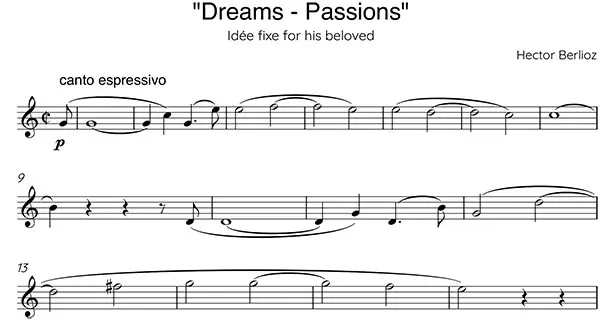
1. First Movement: "Rêveries – Passions" (Dreams, Passions)
In the opening movement, the listener is introduced to the artist in his pre-obsessive state of vague yearnings, followed by the sudden, overwhelming strike of love upon meeting his beloved.

- The Musical Presentation: The idée fixe makes its grand entrance, played primarily by the violins and flutes in unison.
- Character & Mood: The melody is expansive, soaring, and structurally asymmetrical (stretching traditional phrase lengths). It is infused with an aching, breathless quality that captures the emotional vulnerability, longing, and idealistic devotion Berlioz felt toward Harriet Smithson.
- Harmonic Function: It establishes the tonal anchor of the work, serving as the benchmark against which all future distortions of the theme will be measured.
2. Second Movement: "Un bal" (A Ball)
The second movement transports the listener to a glittering, opulent Parisian ballroom. The artist seeks distraction from his obsessive torment amidst the glittering society and swirling dances of high-class revellers.
- The Musical Presentation: The idée fixe is radically altered. It is transformed into a sparkling, elegant waltz set in a 3/8 time signature.
- Character & Mood: Despite the festive, celebratory setting of the waltz, the intrusion of the idée fixe shatters the jovial atmosphere. The melody is rhythmically decorated and ornamented with grace notes and trills.
- Psychological Subtext: This metamorphosis portrays the artist’s unsettled emotions. Even amid swirling couples and intoxicating social pageantry, he cannot escape the haunting presence of his beloved; the joyous dance is subverted by his internal psychological torment.
3. Third Movement: "Scène aux champs" (Scene in the Fields)
Seeking solace in nature, the artist spends a peaceful afternoon in the countryside, listening to two shepherds piping a ranz des vaches (alpine melody) to one another.
- The Musical Presentation: The tempo slows dramatically into an adagio. The idée fixe returns in a reflective, melancholic mood, played delicately by a solo flute and violins, operating within a 6/8 meter.
- Character & Mood: The raw, frantic passion of the first movement and the glittering anxiety of the second are replaced by deep contemplation.
- Psychological Subtext: The artist experiences a complex duality of emotions: a fragile hope that he might win her love, coupled with a deep, crushing loneliness and the underlying fear that she will remain forever out of reach. The fading away of the theme at the movement’s end—punctuated by distant rumbling thunder from a solo timpani—foreshadows psychological doom.
Official Statements & Critical Perspectives
Musicologists, conductors, and historians have long debated the structural and cultural significance of Berlioz’s innovation.
Dr. Julian Rushton, prominent Berlioz scholar and author:
"Berlioz did not merely write music that told a story; he invented a sonic mechanism that mapped the inner workings of human neurosis. The idée fixe in Symphonie Fantastique is the nineteenth-century musical equivalent of stream-of-consciousness writing. By forcing a single melodic cell to endure degradation, terror, and grotesque parody across five distinct movements, Berlioz bridged the gap between classical form and psychological realism."
Maestro Myung-Whun Chung, renowned conductor:
"When conducting the Symphonie Fantastique, the greatest challenge is balancing the architectural brilliance of the orchestration with the raw, bleeding-edge emotion of the narrative. The idée fixe is the compass of the piece. If the orchestra loses the emotional arc of that recurring theme, the symphony collapses into disconnected episodes. When played with structural awareness, it feels like peering directly into the manic, brilliant mind of a tortured artist."
The Paris Conservatoire Review (Retrospective Critique):
"In 1830, Parisian critics were baffled by Berlioz’s disregard for academic conventions. Yet, history has vindicated his vision. The transformation of the idée fixe established a blueprint for narrative cohesion that every major film composer utilizes today whenever they assign a specific theme to a protagonist or a psychological dilemma."
Future Outlook: The Enduring Legacy of the Idée Fixe
As we look toward the future of composition, film scoring, and immersive multimedia art, the DNA of Berlioz’s idée fixe remains more vibrant and influential than ever.
1. The Blueprint for Modern Cinematic Scoring
The lineage running directly from Berlioz’s idée fixe to Richard Wagner’s leitmotifs, and subsequently to the cinematic themes of twentieth-century masters like Bernard Herrmann, John Williams, and Hans Zimmer, is undeniable. Modern film scores rely entirely on the principle that a recurring melodic motif can instantly communicate character psychology, moral alignment, or impending doom to an audience without a single line of dialogue being spoken. As narrative storytelling expands into immersive virtual reality, video games, and interactive media, the strategic reuse and transformation of core thematic ideas remain essential tools for audience engagement.
2. Music Therapy and Cognitive Psychology
In contemporary musicology and music therapy, researchers study how recurring musical themes trigger memory, emotional regulation, and narrative processing in the human brain. The idée fixe serves as an early historical case study in how musical repetition can model obsessive thought patterns, offering fascinating intersections between nineteenth-century Romantic art and modern cognitive science.
3. Pedagogical Value for Contemporary Composers
For modern composition students, mastering the art of thematic transformation—taking a single, simple melodic phrase and forcing it to survive changes in timbre, harmony, meter, and emotional context—is considered a rite of passage. As Ben Dunnett, founder of the Music Theory Academy, notes: "The ability to adapt a melodic idea to depict different emotions, moods, and places is one that will always be of considerable value to any serious composer."
Conclusion
Hector Berlioz’s idée fixe was far more than an innovative structural trick; it was a profound psychological exploration of love, obsession, and artistic vulnerability. By transforming a simple melody into a living, breathing, and ultimately deteriorating psychological entity within Symphonie Fantastique, Berlioz redefined the boundaries of orchestral music and left a legacy that continues to resonate across concert halls, movie theaters, and the digital soundscapes of the twenty-first century.