
Executive Overview
Music has long possessed the profound ability to stir human emotion, transcend language barriers, and evoke visceral psychological responses. Yet, its most sophisticated narrative function lies in its capacity to symbolize identity, memory, and destiny. At the heart of this capability is the leitmotif—a short, recurring musical phrase or theme inextricably linked to a specific person, object, concept, or emotional state.
Derived from the German leitmotiv (literally translating to "leading motive," though "representative theme" serves as an equally accurate functional definition), this foundational compositional device transforms abstract sound into concrete narrative shorthand. Rather than serving merely as ornamental background noise, a leitmotif acts as an active dramatic agent. It reappears at crucial narrative junctures whenever its associated subject is introduced, implied, or physically present. Over time, the primary musical idea evolves alongside the narrative, undergoing subtle transformations in harmony, rhythm, instrumentation, and tempo to reflect character growth, corruption, or environmental tension.
While precursors to the concept appeared in the works of early 19th-century composers like Carl Maria von Gluck, Carl Maria von Weber, and Hector Berlioz—whose Symphonie Fantastique famously utilized an idée fixe—the leitmotif reached its artistic zenith in the monumental operas of Richard Wagner. Wagner weaponized the leitmotif to weave intricate, symphonic textures that underpinned his sprawling stage dramas.
Today, this 19th-century operatic innovation serves as the bedrock of modern film scoring. Cinematic masterminds like John Williams, Howard Shore, and Hans Zimmer rely heavily on leitmotifs to navigate complex plots, cue audience reactions, and establish psychological depth. From the menacing two-note heartbeat of a great white shark to the soaring, tragic foreshadowing of a galactic dictator’s youth, the leitmotif remains one of the most powerful and enduring tools in the composer’s arsenal.
Detailed Chronology: From Romantic Operas to Hollywood Blockbusters
To understand how a brief musical phrase commands such immense narrative authority, one must trace its historical evolution from the stages of 19th-century Europe to the soundstages of modern Hollywood.
The Antecedents and the Birth of the Idée Fixe (Early-to-Mid 19th Century)
Long before Wagner codified the system, composers recognized the dramatic utility of recurring themes. Opera seria and early Romantic works occasionally recycled tunes to remind audiences of past events. However, the conceptual leap toward a psychological representation of character occurred in 1830 with Hector Berlioz’s Symphonie Fantastique. Berlioz introduced the idée fixe—a fixed, obsessive melody representing the artist’s beloved, which twists and mutates across the symphony’s five movements as the protagonist descends into opium-induced hallucinations. Concurrently, German composers like Weber began experimenting with associative themes in operas such as Der Freischütz, laying the theoretical groundwork for what was to come.
The Wagnerian Revolution (1843–1876)
The definitive codification of the leitmotif belongs to Richard Wagner. Across his 13 completed operas and particularly within his monumental tetralogy, Der Ring des Nibelungen (The Ring Cycle), Wagner deployed hundreds of distinct motifs.
In works like Der fliegende Hollander (1843), Wagner established stark contrasts using character-driven themes. The "Dutchman Motif" introduces the protagonist through an uplifting, noble line, which is immediately subverted by the "Ghost Motif"—a chilling phrase utilizing the disquieting tritone interval to instill immediate dread. By the time he completed Tristan und Isolde in 1865, Wagner had pushed harmonic boundaries to a breaking point with the famous "Tristan Chord," a leitmotif whose unresolved tension came to symbolize eternal longing and psychological anguish.
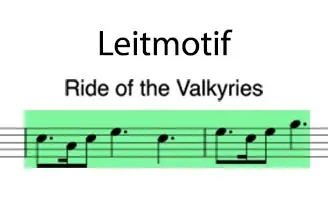
The apex of this technique arrived with the Ring Cycle (comprising Das Rheingold, Die Walküre, Siegfried, and Götterdämmerung). Here, motifs such as the undulating "Rhine Motif" and the aggressive, leaping dotted rhythms of "The Ride of the Valkyries" ceased to be mere musical cues. Instead, as noted by musicologist Deryck Cooke, Wagner’s themes interacted, combined, and clashed in the orchestra pit to tell a story running parallel to—and often deeper than—the vocal text on stage.
The Cinematic Migration (1930s–1970s)
As the film industry blossomed in the 20th century, European émigré composers who had fled political upheaval in Europe—most notably Erich Wolfgang Korngold and Max Steiner—brought late-Romantic orchestral traditions directly to Hollywood. Steiner’s scores for films like King Kong (1933) and Casablanca (1942) utilized leitmotifs to track character motivations and emotional arcs in a manner directly inherited from Wagner and Puccini.
This tradition experienced a massive cultural resurgence in 1977 with the release of Star Wars. Composer John Williams deliberately resurrected the classic Wagnerian leitmotif approach for George Space Opera, providing distinct, unforgettable themes for Luke Skywalker, Princess Leia, Han Solo, and the overarching Force.
Supporting Context & Metrics: Anatomy of a Leitmotif
A leitmotif is fundamentally defined by its adaptability. Composers construct these themes using specific musical parameters that can be manipulated to match narrative developments.
Structural Components of a Leitmotif
- Melody: The most recognizable element. A leitmotif can be as short as two notes (as in Jaws) or span a sweeping, lyrical phrase (as in the "Redemption Motif" from The Flying Dutchman).
- Harmony: Chords dictate emotional color. Consonant harmonies often represent safety, heroism, or stability, whereas dissonant combinations—such as the tritone interval in Wagner’s "Ghost Motif"—significate danger, corruption, or supernatural dread.
- Rhythm: Metric patterns convey physical movement and psychological states. Dotted rhythms often suggest military precision, horseback riding (e.g., "The Ride of the Valkyries"), or urgency, while flowing quavers (eighth notes) can evoke the natural meandering of rivers (e.g., "Rhine Motif").
- Instrumentation: Changing the instrument playing a theme alters its meaning. A theme played softly on a solo French horn may evoke nostalgia, while the same theme blared by full brass sections denotes triumph or overwhelming power.
Comparative Analysis: Operatic vs. Cinematic Leitmotifs
| Feature | Wagnerian Operatic Leitmotif | Modern Cinematic Leitmotif |
|---|---|---|
| Scale | Hundreds of interconnected motifs spanning 4+ hour opera cycles. | Typically 3 to 6 primary themes per feature film. |
| Delivery | Integrated continuously into a dense, non-stop symphonic texture. | Synchronized with visual cuts, action beats, and dialogue pauses. |
| Evolution | Highly metamorphic; themes transform continuously over days of performance. | Often recurring in recognizable forms, with subtle thematic foreshadowing. |
| Audience Function | Acts as an internal psychological monologue for characters. | Acts as an immediate narrative signpost and emotional trigger for viewers. |
Official Perspectives and Critical Analysis
Musicologists and prominent film composers have long debated the psychological mechanisms that make leitmotifs so effective. The prevailing consensus highlights the technique’s unique ability to bridge conscious thought with subconscious emotional processing.
As noted in The Oxford Dictionary of Music by Michael Kennedy (1984), Wagner’s genius lay in his ability to weave "subtle combinations of leitmotiv [to] create symphonic textures." Kennedy emphasizes that these motifs do not merely announce a character’s physical entrance on stage; they expose hidden motives, foreshadow impending doom, and recall absent characters, functioning much like a literary stream-of-consciousness.
In the realm of contemporary cinema, master composer John Williams has frequently discussed his philosophy regarding thematic scoring. In archival interviews addressing his work on the Star Wars franchise, Williams highlights that leitmotifs allow audiences to navigate sprawling universes filled with dozens of characters. By associating a specific brass fanfare or woodwind trill with an individual or concept, the composer bypasses exposition, allowing the audience to instantly comprehend shifting alliances and emotional stakes.
A prime pedagogical example of this is found in Star Wars Episode I: The Phantom Menace (1999). During "Anakin’s Theme," Williams quietly embeds fragments of the "Imperial March" (Darth Vader’s Theme) into the final bars of the melody. This brilliant, subtle orchestration serves as a musical prophecy, communicating to the audience long before visual confirmation that the innocent child on screen is destined to become a galactic tyrant.
Future Outlook: The Leitmotif in the 21st Century and Beyond
As storytelling mediums evolve across television, video games, and immersive virtual reality, the application of the leitmotif is undergoing a radical technological and structural transformation.
Adaptive and Interactive Scoring in Gaming
While linear films rely on a fixed timeline, modern video games require dynamic audio engines. In blockbuster titles like The Witcher 3: Wild Hunt, The Elder Scrolls V: Skyrim, and the Zelda franchise, leitmotifs are programmed to adapt interactively to player input. If a player merely explores a peaceful meadow, a gentle, acoustic rendition of a regional leitmotif plays. The moment an enemy enters the field of view, the orchestration dynamically shifts—seamlessly blending into heavy percussion and aggressive brass variants of the exact same thematic material. This interactive implementation proves that the psychological mechanics discovered by Wagner over 150 years ago remain fully compatible with non-linear digital landscapes.
Television and Long-Form Serialized Narratives
Prestige television has increasingly adopted cinematic leitmotif strategies. In series like Game of Thrones (composed by Ramin Djawadi) and Succession (composed by Nicholas Britell), character themes evolve across seasons to mirror moral decay, shifting power dynamics, and complex familial betrayals. Because television allows for dozens of hours of character development, composers can track subtle psychological shifts through micro-variations in rhythm and instrumentation, offering a modern equivalent to Wagner’s multi-opera cycles.
Conclusion
From the dimly lit orchestra pits of 19th-century Bayreuth to Dolby Atmos-equipped cinema halls and interactive gaming rigs, the leitmotif remains a cornerstone of human artistic expression. By linking sound to memory, emotion, and identity, it elevates narrative art from a passive visual experience into an immersive psychological journey. As long as storytellers seek to plumb the depths of the human condition, the resonant power of the "leading motive" will continue to guide the way.