
Executive Overview
The protracted and increasingly bitter confrontation over the identity, governance, and physical survival of the John F. Kennedy Center for the Performing Arts reached a critical juncture. The institution’s board of trustees—stacked with loyalists appointed by President Donald Trump—voted once again to shutter the iconic national cultural institution.
This latest closure vote is part of a high-stakes standoff involving federal appropriations, judicial interventions, executive overreach, and fierce resistance from cultural leaders, artists, and lawmakers. At the heart of the dispute is an ultimatum issued by President Trump: unless his name is permanently and prominently etched onto the building’s facade, he will block the release of $257 million in congressionally allocated renovation funds.
The controversy is more than a simple dispute over real estate branding or architectural vanity. It has laid bare deep institutional vulnerabilities, transforming a living federal memorial into a proxy war over political control of America’s premier cultural spaces.
With the board’s recent vote to close the facility starting September 15, the nation’s capital faces the suspension of operations for a major artistic hub. Meanwhile, the legal and public relations fallout continues to widen, drawing in federal judges, members of Congress, world-class resident ensembles, and outraged patrons who view the rebranding effort as a desecration of a national monument dedicated to assassinated President John F. Kennedy.
Detailed Chronology of a Cultural Clash
The Takeover and Initial Rebranding
The saga began last year when President Trump assumed sweeping control over the Kennedy Center, installing himself as board president and systematically replacing long-standing trustees with political loyalists. Almost immediately, the newly constituted board moved to reshape the public-facing identity of the institution.
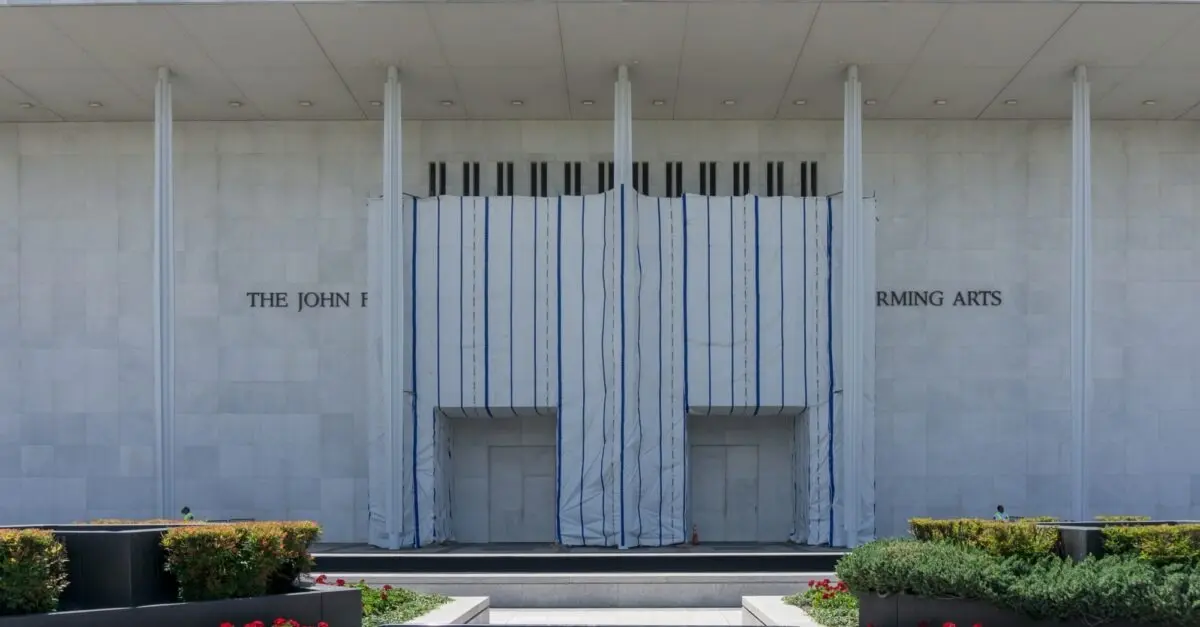
In December, the board authorized the placement of Trump’s name directly above that of President John F. Kennedy on the building’s exterior. Alongside this physical alteration, the administration announced that the cultural center would immediately close its doors for a sweeping, two-year renovation project—a move that stunned the arts community and displaced numerous resident companies.
Judicial Intervention and the Tarp Controversy
The swift and unilateral rebranding provoked immediate legal pushback. U.S. Representative and former Kennedy Center Board Member Joyce Beatty, alongside a coalition of legal advocates, filed a federal lawsuit to halt the closure and force the removal of Trump’s name.
On September 15, U.S. District Judge Christopher Cooper issued a definitive ruling, stating unequivocally that the Center "cannot install memorials for President Trump or anyone or anything else at the Kennedy Center without Congress’s blessing."
Faced with a court order requiring the removal of the unauthorized signage, the board erected a large green tarp over the disputed lettering on the building’s facade. Refusing to back down, the board pivoted in August with a revised proposal. They suggested placing Trump’s name beneath that of President Kennedy with a specific inscription: "The John F. Kennedy Center for the Performing Arts Restored and Renovated By President Donald J. Trump." Additionally, the board voted to rename the surrounding grounds "The President Donald J. Trump Plaza."
The Ultimatum and Social Media Escalation
Following Judge Cooper’s injunction, the standoff escalated from the courtroom to digital media. Taking to Truth Social, President Trump issued an uncompromising ultimatum. He stated that he would actively block the distribution of $257 million authorized by Congress under the One Big Beautiful Bill Act unless the D.C. Circuit Court of Appeals permits the board’s approved naming conventions.
"The closing will take place immediately, however, the Renovation and Reconstruction, which is a very large and complex job, cannot begin until such time as the D.C. Circuit rules on the Board’s approved name," Trump wrote. "If the ruling is a negative one, which it should not be, and is not overturned by the U.S. Supreme Court, the Reconstruction and the Renovation of The Kennedy Center will not take place."
The Confrontation at the Board Meeting
The tensions within the leadership structure spilled into public view during a tumultuous board meeting. According to legal representatives for Rep. Beatty, President Trump "verbally berated" Beatty during the proceedings, aggressively targeting her for her sustained efforts to block the takeover and preserve the institution’s original mandate. Beatty’s legal team confirmed that they are preparing yet another emergency injunction to challenge the legality of this latest closure vote.
Supporting Context & Metrics
Financial Stakes and the Renovation Fund
The financial framework underpinning the Kennedy Center’s operations has become a primary weapon in the ongoing political chess match. Congress previously earmarked $257 million through the One Big Beautiful Bill Act for comprehensive infrastructure updates, modernization, and structural maintenance.
In an attempt to justify the renaming scheme, the board claimed that external private fundraising was essential to supplement these federal allocations. President Trump stated that he personally spearheaded the creation of the Trump Kennedy Center Fund in July, an endowment that he claims has successfully raised $17 million to date. However, critics argue that these financial maneuvers are merely a smokescreen designed to legitimize a vanity project under the guise of fiscal necessity.
The Mass Exodus of Artistic Talent
While the legal and political battles rage in federal courts, the human and artistic cost to the institution has been catastrophic. Long before the latest closure announcement, top-tier artists, touring productions, and cultural icons systematically distanced themselves from the Kennedy Center in protest of the administration’s takeover.
- Theatrical and Musical Defections: Major commercial tours, including blockbuster productions of Hamilton, canceled their scheduled engagements. Renowned soprano Renée Fleming, multi-hyphenate artist Issa Rae, and legendary composer Philip Glass—who was slated to premiere his newest symphonic work at the venue—all severed ties with the institution.
- Resident Ensembles in Exile: The Washington National Opera, the Center’s flagship resident opera company, formally canceled its seasons and cut operational ties. Meanwhile, the National Symphony Orchestra (NSO) found itself displaced, forced to perform across various venues in the D.C. metropolitan area for the 2026–2027 season. Leadership from the NSO publicly admitted they were completely blindsided by the administration’s abrupt shutdown announcements, leaving classical musicians scrambling for rehearsal and performance spaces.
- The Reach: Amid the sweeping closures, the institution’s modern satellite facility, known as The Reach, has managed to host occasional, scaled-down performances, though its programming remains heavily impacted by the overarching administrative chaos.
Official Statements and Perspectives
Representative Joyce Beatty on Fiduciary Duty
In a scathing public statement following the board meeting and the verbal altercation with President Trump, Representative Joyce Beatty condemned the administration’s handling of the national cultural center:
"For years, the Kennedy Center has planned to undergo phased renovations, in which we both renovate and maintain some performances. This is how major performing arts centers in the country operate. But donors, patrons, and artists all fled after the unlawful attempt to rename this sacred memorial after Donald Trump. Donald Trump only cares about the Kennedy Center for his vanity. That is wrong and it is a breach of his fiduciary duty as a trustee. Congress established the Kennedy Center as a living memorial to President Kennedy, and I am proud to defend this cherished institution."
Legal Counsel and Constitutional Questions
Attorneys representing the congressional opposition have emphasized that the board’s actions violate the foundational statutes enacted by Congress when the institution was established as a federal memorial. Legal experts point out that federal property and congressionally designated monuments cannot be unilaterally rebranded by executive appointees without explicit legislative authorization.
The core legal question centers on the separation of powers: whether an executive branch appointee can legally withhold congressionally mandated funds to coerce compliance with a personal naming preference. This constitutional tension is precisely what Judge Cooper’s preliminary injunction sought to address, and it forms the basis of the impending appeals in the D.C. Circuit.
Future Outlook: What Lies Ahead for the Cultural Landmark?
As the September 15 closure date looms, the immediate future of the Kennedy Center remains shrouded in legal uncertainty and administrative turmoil. Several pivotal milestones will determine the path forward for the institution:
- The D.C. Circuit Appeal: The federal appeals court is expected to review the board’s appeal regarding the naming rights. A ruling against the board could permanently halt the administration’s rebranding efforts, while a favorable ruling would likely trigger further constitutional challenges.
- The Fate of Federal Funds: Whether the White House can legally freeze the $257 million in congressionally appropriated infrastructure funds will test the limits of executive impoundment authority and congressional budget controls.
- The Stability of Resident Companies: With the NSO performing in temporary venues and the Washington National Opera operating independently, the long-term viability of the Kennedy Center as a home for world-class resident arts organizations hangs in the balance. Rebuilding trust with alienated artists, donors, and patrons will require years of institutional repair, regardless of how the legal battles conclude.
For now, the symbol of American arts and culture stands caught in a historic crossfire—a testament to the deep political polarization shaping not only the nation’s governance, but its cultural sanctuaries as well.