
Executive Overview
For nearly three decades, the Minskoff Theatre has played host to a cultural phenomenon that fundamentally redefined the boundaries of stagecraft, design, and commercial viability in modern musical theatre. On November 13, Disney’s The Lion King officially celebrates its 29th anniversary on Broadway, a staggering milestone for a production that has long since transcended the category of a hit show to become a permanent fixture of global entertainment history.
Since its legendary opening night on November 13, 1997, at the historic New Amsterdam Theatre—before transferring to its current home at the Minskoff Theatre—the production has not merely endured; it has expanded exponentially. Across its 29-year residency, the international hit musical has spawned 32 distinct productions worldwide, welcoming a cumulative audience exceeding 130 million people. Its global box-office gross currently stands as the highest of any entertainment title in history, eclipsing not only fellow Broadway productions and live theatrical events, but also the highest-grossing cinematic releases in film history.
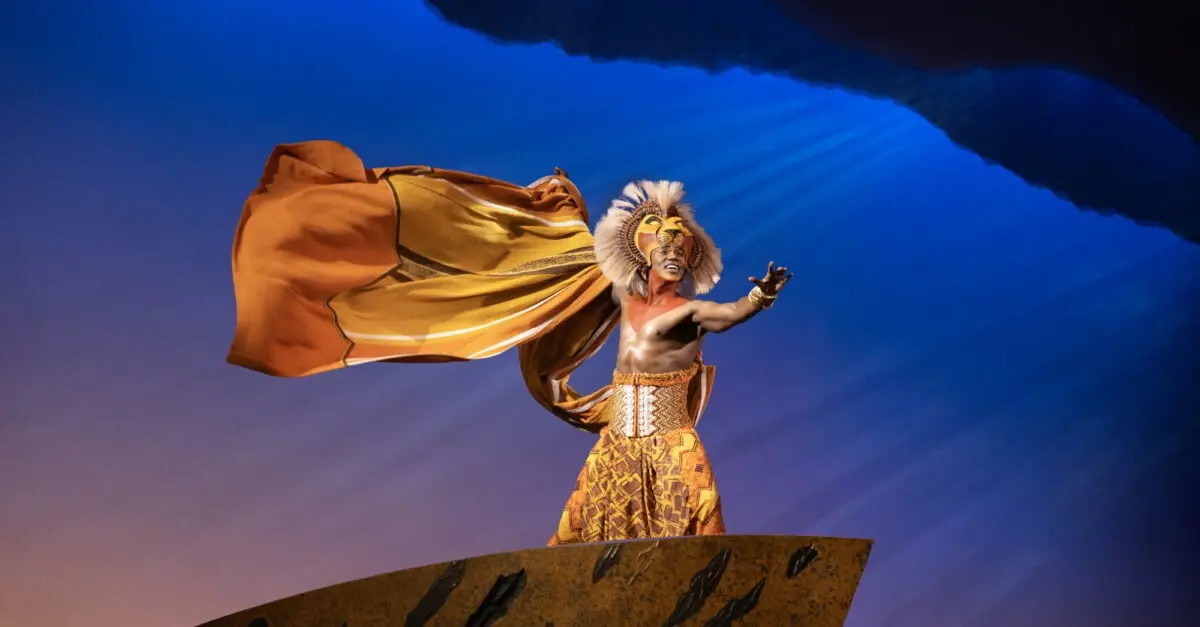
Yet, beyond the staggering financial metrics and box-office dominance lies a story of artistic resilience, groundbreaking diversity, and institutional longevity. Spearheaded by visionary director and designer Julie Taymor—who made history as the first woman to win a Tony Award for Best Director of a Musical—The Lion King remains a vibrant, evolving ecosystem. Supported by a current Broadway cast led by Mduduzi Madela as Simba and Gavin Lee as Scar, and sustained by an astonishing 17 original company members who have remained with the production since its pre-Broadway genesis in the summer of 1997, the musical continues to roar with the same ferocious innovation that stunned audiences in the late 20th century.
Detailed Chronology
The Genesis and Pre-Broadway Trials (1997)
The journey of The Lion King from animated silver-screen masterpiece to the Broadway stage was fraught with artistic risks. When Disney Theatrical Group, under the leadership of producers Peter Schneider and Thomas Schumacher, first envisioned a stage adaptation of the 1994 animated film, industry skeptics questioned whether the film’s vast African savannahs, animal stampedes, and metaphysical themes could be translated into a live theatrical medium without descending into camp or pastiche.
The solution lay in the hands of director Julie Taymor. Eschewing literal animal costumes, Taymor, alongside co-designer Michael Curry, engineered a revolutionary aesthetic vocabulary that blended human actors with double-articulation puppets, stylized masks, and avant-garde Indonesian shadow puppetry. This "double vision" technique allowed audiences to simultaneously perceive the actor and the animal, creating a deeply emotional theatricality.
Before arriving in New York, the production underwent rigorous tryouts, most notably at the Orpheum Theatre in Minneapolis during the summer of 1997. It was during these intense formative weeks that foundational members of the company—such as ensemble member Lindiwe Dlamini—first stepped onto the stage, cementing a symbiotic relationship between performer and material that would endure for nearly three decades.
The Landmark Opening Night and Tony Triumph (1997–1998)
On November 13, 1997, the production officially opened at Broadway’s New Amsterdam Theatre, instantly transforming the cultural landscape of Times Square. The production married the beloved, multi-platinum score by Elton John and Tim Rice with rich, evocative African-inflected compositions, choral arrangements, and musical material by Lebo M, Mark Mancina, Jay Rifkin, Julie Taymor, and Hans Zimmer.
The theatrical community responded with immediate and overwhelming acclaim. At the 52nd Tony Awards in 1998, The Lion King dominated the ceremony, securing six major accolades:
- Best Musical
- Best Direction of a Musical (Julie Taymor)
- Best Choreography (Garth Fagan)
- Best Scenic Design (Richard Hudson)
- Best Costume Design (Julie Taymor)
- Best Lighting Design (Donald Holder)
These victories were matched by critical recognition across the globe, including the New York Drama Critics Circle Award for Best Musical, the Grammy Award for Best Musical Show Album, and dual Laurence Olivier Awards for Best Choreography and Best Costume Design.
Expansion, Institutional Memory, and the Modern Era (1998–Present)
As the production settled into its long-term home at the Minskoff Theatre, it quietly began breaking records not just for ticket sales, but for organizational stability.
Over the decades, The Lion King has expanded into an international juggernaut with 32 productions mounted globally across every inhabited continent. Despite this massive international footprint, the flagship Broadway production has maintained rigorous artistic standards, regularly overseen by Taymor herself.
The production’s legacy is further anchored by historical milestones achieved by its principal creative and artistic teams. Composer Lebo M and choreographer Garth Fagan have each surpassed 11,400 Main Stem performances, officially earning the distinction of being the longest-running Black composer and choreographer in Broadway history. Furthermore, the casting choices continue to break new ground, exemplified by contemporary stars like Mduduzi Madela, who made history as only the second South African actor to assume the iconic role of Simba on Broadway.
Supporting Context & Metrics
Box Office Supremacy and Global Reach
To understand the economic scale of The Lion King is to examine an anomaly in modern commerce. The production’s worldwide cumulative gross exceeds that of any single film franchise, concert tour, or theatrical enterprise in the annals of entertainment history. With over 130 million theatergoers having experienced the production across its 32 global iterations, the musical has generated billions of dollars in economic activity, revitalized commercial real estate in Times Square, and established a blueprint for corporate synergy within the theatrical industry.
The Anatomy of Longevity: Onstage and Backstage
While long-running shows notoriously suffer from artistic fatigue and high turnover, The Lion King boasts a remarkably resilient institutional core. A testament to the supportive working environment cultivated by Disney Theatrical Group is the presence of 17 original company members who continue to ply their trade either onstage or backstage. This cohort includes:
- Lindiwe Dlamini, whose tenure with the show predates Broadway, stretching back to the 1997 Minneapolis tryouts.
- Seven original musicians, whose virtuosic execution of the score anchors every performance.
- Seven original crew members, who manage the intricate, physically demanding backstage operations.
- Two original ushers, who have welcomed generations of theatergoers through the doors of the theatre.
Additionally, veteran cast members like Bonita J. Hamilton have achieved legendary status within the company, having spent nearly two decades portraying the cunning hyena Shenzi—a feat of stamina and character dedication rarely matched in musical theatre history.
The Complete Creative Blueprint
The enduring success of The Lion King rests upon an extraordinarily detailed collaborative framework. The principal and creative architecture behind the production includes:
- Book Adaptation: Roger Allers (co-director of the animated film) and Irene Mecchi (co-screenwriter).
- Music & Lyrics: Elton John and Tim Rice, supplemented by monumental musical contributions from Lebo M, Mark Mancina, Jay Rifkin, Julie Taymor, and Hans Zimmer.
- Direction & Visual Design: Julie Taymor (Director, Costume Designer, Mask Co-Designer) and Michael Curry (Mask and Puppet Co-Designer).
- Choreography: Garth Fagan (Choreographer) and Marey Griffith (Associate Choreographer).
- Scenic & Lighting Design: Richard Hudson (Scenic Designer) and Donald Holder (Lighting Designer).
- Sound, Hair, & Makeup: Steve Canyon Kennedy (Sound Designer) and Michael Ward (Hair and Makeup Designer).
- Production & Management Supervision: Andrew Flatt and Anne Quart (Disney Theatrical Group Leadership), Lisa Dawn Cave (Production Supervisor), Thomas Schlenk (General Manager), and Michael Keller (Music Coordinator).
Official Statements
While the 29th anniversary marks a moment of quiet reflection rather than a glitzy decennial gala, leadership within the Disney Theatrical Group and the creative collective have consistently emphasized the foundational philosophy driving the production’s longevity.
In past reflections on the show’s enduring cultural footprint, Julie Taymor has noted the universality of the narrative: "The reason The Lion King endures is not because of the spectacle alone, though the puppets and masks are striking. It endures because the story touches the primal chords of human existence—loss, responsibility, identity, and generational renewal. The audience sees themselves in a mythic African landscape."
Thomas Schumacher, speaking on behalf of Disney Theatrical Group’s decades-long stewardship of the property, has frequently underscored the human element behind the machinery: "People often look at this show and see a corporate giant or a technical marvel. But if you walk backstage at the Minskoff, you find a family. The actors, musicians, dressers, and crew members who have been here for 10, 20, or nearly 30 years—they are the beating heart of this show. Their dedication is why the lion still roars just as fiercely today as it did in 1997."
Future Outlook
As The Lion King crosses the threshold of its 29th year and trains its sights squarely on an unprecedented horizon—the dreaded yet triumphant approach of its historic 30th anniversary in November 2027—the production shows zero signs of artistic stagnation or commercial fatigue.
In an era where Broadway shows frequently struggle to maintain momentum past a single theatrical season, The Lion King operates with the precision of a classical repertory company infused with the kinetic energy of a contemporary pop-culture event. Disney Theatrical Group continues to invest heavily in maintaining the physical and artistic integrity of the flagship Broadway production, ensuring that every mask, puppet, and orchestral arrangement retains its pristine impact.
Furthermore, the production’s commitment to international casting pipelines—exemplified by the integration of South African talent like Mduduzi Madela—guarantees that the show remains authentically connected to the cultural roots that inspired its creation. By continually refreshing its company with top-tier international artists while maintaining its veteran backstage spine, The Lion King has created a sustainable model for generational longevity in the performing arts.
As the house lights dim at the Minskoff Theatre night after night, and the transcendent opening notes of "Circle of Life" pierce the darkness, The Lion King stands not merely as a monument to past theatrical achievement, but as a living, breathing testament to the timeless power of storytelling. The savannah is as vibrant as ever, and Broadway’s reigning king shows no intention of abdicating his throne.