
Executive Overview
The contemporary recorded jazz landscape remains an arena of startling contrasts, bridging the gap between archival rediscovery and immediate, lived socio-cultural expression. Across three distinct new releases, the spectrum of modern improvised music is laid bare: from the raw, high-wire acoustic energy of a quarter-century-old British quartet session to the cathartic, genre-defying processing of post-viral trauma in London, and finally to the whimsical, highly eccentric folkloric output of a Cuban master.
This review examines three major additions to the global catalogue: Tommy Smith’s Four (Spartacus Records), a newly unspooled 1999 recording capturing a master saxophonist at his technical peak; In Time And Spirit (Clonmell Jazz Social), the expansive and conceptually striking debut from London ensemble Onmo, spearheaded by guitarist Jean de Talhouet; and La Bunga (Dot Time Records), the peculiar, breezy, and idiosyncratic collaborative offering from Cuban veteran Pedro Luis Ferrer and his daughter, Lena.
Together, these releases underscore the resilience of the genre. They demonstrate how jazz can simultaneously serve as a time machine preserving historical lightning in a bottle, a therapeutic canvas for processing chronic health crises, and a vehicle for cryptic, lighthearted social commentary. This report offers a comprehensive analysis of each project, exploring their production aesthetics, historical contexts, sonic identities, and the broader trajectory of the international jazz community.
Detailed Chronology & Production Histories
Tommy Smith: Four (Gateshead, 1999 – Released 2026)
To understand the genesis of Tommy Smith’s Four, one must cast back to a live-in-the-studio session executed more than 25 years ago at the Gateshead Art Centre. At the time, Smith—already a towering figure in British jazz and the future founder and director of the Scottish National Jazz Orchestra—was operating at a blistering creative velocity. Rather than relying on multi-track mixing desks, expensive pre-amplifiers, or isolation booths, the ensemble opted for an uncompromisingly minimalist approach to sound capture: a single microphone positioned directly in front of the band, recording straight to a portable MiniDisc.
The methodological choice stripped away the safety nets of modern studio engineering. There was no Public Address (PA) system, no amplifiers to color the room acoustics in real-time, and no post-session mixing wizardry. The resulting sonic artifact, shelved for a quarter of a century before its digital-only release on Bandcamp via Spartacus Records (STS033), possesses an unusual dual character. The acoustics of the room are occasionally deadened by the proximity and limitations of the single-mic placement, yet this constraint paradoxically gifts the music an unmediated physical presence and ferocious vitality.
The timeline of this release highlights an ongoing trend among veteran jazz instrumentalists: dipping into personal archives to unearth unreleased tapes that capture a spontaneous, unvarnished energy difficult to replicate in the clinical environments of modern digital workstations. Supported by a stellar rhythm section featuring pianist Steve Hamilton, bassist Orlando Le Fleming, and drummer Sebastian De Krom, Smith’s 1999 session functions as a time capsule, transporting listeners straight to the sweaty, charged atmosphere of mid-century jazz clubs like Birdland.
Onmo: In Time And Spirit (London, 2026)
In stark contrast to Smith’s archival retrieval, London-based ensemble Onmo represents the cutting edge of the contemporary capital scene. Led by composer and guitarist Jean de Talhouet, the band entered London’s Fish Factory Studios to record their debut album, In Time And Spirit (released via Clonmell Jazz Social, CJS012LP).
The conceptual timeline of this record is deeply intertwined with the contemporary socio-medical landscape. Talhouet’s creative process was profoundly disrupted by the onset of "long Covid," a debilitating condition that forced the guitarist to re-evaluate his relationship with performance, endurance, and physical expression. This personal crisis birthed Lapse, the nine-minute opening suite of the album. Composed as an auditory diary of chronic illness, the track charts Talhouet’s psychological and physical trajectory from the initial shock of the condition toward a hard-won, albeit fragile, equilibrium.
The physical packaging and release strategy of Onmo’s debut further reflects a modern artisanal ethos. Eschewing compact discs entirely, the ensemble paired the LP release with a striking visual concept: an album cover captured via a pinhole camera during a grueling four-hour exposure of four candles rotating on turntables. This meticulous attention to physical presentation underscores Onmo’s desire to treat the record as an immersive, multi-sensory object, even as the digital edition navigates the complex formatting of multi-part compositions like the title track.
Pedro Luis Ferrer: La Bunga (Havana & Miami, 2025)
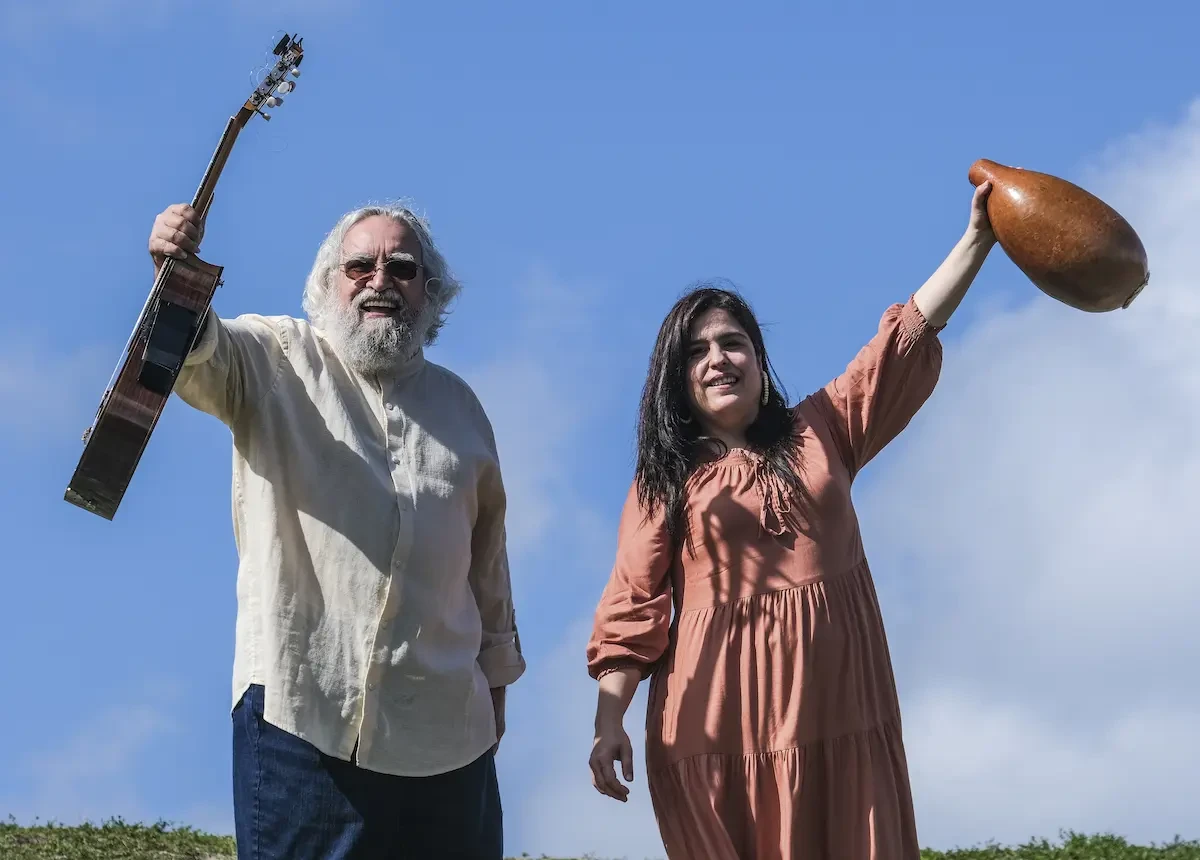
Spanning a career that officially commenced in 1965, Cuban maestro Pedro Luis Ferrer has long occupied a unique space in Caribbean music. Recognized as a singer, songwriter, virtuoso Spanish guitarist, and poet, Ferrer embodies the multifaceted cultural traditions of his homeland. For La Bunga (Dot Time Records DT9196), recorded across Havana, Cuba, and Miami, Florida, in 2025, Ferrer is joined by his daughter, Lena.
The production history of La Bunga is characterized by a rapid, uninhibited creative impulse. Across 14 bite-sized tracks, none exceeding the four-minute mark, the duo traverses themes of daily life, gastronomy, romantic entanglement, and philosophical regret. However, the record’s sonic architecture leans heavily into a bright, glossy aesthetic. The vocal tracks and instrumental arrangements exhibit signs of heavy digital processing, lending an artificial, airbrushed sheen to the upper registers and harmonies—a stark departure from the raw, organic acoustic environments favored by Smith and Onmo.
Supporting Context & Musical Metrics
Sonic Architecture and Stylistic Analysis
+--------------------+------------------------+---------------------------------------+
| Album Title        | Primary Instrumentation| Recording/Production Methodology      |
+--------------------+------------------------+---------------------------------------+
| Tommy Smith: Four  | Tenor Sax, Piano, Bass,| Single-mic, direct-to-MiniDisc,       |
|                    | Drums                  | zero overdubs, no PA/amps             |
+--------------------+------------------------+---------------------------------------+
| Onmo: In Time And  | Dual Tenor Sax, Trumpet| Multi-microphone studio tracking,     |
| Spirit             | Guitar, Keys, Bass,    | hybrid digital/analog mixing, LP-first|
|                    | Drums                  | focus                                 |
+--------------------+------------------------+---------------------------------------+
| Pedro Luis Ferrer: | Multi-instrumentalist  | Transcontinental digital sessions,    |
| La Bunga           | (Vocal/Guitar/Perc.) + | heavy vocal processing, bright pop    |
|                    | daughter (Vocals/Keys) | arrangement aesthetics                |
+--------------------+------------------------+---------------------------------------+
Tommy Smith’s Four
The album bursts open with a breakneck, 15-minute deconstruction of Miles Davis’s modal standard Four. Smith navigates the treacherous upper register of the tenor saxophone with such liquid confidence and agility that listeners could easily mistake his instrument for an alto. This is followed by When I’m All Alone, a self-penned ballad that showcases Smith’s uncanny ability to channel the spectral presence of Ben Webster. By employing a wide, breathy vibrato on low notes, Smith evokes Webster’s unmistakable late-career intimacy.
Clocking in at 65 minutes and 43 seconds, the complete tracklist—featuring The Lady Is A Tramp, Secret Love, Mil Dew/Cotton Tail, and Some Day My Prince Will Come—operates as a masterclass in modern hard bop. The rhythm section functions with hydraulic precision; Hamilton’s piano lines are crisp and uncluttered, Le Fleming’s bass provides a deep, anchoring pulse, and De Krom’s drumming displays a dynamic sensitivity that reacts instantly to Smith’s harmonic excursions.
Onmo’s In Time And Spirit
Musically, Onmo defies easy categorization, drawing explicit inspiration from jazz icons John Coltrane and Eric Dolphy, alongside structural minimalist Steve Reich, contemporary funk, and hip-hop beats. The frontline features saxophonists Jonathan Chung and George Crowley alongside trumpeter Mike Soper, anchored by a rhythm section comprising Rupert Cox (piano/keyboards), Huw V Williams and Flo Moore (double and electric bass), and drummer Joost Hendrickx.
Lapse serves as the emotional anchor of the 44-minute runtime. It begins with delicate, pastoral guitar lines before descending into abrasive, dissonant passages that reflect the disorientation of long Covid. The titular multi-part suite (In Time And Spirit Parts I–III, alongside the unified digital mix) synthesizes lyrical grace with minimalist repetition, proving that the ensemble can pivot effortlessly from cerebral, avant-garde exploration to accessible, groove-oriented interplay.
Pedro Luis Ferrer’s La Bunga
Spanning 43 minutes and 36 seconds across 14 tracks (including Celebración, Papurrico, Soncito, and La Mandonga), Ferrer’s album presents a sonic paradox. The instrumentation is dizzyingly diverse—with Ferrer and Lena handling guitars, keyboards, percussion, cajón, and brass elements. Yet, the compositional landscape suffers from a striking homogeneity.
Nearly every song moves at a similar breezy tempo, masking individual harmonic nuances behind an over-processed pop veneer. The lyrical content elevates the project into the realm of absurdism. Translated into English within the CD booklet, the lyrics range from dubious dietary advice ("If you don’t eat coconut you’ll lose your wits" in Güirón Del Coco) to unconventional hygiene directives ("Don’t let your sweaty groin be anybody’s sorrow. And don’t let your armpits brew their smoky tobacco" in La Mandonga). Far from high art, the album projects the whimsical ambience of an inescapable resort band playing in the background of an afternoon meal.
Official Statements & Industry Reception
The critical reception of these three releases highlights the shifting paradigms of jazz distribution and consumption in the mid-2020s.
Tommy Smith reflected on the rediscovery of his 1999 Gateshead tapes in promotional statements, emphasizing the value of unedited live performance in an era dominated by hyper-polished digital production:
"Capturing music in the raw, without the safety net of modern mixing desks or multi-mic setups, forces musicians to listen to one another in real-time with total vulnerability. Listening back after 25 years, the energy of that quartet was palpable—we weren’t thinking about posterity; we were just playing in the absolute moment."
Jean de Talhouet addressed the cathartic nature of Onmo’s debut, noting how personal adversity shaped the ensemble’s collective identity:
"Long Covid forced me to slow down and listen to sounds differently. Lapse isn’t just a piece of music; it’s a physical diary of adaptation, grief, and resilience. Bringing together influences from Coltrane to Reich allowed Onmo to express the complex emotional landscape of living through chronic illness while maintaining a forward-looking musical horizon."
Conversely, industry critics have received Pedro Luis Ferrer’s La Bunga with bemused detachment. Reviewers note that while Ferrer remains a revered historical custodian of Cuban folklore, his latest collaborative venture with his daughter leans so heavily into whimsical eccentricity and synthetic production that it borders on self-parody. As one European jazz publication observed: "La Bunga is frothy, bizarrely lyrical, and eminently forgettable—a musical curiosity that trades artistic depth for breezy, street-side diversion."
Future Outlook
As the global jazz ecosystem moves deeper into the digital age, these three releases point toward three distinct trajectories for the genre:
- The Archival Renaissance: As demonstrated by Tommy Smith’s Four, artists and independent labels will increasingly mine private vaults for historical tapes. Freed from the overhead of major label studio mandates, digital-first distribution platforms like Bandcamp allow musicians to monetize high-quality historical artifacts directly, bypassing traditional retail bottlenecks.
- The Thematic and Therapeutic Ensemble: Onmo’s success with In Time And Spirit signals a growing appetite for conceptual jazz that engages directly with contemporary socio-medical realities. By merging minimalist structures with free-jazz urgency and personal narrative, modern ensembles are redefining how instrumental music can articulate trauma, recovery, and societal shifts.
- The Preservation of Folkloric Eccentricity: Pedro Luis Ferrer’s work demonstrates that traditional artists can experiment with contemporary pop aesthetics, even if the results occasionally drift into playful absurdity. While La Bunga may not set new technical standards for the genre, it illustrates the enduring vitality of Caribbean song-craft, reminding audiences that jazz and world music retain room for humor, surrealism, and unpretentious entertainment.
Ultimately, whether through the high-wire acoustic bravery of a 1999 British quartet, the post-viral sonic explorations of a London collective, or the whimsical culinary advice of a Cuban troubadour, jazz remains a vibrant, infinitely malleable mirror of the human condition.