
By Ian DeNolfo
Executive Director, The Voice Foundation
Executive Overview
Today, we stand at a definitive inflection point in the history of voice science. Artificial intelligence (AI) and machine learning are fundamentally reshaping how researchers conduct investigations, how data is parsed and evaluated, and how clinicians diagnose and care for patients. This technological renaissance is not an overnight disruption; rather, it is the culmination of decades of interdisciplinary groundwork.
For over fifty years, The Voice Foundation has served as the intellectual bridge between art and science, clinic and stage. As the publisher of the Journal of Voice—the premier peer-reviewed publication dedicated to voice science and medicine—we have witnessed the gradual fusion of computational power with human vocal physiology. Yet, what was once a trickle of algorithmic experimentation has exploded into an exponential wave.
In the last three years alone, the volume of AI-related research has skyrocketed, eclipsing the entire output of the preceding three decades. From deep learning models detecting pathological variations imperceptible to the human ear to the conceptualization of the human voice as a non-invasive digital biomarker for systemic health, AI is rewriting the boundaries of medicine. This article explores the historical roots of this transformation, analyzes the metrics defining the current boom, highlights landmark studies shaping clinical workflows, and outlines the urgent need for a unified ethical framework as we navigate this brave new world.
A Legacy of Innovation: Bridging Art and Science
To understand the magnitude of today’s technological integration, one must look back to the origins of modern voice care. In 1969, Dr. Wilbur James Gould founded The Voice Foundation in New York City. At a time when interdisciplinary care for the human voice was virtually non-existent, Dr. Gould possessed the groundbreaking foresight to unite physicians, scientists, speech-language pathologists, performing artists, and educators. His mission was simple yet radical: pool diverse expertise to better understand and care for the professional voice user.

The Foundation inaugurated its first Annual Symposium—Care of the Professional Voice—in 1972, quickly followed by its premier Gala (later celebrated as Voices of Summer) in 1973. These gatherings established a tradition of cross-disciplinary dialogue that continues to define the field.
Since 1989, The Voice Foundation has been guided by Dr. Robert Thayer Sataloff, an internationally renowned otolaryngologist, professional singer, and conductor. Having authored more than 1,200 publications, including 79 textbooks, Dr. Sataloff steered the Foundation’s relocation to Philadelphia, cementing its status as a global epicenter for voice research. Today, the annual Philadelphia Symposium draws hundreds of medical, scientific, academic, and artistic professionals from across the globe, while the Journal of Voice maintains its position at the bleeding edge of academic publishing.
Thirty Years of AI Research: The Quiet Genesis
While public consciousness around artificial intelligence has surged only recently due to generative language models, the Journal of Voice has been publishing pioneering AI research for over three decades.
Our entry into computational analysis began in 1994—thirty-one years ago—with the publication of a landmark paper by Rihkanen and colleagues titled "Spectral Pattern Recognition of Improved Voice Quality." Utilizing rudimentary neural networks to analyze voice signatures, that paper was published the exact same year the World Wide Web was emerging into public consciousness. Long before emailing became ubiquitous, our pages were already exploring how machines could interpret the human voice.
However, the trajectory of this research has fundamentally shifted from steady accumulation to hyper-exponential growth. The publication timeline tells a striking story:
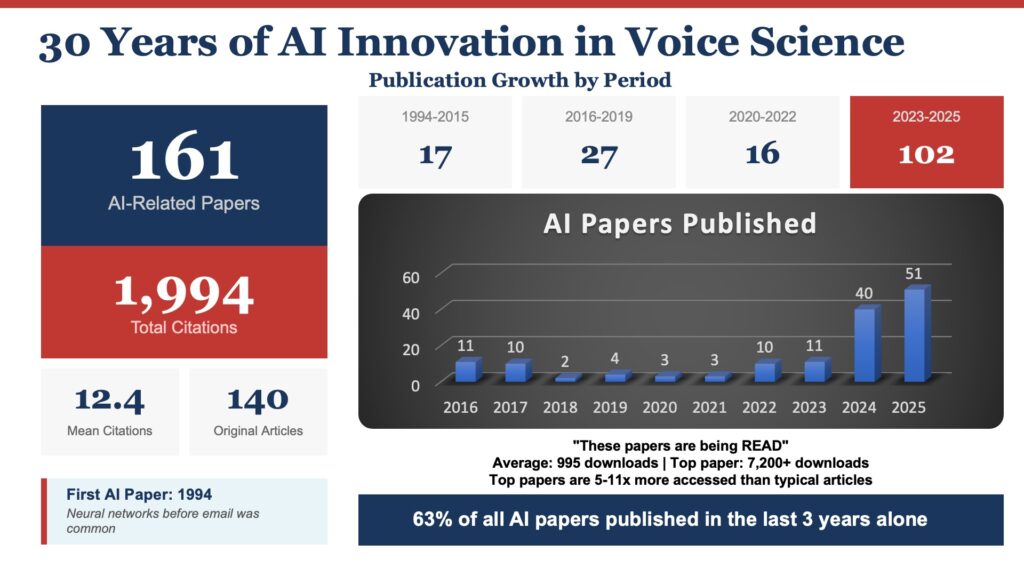
- 1994–2015: 17 papers
- 2016–2019: 27 papers
- 2020–2022: 16 papers
- 2023–2025: 102 papers
Consider the metric that captures the sheer velocity of our current moment: 102 out of 161 total AI-related papers—63 percent—have been published in just the last three years. In the year 2025 alone, we published 51 AI-related papers. That single year surpassed our output for the entire first two decades combined. This is not gradual academic progress; it is an exponential transformation of an entire scientific discipline.
Beyond Citations: Real-World Impact and Global Reach
Academic impact is often measured in citations, but the true value of these publications is found in their practical application by clinicians, speech-language pathologists, and researchers worldwide.
The average AI-focused paper in the Journal of Voice is downloaded nearly 1,000 times—a testament to the high demand for computational insights in clinical settings. Exceptional papers have broken records: our most-accessed AI paper, a study examining machine learning applications for COVID-19 detection, has surpassed 7,200 downloads, generating an audience eleven times the median for articles in its issue.
Similarly, our most-cited works—such as Fang and colleagues’ deep learning study (193 citations) and Hegde’s machine learning survey (147 citations)—have each been downloaded nearly 5,000 times. These figures represent active clinicians and researchers seeking tangible, practical tools to elevate patient care, refine diagnostic precision, and pioneer new avenues of treatment.
Landmark Research Reshaping the Field
Deep Learning for Voice Pathology Detection
The foundational research driving modern clinical AI largely centers on pattern recognition and neural networks. Fang and colleagues’ 2019 study, "Detection of Pathological Voice Using Cepstrum Vectors: A Deep Learning Approach," stands as the most-cited AI paper in our history. By leveraging deep neural networks to evaluate acoustic features imperceptible to the human ear, the study proved that algorithms could identify voice pathologies with unprecedented accuracy.
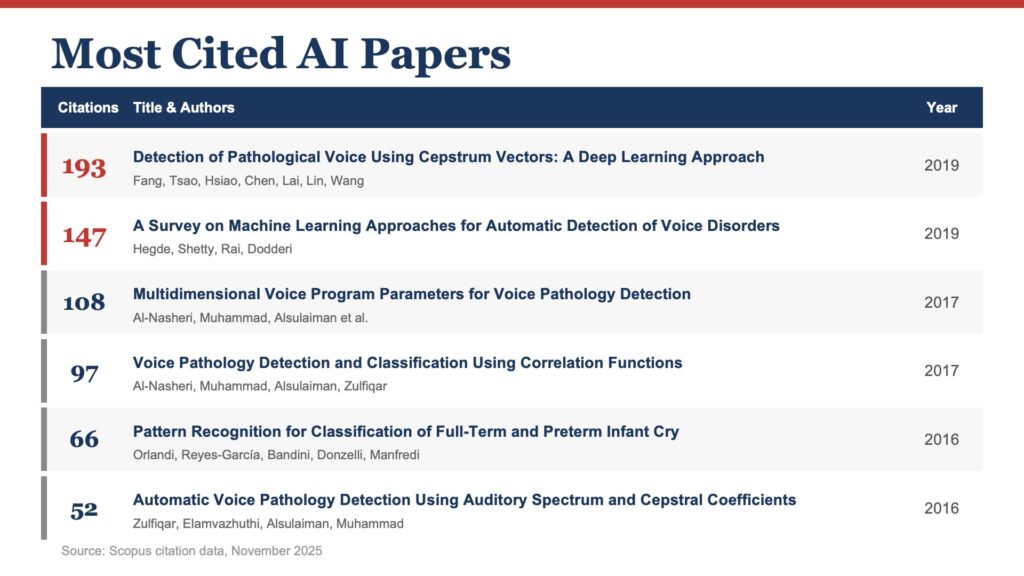
This work built upon earlier foundational literature, such as Hegde and colleagues’ comprehensive "Survey on Machine Learning Approaches for Automatic Detection of Voice Disorders" (147 citations) and Al-Nasheri’s dual 2017 contributions regarding Multidimensional Voice Program parameters and correlation functions. Over time, the methodology evolved rapidly, incorporating Chen and Chen’s deep neural networks for voice classification, Fujimura’s one-dimensional convolutional neural networks (CNNs), and Cho and Choi’s comparative analyses of CNN models for interpreting laryngoscopic images.
The Voice as a Digital Biomarker
Perhaps the most profound paradigm shift in recent years is the conceptualization of the human voice as a digital biomarker—a non-invasive, highly accessible window into systemic health.
Groundbreaking studies published in our pages have demonstrated the viability of using voice analysis to detect and monitor neurological conditions, most notably Parkinson’s disease. Hemmerling and Wójcik-Pędziwiatr’s 2022 paper on predicting Parkinson’s severity from voice signals quickly garnered dozens of citations, paving the way for proactive clinical applications.
Beyond neurology, recent systematic reviews have explored voice quality as a digital biomarker for mental health conditions, including depression and bipolar disorder. The medical implications are transformative: routine voice screening could enable early psychological intervention, drastically reducing the burden on overstretched global mental health systems. Furthermore, ongoing research into using machine learning to assess respiratory health characteristics demonstrates how the voice can act as an early sentinel for pulmonary illnesses.
AI Chatbots in Clinical Decision-Making
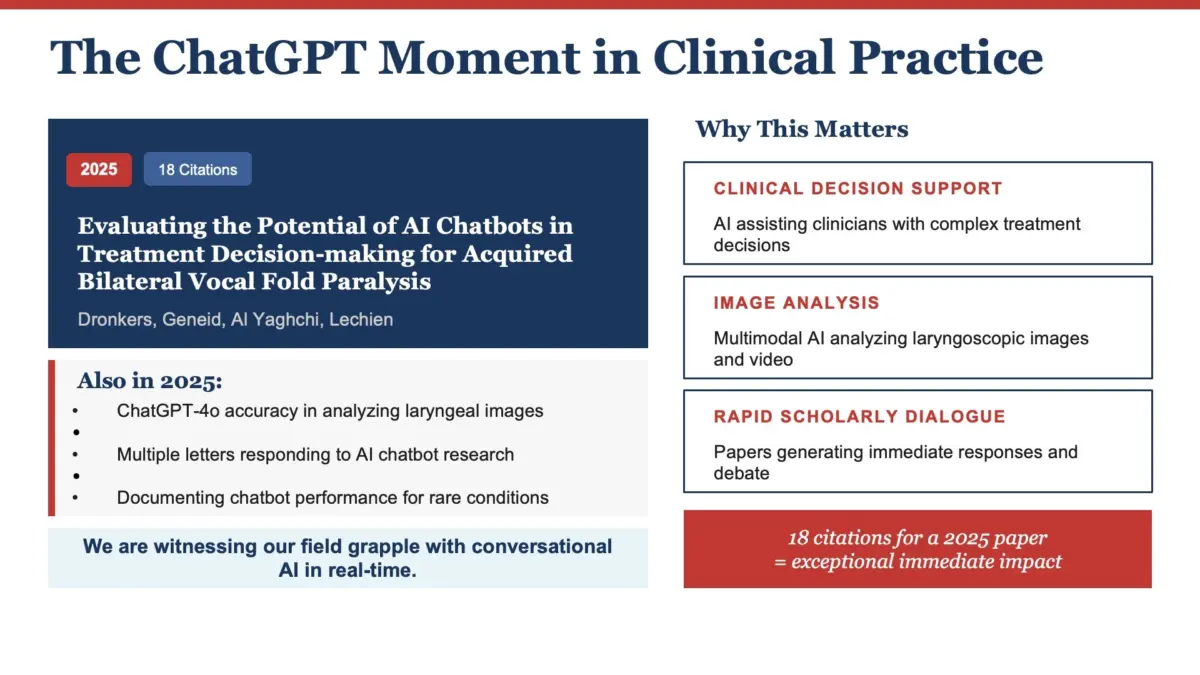
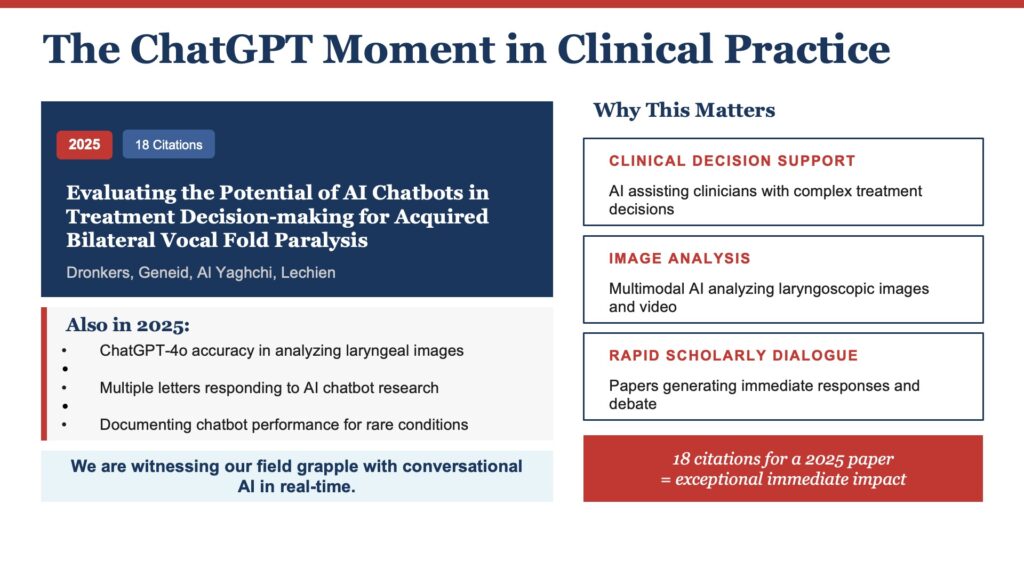
As conversational AI has matured, the Journal of Voice has expanded its scope to evaluate large language models in direct clinical workflows. A prime example is Dronkers and colleagues’ 2025 paper, "Evaluating the Potential of AI Chatbots in Treatment Decision-making for Acquired Bilateral Vocal Fold Paralysis," which rapidly accumulated significant scholarly engagement.

Spurring multiple letters to the editor and follow-up studies—including evaluations of ChatGPT-4o’s precision in analyzing laryngeal imagery—these publications document a field actively and critically interrogating the limits and utility of conversational AI in medical environments.
Expert Perspectives on AI in Voice Science
To fully understand how researchers are navigating this technological leap, we look to leading minds bridging computational science and clinical practice.
Dr. Mark Berardi: Managing Complexity and Synthetic Communication
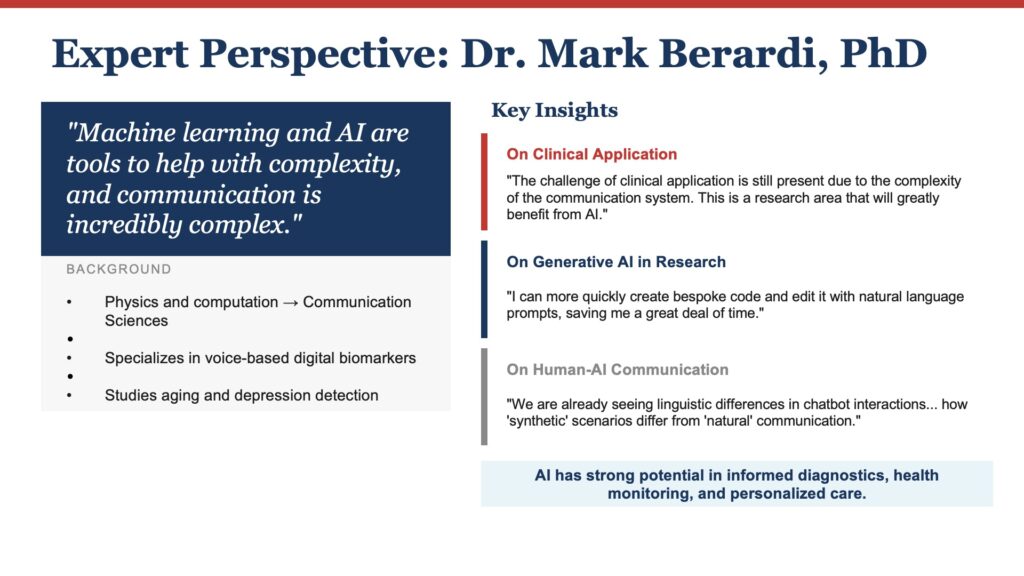
Dr. Mark Berardi brings a unique interdisciplinary lens to voice science, rooted in physics and computation. He views AI primarily as an indispensable instrument for managing complexity.
"Machine learning and AI are tools to help with complexity, and communication is incredibly complex in its neurobiological and physiological processes. So I think the application is warranted," Dr. Berardi explains.
His research focuses on extracting health information from speech signals to monitor aging and depression. While acknowledging that acquiring voice data has become remarkably easy, he notes that the primary hurdle remains the intricate nature of human communication itself—an area where machine learning excels.
Regarding generative AI, Dr. Berardi offers a pragmatic assessment. While it may not have completely reinvented theoretical frameworks overnight, it has dismantled major operational bottlenecks. "I can now quickly create bespoke code and edit it with natural language prompts," he notes.
Intriguingly, Dr. Berardi’s latest work investigates human-AI communication dynamics: how individuals alter their speech patterns when interacting with chatbots versus humans, and how "synthetic" conversational environments (such as Zoom calls) modify linguistic delivery compared to face-to-face exchanges. As digital interfaces multiply, voice science must expand to decode human vocal behavior in conversation with machines.
Dr. Eric Hunter: Embracing Change with Ethical Clarity
Dr. Eric Hunter emphasizes the institutional and workflow implications of artificial intelligence in academia.
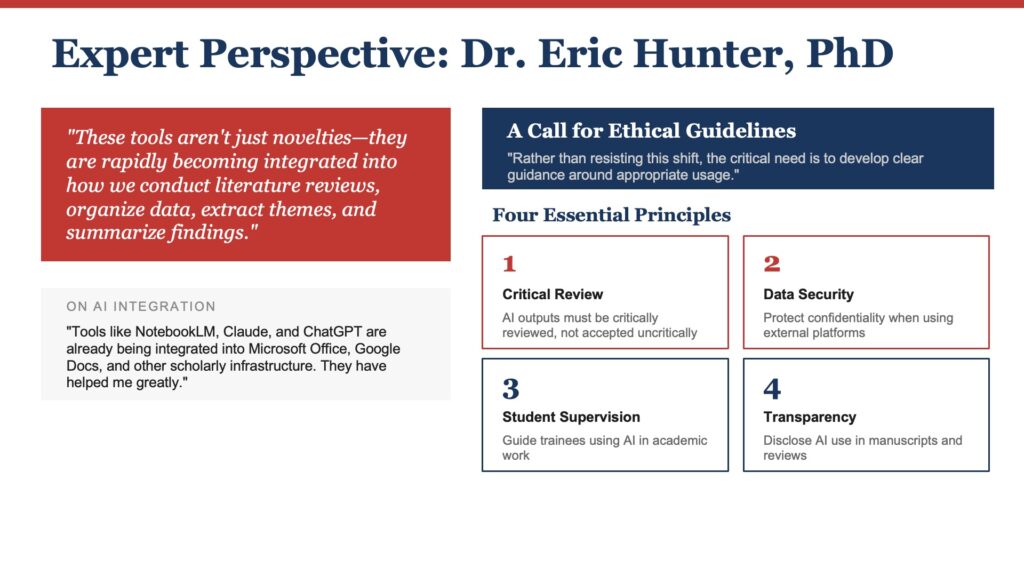
"These tools aren’t just novelties," Dr. Hunter observes. "They are rapidly becoming integrated into how we conduct literature reviews, organize data, extract themes from large bodies of text, and even summarize findings."
Dr. Hunter points out an inescapable academic reality: large language models and AI-driven platforms are permanently embedded in modern scholarly infrastructure, from manuscript preparation and peer review to data analytics. Rather than resisting this technological shift, he issues a clarion call for proactive adaptation through clear, ethical guidance.
He outlines four essential pillars for responsible AI integration in academic workflows:
- Transparency: Openly disclosing the utilization of AI tools in research and manuscript preparation.
- Accountability: Ensuring human authors retain absolute responsibility for the accuracy, integrity, and ethical sourcing of published data.
- Data Integrity: Safeguarding patient privacy and proprietary datasets when employing cloud-based analytical models.
- Editorial Oversight: Equipping peer reviewers and editors with the training necessary to evaluate AI-assisted scholarship effectively.
"Our field will benefit most," Dr. Hunter concludes, "if we embrace the productivity these tools offer while also building a shared ethical framework for their responsible use."
A Global Research Community
The rapid acceleration of AI in voice science is propelled by a vast, interconnected international network. Leading contributors to the Journal of Voice represent institutions spanning every continent. Among the most prolific authors driving this wave are:
- Jérôme René Lechien (6 papers)
- Dimitar Deliyski (5 papers)
- Stephanie Zacharias (5 papers)
- Ahmed Yousef (4 papers as first author)
- Paavo Alku (4 papers)
- Leonardo Wanderley Lopes (4 papers)
- Maryam Naghibolhosseini (4 papers)
This global collective demonstrates that the pivot toward machine learning is not the isolated project of a few tech-heavy labs, but a synchronized, worldwide commitment to decoding human vocal physiology through advanced computation.
The Path Forward: Challenges and Actionable Steps
As the Journal of Voice continues to chart the course for this evolving discipline, we remain steadfast in our dedication to rigorous, peer-reviewed excellence. However, this growth demands a coordinated, community-wide response to three critical challenges:
- Thoughtful Engagement with Limitations: Researchers and clinicians must understand that AI tools are designed to manage complexity and augment human judgment—not replace clinical intuition.
- Developing Shared Ethical Frameworks: As Dr. Hunter emphasizes, establishing clear guidelines for AI usage in research and publishing is a collective responsibility that transcends any single institution.
- Fostering Open Collaboration: The 161 AI-related papers published to date represent merely the foundation. Continued knowledge-sharing among clinicians, educators, and computational scientists is vital to driving future breakthroughs.
An Extraordinary Moment
For hundreds of thousands of years, the human voice has served as our ultimate instrument of connection, emotional expression, and identity. It carries the markers of our health, our psychology, and our humanity in ways no other biological signal can replicate.
Now, for the first time in human history, we possess computational tools sophisticated enough to truly decode that complexity. We have technology capable of extending the reach of expert clinicians, identifying subtle pathologies before symptoms manifest, and democratizing access to high-quality voice care across the globe.
We are living through an extraordinary moment, and the Journal of Voice stands proudly at its center. The next decade promises even greater discoveries as the dialogue between human artistry and artificial intelligence deepens. We look forward to sharing those milestones with you as we chart the future of voice science.